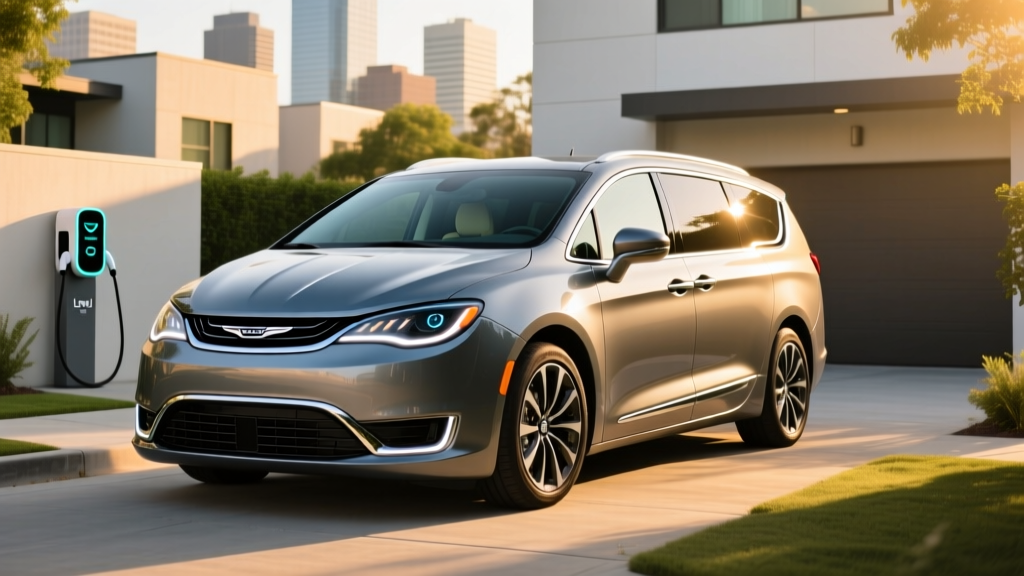
The family-hauler market has no shortage of gasoline minivans, but if you want a plug-in hybrid minivan in 2026, there is exactly one option: the Chrysler Pacifica PHEV. Toyota's Sienna is a conventional hybrid (HEV) only. Honda's Odyssey remains gasoline-only. Kia and Hyundai offer no electrified minivans in the U.S. market. So the Pacifica PHEV carries the entire minivan PHEV segment on its shoulders — and after multiple model years of refinement, it does so competently, if not cheaply.
This guide breaks down what the Pacifica PHEV actually delivers in range, efficiency, charging, and ownership cost — and whether its premium over the Sienna HEV is justified for your driving pattern.
HEV vs. PHEV: Why the Pacifica and Sienna Are Fundamentally Different
Before examining specs, it's critical to understand the architectural difference between the two electrified minivans on the market. This isn't a trim-level distinction — it's a powertrain philosophy.
| Attribute | Conventional Hybrid (HEV) | Plug-in Hybrid (PHEV) |
|---|---|---|
| Example | Toyota Sienna Hybrid | Chrysler Pacifica PHEV |
| Battery size | ~1.6 kWh (small, self-charging) | 16.0 kWh usable (large, plug-in) |
| Plug in to charge? | No — regenerates via braking/engine | Yes — Level 1 or Level 2 |
| Electric-only driving | Minimal (low-speed assist only) | 32 miles EPA at highway-capable speeds |
| Best use case | Consistent MPG without behavior change | Short daily commutes on electricity + road trips on gas |
| Federal tax credit | None | Up to $7,500 (eligibility varies) |
The Toyota Sienna is an HEV. It uses a small battery and electric motors to supplement its 2.5L engine, achieving excellent MPG without ever plugging in. You drive it exactly like a gas car; it just sips less fuel.
The Chrysler Pacifica PHEV is a plug-in hybrid. It carries a much larger 16.0 kWh (usable) lithium-ion battery that you charge from a wall outlet or Level 2 charger. On a full charge, it drives 32 miles on electricity alone — enough for many school runs, grocery trips, and commutes without the engine ever starting. Once the battery depletes, it operates as a conventional hybrid, blending the 3.6L V6 with electric motors.
2026 Pacifica PHEV Specs: Range, Powertrain, and Efficiency
| Specification | 2026 Chrysler Pacifica PHEV |
|---|---|
| Powertrain | 3.6L V6 + 2 electric motors (eFlite dual-motor eCVT) |
| Combined horsepower | 260 hp |
| Battery (usable) | 16.0 kWh lithium-ion |
| EPA electric-only range | 32 miles |
| EPA combined MPGe (electric+gas) | 82 MPGe |
| EPA MPG (charge-sustaining hybrid mode) | 30 combined (29 city / 30 highway) |
| Total combined range | ~430 miles (electric + gas) |
| 0–60 mph | ~7.1 seconds |
| Fuel tank | 14.5 gallons |
| Drivetrain | Front-wheel drive (AWD unavailable on PHEV) |
| Seating | 7 passengers (Stow 'n Go unavailable in 2nd row due to battery) |
| Cargo (behind 3rd row) | 32.3 cu ft |
| Base MSRP (Limited trim) | $49,995 |
| Battery warranty | 10 years / 100,000 miles |
Fuel Economy Breakdown: Pacifica PHEV vs. Sienna HEV vs. Gas Odyssey
| Vehicle | City MPG | Highway MPG | Combined | Annual Fuel Cost* |
|---|---|---|---|---|
| Chrysler Pacifica PHEV (hybrid mode) | 29 | 30 | 30 | ~$2,100 |
| Chrysler Pacifica PHEV (w/ daily charging) | 82 MPGe combined; gasoline use minimal | ~$900–$1,300 | ||
| Toyota Sienna HEV (FWD) | 36 | 36 | 36 | ~$1,750 |
| Toyota Sienna HEV (AWD) | 35 | 35 | 35 | ~$1,800 |
| Honda Odyssey (gas only) | 19 | 28 | 22 | ~$2,860 |
*Based on 15,000 miles/year, $3.50/gallon regular unleaded, and $0.16/kWh for electricity. Source: fueleconomy.gov.
The Sienna HEV wins on pure gasoline efficiency — 36 MPG combined is remarkable for a minivan. But the Pacifica PHEV's advantage emerges when you charge daily. If your commute and errands stay within ~30 miles round-trip, you could burn very little gasoline for weeks at a time, running almost entirely on electricity at a fraction of the per-mile cost.
Real-world MPG note: Conventional hybrids like the Sienna often exceed EPA city estimates because regenerative braking recaptures more energy in stop-and-go traffic. Many Sienna owners report 38–40 MPG in urban driving. The Pacifica PHEV, when operating in hybrid mode, tends to land closer to its EPA numbers — around 28–31 MPG combined in real-world use.
Charging the Pacifica PHEV: Times, Equipment, and What You Need
| Charging Level | Power | Time (0–100%) | Equipment Needed |
|---|---|---|---|
| Level 1 (120V household outlet) | ~1.4 kW | ~14 hours | Included portable cordset |
| Level 2 (240V, 32A) | ~7.2 kW | ~2 hours | Home wall charger or public Level 2 |
| DC Fast Charging | Not supported | N/A | N/A |
The Pacifica PHEV uses a standard J1772 connector for Level 1 and Level 2 AC charging. It does not support DC fast charging — a limitation common to most PHEVs, whose smaller batteries don't justify the added cost and weight of DC fast-charge hardware.
Practical charging reality: A Level 1 overnight charge (plugging into a standard 120V garage outlet at 10 PM and unplugging at 7 AM) delivers roughly 12–14 miles of electric range — enough for a short commute but not a full battery. For the full 32-mile electric range, you'll want a Level 2 home charger.
A Level 2 installation typically costs $600–$1,500 total (charger hardware: $300–$600; electrician labor and permit: $300–$900), assuming your electrical panel has capacity for a 40A circuit. If a panel upgrade is needed, add $1,500–$3,000.
Tax Credit Eligibility: Does the Pacifica PHEV Qualify?
- Credit amount: Up to $7,500 for qualifying new PHEVs with ≥7 kWh battery capacity
- MSRP cap: Vans/minivans must have MSRP ≤ $80,000
- Buyer income cap: AGI ≤ $150,000 (single) / $300,000 (joint)
- Battery sourcing: Critical minerals and battery component requirements phase in annually — check current-year rules
- Point-of-sale transfer: Eligible buyers can apply the credit as a down-payment reduction at the dealer
- Assembly: Vehicle must undergo final assembly in North America
The Pacifica PHEV is assembled in Windsor, Ontario (North American assembly ✓), has a 16.0 kWh battery (≥7 kWh ✓), and its MSRP falls under the $80,000 van cap. However, battery sourcing and critical mineral requirements may limit the full $7,500 depending on the model year and current IRS guidance. Always verify at irs.gov or with a tax professional before purchasing.
Key point: The Toyota Sienna HEV does not qualify for any federal tax credit — it's a conventional hybrid, not a plug-in. This credit eligibility is one of the Pacifica PHEV's strongest financial arguments, potentially narrowing the price gap substantially.
Battery Longevity, Warranty, and Replacement Cost
10 years or 100,000 miles (whichever comes first), covering defects and capacity loss below 70% of original capacity. This is the industry-standard hybrid/PHEV battery warranty, matching Toyota's coverage on the Sienna HEV. Chrysler's hybrid battery is manufactured by LG Energy Solution.
How long do PHEV batteries actually last? Lithium-ion batteries in PHEVs typically retain 85–92% of original capacity after 100,000 miles based on fleet data from earlier Pacifica PHEV model years. The 16.0 kWh battery is liquid-cooled, which significantly slows degradation compared to passively cooled packs.
Replacement cost if out of warranty: A Pacifica PHEV battery replacement runs approximately $8,500–$11,000 including parts and labor at a dealership. This is a real cost to budget for if you plan to keep the vehicle beyond 10 years or 100,000 miles — though many hybrid batteries last 150,000+ miles before falling below the 70% threshold.
Reliability context: Chrysler's PHEV powertrain has been in production since the 2017 model year, giving it one of the longest track records of any PHEV on the market. The eFlite dual-motor eCVT transmission is purpose-built and has proven robust. The main reliability concerns historically have been with infotainment software and minor electrical gremlins — not the hybrid system itself. Consult NHTSA for model-year-specific complaint data.
Who Should Buy the Pacifica PHEV (And Who Shouldn't)
- Your daily driving is under 30 miles round-trip and you can charge at home
- You want to minimize gasoline use without committing to a full EV
- You need a minivan specifically (7 seats, sliding doors, cargo space)
- You qualify for the federal tax credit, narrowing the price gap
- You take occasional long road trips and need gas-engine range flexibility
- You can't charge at home (apartment, no garage, street parking)
- You want the lowest purchase price and highest gasoline-only MPG
- You need AWD (unavailable on Pacifica PHEV)
- You want Stow 'n Go second-row seating (Pacifica PHEV battery blocks it)
- You prefer Toyota's long-term reliability reputation
- Your daily driving is under 250 miles and you want zero gasoline
- You want the lowest per-mile "fuel" cost and minimal maintenance
- You have reliable home Level 2 charging
- You're comfortable with public DC fast charging for road trips
- Only PHEV minivan on the market — no direct competitor
- 32-mile electric range covers most daily family logistics
- 260 hp combined — confident highway merging and passing
- Federal tax credit eligibility (up to $7,500)
- Smooth, quiet electric-only driving experience
- 10-year/100,000-mile battery warranty
- Mature powertrain with years of real-world data
- High starting price (~$49,995 before incentives)
- No AWD option (Sienna HEV offers AWD)
- No Stow 'n Go second row — battery occupies under-floor space
- No DC fast charging
- Level 1 charging too slow for daily full recharges
- Less cargo volume than Sienna due to battery placement
- Chrysler brand reliability perception trails Toyota/Honda
Pacifica PHEV Trim Pricing for 2026
| Trim | MSRP | Est. After $7,500 Credit | Key Features |
|---|---|---|---|
| Limited | $49,995 | ~$42,495 | Leather, 10.1" Uconnect 5, power sliding doors, 360° camera |
| Pinnacle | $55,490 | ~$47,990 | Nappa leather, panoramic sunroof, Harman Kardon audio, ventilated front seats |
Credit estimates assume full eligibility under current IRS §30D rules. Verify at irs.gov. Point-of-sale transfer available at participating dealers.
Frequently Asked Questions
How many MPG does the Pacifica PHEV get?
In hybrid mode (battery depleted), the Pacifica PHEV achieves 29 city / 30 highway / 30 combined MPG per the EPA. When regularly charged, it earns 82 MPGe combined. Real-world hybrid-mode driving typically yields 28–31 MPG combined. By comparison, the Toyota Sienna HEV achieves 36 MPG combined without ever plugging in.
How far can the Pacifica PHEV go on electric only?
The EPA rates the Pacifica PHEV at 32 miles of electric-only range. In warm weather with moderate driving, expect 27–30 real-world miles. In freezing temperatures or aggressive highway driving, expect 22–25 miles. The electric motors can propel the Pacifica up to 75 mph without the engine engaging — this isn't a golf-cart mode; it's full freeway-capable electric driving.
Does the Pacifica PHEV qualify for a tax credit?
Yes — the Pacifica PHEV can qualify for the federal §30D clean vehicle credit of up to $7,500, subject to buyer income limits (≤$300,000 joint AGI), MSRP caps (≤$80,000 for vans), battery sourcing requirements, and North American final assembly (met — assembled in Windsor, Ontario). The credit can be applied at the point of sale as a down-payment reduction. Always verify current-year eligibility at irs.gov or with a tax professional.
Is the Pacifica PHEV reliable? What does a battery replacement cost?
The PHEV powertrain has been in production since 2017, giving it a long track record. The hybrid battery carries a 10-year/100,000-mile warranty. Real-world fleet data shows typical capacity retention of 85–92% at 100,000 miles. Out-of-warranty battery replacement costs approximately $8,500–$11,000. The eFlite eCVT transmission has proven reliable. Historical complaints center on infotainment and minor electronics — not the hybrid system.
Can I charge the Pacifica PHEV at home on a regular outlet?
Yes, but slowly. A standard 120V outlet (Level 1) delivers about 1.4 kW, requiring approximately 14 hours for a full charge — yielding roughly 12–14 miles of range from a 9-hour overnight charge. For the full 32-mile electric range daily, a Level 2 (240V) home charger is strongly recommended, achieving a full charge in about 2 hours.
Why doesn't the Pacifica PHEV offer AWD or Stow 'n Go?
The PHEV's 16.0 kWh battery pack is mounted under the floor where the Stow 'n Go second-row seats would normally fold. This packaging trade-off is unavoidable in the current platform. AWD is unavailable because the rear axle packaging is occupied by hybrid system components. If you need either feature, the Toyota Sienna HEV (available with AWD, retains Stow 'n Go-style seating in some trims) or the gas-only Chrysler Pacifica AWD are alternatives — but neither offers plug-in capability.
Hybrid vs. PHEV vs. EV — which minivan fits my family?
HEV (Sienna): Best if you can't charge at home and want maximum MPG without behavior change. PHEV (Pacifica): Best if you can charge at home, drive under 30 miles daily, and want to minimize gas use while retaining road-trip flexibility. Full EV (Kia EV9, Tesla Model X): Best if your daily driving is under 250 miles, you want zero gasoline, and you're comfortable planning DC fast-charge stops on road trips.