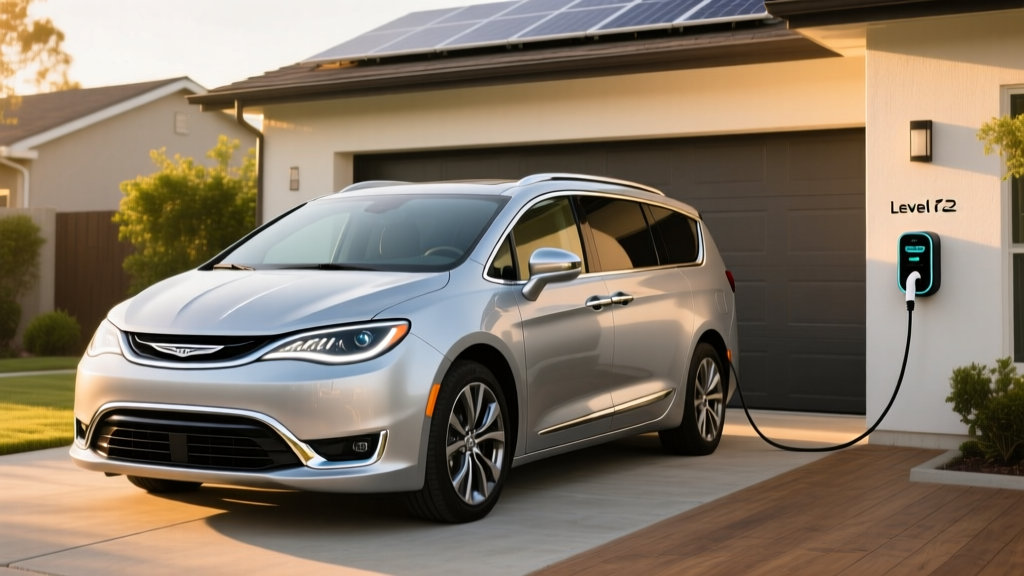
If you need a minivan but want to cut fuel costs without committing to a full battery-electric vehicle, the Chrysler Pacifica Hybrid remains one of the only plug-in hybrid (PHEV) minivans on the market. This 2026 Chrysler Pacifica Hybrid review breaks down exactly what you get: 32 miles of electric-only driving, 30 MPG combined once the battery depletes, and a powertrain that balances family practicality with meaningful efficiency gains over the gas-only Pacifica.
But the Pacifica Hybrid isn't without trade-offs. It can't DC fast charge, the battery eats into cargo space, and at over $50,000 to start, the math only works if you can charge at home. Let's run the numbers.
HEV vs PHEV: What the Pacifica Hybrid Actually Is
Before we get into specs, a critical distinction: the Chrysler Pacifica Hybrid is a plug-in hybrid electric vehicle (PHEV), not a conventional hybrid (HEV). Here's what that means in practice:
Conventional Hybrid (HEV)
- Small battery (~1-2 kWh), recharged only by regenerative braking and the engine
- Never plugs in
- No electric-only range to speak of (maybe 1 mile at low speed)
- Example: Toyota Sienna Hybrid
Plug-in Hybrid (PHEV) — Pacifica Hybrid
- Larger battery (16 kWh), charges via plug or regenerative braking
- Plugs into a standard 120V outlet or 240V Level 2 charger
- 32 miles of electric-only driving before the engine kicks in
- Operates as a conventional hybrid once the battery is depleted
The practical implication: if your daily school run, grocery trips, and commutes stay under ~30 miles and you charge at home overnight, you might go weeks without burning gas. If you can't charge at home, you're carrying extra battery weight for nothing — and the gas-only Pacifica or a Toyota Sienna Hybrid would serve you better.
MPG and Electric Range: The Numbers That Matter
| Metric | EPA Rating | Real-World Expectation |
|---|---|---|
| Combined MPGe (electric + gas) | 82 MPGe | 70-85 MPGe depending on charging frequency |
| Combined MPG (gas only, battery depleted) | 30 MPG | 27-32 MPG (hybrids often beat EPA in city) |
| City MPG (gas only) | 29 MPG | 30-34 MPG (regen braking excels in stop-and-go) |
| Highway MPG (gas only) | 30 MPG | 26-29 MPG (less regen benefit at steady speed) |
| Electric-only range | 32 miles | 26-32 miles (less in cold weather or at highway speed) |
| Total combined range | 430 miles | 380-440 miles depending on conditions |
Source: EPA Fuel Economy
Real-world range reality check: The EPA's 32-mile electric estimate assumes moderate temperatures and mixed driving. In our experience, expect 26-28 miles in winter (below 40°F) due to cabin heating demands and reduced battery efficiency. On pure highway driving at 70+ mph, the electric range drops to around 24-26 miles because the Pacifica's aerodynamics and 5,000+ lb curb weight work against it. In mild weather with city driving, hitting 30-32 miles is achievable.
The 30 MPG combined gas rating is competitive, though the Toyota Sienna Hybrid achieves 36 MPG combined as a conventional HEV — without the plug-in complexity. The Pacifica Hybrid's advantage is that first 32 miles of zero-gas driving, which dramatically lowers per-mile costs for short-trip families.
Powertrain and Battery Specs
| Specification | Detail |
|---|---|
| Engine | 3.6L Pentastar V6 (Atkinson cycle) |
| Electric motors | Two motor-generators integrated into transmission |
| Combined system horsepower | 260 hp |
| Transmission | eFlite EVT (electrically variable transmission) |
| Battery capacity (usable) | 16 kWh (lithium-ion, NMC chemistry) |
| Battery location | Under second-row floor (eliminates Stow 'n Go on that row) |
| Drivetrain | Front-wheel drive |
| 0-60 mph | ~7.1 seconds |
| Towing capacity | Not rated for towing (FWD PHEV limitation) |
The 3.6L V6 runs on the more efficient Atkinson cycle when in hybrid mode, and the two electric motors handle low-speed propulsion and regenerative braking. Combined output of 260 hp is adequate for a loaded minivan — it won't feel quick, but merging and passing are confident.
Charging: Level 1, Level 2, and the No-DCFC Limitation
| Charging Level | Power | Time (0-100%) | Notes |
|---|---|---|---|
| Level 1 (120V household) | ~1.4 kW | ~14 hours | Comes with portable cord; sufficient for overnight if you drive <30 mi/day |
| Level 2 (240V, 32A) | ~7.2 kW | ~2 hours | Requires home wall charger or public Level 2 station |
| DC Fast Charging | Not supported | N/A | No DCFC capability — a significant limitation for road trips |
The Pacifica Hybrid's onboard charger maxes out at 7.2 kW on Level 2, which is perfectly adequate for a 16 kWh battery — you'll refill overnight or during a workday. The included Level 1 cord works for topping up but won't fully recharge from empty in a single night if you arrive home nearly depleted.
The lack of DC fast charging is the Pacifica Hybrid's biggest technical shortcoming. On road trips, you're limited to gas-only hybrid operation. You can't pull into a fast-charging station and add electric range in 20 minutes the way a full EV or some larger-battery PHEVs can. For a family hauler that will see highway miles, this is worth understanding before purchase.
Pricing, Trims, and Tax Credit Eligibility
| Trim | 2026 MSRP | After Potential Federal Credit |
|---|---|---|
| Hybrid Select | $51,095 | ~$47,595 (if eligible for $3,500-$7,500 credit) |
| Hybrid Limited | $55,595 | ~$51,595 |
| Hybrid Pinnacle | $59,095 | ~$55,095 |
Destination charge additional (~$1,795). Pricing reflects 2026 model year estimates based on Chrysler's current trajectory.
Federal Tax Credit: §30D Eligibility
The Pacifica Hybrid may qualify for a federal tax credit under IRS §30D, but eligibility depends on multiple factors that change regularly:
- MSRP cap: Vans/minivans must be under $80,000 — Pacifica Hybrid clears this easily
- Buyer income cap: Modified AGI must not exceed $150,000 (single), $225,000 (head of household), or $300,000 (joint)
- Battery sourcing: Critical minerals and battery components must meet phased-in domestic/FtA-country sourcing thresholds that tighten annually through 2030
- Point-of-sale transfer: Eligible buyers can transfer the credit to the dealer at purchase, reducing the purchase price directly
- Credit amount: Up to $7,500, split between critical minerals ($3,750) and battery components ($3,750) — the Pacifica may qualify for partial or full credit depending on current sourcing compliance
Source: IRS Clean Vehicle Credits. Always verify current eligibility with your tax professional before purchase.
Battery Warranty, Reliability, and Replacement Costs
Hybrid Battery Warranty
Coverage: 10 years / 100,000 miles (whichever comes first)
Capacity retention threshold: Chrysler warrants the high-voltage battery against defects and excessive capacity loss. If the battery drops below approximately 70% of original capacity within the warranty period, Chrysler will repair or replace it.
Hybrid system components: The electric motors, inverter, and related powertrain components are covered under the same 10-year/100,000-mile powertrain warranty.
Chrysler's hybrid battery warranty is competitive with Toyota and Hyundai's industry-standard 10-year coverage. In real-world ownership, PHEV battery degradation tends to be modest — the 16 kWh pack is relatively small and the battery management system (BMS) maintains conservative charge buffers to prolong life. Most Pacifica Hybrid owners report minimal range loss over 5-7 years of use.
Out-of-Warranty Replacement Cost
If the high-voltage battery fails outside the warranty window, replacement costs typically range from $5,500 to $8,000 including parts and labor, based on dealer and independent hybrid-shop pricing. This is a meaningful expense, but the 10-year coverage window means most original owners will never face it. For used buyers, checking the battery's state of health (SoH) via an OBD-II scanner or dealer diagnostic is essential.
On general reliability, the Pacifica Hybrid has a mixed track record. Early model years (2017-2019) had recalls related to the hybrid system, but Chrysler addressed these through software updates and component revisions. The 2024-2026 models benefit from these refinements. Check NHTSA recall data for the specific VIN you're considering.
Pacifica Hybrid vs. the Competition
The minivan segment offers a direct PHEV comparison and several conventional hybrid alternatives:
| Specification | Chrysler Pacifica Hybrid | Toyota Sienna Hybrid (HEV) | Honda Odyssey (Gas) |
|---|---|---|---|
| Powertrain type | PHEV | HEV (no plug) | Gas V6 |
| Combined MPG (gas) | 30 MPG | 36 MPG | 22 MPG |
| Electric-only range | 32 miles | None | None |
| Combined horsepower | 260 hp | 245 hp | 280 hp |
| AWD available | No | Yes | No |
| Stow 'n Go (2nd row) | No (battery occupies space) | No (no fold-flat) | Yes (Magic Slide) |
| Starting MSRP | ~$51,095 | ~$39,085 | ~$39,635 |
| Federal tax credit | Up to $7,500 (if eligible) | None (HEV) | None |
The Toyota Sienna Hybrid delivers better gas-only fuel economy and offers AWD at a significantly lower starting price, but it has zero electric-only range. The Pacifica Hybrid wins for families who can charge at home and whose daily trips stay within that 32-mile electric window — the per-mile cost advantage of electricity vs. gas is substantial.
Who Should Choose the Pacifica Hybrid?
Choose the Chrysler Pacifica Hybrid if:
- You have home charging access (garage or driveway with outlet access)
- Your daily driving is mostly under 30 miles (school runs, errands, short commutes)
- You want to reduce gas consumption without range anxiety on road trips
- You value the minivan form factor and Chrysler's available features (dual sunroofs, rear entertainment, hands-free sliding doors)
- You qualify for the federal tax credit, narrowing the price gap with competitors
Choose the Toyota Sienna Hybrid instead if:
- You can't charge at home
- You need AWD for snow/ice climates
- You want a lower starting price and proven Toyota hybrid reliability
- Your daily miles exceed 30 and you'd benefit from 36 MPG combined without plugging in
Consider a full EV (e.g., Kia EV9) if:
- You want zero tailpipe emissions and minimal maintenance
- Your daily range needs are under 250 miles and you have reliable home charging
- You're ready to commit to DC fast charging for road trips
Pros
- 32 miles electric-only eliminates gas for short daily trips
- Only PHEV minivan available in the US market
- Competitive 30 MPG once battery depletes
- 10-year / 100,000-mile hybrid battery warranty
- Eligible for up to $7,500 federal tax credit (verify current sourcing rules)
- Comfortable ride, well-equipped interior across trims
Cons
- No DC fast charging — road trips are gas-only
- High starting price (~$51K) vs. Sienna Hybrid (~$39K)
- Battery eliminates second-row Stow 'n Go seating
- No AWD option
- Not rated for towing
- Real-world electric range drops to ~26 miles in cold weather
Frequently Asked Questions
How many MPG does the Chrysler Pacifica Hybrid get?
The EPA rates the Pacifica Hybrid at 30 MPG combined (29 city / 30 highway) when operating on gas after the battery is depleted. In real-world driving, many owners report 27-34 MPG depending on conditions — hybrids tend to exceed EPA estimates in city driving thanks to regenerative braking but may fall slightly short on sustained highway trips. The combined MPGe rating (accounting for electric driving) is 82 MPGe.
How far can the Pacifica Hybrid go on electric only?
The EPA rates it at 32 miles of electric-only range. Real-world results vary: expect 26-28 miles in cold weather (below 40°F), 24-26 miles at sustained highway speeds, and up to 30-32 miles in mild weather with mixed city driving. Once the battery depletes, the V6 engine engages seamlessly and the van operates as a conventional hybrid.
Does the Chrysler Pacifica Hybrid qualify for a tax credit?
It may qualify for up to $7,500 under the federal §30D Clean Vehicle Credit, but eligibility depends on your income (capped at $300K joint / $150K single), the vehicle's battery sourcing compliance (which shifts annually), and the MSRP cap (the Pacifica clears the $80K van limit). The credit can be transferred to the dealer at point of sale. Always confirm current eligibility on IRS.gov and with your tax professional before purchasing.
Is the Pacifica Hybrid reliable and what does battery replacement cost?
Chrysler covers the hybrid battery for 10 years / 100,000 miles, which is the industry standard alongside Toyota and Hyundai. Early model years had some hybrid-system recalls that have since been addressed. Out-of-warranty battery replacement runs approximately $5,500-$8,000. Most owners never need this within the warranty period, as the BMS manages charge buffers to limit degradation.
Do I need to plug in the Pacifica Hybrid?
You don't have to — if you never plug it in, it operates as a conventional hybrid getting 30 MPG combined. But if you don't plug in, you're paying a premium for a PHEV battery you never use, and the Toyota Sienna Hybrid at 36 MPG combined would be a more cost-effective choice. The Pacifica Hybrid only makes financial sense if you charge regularly to leverage those 32 electric miles.
How long does it take to charge?
On a standard 120V household outlet (Level 1), a full charge takes approximately 14 hours — adequate for topping up overnight if you didn't fully deplete the battery. On a 240V Level 2 charger at 32 amps, a full charge takes about 2 hours. A home Level 2 installation typically costs $500-$2,000 depending on your electrical panel's capacity and the run from panel to garage.
Can the Pacifica Hybrid tow?
No. The Pacifica Hybrid is not rated for towing. The gas-only Pacifica with the factory towing package can tow up to 3,600 lbs. If you need to tow a small trailer or pop-up camper, the PHEV variant isn't the right choice.