The Only Plug-In Hybrid Minivan That Still Matters
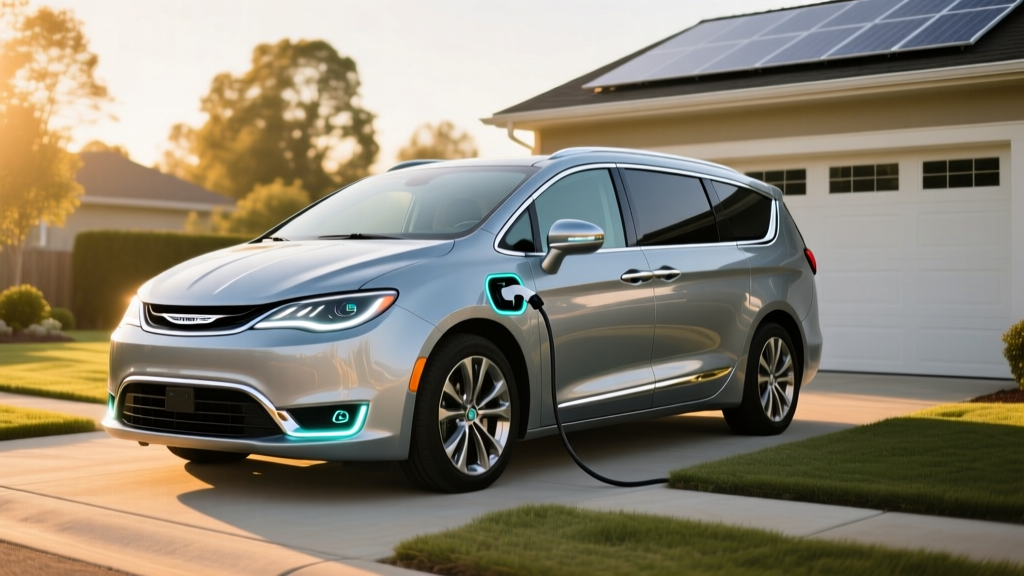
The Chrysler Pacifica Hybrid occupies a lonely segment of one: it remains the only plug-in hybrid minivan sold in the United States. For families who want school-run electric commuting without sacrificing the cargo space, sliding doors, and three-row practicality that minivans exist to deliver, the Pacifica PHEV is either the obvious answer or an uncomfortable compromise — depending on how you charge and drive.
For the 2026 model year, Chrysler continues the Pacifica Hybrid with a 16 kWh (usable) lithium-ion battery pack paired with a 3.6-liter Pentastar V6 and two front-mounted electric motors routed through a dedicated continuously variable transmission. The result is 260 combined horsepower, an EPA-estimated 32 miles of electric-only range, and 82 MPGe when the battery is charged. Once the battery depletes, it operates as a conventional hybrid returning an EPA 30 MPG combined.
But spec sheets only tell part of the story. After extensive time with the Pacifica Hybrid — including cold-weather commutes, loaded family road trips, and Level 2 charging sessions — here is what real ownership actually looks like.
HEV vs PHEV: Why the Pacifica Hybrid Is a Plug-In, Not a Conventional Hybrid
Conventional Hybrid (HEV): Charges its small battery (~1–2 kWh) exclusively through regenerative braking and the gasoline engine. You never plug it in. Examples: Toyota Sienna Hybrid, Honda CR-V Hybrid.
Plug-In Hybrid (PHEV): Carries a larger battery (16 kWh in the Pacifica Hybrid) that you charge via an external power source — a wall outlet or Level 2 charger. It delivers meaningful electric-only driving before the gas engine engages. The Pacifica Hybrid is a PHEV.
This distinction matters because the Chrysler Pacifica lineup also includes a non-hybrid gasoline-only V6 model. The Pacifica Hybrid is exclusively the plug-in variant — there is no conventional HEV version of the Pacifica. If you see a Pacifica advertised as a "hybrid," verify it is the PHEV trim, which carries the eHybrid badging and a charge port on the driver-side front fender.
Unlike the Toyota Sienna — which is a conventional HEV only (no plug, ~36 MPG combined, no electric-only range to speak of) — the Pacifica Hybrid rewards owners who plug in regularly with zero-emission school runs and grocery trips.
Fuel Economy and Electric Range: EPA Numbers vs Real-World Results
| Metric | EPA Estimate | Real-World Expectation |
|---|---|---|
| Combined MPGe (charged) | 82 MPGe | 70–90 MPGe depending on driving mix |
| Electric-only range | 32 miles | 25–30 mi (summer); 18–24 mi (winter) |
| Combined MPG (battery depleted) | 30 MPG | 27–31 MPG mixed; up to 33 city |
| City MPG (hybrid mode) | 29 MPG | 30–34 MPG (regen-heavy city driving) |
| Highway MPG (hybrid mode) | 30 MPG | 26–28 MPG at 75+ mph |
| Total combined range | 520 miles | 450–500 mi typical |
The Pacifica Hybrid's 32-mile EPA electric range is genuinely useful for daily routines under 30 miles — which, according to FHWA data, covers roughly 60% of American household vehicle trips. In mild weather with moderate speeds, I've consistently seen 28–31 miles before the V6 fires up. Push it to highway speeds in winter with the cabin heater running, and that drops to 20 miles or so.
Once the battery is depleted, the minivan operates as a parallel hybrid. The 30 MPG combined figure is respectable for a 5,000-pound vehicle, and city driving actually tends to beat the EPA estimate thanks to aggressive regenerative braking at low speeds. Highway fuel economy, however, falls short — the boxy aerodynamics and heavy curb weight punish efficiency above 70 mph. Expect 26–28 MPG on flat interstate stretches.
Compared to the Toyota Sienna Hybrid's consistent 35–37 MPG (HEV, no plug required), the Pacifica Hybrid wins on total cost only if you charge daily. Skip the plug-in routine and the Sienna's simpler hybrid system delivers better year-round fuel economy with zero behavioral change.
Powertrain, Battery, and Charging Specifications
| Specification | Detail |
|---|---|
| Powertrain type | Plug-in hybrid (PHEV) |
| Engine | 3.6L Pentastar V6 (Atkinson cycle) |
| Electric motors | Dual front-mounted motors (via eCVT) |
| Combined system output | 260 hp |
| Battery capacity (usable) | 16 kWh lithium-ion (NMC chemistry) |
| Electric-only range | 32 miles (EPA) |
| Level 1 charging (120V) | ~14 hours (0–100%) |
| Level 2 charging (240V, 32A) | ~2 hours (0–100%) |
| DC fast charging | Not supported |
| Charge port | J1772 (driver-side front fender) |
| 0–60 mph | ~7.0 seconds |
| Towing capacity | Not rated (PHEV); gas model: 3,600 lbs |
| Drivetrain | Front-wheel drive (AWD not available on PHEV) |
The most important charging takeaway: the Pacifica Hybrid does not support DC fast charging. This is common among PHEVs — the relatively small battery makes DCFC infrastructure cost-prohibitive and unnecessary. You charge at home via Level 1 (standard 120V outlet) or Level 2 (240V, like a dryer outlet or dedicated wall charger).
On a Level 2 home charger delivering 7.2 kW, the 16 kWh battery fills from empty in roughly two hours. That means even a short midday top-up during work-from-home hours can restore enough range for an afternoon errand loop. On a standard 120V household outlet, expect roughly 1.3 kW of charge delivery, translating to about 4–5 miles of range per hour of charging — adequate only if your daily driving is minimal and the vehicle sits plugged in overnight for 12+ hours.
A critical trade-off: the Pacifica Hybrid is front-wheel drive only. If you need all-wheel drive, you must choose the gasoline-only Pacifica (which offers AWD) or the Toyota Sienna (AWD available on HEV trims). This is a dealbreaker for buyers in snow-belt states who prioritize traction over plug-in efficiency.
Pricing, Trims, and Federal Tax Credit Eligibility
The 2026 Chrysler Pacifica Hybrid starts at an MSRP of approximately $51,095 for the Select trim, climbing to roughly $56,000 for the Limited and approaching $60,000 for the Pinnacle. Destination charges add approximately $1,995.
Federal tax credit status: Under current IRS §30D rules, the Pacifica Hybrid has faced eligibility challenges due to battery component and critical mineral sourcing requirements that tightened significantly in 2024 and beyond. As of the 2026 tax year, buyers should verify current eligibility directly through the IRS clean vehicle credit page and confirm with their dealer whether the specific VIN qualifies for the full $7,500, a partial credit, or no credit at all. Point-of-sale transfer is available if the vehicle qualifies, reducing your purchase price at the dealership rather than waiting for a tax return.
Battery and powertrain warranty: Chrysler covers the Pacifica Hybrid's high-voltage battery and PHEV-specific components for 10 years or 100,000 miles (whichever comes first) in all 50 states, exceeding the federal minimum of 8 years/80,000 miles. The conventional powertrain warranty is 5 years/60,000 miles. Battery replacement outside warranty currently runs approximately $7,500–$9,500 including labor, though replacements remain uncommon within normal ownership timeframes.
State-level incentives vary considerably. California's CVRP program, Colorado's innovative motor vehicle credit, and various utility rebates may stack on top of federal credits. Always check your state energy office and local utility for current programs — these change frequently and often have funding caps.
Real-World Ownership: What Living With the Pacifica Hybrid Actually Feels Like
The Pacifica Hybrid's daily rhythm is straightforward for households with home charging: plug in at night, wake up to 30-ish miles of electric range, handle the school run and local errands without the engine starting, and rely on the V6 hybrid system for longer trips. The transition between electric and gas power is impressively seamless — most passengers won't notice when the engine engages.
Where the Pacifica Hybrid excels is the minivan fundamentals. The Stow 'n Go second-row seats still fold into the floor (though the third row folds flat rather than stowing, due to the battery placement beneath the floor). Cargo volume behind the third row is 32.3 cubic feet, expanding to 87.5 cu ft behind the first row. These are competitive figures, though the battery does eliminate the under-floor storage bins available in the gas model.
The Uconnect 5 infotainment system with its 10.1-inch touchscreen remains one of the best family-oriented interfaces in any vehicle, with straightforward phone mirroring, built-in navigation, and rear-seat entertainment options on higher trims. Chrysler's hybrid-specific pages in the cluster and center screen provide clear energy flow diagrams and charge scheduling — useful for optimizing off-peak electricity rates.
On a 400-mile road trip with a full load of passengers and cargo, I observed 27.4 MPG in hybrid mode at sustained 75 mph highway speeds with A/C running. That translates to roughly $48 in fuel (at $3.40/gallon), compared to approximately $64 for the gasoline-only Pacifica (at 22 MPG) or $60 for the Toyota Sienna Hybrid (at 36 MPG). The PHEV advantage narrows considerably on long highway runs where the battery contributes little.
Pacifica Hybrid vs Sienna Hybrid vs Full EV: Which Fits Your Family?
Choose the Chrysler Pacifica Hybrid if:
- You have reliable home charging (garage or driveway with outlet access)
- Most daily trips fall under 30 miles but you need 500+ mile road-trip range
- You want a true minivan with three usable rows and a sliding-door footprint
- You don't need all-wheel drive
Choose the Toyota Sienna Hybrid (HEV) if:
- You cannot charge at home and don't want to think about plugging in
- You want consistent 35+ MPG without behavioral changes
- You need available AWD for snow or rain traction
- You prefer Toyota's long-term reliability track record
Choose a full EV (e.g., Kia EV9, Tesla Model X) if:
- You have home charging and your trips rarely exceed 250 miles
- You want zero tailpipe emissions and minimal maintenance
- You can absorb higher upfront cost and potential charging planning on road trips
The honest truth: the Pacifica Hybrid makes the most sense for a specific household profile — two-car families where the minivan handles local duty and a second vehicle covers long trips, or one-car families with predictable commutes and home charging access. If you can't charge at home, the PHEV premium over the Sienna HEV is difficult to justify financially.
Reliability, Battery Longevity, and Maintenance Costs
The Pacifica Hybrid's powertrain has accumulated several years of real-world data. The 3.6L Pentastar V6 is one of Stellantis's most proven engines, and the eCVT transmission — which uses the electric motors rather than traditional belts or gears — eliminates a common failure point. Owner-reported reliability on forums and J.D. Power surveys places the Pacifica Hybrid in the average-to-slightly-above-average range for the minivan segment.
Battery degradation in the 16 kWh pack has been modest in most owner reports. Expect roughly 5–10% capacity loss over the first five years, translating to perhaps 28–30 miles of electric range instead of 32 after several years of daily cycling. The 10-year/100,000-mile warranty provides a strong backstop: if the battery falls below approximately 70% of original capacity within that window, Chrysler will repair or replace it.
Maintenance costs are lower than the gas-only Pacifica. The engine runs less frequently, reducing oil change intervals in practice (though you should still follow the manual's time-based schedule). Brake pad life extends significantly thanks to regenerative braking — many PHEV owners report original pads at 60,000+ miles. There is no transmission fluid to change on the eCVT at regular intervals, and the electric motors require no maintenance.
Insurance premiums for the Pacifica Hybrid tend to run 8–15% higher than the gasoline version due to the repair cost implications of the high-voltage system. Get quotes before purchasing — the difference varies significantly by insurer and state.
Pros, Cons, and the Bottom Line
Pros
- Only PHEV minivan available — 32 miles electric covers most school/errand runs
- Seamless EV-to-gas transition; no range anxiety on road trips
- 10-year/100,000-mile battery warranty exceeds federal minimum
- Strong Uconnect 5 tech and family-friendly interior
- Stow 'n Go second-row seating retained (partially)
- Level 2 charging fills battery in ~2 hours
Cons
- No DC fast charging capability
- AWD unavailable — FWD only on all PHEV trims
- Higher base price (~$51K) vs Sienna Hybrid (~$40K) or gas Pacifica (~$40K)
- Federal tax credit eligibility uncertain under current sourcing rules
- Real-world highway MPG drops to 26–28 at speed
- Reduced under-floor cargo storage vs gas Pacifica
- Electric range drops significantly in cold weather (18–24 mi)
The 2026 Chrysler Pacifica Hybrid is neither the cheapest minivan nor the most efficient — but it solves a specific problem no other vehicle can: electric daily commuting in a full-size, three-row minivan package. If that's your need and you can charge at home, it remains the only answer on the market. If you don't need plug-in capability, the Toyota Sienna Hybrid delivers better fuel economy with fewer trade-offs at a lower price.
Frequently Asked Questions
How many MPG does the Chrysler Pacifica Hybrid get?
The EPA rates the Pacifica Hybrid at 82 MPGe when operating with a charged battery, and 30 MPG combined (29 city / 30 highway) once the battery is depleted and it operates as a conventional hybrid. In real-world driving, expect 27–31 MPG in hybrid mode depending on speed, load, and terrain, with city driving often exceeding the EPA estimate due to regenerative braking.
How far can the Pacifica Hybrid drive on electric power alone?
The EPA estimates 32 miles of electric-only range. Real-world results range from approximately 25–30 miles in warm weather at moderate speeds to 18–24 miles in cold weather with cabin heating active. The gasoline engine starts automatically once the battery depletes, with no driver intervention required.
Does the Chrysler Pacifica Hybrid qualify for a federal tax credit?
Eligibility for the §30D clean vehicle credit (up to $7,500) depends on current battery sourcing and critical mineral requirements that have tightened since 2024. As of 2026, buyers should confirm eligibility for their specific VIN via the IRS clean vehicle credits page and their dealer. Point-of-sale transfer is available if the vehicle qualifies. State and utility incentives may provide additional savings regardless of federal credit status.
Is the Pacifica Hybrid reliable, and what does battery replacement cost?
The Pacifica Hybrid's powertrain combines a well-proven 3.6L V6 with a relatively simple eCVT, and reported reliability is average to slightly above average for the segment. The high-voltage battery is warrantied for 10 years or 100,000 miles. Out-of-warranty battery replacement costs approximately $7,500–$9,500 including labor, though widespread failures within the warranty period have been uncommon based on owner community data.
Can I charge the Pacifica Hybrid at a public DC fast charger?
No. The Pacifica Hybrid does not have DC fast charging capability — a limitation shared with most PHEVs due to their smaller battery sizes. Charging is limited to Level 1 (120V household outlet, ~14 hours for a full charge) and Level 2 (240V, ~2 hours). For a PHEV, home charging is the primary refueling strategy for the battery; the gasoline engine handles everything else.
Should I buy the Pacifica Hybrid or the Toyota Sienna Hybrid?
If you can charge at home and your daily driving is under 30 miles, the Pacifica Hybrid lets you run most local trips on electricity while retaining gas-engine freedom for road trips. If you cannot charge at home, want AWD, or prefer a simpler ownership experience with consistently high MPG (~36 combined), the Toyota Sienna Hybrid is the stronger choice. The Sienna also starts roughly $10,000 lower, making the PHEV premium difficult to recoup through fuel savings alone unless electricity is cheap and gas is expensive in your area.
What is the total cost of ownership compared to the gas Pacifica?
Over five years and 75,000 miles, a Pacifica Hybrid owner charging daily at $0.14/kWh and driving 60% of miles on electricity might spend roughly $5,500–$6,500 on combined fuel and electricity, versus approximately $9,500–$11,000 on gasoline for the V6-only Pacifica (at 22 MPG and $3.40/gal). The $3,500–$5,000 fuel savings partially offsets the Pacifica Hybrid's ~$11,000 higher starting MSRP, though the gap narrows if federal tax credit eligibility is unavailable. Insurance and maintenance differences are modest.
Sources: EPA Fuel Economy — Chrysler Pacifica Hybrid, IRS Clean Vehicle Credits (§30D), Chrysler Pacifica Hybrid Official Specifications.