Quick Verdict: The Only Plug-In Hybrid Minivan in America
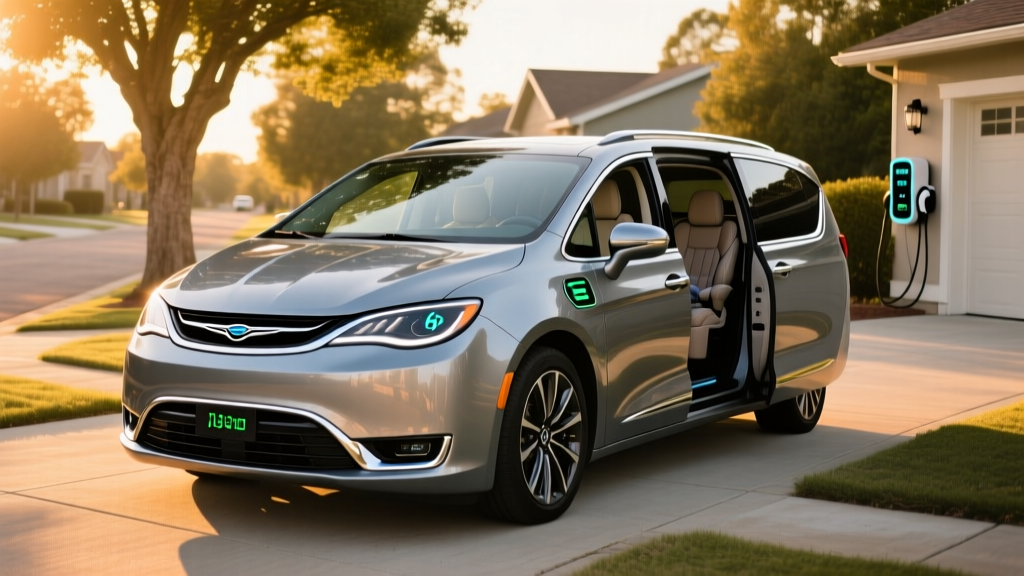
If you search for a Chrysler minivan hybrid, you'll find exactly one vehicle: the Chrysler Pacifica Hybrid (officially the Pacifica PHEV). It remains the sole plug-in hybrid minivan sold in the United States, occupying a unique niche for families who want school-run electric commuting without sacrificing the cargo space, sliding doors, and seven-passenger seating that minivans exist to deliver.
But the Pacifica Hybrid carries trade-offs that its gas-only sibling does not: a smaller fuel tank, the loss of Stow 'n Go second-row seating (the battery occupies that under-floor space), and a price premium that takes years to recoup at the pump. This guide breaks down the real numbers — EPA MPG, electric range, charging times, battery warranty, and tax credit eligibility — so you can decide whether the PHEV powertrain fits your family's driving pattern or whether a conventional hybrid, gas model, or full EV makes more sense.
| Spec | Value |
|---|---|
| Powertrain | 3.6L V6 + 2 electric motors (eFlite dual-motor eCVT) |
| Combined Horsepower | 260 hp |
| Battery (usable) | 16.0 kWh lithium-ion (NMC chemistry) |
| EPA Electric-Only Range | 32 miles |
| EPA Total Combined Range | 430 miles (electric + gas) |
| MPGe (electric + gas) | 82 MPGe combined |
| Gas-Only MPG (charge-sustaining) | 30 MPG combined |
| Fuel Tank | 14.5 gallons |
| Level 2 Charge Time (0–100%) | ~2 hours at 7.2 kW |
| DC Fast Charging | Not available |
| 0–60 mph | ~7.1 seconds |
| Drivetrain | FWD only (no AWD on PHEV) |
| Seating | 7 passengers (2nd-row captain's chairs, no Stow 'n Go) |
| Battery Warranty | 10 years / 100,000 miles |
| Base MSRP (Pinnacle PHEV) | ~$51,095 |
HEV vs PHEV: What the Chrysler Minivan Hybrid Actually Is
Chrysler does not sell a conventional hybrid (HEV) Pacifica — the kind that recharges its small battery through regenerative braking and the engine, never needing a plug. The Pacifica Hybrid is exclusively a plug-in hybrid electric vehicle (PHEV). That distinction matters enormously for your daily routine and expectations.
| Factor | Conventional Hybrid (HEV) | Plug-In Hybrid (PHEV) | Battery Electric (BEV) |
|---|---|---|---|
| Plug in to charge? | No | Yes (recommended for full benefit) | Yes (required) |
| Electric-only driving | Minimal (under 1 mi at low speed) | 20–40 mi typical | 200–400 mi |
| Gas engine backup | Always available | Always available | None |
| Home charging needed | No | Recommended (Level 1 works, Level 2 ideal) | Essential |
| Maintenance | Low (engine + regen) | Moderate (engine + battery + motor) | Lowest (no engine) |
| Example minivan | Toyota Sienna (36 MPG) | Chrysler Pacifica Hybrid (82 MPGe) | None currently (closest: VW ID. Buzz at ~230 mi range) |
The Pacifica PHEV operates in two modes. In EV mode, the 16.0 kWh battery powers two electric motors integrated into the eFlite transmission, delivering silent, zero-tailpipe-emission driving for up to 32 EPA-rated miles. Once the battery depletes to its buffer threshold, the 3.6-liter Pentastar V6 seamlessly engages and the vehicle operates as a series-parallel hybrid, returning an EPA-estimated 30 MPG combined in charge-sustaining mode.
If you never plug in, you're carrying 500+ pounds of battery and motor hardware you aren't using — you'd be better off in a Toyota Sienna hybrid, which delivers 36 MPG combined without a plug. The Pacifica Hybrid's value proposition only works if you charge regularly.
Fuel Economy: EPA MPG and Real-World Expectations
| Driving Mode | City | Highway | Combined |
|---|---|---|---|
| Electric + Gas (MPGe) | 84 MPGe | 80 MPGe | 82 MPGe |
| Gas Only (charge-sustaining) | 29 MPG | 30 MPG | 30 MPG |
Source: EPA Fuel Economy
Real-world MPG vs. EPA: PHEVs are highly sensitive to driving habits. Owners who plug in nightly and drive under 30 miles per day report using almost no gasoline for weeks — effectively achieving infinite MPG for local driving. On longer road trips where the battery depletes within the first 32 miles, expect the charge-sustaining 30 MPG figure to hold fairly steady. In cold weather (below 30°F), electric-only range drops by roughly 20–30%, shrinking that 32-mile figure to approximately 22–26 miles before the engine engages. Highway driving at 75+ mph also reduces both electric range and gas-mode efficiency — plan for 27–28 MPG in sustained interstate driving once the battery is depleted.
Charging: Level 1, Level 2, and What You Need at Home
The Pacifica Hybrid uses a standard J1772 connector for AC charging. It does not support DC fast charging — there's no CCS or CHAdeMO port. This is typical for PHEVs with smaller batteries, but it means all charging happens at AC speeds.
| Charging Level | Power (kW) | Voltage / Amperage | Time (0–100%) | Miles of Range per Hour |
|---|---|---|---|---|
| Level 1 (standard outlet) | ~1.4 kW | 120V / 12A | ~12–14 hours | ~2–3 mi/hr |
| Level 2 (home/public AC) | 7.2 kW | 240V / 30A | ~2 hours | ~16 mi/hr |
A Level 2 home charger is strongly recommended. At 7.2 kW, the onboard charger replenishes the 16.0 kWh battery in roughly two hours — meaning you can easily top off during the day if you return home for lunch, or fully charge overnight on a standard 240V circuit. The included Level 1 cord will technically work on a standard 120V outlet, but at 12–14 hours for a full charge, it's impractical for daily use unless your commute is very short and you charge every night.
Home charging installation: A Level 2 charger requires a dedicated 240V circuit (typically a NEMA 14-50 outlet or hardwired connection). Installation costs range from $500–$1,500 if your electrical panel has capacity, or $2,000–$4,000+ if a panel upgrade is needed. Consult a licensed electrician for your specific situation. Equipment (a quality Level 2 EVSE like a ChargePoint Home Flex or Emporia Level 2) adds $300–$700.
Powertrain: V6 Meets Dual Electric Motors
The Pacifica Hybrid's powertrain is built around Chrysler's eFlite dual-motor electrically variable transmission (eCVT). Unlike a traditional transmission with fixed gears, this system blends power from the 3.6-liter Pentastar V6 (262 lb-ft of torque) and two permanent-magnet electric motors through a planetary gearset. Combined system output is 260 horsepower.
The result is smooth, linear acceleration — the electric motors deliver instant torque from a stop, and the V6 fills in for highway merging and passing. The 0–60 mph time of approximately 7.1 seconds is adequate for a 5,000-pound family hauler. Regenerative braking recaptures energy during deceleration, and the Pacifica offers adjustable regen levels, though it does not achieve true one-pedal driving like a full EV.
Important limitation: The Pacifica Hybrid is available only with front-wheel drive. If you need all-wheel drive, the gas-only Pacifica offers AWD, and the Toyota Sienna hybrid offers AWD as well. The PHEV powertrain's packaging simply doesn't accommodate a rear driveshaft.
Pricing, Tax Credits, and Ownership Cost
The 2025 Chrysler Pacifica Hybrid is offered in a single well-equipped trim: Pinnacle PHEV, starting at approximately $51,095 (including destination). That's roughly $10,000–$12,000 above a comparably equipped gas-only Pacifica Limited.
- Vehicle must be new (not previously titled)
- Buyer AGI must not exceed: $150,000 (single), $225,000 (head of household), $300,000 (joint)
- MSRP cap for vans/SUVs: $80,000 (Pacifica Hybrid qualifies)
- Battery must meet critical-mineral and battery-component sourcing requirements (these thresholds tighten annually — verify current-year rules at IRS.gov)
- Credit amount: up to $7,500 if all sourcing requirements met; $3,750 if only one threshold is satisfied
- Point-of-sale transfer available (dealer applies credit at purchase, reducing out-of-pocket cost)
Does the Pacifica Hybrid qualify? The Pacifica PHEV has historically qualified for the full $7,500 federal tax credit, but battery-sourcing rules under §30D tighten each year. For the 2025 model year, verify current eligibility with your dealer and cross-reference fueleconomy.gov's credit lookup tool. State incentives may also apply — check your state's energy office or AFDC's state incentive database.
5-year ownership cost snapshot: Assuming 15,000 miles/year, 60% electric-mode driving (plugging in daily), electricity at $0.14/kWh, and gas at $3.50/gallon, a Pacifica Hybrid owner might spend roughly $1,100–$1,400/year on energy. A gas-only Pacifica (22 MPG combined) would cost approximately $2,400/year at the same mileage. That's roughly $5,000–$6,500 in fuel savings over five years — not enough to close the $10,000+ price gap without the tax credit. With a $7,500 credit applied, the PHEV breaks even around year three or four, then begins saving money.
Battery Warranty, Reliability, and Replacement Cost
Is the Pacifica Hybrid reliable? The Pacifica PHEV has had a mixed reliability record. Early model years (2017–2019) saw recalls related to the high-voltage battery, including a notable 2020 recall for potential battery cell defects that could cause fires. Chrysler addressed this with software updates and battery module replacements under recall. Later model years (2021+) have shown improved reliability. Always verify recall status on any used Pacifica Hybrid at NHTSA.gov before purchase.
Battery replacement cost: Outside of warranty, a full high-voltage battery replacement for the Pacifica Hybrid runs approximately $8,000–$12,000 including parts and labor. Individual module replacement (if only certain cells degrade) can be significantly less. However, PHEV batteries experience less stress than full EV batteries because they operate within a narrower state-of-charge window (the system maintains a buffer to protect longevity). Most PHEV batteries outlast their warranty periods with manageable degradation.
General maintenance: The Pacifica Hybrid still requires oil changes, transmission fluid service, brake fluid, and coolant flushes — the V6 engine is a conventional internal-combustion engine. However, regenerative braking reduces brake pad wear, and the electric motors require no maintenance. Budget for typical minivan maintenance costs with a slight premium for hybrid-system diagnostics.
Who Should Choose the Chrysler Pacifica Hybrid?
- Only PHEV minivan on the market — no direct competitor
- 32 miles electric covers most school runs, errands, and short commutes
- Gas engine eliminates range anxiety for road trips
- Smooth, quiet electric-mode driving around town
- Eligible for up to $7,500 federal tax credit (verify current sourcing rules)
- Premium Pinnacle interior with standard features
- 7-passenger seating with captain's chairs
- No Stow 'n Go second-row seats (battery occupies under-floor space)
- Smaller 14.5-gallon fuel tank limits total road-trip range
- FWD only — no AWD option
- $10,000+ premium over gas Pacifica; takes years to recoup
- No DC fast charging
- Early-model-year reliability concerns and recalls
- Only available in top Pinnacle trim — no budget option
- You can charge at home (Level 2 strongly recommended)
- Your daily driving is mostly under 30 miles
- You need a minivan's cargo space and sliding doors but want to minimize gas use
- You take occasional long road trips where a full EV would require charging stops
- You qualify for the federal tax credit, which substantially closes the price gap
- You cannot install a home charger
- You want AWD availability
- You prefer Stow 'n Go–style fold-flat seating (Sienna doesn't have this either, but offers lower base pricing)
- Your daily mileage regularly exceeds 40+ miles (the Sienna's consistent 36 MPG may save more in high-mileage scenarios)
- You want zero engine maintenance
- Your daily driving is under 250 miles and you can charge at home
- You want access to HOV lanes (varies by state — some states grant HOV access to PHEVs, others only to BEVs)
Frequently Asked Questions
How many MPG does the Chrysler Pacifica Hybrid get?
The EPA rates the Pacifica Hybrid at 82 MPGe combined when using both electric and gas power, and 30 MPG combined in gas-only (charge-sustaining) mode. In city driving with a full battery, you may use almost no gas for trips under 32 miles. On long highway road trips after the battery depletes, expect 27–30 MPG depending on speed and conditions.
How far can the Chrysler Pacifica Hybrid go on electric only?
The EPA rates the Pacifica Hybrid at 32 miles of electric-only range. In real-world conditions, expect 22–28 miles in cold weather or at highway speeds, and up to 30–32 miles in mild conditions with moderate city driving. Once the battery depletes, the gas engine engages seamlessly.
Does the Chrysler Pacifica Hybrid qualify for a tax credit?
The Pacifica PHEV has historically qualified for the full $7,500 federal §30D clean vehicle credit, but eligibility depends on current-year battery sourcing requirements, your income, and the vehicle's MSRP. Verify eligibility at IRS.gov and confirm with your dealer before purchase. The credit can be transferred to the dealer at point of sale, reducing your purchase price directly.
Is the Chrysler Pacifica Hybrid reliable?
Early model years (2017–2019) had notable recalls related to the high-voltage battery system. Model years from 2021 onward have shown improved reliability. The battery carries a 10-year/100,000-mile warranty in CARB states. Check NHTSA for open recalls on any used example, and ensure recall repairs were completed.
What does it cost to replace the Pacifica Hybrid battery?
Out of warranty, a full high-voltage battery replacement costs approximately $8,000–$12,000 including labor. Partial module replacement may be less expensive. Most PHEV batteries last well beyond their warranty periods due to the system's built-in charge buffer that prevents full cycling.
Can the Chrysler Pacifica Hybrid charge at a DC fast charger?
No. The Pacifica Hybrid only supports AC charging via a J1772 connector — Level 1 (120V) and Level 2 (240V) up to 7.2 kW. There is no DC fast-charging capability. This is standard for PHEVs with smaller battery packs.
Does the Pacifica Hybrid have Stow 'n Go seating?
No. The high-voltage battery is mounted under the second-row floor, which eliminates the Stow 'n Go fold-into-the-floor seating that the gas-only Pacifica offers. The second-row captain's chairs slide, recline, and fold forward, but they cannot be stowed under the floor. This is the single biggest practical compromise of the PHEV model.
Hybrid vs PHEV vs EV — which is right for my family?
If you can charge at home and drive under 30 miles most days, the Pacifica PHEV lets you run mostly on electricity while keeping the gas engine for road trips. If you can't charge at home, a conventional hybrid like the Toyota Sienna (36 MPG) is simpler and cheaper. If you want zero gas use and your daily range needs are under 250 miles, a full EV is the future-proof choice — but no fully electric minivan with Pacifica-class space is widely available yet.