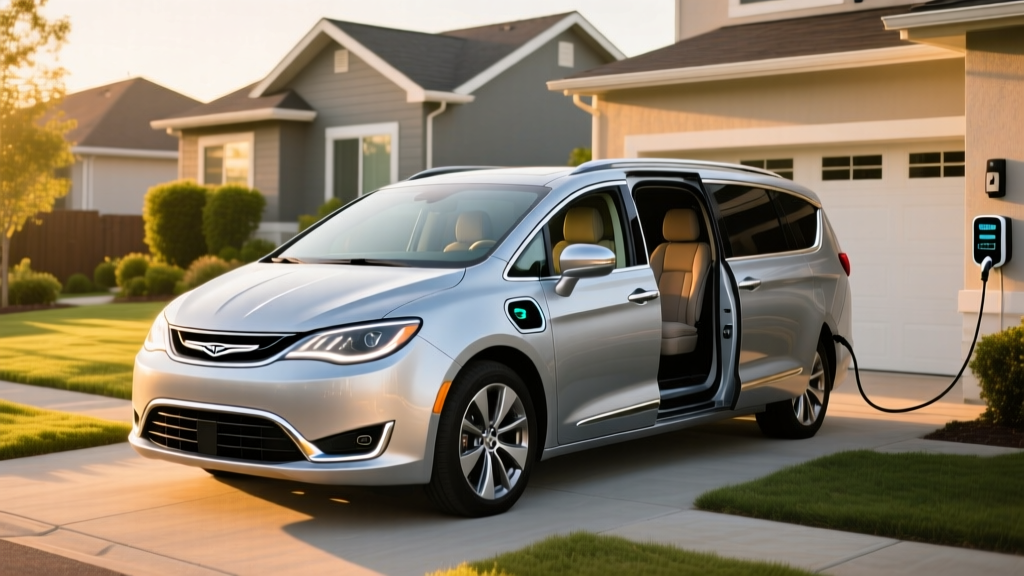
The Chrysler Pacifica Hybrid remains the only plug-in hybrid minivan on the U.S. market, occupying a niche that no three-row electric SUV has fully replaced. For families who need max cargo volume and seating for seven or eight but aren't ready to commit to a full battery-electric vehicle, the Pacifica PHEV offers a bridge: short electric-only commutes during the week, gas-hybrid flexibility for weekend road trips.
But how does the Chrysler Pacifica Hybrid MPG actually shake out once you leave the dealership? This guide breaks down the EPA sticker numbers, real-world efficiency from daily driving, charging logistics, battery longevity, and whether this PHEV still makes financial sense in 2026.
HEV vs PHEV: What the Pacifica Actually Is
Before examining the numbers, it's worth clarifying a common source of confusion. Chrysler also sells a conventional (non-plug-in) Pacifica with a V6 engine. That model is a standard gasoline vehicle — no hybrid system, no battery assist, no plug. The Pacifica Hybrid is a plug-in hybrid electric vehicle (PHEV), meaning it carries a larger battery you can charge from a wall outlet or public charger, giving it a meaningful electric-only driving range before the gas engine engages.
| Feature | Conventional Hybrid (HEV) | Pacifica Hybrid (PHEV) |
|---|---|---|
| Plug-in charging | No — battery charges via regenerative braking and engine | Yes — 16 kWh battery charges via plug or regen |
| Electric-only range | Typically under 1 mile at low speed | 32 miles (EPA) |
| Gasoline engine | Yes, paired with small electric motor | 3.6L V6 + two electric motors |
| Federal tax credit (§30D) | Not eligible | Potentially up to $7,500 (subject to sourcing/income rules) |
| Best use case | Drivers who want better MPG without changing habits | Drivers with short commutes + home charging access |
If you've seen "Pacifica Hybrid" referenced online and wondered whether you need to plug it in — yes, to get the full benefit. You can drive it without ever plugging in (it functions as a conventional hybrid once the battery depletes), but you'd be paying a premium for battery capacity you never use.
Chrysler Pacifica Hybrid MPG: EPA Numbers and Real-World Results
The Pacifica Hybrid operates in two distinct modes, each with its own efficiency rating:
| Mode | City | Highway | Combined |
|---|---|---|---|
| Charge-depleting (electric + gas blend) | 82 MPGe combined | ||
| Charge-sustaining (hybrid mode after battery depletes) | 29 MPG | 30 MPG | 30 MPG |
The 82 MPGe figure applies when the battery is fully charged and you're driving within the 32-mile electric range, blending electricity and gasoline. Once you've used up that electric buffer, the Pacifica operates as a conventional hybrid and delivers 30 MPG combined — respectable for a 5,000+ pound minivan but not class-leading among hybrids.
Real-World MPG: What to Actually Expect
EPA estimates are a starting point, not a guarantee. Based on owner reports and third-party testing, here's how the Pacifica Hybrid performs in practice:
- City commuting (under 32 miles, charged nightly): Most drivers use zero gasoline. If your round-trip commute is 25 miles and you charge at home, you may go weeks between fill-ups.
- Mixed driving with regular charging: Owners consistently report 40–60 MPG effective averages over a month of mixed city/highway driving with nightly Level 2 charging.
- Highway road trips (no charging): Expect 27–30 MPG at 70–75 mph. The V6 hybrid system is less efficient at sustained high speeds than at city speeds — the opposite of a gas-only car's behavior.
- Cold weather (below 30°F): Electric-only range drops to roughly 24–27 miles due to cabin heating demands and reduced battery efficiency. Hybrid-mode MPG falls to approximately 26–28 MPG.
The Pacifica Hybrid rewards plug-in discipline. Charge it every night and keep trips under 32 miles, and your gas consumption approaches zero. Ignore the plug entirely, and you're driving a heavy hybrid minivan that gets about the same MPG as a Toyota Sienna Hybrid (36 MPG combined) — but with less efficiency.
Electric-Only Range, Battery Specs, and Charging
| Specification | Value |
|---|---|
| Battery capacity (total / usable) | 16 kWh total / ~14 kWh usable |
| Battery chemistry | NMC (nickel-manganese-cobalt) lithium-ion |
| EPA electric-only range | 32 miles |
| Total combined range (electric + gas) | ~520 miles |
| Level 1 charging (120V household outlet) | ~14 hours (0–100%) |
| Level 2 charging (240V, 32A) | ~2 hours (0–100%) |
| DC fast charging | Not supported |
| Charge port / connector | J1772 (Level 1 and Level 2) |
The 32-mile electric range is the Pacifica Hybrid's headline feature for daily driving. For context, the U.S. average one-way commute is roughly 16 miles (U.S. Census Bureau), meaning a large majority of drivers could complete their daily commute entirely on electricity — provided they charge at home.
Charging in Practice: What You Need at Home
The Pacifica Hybrid does not support DC fast charging. This is typical for PHEVs — the battery is small enough that Level 2 charging fills it quickly, and the added cost/weight of DC fast-charge hardware isn't justified.
On a standard 120V household outlet (Level 1), a full charge takes approximately 14 hours. That's slow enough that you'd need to plug in as soon as you get home to ensure a full battery by morning. Most PHEV owners upgrade to a Level 2 home charger (240V, 32-amp circuit), which fills the 16 kWh battery in about 2 hours. A Level 2 installation typically costs $500–$2,000 depending on whether your electrical panel needs an upgrade — a worthwhile investment for any PHEV owner planning to stay in their home.
The charge port uses the standard J1772 connector, compatible with every public Level 2 charger in the country. You won't need adapters for public charging, though you'll rarely need public charging given the battery's small size.
Powertrain: V6 Meets Dual Electric Motors
The Pacifica Hybrid's powertrain pairs Chrysler's 3.6-liter Pentastar V6 engine with two electric motors integrated into a continuously variable transmission (eCVT). The system produces a combined 260 horsepower. Unlike some PHEVs that use a small four-cylinder engine, the V6 provides confident highway merging and passing power even when the battery is depleted.
One mechanical trade-off: the Pacifica Hybrid is front-wheel drive only. Chrysler does not offer all-wheel drive on the Hybrid trim, though AWD is available on the conventional gas-only Pacifica. For families in snow-belt states, this is a meaningful limitation — and one reason some buyers cross-shop the Toyota Sienna (which offers AWD with its hybrid powertrain, though as a conventional HEV, not a PHEV).
The eCVT operates differently from a traditional automatic transmission. There are no fixed gear ratios and no shift shock. Acceleration is linear, and the transition between electric and gas power is generally seamless, though you may notice the V6 engaging under hard acceleration or when the battery is low.
Pricing, Trims, and Federal Tax Credit Eligibility
For the 2026 model year, the Chrysler Pacifica Hybrid is offered in three trims. Pricing reflects the manufacturer's suggested retail price (MSRP) before any incentives:
| Trim | MSRP (approx.) | Key Features |
|---|---|---|
| Hybrid Select | $51,000 | Leatherette seats, 10.1" Uconnect, power sliding doors |
| Hybrid Limited | $55,000 | Nappa leather, ventilated front seats, hands-free liftgate |
| Hybrid Pinnacle | $59,000 | Quilted leather, premium audio, advanced driver assist pkg |
Does the Pacifica Hybrid Qualify for the Federal Tax Credit?
Under the IRS §30D Clean Vehicle Credit, plug-in hybrids with sufficient battery capacity can qualify for up to $7,500 — but eligibility depends on several requirements that change frequently:
- Battery component sourcing: A percentage of battery components must be manufactured or assembled in North America (threshold increases annually).
- Critical minerals: A percentage of critical minerals must be sourced from the U.S. or a free-trade-agreement country.
- MSRP cap: Vans, SUVs, and pickups must have an MSRP under $80,000. All Pacifica Hybrid trims clear this threshold.
- Buyer income cap: Adjusted gross income must not exceed $300,000 (joint filers), $225,000 (head of household), or $150,000 (single).
- Point-of-sale transfer: As of 2024, buyers can transfer the credit to the dealer for an immediate price reduction at purchase, rather than waiting to claim it on their tax return.
As of early 2026, the Pacifica Hybrid's eligibility for the full $7,500 depends on whether its battery sourcing meets the current-year thresholds. Chrysler has historically qualified for partial or full credit on the Pacifica Hybrid, but you should verify current eligibility on fueleconomy.gov before purchasing. Always consult a tax professional to confirm your personal eligibility.
Battery Warranty, Reliability, and Replacement Cost
Pacifica Hybrid Battery Warranty
- Coverage: 10 years / 100,000 miles (whichever comes first) in CARB states; 8 years / 80,000 miles in non-CARB states
- Capacity threshold: Warranty covers battery failure or capacity loss below 70% of original capacity
- Transferability: Warranty transfers to subsequent owners
Battery longevity is the top concern for any hybrid or PHEV buyer, and it's the right question to ask. The Pacifica Hybrid's 16 kWh NMC battery is larger and more complex than a conventional hybrid's battery, meaning replacement costs are higher if something goes wrong out of warranty.
Out-of-warranty battery replacement for the Pacifica Hybrid typically runs $6,000–$9,000 including parts and labor at a dealership. Independent hybrid-battery specialists may offer refurbished replacements for $4,000–$6,000. This is a real cost to factor in if you plan to keep the vehicle past 100,000 miles.
In practice, PHEV battery degradation tends to be gradual rather than catastrophic. Owners who regularly charge to 100% and deplete to near-zero (the Pacifica has a built-in buffer that prevents true 0% or 100% at the cell level) may see range drop from 32 miles to 27–29 miles over 5–7 years. This is normal lithium-ion behavior and doesn't indicate a defect.
Overall reliability for the Pacifica Hybrid has been mixed across model years. Early models (2017–2019) had more reported issues with the hybrid system and electrical components. Later model years have shown improvement, though the Pacifica Hybrid generally trails the Toyota Sienna in long-term reliability surveys from Consumer Reports and J.D. Power. The hybrid powertrain warranty provides a meaningful safety net during the ownership period most buyers will experience.
Pacifica Hybrid vs. Full EV vs. Gas Minivan: Which Fits Your Family?
The Pacifica Hybrid doesn't exist in a vacuum. Families shopping for a three-row vehicle in 2026 face a genuine choice between three powertrain paths:
Choose the Pacifica Hybrid (PHEV) if:
- Your daily driving is under 30 miles and you can charge at home
- You take road trips of 300+ miles several times per year
- You need a true minivan floor with Stow 'n Go seating (note: hybrid battery eliminates Stow 'n Go in the second row — seats fold but don't stow into the floor)
- You want to reduce gas consumption without depending on public charging infrastructure
Choose a full EV (e.g., Kia EV9, Tesla Model X) if:
- You have reliable home Level 2 charging and your daily driving is under 250 miles
- You want zero tailpipe emissions and the lowest per-mile fuel cost
- You're comfortable planning DC fast-charging stops on road trips
- You prefer the latest ADAS technology and over-the-air updates
Choose a gas hybrid minivan (Toyota Sienna HEV) if:
- You don't have access to home charging
- You want AWD availability
- You prioritize long-term reliability data and lower maintenance costs
- You want consistent 36 MPG combined without plugging in
Choose the conventional gas Pacifica if:
- You need AWD and Stow 'n Go second-row seating
- Your annual mileage is low and fuel cost isn't a primary concern
- You want the lowest purchase price in the Pacifica lineup
One specific limitation worth noting: the Pacifica Hybrid's battery pack occupies the space normally used for Chrysler's signature Stow 'n Go second-row seats. In the Hybrid, the second-row seats fold flat but cannot be stowed into the floor. If maximum cargo flexibility with a completely flat floor is your top priority, this is a real compromise compared to the gas Pacifica.
5-Year Ownership Cost Snapshot
To put the Pacifica Hybrid's economics in perspective, here's a simplified 5-year / 75,000-mile ownership comparison assuming $3.50/gallon gas, $0.14/kWh electricity, and nightly home charging for the PHEV:
| Cost Category | Pacifica Hybrid (PHEV) | Toyota Sienna (HEV) | Pacifica Gas V6 |
|---|---|---|---|
| Purchase price (base MSRP) | $51,000 | $39,000 | $40,000 |
| Est. federal tax credit | Up to $7,500* | $0 | $0 |
| Fuel cost (5 years) | ~$2,800 | ~$6,500 | ~$8,800 |
| Home charger install | ~$1,200 | $0 | $0 |
| Net 5-year fuel + purchase | ~$47,500 | ~$45,500 | ~$48,800 |
*Tax credit eligibility depends on battery sourcing, buyer income, and current-year IRS rules. Verify at irs.gov.
The Pacifica Hybrid narrows the price gap with the Sienna significantly when the tax credit applies, and its fuel cost advantage over the gas Pacifica is substantial. However, the Sienna's lower starting price and superior fuel economy in hybrid mode (36 vs. 30 MPG) make it the more economical choice for buyers who cannot charge at home.
Frequently Asked Questions
How many MPG does the Chrysler Pacifica Hybrid get?
The EPA rates the Pacifica Hybrid at 82 MPGe combined when operating in charge-depleting (electric + gas blend) mode, and 30 MPG combined (29 city / 30 highway) in charge-sustaining hybrid mode after the battery is depleted. Real-world results vary: owners who charge nightly and drive under 32 miles daily often see effective averages of 40–60+ MPG, while road-trip driving without charging yields 27–30 MPG.
How far can the Pacifica Hybrid go on electric only?
The EPA rates the Pacifica Hybrid at 32 miles of electric-only range on a full charge. In cold weather (below 30°F), expect that to drop to roughly 24–27 miles due to cabin heating demands and reduced battery efficiency. The total combined range (electric + gasoline) is approximately 520 miles.
Does the Pacifica Hybrid qualify for a tax credit?
The Pacifica Hybrid may qualify for up to $7,500 under the federal §30D Clean Vehicle Credit, subject to current-year battery sourcing requirements, buyer income caps ($300K joint / $150K single), and the $80,000 MSRP cap for vans. Eligibility can change annually as sourcing thresholds tighten. Check the current status on fueleconomy.gov and consult a tax professional before purchasing.
Is the Chrysler Pacifica Hybrid reliable?
Reliability has been mixed across model years. Early Pacifica Hybrid models (2017–2019) had more reported hybrid-system and electrical issues. Later model years show improvement, but the Pacifica Hybrid generally trails the Toyota Sienna in long-term reliability rankings. The 8-year/80,000-mile (or 10-year/100,000-mile in CARB states) hybrid battery warranty provides coverage during the typical first-ownership period.
What does it cost to replace the Pacifica Hybrid battery?
Out-of-warranty battery replacement runs approximately $6,000–$9,000 at a dealership, or $4,000–$6,000 through independent hybrid-battery specialists using refurbished units. The battery warranty covers failure or capacity loss below 70% for 8 years/80,000 miles (10/100,000 in CARB states).
Can I charge the Pacifica Hybrid at a DC fast charger?
No. The Pacifica Hybrid does not support DC fast charging. It charges via Level 1 (120V, ~14 hours for a full charge) or Level 2 (240V, ~2 hours). This is standard for PHEVs — the battery is small enough that Level 2 charging is sufficient.
Does the Pacifica Hybrid have Stow 'n Go seating?
Not in the second row. The hybrid battery pack is mounted under the floor where the second-row seats would normally stow. The second-row captain's chairs fold flat but cannot be stowed into the floor. The third row still folds flat into the floor as in the gas Pacifica. If maximum flat-floor cargo space is a priority, the gas-only Pacifica retains full Stow 'n Go functionality.
How does the Pacifica Hybrid compare to the Toyota Sienna Hybrid?
The Sienna is a conventional hybrid (HEV) — no plug, no electric-only range — and gets 36 MPG combined vs. the Pacifica Hybrid's 30 MPG in hybrid mode. However, the Pacifica Hybrid can drive 32 miles on electricity alone, which the Sienna cannot do. The Sienna offers AWD (the Pacifica Hybrid is FWD only) and generally stronger reliability ratings. The Pacifica Hybrid may qualify for a federal tax credit; the Sienna does not. Your choice depends on whether you can charge at home and whether you value electric-only commuting or consistent hybrid MPG more.