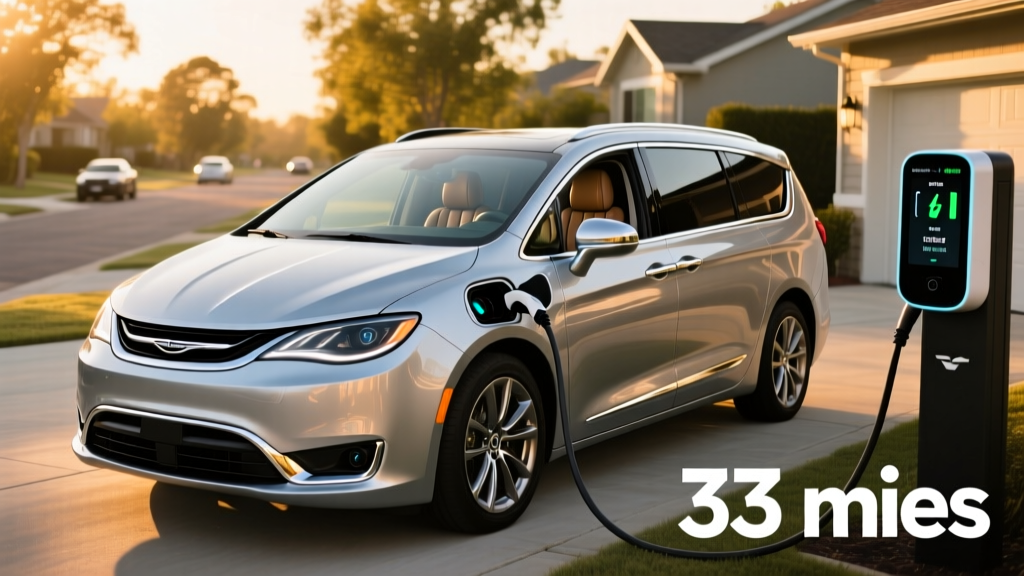
The Chrysler Pacifica Hybrid occupies a unique position in the electrified vehicle market: it remains the only plug-in hybrid (PHEV) minivan available in the United States. For families that need three-row seating, cargo capacity, and the ability to handle school runs on electric power alone, it's a compelling option. But how does it stack up in real-world efficiency, charging practicality, and long-term ownership cost? We break down every spec that matters.
Quick Verdict: The Only PHEV Minivan on the Market
The Pacifica Hybrid pairs a 3.6-liter V6 with two electric motors and a 16 kWh lithium-ion battery pack, delivering 260 combined horsepower and an EPA-estimated 32 miles of electric-only range. When the battery depletes, it operates as a conventional hybrid, returning 30 MPG combined. It's not the most efficient PHEV on paper, but no other vehicle offers this combination of passenger space, sliding doors, and a plug.
A conventional hybrid (HEV) like the Toyota Sienna uses a small battery charged entirely by the engine and regenerative braking — you never plug it in. A plug-in hybrid (PHEV) like the Pacifica Hybrid has a larger battery you charge from a wall outlet or charger, enabling a meaningful electric-only driving range before the gas engine takes over. The Pacifica is only sold as a PHEV; there is no non-plug-in Pacifica Hybrid variant.
Fuel Economy: EPA Ratings and Real-World MPG
The EPA rates the Pacifica Hybrid at 82 MPGe when operating in electric mode and 30 MPG combined once the battery is depleted and it functions as a conventional hybrid. Here's the full breakdown:
| Mode | City | Highway | Combined |
|---|---|---|---|
| Electric (MPGe) | — | — | 82 MPGe |
| Gas Hybrid (MPG) | 29 | 30 | 30 |
Source: EPA / fueleconomy.gov
In mixed suburban driving with regular plug-in charging, owners report achieving 35-45 MPG equivalent over a month because most short trips (under 30 miles) are completed entirely on electric power. On long highway road trips where the battery depletes quickly, expect the hybrid-mode figure to hover around 27-29 MPG — slightly below the EPA's 30 MPG highway estimate due to the minivan's 5,000+ lb curb weight and aerodynamic profile. Cold weather (below 35°F) reduces electric-only range by roughly 20-30%, dropping usable electric miles to approximately 22-26.
Electric-Only Range and Total Driving Range
The EPA rates the Pacifica Hybrid at 32 miles of electric-only range. That's enough to cover the average American's one-way commute and school drop-off without burning a drop of gasoline, provided you charge overnight.
Once the battery depletes, the 14-gallon fuel tank and hybrid-mode efficiency yield approximately 420 miles of additional range, for a total combined range of roughly 450 miles.
| Spec | Value |
|---|---|
| EPA Electric-Only Range | 32 miles |
| Real-World Electric Range (mixed) | 25-30 miles |
| Cold-Weather Electric Range (~20°F) | 22-26 miles |
| Total Combined Range | ~450 miles |
| Fuel Tank Capacity | 14.0 gallons |
Battery, Charging, and Powertrain Specs
The Pacifica Hybrid uses a 16 kWh lithium-ion battery pack (approximately 13 kWh usable, as the system maintains a buffer to protect longevity). Unlike many modern PHEVs, the Pacifica Hybrid does not support DC fast charging. Charging is limited to Level 1 (120V household outlet) and Level 2 (240V).
| Specification | Detail |
|---|---|
| Battery Capacity (Total / Usable) | 16 kWh / ~13 kWh |
| Battery Chemistry | Lithium-ion (NMC) |
| Level 1 Charge Time (120V / 1.4 kW) | ~14 hours (0-100%) |
| Level 2 Charge Time (240V / 6.6 kW) | ~2 hours (0-100%) |
| DC Fast Charging | Not supported |
| Charge Port / Connector | J1772 |
| Combined System Horsepower | 260 hp |
| Engine | 3.6L V6 Atkinson-cycle |
| Electric Motors | Dual motor (integrated in eFlite transaxle) |
| Transmission | eFlite EVT (electrically variable) |
| Drivetrain | Front-wheel drive (FWD only) |
| 0-60 mph (est.) | ~7.5 seconds |
Charging reality check: The onboard charger maxes out at 6.6 kW on Level 2. That means a full charge from empty takes about 2 hours on a 240V home charger — fast enough to top off during a midday stop if you have access to a Level 2 outlet. On a standard 120V household outlet (Level 1), expect roughly 14 hours, which works fine for overnight replenishment but won't fully recharge if you get home late and leave early.
Battery Warranty, Reliability, and Replacement Cost
- High-voltage battery: 10 years / 100,000 miles (whichever comes first)
- Powertrain: 5 years / 60,000 miles
- Bumper-to-bumper: 3 years / 36,000 miles
Stellantis warrants the battery to retain a minimum capacity threshold during the coverage period. If the pack degrades below that threshold, repair or replacement is covered. Note: In states that follow California Air Resources Board (CARB) standards, the hybrid battery warranty may extend further — check your state's specific emissions warranty requirements.
Regarding reliability: the Pacifica Hybrid's powertrain has been in production since the 2017 model year, giving it a longer track record than most PHEVs. Early model years (2017-2018) experienced some high-voltage battery recall issues related to potential fire risk, but Stellantis addressed those through software updates and module replacements. The 2021+ models have shown improved reliability in owner surveys.
Battery replacement cost: If the high-voltage battery fails outside of warranty, expect a replacement cost between $6,000 and $9,000 including parts and labor at a dealership. Independent hybrid battery specialists may offer refurbished packs for $4,000-$6,000. Given the 10-year/100,000-mile warranty, most original owners will never face this expense — but it's a factor for second-hand buyers purchasing vehicles with high mileage or expired coverage.
Pricing, Trims, and Federal Tax Credit Eligibility
The 2026 Chrysler Pacifica Hybrid starts at approximately $51,095 MSRP (including destination) for the base Select trim and climbs to roughly $59,000+ for the top Limited and Pinnacle trims. That's a significant premium over the gas-only Pacifica and competitors like the Toyota Sienna hybrid.
| Trim | Approx. MSRP |
|---|---|
| Select | $51,095 |
| Limited | $54,595 |
| Pinnacle | $59,095 |
Federal Tax Credit (§30D) — Does the Pacifica Hybrid Qualify?
The Pacifica Hybrid's eligibility for the federal §30D clean vehicle tax credit is complex and subject to change based on battery sourcing requirements, MSRP caps, and buyer income limits. As of 2026, key eligibility criteria include:
- MSRP cap: Vans and SUVs must be under $80,000 — the Pacifica Hybrid clears this.
- Buyer income cap: Modified adjusted gross income must not exceed $150,000 (single), $225,000 (head of household), or $300,000 (joint filers).
- Battery sourcing: A percentage of critical minerals and battery components must be sourced from the U.S. or free-trade-agreement countries. Stellantis has worked to increase North American sourcing, but exact credit amounts ($3,750 or $7,500) depend on current-year compliance thresholds.
- Point-of-sale transfer: Eligible buyers can transfer the credit to the dealer at purchase, reducing the upfront price rather than waiting for a tax refund.
Bottom line: Check the latest eligibility status on IRS.gov or consult a tax professional before purchasing. Credit availability can change mid-year as manufacturers hit sourcing thresholds. Some buyers may qualify for the full $7,500, others for $3,750, and some may not qualify at all depending on income and the specific vehicle's build date and battery composition.
Who Should Buy the Pacifica Hybrid vs a Full EV or Gas Minivan?
- You need a three-row minivan with sliding doors
- Most daily trips are under 30 miles (school, errands, commute)
- You can charge at home overnight (Level 1 or Level 2)
- You take occasional long road trips and don't want range anxiety
- You want to reduce fuel costs without committing to full EV infrastructure
- You can't charge at home or at work (you'll never access the electric range)
- You want AWD (Pacifica Hybrid is FWD only; the Sienna Hybrid offers AWD)
- You want the lowest possible fuel cost — a full EV like the Kia EV9 will cost less per mile
- You want DC fast charging for road-trip convenience
- Budget is a primary concern — the Sienna Hybrid starts ~$12,000 lower
- Conventional hybrid (HEV): Best if you never want to plug in. The Toyota Sienna Hybrid (36 MPG combined) is the benchmark. No electric-only range to speak of, but no behavior change required.
- Plug-in hybrid (PHEV): Best if you can charge daily and want electric commuting with gas road-trip flexibility. The Pacifica Hybrid is the only minivan option here.
- Full EV (BEV): Best if you want the lowest operating cost, have home charging, and your longest regular trip is within the vehicle's range (or you're willing to use DC fast charging). The Kia EV9 (300+ mile range, 3-row SUV) is the closest electric alternative, though it's an SUV, not a minivan.
Ownership Costs: Fuel Savings vs the Upfront Premium
The Pacifica Hybrid costs roughly $10,000-$12,000 more than a gas-only Toyota Sienna LE. Let's see how fuel savings compare over five years, assuming 15,000 miles per year, $3.50/gallon gas, and $0.14/kWh electricity:
| Vehicle | Efficiency | 5-Year Fuel Cost |
|---|---|---|
| Pacifica Hybrid (PHEV, regular charging) | ~40 MPG-e blended | $7,200 |
| Toyota Sienna Hybrid (HEV) | 36 MPG combined | $10,940 |
| Gas-only minivan (22 MPG avg) | 22 MPG combined | $17,900 |
The Pacifica Hybrid saves roughly $3,700 over the Sienna Hybrid over five years with regular charging — not enough to offset the $10,000+ price premium without factoring in the federal tax credit. If you qualify for the full $7,500 credit, the math improves substantially, bringing the effective price gap to $3,000-$5,000, which fuel savings can close within 4-6 years.
Pros and Cons at a Glance
- Only PHEV minivan on the market — no direct competitor
- 32 miles electric covers most daily family driving
- Stow 'n Go second-row seating (hybrid battery doesn't compromise cargo)
- 10-year / 100,000-mile battery warranty
- Potential $7,500 federal tax credit (eligibility varies)
- Smooth, quiet electric-mode driving around town
- High starting price ($51K+) vs Sienna Hybrid ($39K)
- No DC fast charging — Level 2 only
- FWD only — no AWD option
- Electric range drops significantly in cold weather
- Third-row space tighter than Sienna due to battery packaging
- Hybrid-mode MPG (30) trails Sienna Hybrid (36)
Frequently Asked Questions
How many MPG does the Chrysler Pacifica Hybrid get?
The EPA rates the Pacifica Hybrid at 30 MPG combined (29 city / 30 highway) when operating as a conventional hybrid after the battery is depleted. In electric mode, it achieves 82 MPGe combined. Real-world results vary: owners who charge daily and drive short distances often see 35-45 MPG equivalent, while highway-heavy trips yield 27-29 MPG.
How far can the Pacifica Hybrid go on electric only?
The EPA-estimated electric-only range is 32 miles. In real-world mixed driving, expect 25-30 miles. In cold weather (below 35°F), that drops to approximately 22-26 miles due to reduced battery efficiency and cabin heating demands.
Does the Pacifica Hybrid qualify for the federal tax credit?
It may qualify for up to $7,500 under the IRS §30D clean vehicle credit, depending on the specific vehicle's battery sourcing compliance, your income level (caps at $150K single / $300K joint), and the MSRP cap (under $80K for vans/SUVs — which the Pacifica clears). Eligibility rules change as sourcing requirements tighten annually. Verify current status at IRS.gov before purchasing.
Is the Pacifica Hybrid reliable, and what does a battery replacement cost?
The Pacifica Hybrid's powertrain has been in production since 2017, and post-2021 models show improved reliability. The high-voltage battery is warranted for 10 years / 100,000 miles. Out-of-warranty replacement costs approximately $6,000-$9,000 at a dealer, or $4,000-$6,000 through an independent hybrid specialist.
Can I charge the Pacifica Hybrid at a DC fast charger?
No. The Pacifica Hybrid only supports Level 1 (120V) and Level 2 (240V / J1772 connector) charging. The onboard charger maxes out at 6.6 kW, yielding a full charge in approximately 2 hours on Level 2 or 14 hours on Level 1.
How does the Pacifica Hybrid compare to the Toyota Sienna Hybrid?
The Sienna is a conventional hybrid (HEV) — you never plug it in — and achieves 36 MPG combined at a starting price around $39,000. The Pacifica Hybrid costs $12,000+ more but offers 32 miles of electric-only driving, which can dramatically cut fuel use on short trips if you charge regularly. The Sienna also offers AWD; the Pacifica Hybrid does not. Choose the Pacifica if you value plug-in electric commuting; choose the Sienna for lower upfront cost and higher hybrid-mode efficiency.