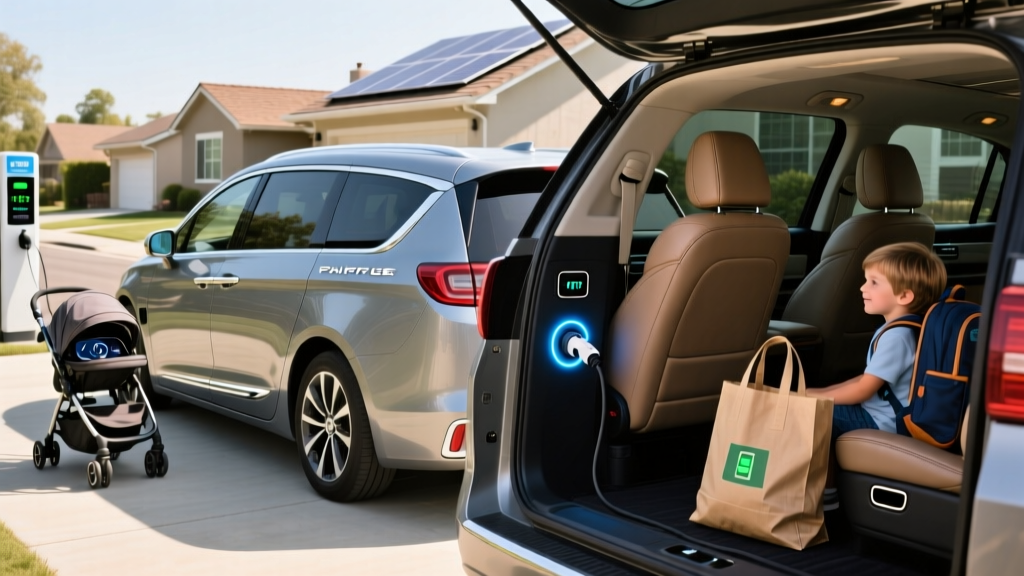
The Chrysler Pacifica Hybrid occupies a rare niche: it's the only plug-in hybrid minivan sold in the United States. For families who want to run school-drop errands on electricity but still need the flexibility to drive 500 miles cross-country without route-planning anxiety, the Pacifica Hybrid Limited — the top trim — has been the default choice for years. For the 2026 model year, Chrysler continues to refine this formula, though the core powertrain remains a proven quantity.
But does a plug-in hybrid minivan still make sense in 2026, when fully electric SUVs now offer 300+ miles of range and charging infrastructure has expanded significantly? This review breaks down the Pacifica Hybrid Limited's real-world efficiency, electric-only capability, charging behavior, and ownership economics to help you decide.
Pacifica Hybrid vs. Pacifica Gas: HEV or PHEV?
First, a critical clarification. The Chrysler Pacifica Hybrid is a plug-in hybrid electric vehicle (PHEV), not a conventional hybrid (HEV). This distinction matters for how you use it:
Conventional Hybrid (HEV)
- Small battery (~1-2 kWh) charged only by the engine and regenerative braking
- Cannot be plugged in
- Electric motor assists the gas engine; very limited electric-only driving
- Example: Toyota Sienna Hybrid
Plug-in Hybrid (PHEV) — Pacifica Hybrid
- Larger battery (16 kWh) that can be plugged in to charge
- Delivers meaningful electric-only range (32 miles EPA)
- Once the battery depletes, operates as a conventional hybrid
- No range anxiety — the gas engine takes over seamlessly
The standard (non-hybrid) Chrysler Pacifica with its 3.6L V6 is a conventional gas vehicle. The Toyota Sienna is a conventional HEV — it cannot plug in and offers no meaningful electric-only range. The Pacifica Hybrid is the only minivan that lets you plug in and drive on electricity alone for daily trips.
Real-World MPG and Electric-Only Range
The 2026 Chrysler Pacifica Hybrid carries an EPA-estimated 82 MPGe when operating on electricity and 30 MPG combined once the battery is depleted and the vehicle runs as a hybrid. Here's the full breakdown from fueleconomy.gov:
| Mode | City | Highway | Combined |
|---|---|---|---|
| Electric + Gas (MPGe) | — | — | 82 MPGe |
| Hybrid (Gas Only, MPG) | 29 | 30 | 30 |
Electric-only range: The EPA rates the Pacifica Hybrid at 32 miles on a full charge. That's enough for most daily routines — school drop-off, grocery runs, and local errands — without burning a drop of gasoline.
Total combined range: With a full tank (16.5 gallons) and a full battery, the Pacifica Hybrid can cover roughly 520 miles before needing fuel or a charge.
Real-World Expectations
The 32-mile electric range is achievable in mild weather (50-80°F) at city speeds. Expect 24-28 miles in cold weather (below 40°F) due to battery chemistry limitations and cabin heating demands. On the highway at 70+ mph, electric range drops to roughly 20-24 miles as aerodynamic drag increases. The 30 MPG hybrid rating is fairly honest — owners report 28-31 MPG in mixed driving, with highway-only trips sometimes yielding 32-33 MPG thanks to the engine's efficiency at steady speeds.
Compared to the Toyota Sienna Hybrid (36 MPG combined, but zero electric-only range), the Pacifica Hybrid trades some overall fuel economy for the ability to drive locally on electricity. If your daily mileage is under 30 miles and you can charge at home, your effective fuel cost drops dramatically.
Powertrain, Battery, and Charging Specs
| Specification | 2026 Pacifica Hybrid Limited |
|---|---|
| Engine | 3.6L Atkinson-cycle V6 |
| Electric Motors | Dual-motor eFlite electrically variable transmission |
| Combined System Power | 260 hp |
| Battery Capacity | 16 kWh (lithium-ion, NMC chemistry) |
| Usable Battery Capacity | ~13 kWh (buffer preserves longevity) |
| EPA Electric Range | 32 miles |
| EPA Combined MPG (hybrid) | 30 MPG |
| Level 1 Charging (120V) | ~14 hours (0-100%) |
| Level 2 Charging (240V) | ~2 hours (0-100%) |
| DC Fast Charging | Not available |
| Charge Port | J1772 (driver-side front fender) |
| 0-60 mph | ~7.1 seconds (estimated) |
| Drivetrain | Front-wheel drive |
Charging Behavior: What to Expect
The Pacifica Hybrid's onboard charger maxes out at 6.6 kW on Level 2 (240V). That means a full 0-100% charge takes roughly two hours on a home Level 2 charger. On a standard 120V household outlet (Level 1), expect about 14 hours — functional for overnight charging if you drive under 30 miles daily, but slow for replenishing a fully depleted battery.
Critical limitation: The Pacifica Hybrid does not support DC fast charging. There is no CCS or CHAdeMO port. This is typical for PHEVs — their smaller batteries don't justify the cost and weight of DC fast-charge hardware — but it means you cannot top up quickly on a road trip. On long drives, the vehicle simply operates as a 30 MPG hybrid, which is its intended behavior.
For home charging, a Level 2 wallbox (such as a ChargePoint Home Flex or Emporia Vue) is strongly recommended. Installation costs typically range from $500 to $1,500 depending on whether your electrical panel needs an upgrade. Consult a licensed electrician for a site assessment.
Pricing, Trims, and Tax Credit Eligibility
The 2026 Chrysler Pacifica Hybrid is offered in Select and Limited trims. The Limited is the top-tier model with premium features:
- Pacifica Hybrid Select: Starting MSRP ~$50,990
- Pacifica Hybrid Limited: Starting MSRP ~$55,490
The Limited trim adds Nappa leather seats, a 10.1-inch Uconnect 5 infotainment screen, a 19-speaker Harman Kardon audio system, a hands-free power liftgate, and a panoramic sunroof. It's a well-equipped family hauler, though the price pushes into luxury SUV territory.
Federal Tax Credit (§30D) — 2026 Rules
Under the Inflation Reduction Act, the Chrysler Pacifica Hybrid has previously qualified for a partial or full federal tax credit. However, eligibility under IRS §30D depends on several factors that change periodically:
- MSRP cap: Vans and SUVs must be under $80,000 MSRP — the Pacifica Hybrid qualifies.
- Buyer income cap: Modified AGI must not exceed $150,000 (single), $225,000 (head of household), or $300,000 (joint).
- Battery sourcing: Critical minerals and battery components must meet escalating domestic-content thresholds. Check the latest fueleconomy.gov tax credit list for current Pacifica Hybrid eligibility.
- Point-of-sale transfer: As of 2024, eligible buyers can transfer the credit to the dealer for an immediate price reduction at purchase.
Important: Tax credit eligibility for specific models changes as battery supply chains shift. Always verify current Pacifica Hybrid eligibility on fueleconomy.gov and consult a tax professional before relying on the credit in your purchase decision. Some states also offer additional PHEV rebates — check your state's energy office for details.
Battery Warranty, Reliability, and Replacement Cost
Stellantis Hybrid Battery Warranty
The Pacifica Hybrid's 16 kWh lithium-ion battery is covered by Stellantis's hybrid battery warranty: 10 years or 100,000 miles (whichever comes first) in most states, and 10 years or 150,000 miles in California Air Resources Board (CARB) states. The warranty covers defects and capacity loss below a defined threshold (typically 70% of original capacity).
Reliability Track Record
The Pacifica Hybrid's powertrain has been in production since the 2017 model year, giving it one of the longest PHEV track records in the minivan segment. Early models (2017-2019) experienced some recalls related to the high-voltage battery system, including a notable fire-risk recall that required a software update and, in some cases, battery module replacement. Stellantis addressed these issues, and models from 2020 onward have shown improved reliability.
That said, the Pacifica Hybrid's overall reliability ratings from sources like Consumer Reports and J.D. Power have historically trailed the Toyota Sienna. The complexity of a plug-in hybrid system — with both a V6 engine and dual electric motors routed through an eFlite transmission — means more potential failure points than a conventional hybrid or a pure EV.
Battery Replacement Cost
Out-of-warranty replacement of the Pacifica Hybrid's 16 kWh battery pack is estimated at $5,000 to $8,000 including parts and labor. This is a significant expense, but the 10-year/100,000-mile warranty provides substantial coverage. Most Pacifica Hybrid batteries are expected to last well beyond the warranty period with normal use. PHEV batteries experience less stress than full EV batteries because the battery buffer (roughly 3 kWh reserved at the top and bottom of the pack) prevents deep cycling.
Pacifica Hybrid Limited vs. the Alternatives
The Pacifica Hybrid doesn't compete in a crowded field. Here's how it stacks up against the closest alternatives:
| Attribute | 2026 Chrysler Pacifica Hybrid Limited | 2026 Toyota Sienna Hybrid (XLE) | 2026 Kia Carnival Hybrid (SX Prestige) |
|---|---|---|---|
| Powertrain Type | PHEV | HEV | HEV |
| Plug-In Capable? | Yes | No | No |
| Electric-Only Range | 32 miles | 0 miles | 0 miles |
| Combined MPG (hybrid) | 30 MPG | 36 MPG | 33 MPG (est.) |
| Combined HP | 260 hp | 245 hp | 245 hp (est.) |
| AWD Available? | No | Yes | No |
| Starting MSRP | ~$55,490 | ~$44,990 | ~$50,990 |
| Federal Tax Credit | Check eligibility | None (HEV) | None (HEV) |
The Sienna Hybrid wins on pure fuel economy and available AWD, and it costs significantly less. The Carnival Hybrid offers a premium interior at a lower price point. But neither can plug in. If your goal is to run local errands on electricity while retaining gas-engine flexibility for road trips, the Pacifica Hybrid is still the only minivan that does it.
Pros
- Only PHEV minivan — 32 miles of electric-only driving
- Stow 'n Go seating (second-row seats fold into the floor; note: not available on Hybrid for third row only)
- Limited trim offers luxury-level features
- 520+ mile total range eliminates road-trip anxiety
- 10-year/100,000-mile battery warranty
- Potential federal tax credit reduces effective price
Cons
- 30 MPG hybrid mode trails Sienna's 36 MPG
- No DC fast charging
- FWD only — no AWD option
- Higher MSRP than competing hybrid minivans
- Reliability history lags Toyota
- Second-row Stow 'n Go removed to accommodate battery (third row still folds flat)
Who Should Buy the Pacifica Hybrid Limited?
Choose the Pacifica Hybrid Limited if:
- You can charge at home (Level 2 recommended) and your daily driving is under 35 miles
- You want to minimize gasoline use for local trips but still need 500+ mile road-trip capability
- You need minivan space and sliding doors — no electric SUV matches the Pacifica's cargo versatility
- You value the Limited trim's premium features and are willing to pay for them
Choose the Toyota Sienna Hybrid instead if:
- You cannot charge at home and want maximum MPG without plugging in
- You need AWD for snow-belt winters
- You want lower upfront cost and Toyota's long-term reliability reputation
Choose a full EV (like the Kia EV9) if:
- You want zero tailpipe emissions and can charge at home
- Your road trips are infrequent or you're comfortable planning DC fast-charge stops
- You want lower maintenance costs (no oil changes, no engine)
Frequently Asked Questions
How many MPG does the Chrysler Pacifica Hybrid get?
The EPA rates the Pacifica Hybrid at 30 MPG combined (29 city / 30 highway) when running as a hybrid after the battery is depleted. When factoring in electric-only driving, the combined rating is 82 MPGe. Real-world results cluster around 28-31 MPG in hybrid mode, with some owners reporting slightly better highway figures.
How far can the Pacifica Hybrid go on electric only?
The EPA rates it at 32 miles on a full charge. In real-world conditions, expect 24-28 miles in cold weather and up to 32-34 miles in mild city driving. Highway speeds significantly reduce electric-only range to about 20-24 miles.
Does the Pacifica Hybrid qualify for a federal tax credit?
It may qualify for a partial or full federal tax credit under IRS §30D, depending on current battery-sourcing rules and your income. The MSRP is under the $80,000 cap for vans. Always verify current eligibility on fueleconomy.gov and consult a tax professional.
Is the Pacifica Hybrid reliable?
The powertrain has been in production since 2017 and has improved over successive model years. Early models had high-voltage battery recalls, but these have been addressed. Overall reliability still trails the Toyota Sienna. The 10-year/100,000-mile battery warranty provides strong protection against premature degradation.
What does it cost to replace the Pacifica Hybrid battery?
Out-of-warranty replacement is estimated at $5,000 to $8,000. However, the battery is covered for 10 years/100,000 miles (10 years/150,000 miles in CARB states), and most PHEV batteries outlast their warranty periods. The battery buffer system reduces deep-cycling stress.
Can the Pacifica Hybrid DC fast charge?
No. The Pacifica Hybrid supports Level 1 (120V, ~14 hours) and Level 2 (240V, ~2 hours) charging only. There is no DC fast-charge port. This is standard for PHEVs with smaller battery packs.
Does the Pacifica Hybrid have Stow 'n Go seating?
Partially. The third-row seat still folds flat into the floor via Stow 'n Go. However, the second-row seats do not fold into the floor because the hybrid battery occupies that space. The second-row seats are removable but not stowable. This is a trade-off unique to the Hybrid model.