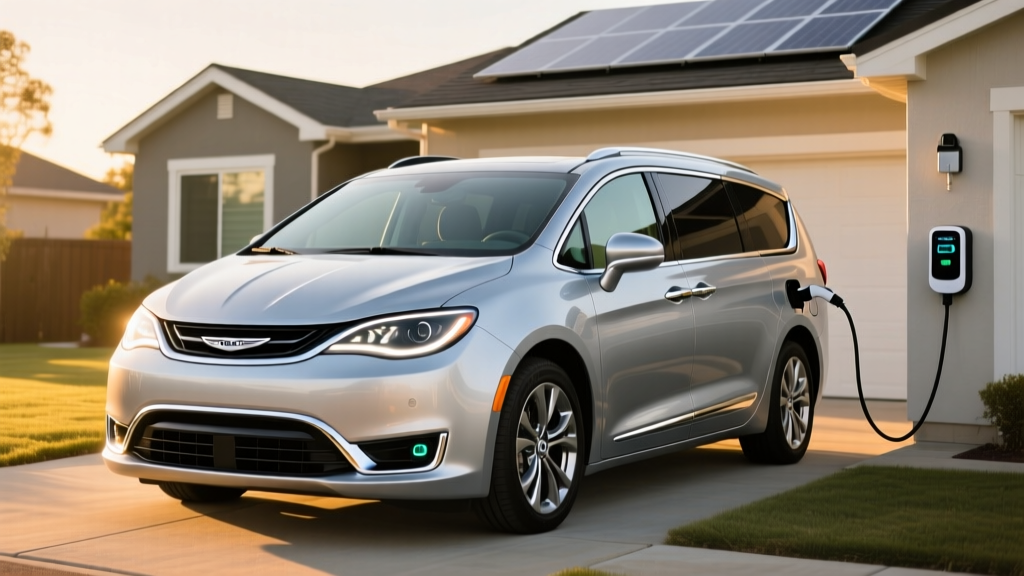
If you're researching the Chrysler Pacifica Hybrid fuel economy, you're likely weighing whether a plug-in hybrid minivan makes financial and practical sense for your family. The Pacifica Hybrid remains the only plug-in hybrid minivan sold in the United States, giving it a unique position for families who want electric-only school runs and weekend road-trip capability without range anxiety. Below, we break down every efficiency number — EPA estimates, real-world expectations, charging logistics, and total cost of ownership — so you can decide if this PHEV fits your garage.
Pacifica Hybrid Powertrain: What's Under the Hood
The Chrysler Pacifica Hybrid pairs a 3.6-liter Pentastar V6 engine with a dual-motor electrically variable transmission (eVT) and a 16 kWh lithium-ion battery pack (approximately 13 kWh usable). This is a plug-in hybrid electric vehicle (PHEV), meaning it can drive on electricity alone for a limited range before the gasoline engine engages. Unlike a conventional hybrid (HEV) such as the Toyota Sienna, the Pacifica Hybrid can be plugged in to recharge its battery and operate as a short-range EV for daily errands.
| Spec | Value |
|---|---|
| Combined System Horsepower | 260 hp |
| Engine | 3.6L V6 (Atkinson cycle) |
| Electric Motors | Dual-motor eVT |
| Battery Capacity | 16 kWh total / ~13 kWh usable |
| Battery Chemistry | NMC (Nickel Manganese Cobalt) |
| EPA Electric-Only Range | 32 miles |
| Total Combined Range (EV + Gas) | 520 miles |
| EPA MPGe (Electric + Gas Combined) | 82 MPGe |
| EPA MPG (Gas Only, Charge-Sustaining) | 30 combined (29 city / 30 highway) |
| Fuel Tank Capacity | 16.5 gallons |
| 0–60 mph | ~7.1 seconds |
| Towing Capacity | Not rated for towing (PHEV model) |
A critical note for family buyers: the Pacifica Hybrid cannot tow. Chrysler disables towing on the PHEV variant due to the battery's weight distribution and thermal management constraints. If you need a minivan that can pull a small trailer, the gas-only Pacifica (rated at 3,600 lbs with the factory tow package) is your option.
Fuel Economy Breakdown: EPA Numbers vs. Real-World MPG
The headline Chrysler Pacifica Hybrid fuel economy figure is 82 MPGe combined when operating in blended electric-and-gas mode. But MPGe can be misleading if you don't understand how it's calculated. MPGe (miles per gallon equivalent) converts the energy in electricity to a gasoline-equivalent figure. Your actual experience depends entirely on how often you charge and how you drive.
| Driving Mode | City | Highway | Combined |
|---|---|---|---|
| Charge-Depleting (EV Priority, Blended) | 82 MPGe combined | ||
| Charge-Sustaining (Gas Only, Battery Depleted) | 29 MPG | 30 MPG | 30 MPG |
| Electric-Only Efficiency | ~2.0 kWh/mile (approx. 32 mi on 13 kWh usable) | ||
Real-World MPG: What Owners Actually Report
According to aggregated owner data on fueleconomy.gov's My MPG tracker, Pacifica Hybrid owners report a wide spread depending on charging habits:
- Daily chargers (short commutes under 30 miles): Many owners use little to no gasoline during the week, effectively achieving 60–100+ MPGe equivalent over a tank cycle.
- Infrequent chargers (road-trip heavy or no home charging): Expect 27–31 MPG once the battery is depleted — consistent with the EPA's 30 MPG combined charge-sustaining estimate.
- Cold-weather penalty: In sub-freezing temperatures, electric-only range drops to roughly 22–26 miles as the battery's usable capacity shrinks and cabin heating draws energy. Gas-mode MPG can dip to 25–28 MPG in winter city driving.
- Highway-heavy driving: Unlike conventional hybrids that shine in stop-and-go traffic, the Pacifica Hybrid's highway MPG is nearly identical to its city MPG (30/29). At 75+ mph, aerodynamic drag and the minivan's 5,000+ lb curb weight work against efficiency.
HEV vs. PHEV: How the Pacifica Hybrid Compares to the Sienna
The most common cross-shop is the Pacifica Hybrid (PHEV) against the Toyota Sienna, which is a conventional hybrid (HEV). Understanding the difference is essential before you buy.
| Attribute | Chrysler Pacifica Hybrid (PHEV) | Toyota Sienna (HEV) |
|---|---|---|
| Plug-In Required? | Yes — to access EV range | No — never plugs in |
| Electric-Only Range | 32 miles | None (EV assist only) |
| EPA Combined MPG/MPGe | 82 MPGe / 30 MPG (gas) | 36 MPG combined |
| Battery Size | 16 kWh | ~1.9 kWh (NiMH) |
| Home Charging | Level 2 recommended (240V) | Not applicable |
| AWD Available? | No (FWD only) | Yes (AWD available) |
| Towing | Not rated | 3,500 lbs |
| Base MSRP (2025–2026) | ~$51,095 | ~$39,285 |
Bottom line: If you can charge at home nightly and your daily driving stays under 30 miles, the Pacifica Hybrid will use dramatically less gasoline — potentially zero on weekdays. If you lack home charging access, tow a trailer, need AWD, or want a lower purchase price, the Sienna HEV is the more practical hybrid choice. The Sienna's 36 MPG combined is also higher than the Pacifica's 30 MPG in gas-only mode, so if you never plug in, the Sienna wins on fuel economy.
Charging the Pacifica Hybrid: Times, Levels, and Costs
The Pacifica Hybrid's 16 kWh battery pack can be recharged in two ways — and understanding the difference between kW (power, or how fast energy flows) and kWh (energy, or how much the battery holds) is key to setting expectations.
| Charging Level | Power (kW) | Voltage | 0–100% Time | Miles of EV Range Per Hour |
|---|---|---|---|---|
| Level 1 (Standard Outlet) | ~1.4 kW | 120V | ~14 hours | ~2 miles/hr |
| Level 2 (Home/Public AC) | ~7.2 kW | 240V | ~2 hours | ~16 miles/hr |
| DC Fast Charging | Not supported — no DC fast-charge port | |||
Important limitation: The Pacifica Hybrid does not support DC fast charging. It uses a J1772 AC charging port only. This means you cannot top up at Electrify America or Tesla Supercharger stations. For a minivan with 32 miles of EV range, this isn't a dealbreaker — the battery is small enough that a Level 2 session fully recharges it in about two hours — but it does mean road-trip charging stops aren't practical for adding EV range.
Home Charging Setup and Cost
Most Pacifica Hybrid owners install a Level 2 (240V) home charger, which fully replenishes the battery overnight. A typical Level 2 EVSE (Electric Vehicle Supply Equipment) for the Pacifica Hybrid requires:
- A 240V / 40-amp circuit (NEMA 14-50 outlet or hardwired)
- A Level 2 charger rated at 32–48 amps (e.g., ChargePoint Home Flex, Emporia Level 2)
- Installation cost: $500–$2,000 depending on panel proximity and local permit requirements
At the national average electricity rate of ~$0.16/kWh, a full 13 kWh charge costs approximately $2.08, giving you 32 miles of electric driving — roughly $0.065 per mile. Compare that to gasoline at $3.50/gallon and 30 MPG, which costs about $0.117 per mile. The electric mode cuts your per-mile fuel cost nearly in half.
Pricing, Trims, and Federal Tax Credit Eligibility
The 2025–2026 Chrysler Pacifica Hybrid starts at approximately $51,095 (Select trim) and climbs to roughly $59,895 for the top Pinnacle trim, including destination charges. This represents a significant premium over the gas-only Pacifica and the Toyota Sienna.
Federal §30D Tax Credit: Does the Pacifica Hybrid Qualify?
Under current IRS rules for the §30D New Clean Vehicle Credit, the Pacifica Hybrid has historically qualified for a partial or full credit, but eligibility depends on several moving targets:
- MSRP Cap: Vans/minivans must be under $80,000 MSRP — the Pacifica Hybrid clears this easily.
- Buyer Income Cap: Modified adjusted gross income must not exceed $150,000 (single), $225,000 (head of household), or $300,000 (joint filers).
- Battery Sourcing: Critical minerals and battery components must meet phased-in percentages from US/FTA partners. Chrysler has adjusted sourcing, but the exact credit amount ($3,750 or $7,500) depends on current-year compliance.
- Point-of-Sale Transfer: You can now transfer the credit to the dealer at purchase, reducing your out-of-pocket cost immediately rather than waiting for tax season.
Consult a tax professional before relying on the credit. The IRS updates qualified-vehicle lists periodically, and battery-sourcing rules tighten annually. Verify the Pacifica Hybrid's current eligibility on the IRS clean vehicle list before signing a purchase agreement.
Battery Warranty, Reliability, and Replacement Costs
Hybrid battery longevity is consistently a top concern for PHEV buyers. Chrysler backs the Pacifica Hybrid's battery with a robust warranty, and real-world data is encouraging.
- High-Voltage Battery: 10 years / 100,000 miles (whichever comes first) — covers defects and capacity loss below a defined threshold (typically ~70% state of health).
- Powertrain (Engine + eVT + Motors): 5 years / 60,000 miles.
- Bumper-to-Bumper: 3 years / 36,000 miles.
Reliability Track Record
The Pacifica Hybrid's reliability record has been mixed across model years. Early 2017–2019 models experienced battery recall campaigns related to potential fire risk (Chrysler issued a recall and software update). The 2021+ refresh addressed several powertrain control issues. As of 2025–2026, the model has stabilized, but it does not match the Toyota Sienna's long-standing reliability reputation. We recommend checking NHTSA recall data for any open recalls on a specific VIN before purchase.
Battery Replacement Cost
If the high-voltage battery requires replacement outside of warranty coverage, expect a cost in the range of $7,000–$9,500 (parts and labor) based on current Chrysler dealer pricing. This is comparable to other PHEV battery replacements in this class. However, with the 10-year/100,000-mile warranty and data showing most PHEV batteries retain 85–90% capacity after 100,000 miles, premature failure is uncommon.
Who Should Buy the Pacifica Hybrid — And Who Shouldn't
- You can install a Level 2 charger at home and your daily driving is under 30 miles round-trip.
- You want to minimize gasoline use for school runs, grocery trips, and commuting without sacrificing road-trip range.
- You need minivan space (Stow 'n Go seating is partially available — note the third row still folds flat, but second-row seats do not fold into the floor on the PHEV due to battery placement).
- You qualify for the §30D tax credit, which can bring the effective price closer to a loaded gas minivan.
- You cannot charge at home — without plugging in, the Pacifica Hybrid is just a heavier, less efficient minivan than the Sienna.
- You need AWD (Pacifica Hybrid is FWD only).
- You need towing capacity (Pacifica Hybrid is not rated for towing).
- You want second-row Stow 'n Go seating (the battery eliminates under-floor second-row storage).
- You drive 200+ miles daily — a full EV like the Kia EV9 or a longer-range PHEV would serve you better.
- Only PHEV minivan on the US market — no direct competitor
- 32 miles EV range covers most family daily errands without gasoline
- 520 miles total range eliminates road-trip range anxiety
- Eligible for federal tax credit (verify current-year status)
- Smooth, quiet electric-mode driving around town
- No DC fast charging — limited to Level 2 AC
- Cannot tow; not rated for any trailer weight
- Second-row seats don't fold into the floor (battery in the way)
- Premium MSRP — $10,000+ over a base Sienna
- FWD only; no AWD option for snow-belt families
- Early model-year reliability concerns (improved post-2021)
Frequently Asked Questions
How many MPG does the Chrysler Pacifica Hybrid get?
The EPA rates the Pacifica Hybrid at 82 MPGe combined when using its blended electric-and-gas mode. Once the battery is depleted, it operates as a conventional hybrid at 30 MPG combined (29 city / 30 highway). Real-world results vary widely: owners who charge daily and drive under 32 miles use very little gasoline, while those who never charge see 27–31 MPG.
How far can the Pacifica Hybrid go on electric only?
The EPA rates it at 32 miles of electric-only range. In real-world conditions, expect 28–32 miles in mild weather and 22–26 miles in freezing temperatures or sustained highway driving above 65 mph. This covers most family daily errands — school drop-off, groceries, and commuting — without using a drop of gasoline.
Does the Chrysler Pacifica Hybrid qualify for a tax credit?
It has historically qualified for a partial or full §30D federal tax credit (up to $7,500), subject to buyer income limits, MSRP caps, and battery-sourcing requirements. The MSRP cap for vans is $80,000, which the Pacifica Hybrid clears. Always verify current eligibility on the IRS qualified-vehicle list before purchasing, as sourcing rules change annually.
Is the Pacifica Hybrid reliable, and what does a battery replacement cost?
Post-2021 models have shown improved reliability after early battery recall campaigns. The high-voltage battery is warranted for 10 years / 100,000 miles. Out-of-warranty battery replacement costs approximately $7,000–$9,500. Most PHEV batteries retain 85–90% capacity at 100,000 miles based on industry data.
Should I get the Pacifica Hybrid or a full EV?
If your family takes regular road trips over 200 miles, the Pacifica Hybrid's 520-mile total range and 5-minute gas fill-ups beat any current EV's charging logistics. If you drive under 200 miles daily and have reliable home charging, a full EV like the Kia EV9 or Tesla Model X offers lower running costs and zero tailpipe emissions — but neither offers minivan sliding doors or the Pacifica's interior flexibility.
Can I charge the Pacifica Hybrid at a Tesla Supercharger?
No. The Pacifica Hybrid only accepts AC charging via a J1772 connector. It cannot use DC fast chargers of any kind, including Tesla Superchargers, Electrify America, or EVgo stations. Home Level 2 charging (240V) is the primary refueling method for the battery.
How long does it take to charge the Pacifica Hybrid at home?
On a Level 2 (240V) home charger at 7.2 kW, a full 0–100% charge takes approximately 2 hours. On a standard 120V household outlet (Level 1), a full charge takes roughly 14 hours — adequate for overnight replenishment but slow for same-day turnaround.
Sources: EPA fueleconomy.gov, IRS §30D Clean Vehicle Credit, NHTSA Recall Database. All specs reflect the latest available model-year data as of publication. Verify trim-level pricing and tax-credit eligibility with your dealer and tax advisor before purchase.