Quick Verdict: The Only Plug-In Hybrid Minivan That Matters
If you need three rows, sliding doors, and the ability to do school runs on electricity alone, the 2026 Chrysler Pacifica Hybrid occupies a segment of one. No other minivan on the US market offers a plug-in hybrid powertrain with usable electric-only range. For families not ready to commit to a full battery-electric vehicle — whether because of road-trip habits, apartment living without reliable charging, or simply wanting a safety net — the Pacifica PHEV remains the most practical bridge vehicle available.
But practicality comes with trade-offs: the Pacifica Hybrid is heavier than its gas-only sibling, loses the Stow 'n Go second-row seating due to the battery pack, and carries a price premium that takes years of fuel savings to recoup. Here's every number you need to decide if it's right for your driveway.
| Specification | 2026 Pacifica Hybrid (PHEV) |
|---|---|
| Powertrain | 3.6L V6 + 2 electric motors (eCVT) |
| Combined Horsepower | 260 hp |
| Battery (usable) | 16.0 kWh lithium-ion |
| EPA Electric-Only Range | 32 miles |
| Total Combined Range | ~430 miles |
| EPA MPGe (charge-sustaining + electric) | 82 MPGe |
| EPA MPG (gas-only, charge-sustaining) | 30 combined / 29 city / 30 hwy |
| Max AC Charging (Level 2) | 6.6 kW |
| DC Fast Charging | Not supported |
| Level 2 Charge Time (0–100%) | ~2 hours |
| Level 1 Charge Time (120V) | ~13 hours |
| 0–60 mph | ~7.1 seconds |
| Starting MSRP | $51,095 (Select trim) |
| Battery/Powertrain Warranty | 10 yr / 100,000 mi |
HEV vs PHEV: What the Pacifica Actually Is
Chrysler sells the Pacifica in two electrified-adjacent forms, and confusing them is easy. Here's the breakdown:
| Feature | Conventional Hybrid (HEV) | Plug-In Hybrid (PHEV) |
|---|---|---|
| Battery Size | ~1–2 kWh (small buffer) | 16.0 kWh usable |
| Plug-In Required? | No — regenerates while driving | Yes — plug in for electric range |
| Electric-Only Range | ~1 mile at low speed | 32 miles (EPA) |
| Typical Use Case | Set-and-forget fuel savings | Daily EV commuting + gas road trips |
| Federal Tax Credit | Not eligible under §30D | Eligibility varies by sourcing rules |
The 2026 Pacifica Hybrid is a plug-in hybrid (PHEV). It has a substantially larger battery than a conventional hybrid and can be plugged into a wall outlet or Level 2 charger. If you never plug it in, it still functions as a hybrid — you'll just never access the 32 miles of electric-only range that make it worthwhile. Chrysler does not currently sell a non-plug-in HEV version of the Pacifica in the US market for 2026, so every Pacifica Hybrid you encounter is the PHEV variant.
Real-World MPG and Electric Range: Beyond the EPA Sticker
EPA Electric Range: 32 miles
Real-World Expectation: 25–30 miles in mixed driving; 20–24 miles at sustained highway speeds or in cold weather (below 40°F).
EPA Combined MPG (gas mode): 30 MPG
Real-World Expectation: 28–31 MPG highway; 32–35 MPG in city driving where regenerative braking recovers more energy.
According to fueleconomy.gov, the Pacifica Hybrid achieves 30 MPG combined when operating in charge-sustaining (gas) mode and 82 MPGe when factoring in electric operation. These numbers are solid for a 5,000+ pound minivan, but context matters.
The 32-mile electric range is most valuable when your daily driving falls under that threshold. A family with a 10-mile school run and a 6-mile grocery trip might go weeks without buying gas. But load the van with seven passengers, hit the interstate at 75 mph, and the battery depletes in roughly 22–24 miles before the V6 seamlessly takes over. Cold weather further compresses electric range by 15–25% due to cabin heating demands and reduced battery efficiency — a reality that applies to every PHEV and BEV on the market.
In gas-only mode, the Pacifica Hybrid actually tends to beat its EPA city estimate in stop-and-go traffic. Regenerative braking recovers kinetic energy that a conventional minivan wastes as heat. On the highway, where regen opportunities are scarce and aerodynamic drag dominates, expect numbers closer to 28 MPG. That's still a meaningful improvement over the gas-only Pacifica's 22 MPG combined.
Charging: Level 2 Only, No DC Fast Charging
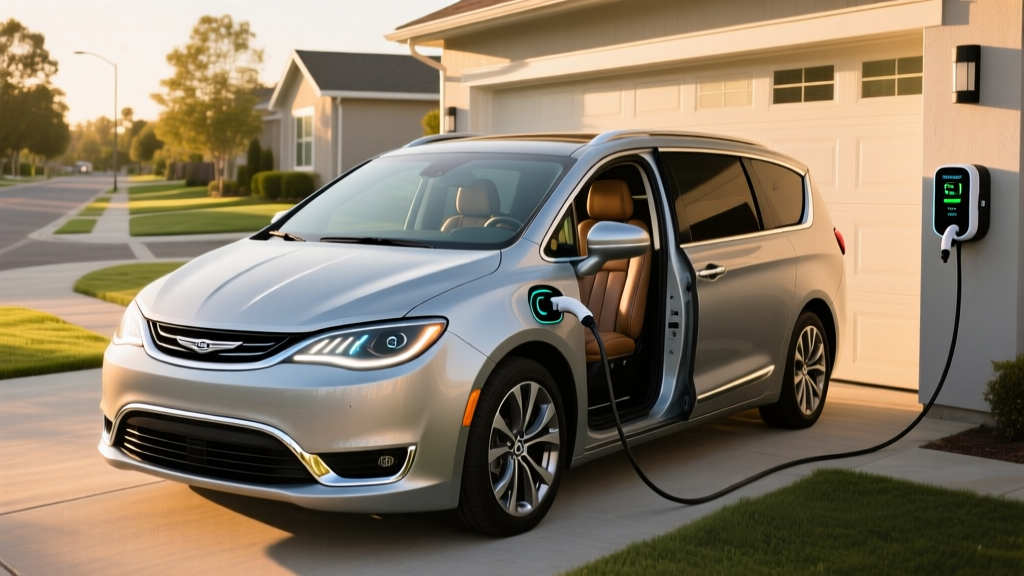
The Pacifica Hybrid uses a standard J1772 connector and charges at up to 6.6 kW on Level 2 (240V). A full charge from empty takes roughly 2 hours. On a standard 120V household outlet (Level 1), expect about 13 hours — fine for overnight replenishment if your daily electric use is modest.
| Charging Level | Power | Time (0–100%) | Practical Use |
|---|---|---|---|
| Level 1 (120V outlet) | ~1.4 kW | ~13 hours | Overnight top-up |
| Level 2 (240V, 32A) | 6.6 kW | ~2 hours | Home/work charging |
| DC Fast Charge | N/A | N/A | Not supported |
The lack of DC fast charging is a deliberate engineering choice. The 16 kWh battery is small enough that Level 2 refills it quickly, and adding DC fast-charge hardware would increase cost, weight, and packaging complexity. For a PHEV designed to charge at home overnight, this is a reasonable trade-off. You won't find the Pacifica Hybrid at Electrify America or Tesla Supercharger stations — and it doesn't need to be there.
One practical note: if you're installing a Level 2 home charger specifically for the Pacifica, a 32-amp circuit (requiring a 40-amp breaker) is sufficient. You don't need the 48-amp circuits that full BEVs like the Ford F-150 Lightning demand. This can save $200–$500 on electrical panel upgrades. Always confirm requirements with a licensed electrician before installation.
Powertrain and Driving Experience
The Pacifica Hybrid pairs Chrysler's 3.6-liter Pentastar V6 with two electric motors integrated into an electronically controlled continuously variable transmission (eCVT). Combined output is 260 horsepower. One motor primarily drives the wheels; the other acts as a generator or provides additional torque assist.
The result is a minivan that feels surprisingly quick off the line — electric torque fills the low-RPM gap that makes conventional V6 minivans feel sluggish from a stop. The 0–60 mph time of approximately 7.1 seconds is competitive with the non-hybrid Pacifica and quicker than the Toyota Sienna hybrid (which uses a 4-cylinder-based system rated at 245 hp).
Driving dynamics are what you'd expect from a family hauler: soft, compliant, and uninterested in canyon carving. The added weight of the battery pack (~600 lbs over the gas model) is noticeable during hard braking and quick direction changes, but the low-mounted battery slightly improves the center of gravity. Ride quality remains excellent, and cabin noise is well-managed — especially in electric-only mode, where the V6 is silent.
Pricing, Trims, and Tax Credit Eligibility
The 2026 Pacifica Hybrid starts at $51,095 for the Select trim and climbs to approximately $58,000+ for the Pinnacle trim with options. That's a roughly $8,000–$10,000 premium over an equivalently trimmed gas-only Pacifica.
Federal §30D Tax Credit Eligibility (2026 Rules):
- Vehicle MSRP Cap: Vans/SUVs must be under $80,000 — Pacifica Hybrid qualifies
- Buyer Income Cap: $150,000 single / $300,000 married filing jointly
- Battery Sourcing: Critical minerals and battery component requirements must be met — check the IRS qualified vehicles list for current Pacifica Hybrid eligibility
- Credit Amount: Up to $7,500 if all sourcing requirements are met; partial credit ($3,750) if only one requirement is satisfied
- Point-of-Sale Transfer: Eligible buyers can transfer the credit to the dealer for an immediate price reduction at purchase
Note: Battery sourcing requirements tighten annually. Consult a tax professional and verify the Pacifica Hybrid's current status on the IRS qualified vehicle list before purchasing.
If the Pacifica Hybrid qualifies for the full $7,500 credit, the effective starting price drops to roughly $43,595 — narrowing the gap with the gas model significantly. Factor in fuel savings (approximately $1,000–$1,500/year for drivers who charge regularly and drive 12,000 miles annually), and the payback period compresses to 3–5 years depending on your electricity and gas prices.
Battery Longevity, Warranty, and Replacement Cost
High-Voltage Battery Warranty: 10 years / 100,000 miles (whichever comes first)
Coverage Threshold: Chrysler warrants the battery against defects and capacity loss below 70% of original capacity during the warranty period.
Powertrain Warranty: The eCVT and electric motors are covered under the same 10/100,000 term.
This is the question every hybrid buyer asks, and the answer is reassuring. The Pacifica's 16 kWh lithium-ion pack is liquid-cooled and conservatively managed — Chrysler doesn't push the cells to their electrochemical limits, which extends cycle life. In real-world ownership data aggregated from forums and fleet reports, Pacifica Hybrid batteries are showing minimal degradation (typically 5–8% capacity loss) at the 80,000–100,000 mile mark.
If the battery does need replacement outside of warranty, expect a cost between $5,500 and $8,000 including labor, based on current dealer parts pricing and independent hybrid repair shops. Refurbished battery packs are becoming available at lower cost as early 2017–2019 Pacifica Hybrids age out. This is a meaningful expense, but one that most owners will never face during typical ownership.
For comparison, the Toyota Sienna Hybrid (a conventional HEV, not a PHEV) carries a similar 10-year/150,000-mile hybrid battery warranty and has demonstrated excellent longevity in taxi and fleet use. The Pacifica's warranty is competitive, though Toyota's 150,000-mile threshold edges it out on paper.
Who Should Buy the Pacifica Hybrid — and Who Shouldn't
Choose the Pacifica Hybrid if:
- Your daily driving is under 30 miles and you can charge at home
- You take 3+ road trips per year where 430-mile total range matters
- You need three rows and sliding doors but aren't ready for a full EV
- You qualify for the §30D tax credit and want to reduce effective purchase price
Choose a full BEV (like the Kia EV9) if:
- You have reliable home charging and rarely drive more than 250 miles in a day
- You want zero tailpipe emissions and lower per-mile energy costs
- You don't mind planning charging stops on road trips
Choose the gas-only Pacifica or Toyota Sienna HEV if:
- You can't charge at home (apartment, street parking)
- The $8,000+ hybrid premium doesn't pencil out for your mileage
- You need Stow 'n Go second-row seats (not available on the PHEV)
The Pacifica Hybrid's biggest competitor isn't another PHEV — it's the conventional hybrid Toyota Sienna, which achieves 36 MPG combined without ever plugging in, starts lower, and offers all-wheel drive. The Sienna can't do 32 miles on electricity, but it also doesn't require any behavior change. If you won't plug in, the Sienna HEV is the smarter buy. If you will plug in and your daily miles are modest, the Pacifica PHEV delivers a near-EV daily experience with gas-car flexibility.
Pros
- Only PHEV minivan on the market — no direct competitor
- 32 miles electric covers most daily family driving
- Smooth, quiet electric-mode operation
- Competitive 30 MPG combined even without charging
- 10-year/100,000-mile battery warranty
- Potential $7,500 federal tax credit reduces effective price
Cons
- $8,000+ premium over gas Pacifica
- No Stow 'n Go second-row seating (battery occupies under-floor space)
- No DC fast charging
- Electric range drops significantly in cold weather and at highway speeds
- No AWD availability (gas Pacifica offers it)
- Heavier than gas model — affects braking and handling
Frequently Asked Questions
How many MPG does the 2026 Chrysler Pacifica Hybrid get?
The EPA rates it at 30 MPG combined (29 city / 30 highway) when running on gasoline after the battery is depleted. When factoring in electric-only driving, it achieves 82 MPGe. In real-world city driving with regular charging, many owners report 32–35 MPG in gas mode thanks to regenerative braking. Highway-only driving without charging yields closer to 28 MPG.
How far can the Pacifica Hybrid go on electric only?
The EPA rates the Pacifica Hybrid at 32 miles of electric-only range. In real-world conditions, expect 25–30 miles in mixed suburban driving and as little as 20–24 miles at sustained highway speeds or in cold weather (below 40°F). The gasoline engine seamlessly engages once the battery is depleted, so there's no range anxiety — total range is approximately 430 miles with a full tank and full battery.
Hybrid vs PHEV vs EV — which is right for my family?
A conventional hybrid (HEV) like the Toyota Sienna requires no plugging in and delivers consistent fuel savings — ideal if you lack home charging. A plug-in hybrid (PHEV) like the Pacifica Hybrid gives you electric-only daily driving with gas backup — best if you can charge at home but take longer road trips. A full EV (BEV) like the Kia EV9 offers the lowest operating cost and zero tailpipe emissions but requires charging infrastructure and route planning for long trips. For most families with home charging and sub-30-mile commutes, a PHEV is the lowest-risk entry point to electrification.
Is the Pacifica Hybrid reliable, and what does battery replacement cost?
The Pacifica Hybrid's powertrain has proven generally reliable, with the high-voltage battery showing minimal degradation in long-term ownership data. Chrysler covers the battery for 10 years / 100,000 miles against defects and capacity loss below 70%. Out-of-warranty battery replacement costs approximately $5,500–$8,000 including labor. Common complaints center on infotainment software and minor electrical gremlins rather than the hybrid system itself. Always check NHTSA recall data for the specific model year before purchasing.
Does the 2026 Pacifica Hybrid qualify for a tax credit?
It may qualify for up to $7,500 under the federal §30D clean vehicle credit, but eligibility depends on battery component and critical mineral sourcing requirements that tighten annually. Buyer income caps ($150K single / $300K joint) and the $80,000 MSRP cap for vans also apply. The credit can be transferred to the dealer at point of sale for an immediate price reduction. Verify the Pacifica Hybrid's current status on the IRS qualified vehicles list before purchasing, and consult a tax professional for your specific situation.
Can I charge the Pacifica Hybrid at a Tesla Supercharger?
No. The Pacifica Hybrid uses a J1772 connector for AC charging and does not support DC fast charging at all. Tesla Superchargers (NACS) and other DC fast-charging networks (Electrify America, EVgo) are designed for battery-electric vehicles with DC capability. The Pacifica charges exclusively on Level 1 (120V) and Level 2 (240V) AC equipment using the J1772 standard.
Does the Pacifica Hybrid have Stow 'n Go seating?
No. The high-voltage battery pack is mounted under the floor where the second-row Stow 'n Go compartments would normally be. Second-row seats are captain's chairs that fold forward and slide but cannot be stowed into the floor. The third row still folds flat. If maximum cargo flexibility with fold-flat second-row seats is a priority, you'd need the gas-only Pacifica or a competitor like the Toyota Sienna.