If you need three rows of seating, sliding doors, and the ability to handle school runs on electricity alone, the 2025 Chrysler Pacifica Hybrid occupies a lane no other minivan currently fills. It's a plug-in hybrid (PHEV) that pairs a 16 kWh battery with a 3.6-liter V6, giving families a genuine taste of EV commuting without the range commitment of a full battery-electric vehicle. But does the math work in 2025, especially with shifting federal tax credit rules? Here's the complete spec-driven breakdown.
HEV vs PHEV: Why the Pacifica Hybrid Is a Plug-In
Before we get into numbers, a critical distinction: the Pacifica Hybrid is a plug-in hybrid electric vehicle (PHEV), not a conventional hybrid (HEV) like the Toyota Sienna. That means:
Conventional Hybrid (HEV)
- Small battery (~1-2 kWh), recharged only by regenerative braking and the engine
- Never plugs in
- No electric-only range to speak of (maybe 1 mi at low speed)
- Example: Toyota Sienna Hybrid (36 MPG combined)
Plug-In Hybrid (PHEV)
- Larger battery (16 kWh usable in the Pacifica), charges via plug
- Genuine electric-only range for daily commuting
- Gas engine kicks in for longer trips — no range anxiety
- Example: Chrysler Pacifica Hybrid (32 mi electric, 82 MPGe)
If you can charge at home and your daily driving stays under ~30 miles, the Pacifica Hybrid operates as an EV most days. If you can't plug in regularly, you're carrying dead battery weight and paying a premium for capability you aren't using — in that case, a conventional HEV minivan makes more financial sense.
Electric-Only Range and Total Driving Range
| Metric | Value |
|---|---|
| EPA Electric-Only Range | 32 miles |
| Real-World Electric Range (mixed driving) | 26-30 miles |
| Real-World Electric Range (cold weather, ~30°F) | 20-24 miles |
| EPA Combined Range (electric + gas) | 520 miles |
| Battery Capacity (usable) | 16 kWh |
| Battery Chemistry | NMC (nickel manganese cobalt) |
| EPA MPGe (electric mode) | 82 MPGe |
| EPA MPG (gas-only, combined) | 30 MPG |
| Fuel Tank Capacity | 14.0 gallons |
Real-World Range Reality Check: The EPA's 32-mile electric estimate assumes moderate temperatures and mixed city/highway driving. In practice, expect 26-30 miles in spring/fall conditions. Highway-only driving at 70+ mph drops this to roughly 22-25 miles because the Pacifica's aerodynamic profile and 5,000+ lb curb weight demand more energy at speed. In winter, battery chemistry and cabin heating can cut electric range to 20-24 miles. For a 15-mile-each-way commute with home charging, you'll rarely touch gas. For a 25-mile highway commute, expect the engine to fire up in the final stretch.
Fuel Economy: EPA Ratings and Real-World MPG
| Mode | City | Highway | Combined |
|---|---|---|---|
| Electric (MPGe) | — | — | 82 MPGe |
| Gas-Only (MPG) | 29 | 30 | 30 |
Once the battery depletes, the Pacifica Hybrid operates as a conventional hybrid, returning an EPA-estimated 30 MPG combined. That's respectable for a 5,000-lb minivan, though it trails the Toyota Sienna Hybrid's 36 MPG combined. The difference comes down to weight — the Pacifica carries a larger battery and more complex powertrain.
Real-world MPG note: In city driving with frequent stops, owners often report 31-33 MPG in hybrid mode thanks to aggressive regenerative braking. Highway cruising at 75 MPH tends to yield 27-29 MPG. According to fueleconomy.gov, the combined gas-only figure sits at 30 MPG, and that aligns with owner-reported averages on mixed routes.
Powertrain Specs: Engine, Motors, and Horsepower
| Component | Specification |
|---|---|
| Engine | 3.6L Pentastar V6 (Atkinson cycle) |
| Electric Motors | Dual-motor eFlite electrically variable transmission (EVT) |
| Combined System Horsepower | 260 hp |
| Transmission | Single-speed EVT (no traditional gears) |
| Drivetrain | Front-wheel drive (FWD only) |
| 0-60 MPH (est.) | ~7.1 seconds |
| Towing Capacity | Not rated for towing (FWD PHEV limitation) |
The dual-motor EVT setup is clever: one motor primarily drives the wheels while the second can either assist or act as a generator. Under hard acceleration, both motors and the V6 contribute to the 260 hp combined output. The result is surprisingly quick off the line — electric torque fills the low-end gap that plagues many minivans. However, this powertrain is FWD only. If you need all-wheel drive, the gas-only Pacifica offers it, but the Hybrid does not — a genuine limitation for snow-belt buyers.
Charging: Level 1, Level 2, and the DC Fast Charge Question
| Charging Level | Power (kW) | 0-100% Time | Connector |
|---|---|---|---|
| Level 1 (120V household) | ~1.4 kW | ~14 hours | |
| Level 2 (240V, 32A) | ~7.2 kW | ~2 hours | |
| DC Fast Charge | Not supported | N/A | |
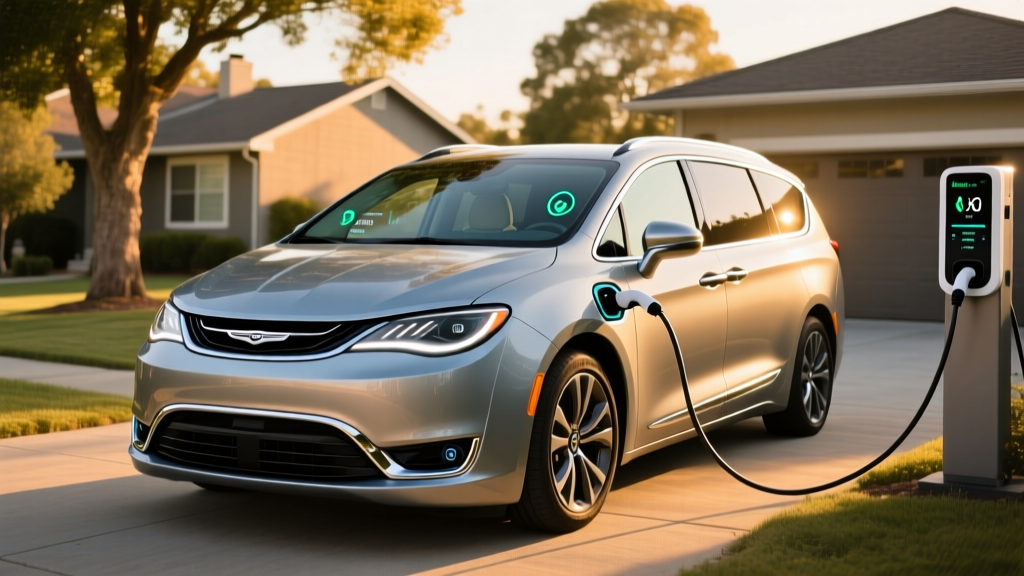
The Pacifica Hybrid charges through a J1772 port (standard for non-Tesla PHEVs). On a standard 120V outlet, a full charge takes roughly 14 hours — fine for overnight top-ups if you're not fully depleting the battery daily. A Level 2 home charger at 240V cuts this to about 2 hours, which means you can easily recharge during the workday or between errands.
DC fast charging is not available. This is typical for PHEVs with smaller batteries — the 16 kWh pack doesn't justify the cost and weight of DC fast-charge hardware. You won't find this at Electrify America or EVgo stations. For a PHEV, this isn't a dealbreaker; the gas engine handles long trips, and Level 2 covers daily needs.
Home charging setup cost: If you need a 240V outlet installed, expect $500-$1,500 for a licensed electrician to add a NEMA 14-50 outlet near your parking spot, depending on panel proximity and local permit requirements. A quality Level 2 EVSE (charger) runs $300-$600. Always consult a licensed electrician for final specs — panel capacity and wire gauge matter.
Pricing, Trims, and Tax Credit Eligibility
| Trim | Base MSRP (2025) | Key Features |
|---|---|---|
| Hybrid Select | ~$51,095 | Leatherette seats, 10.1" Uconnect, power sliding doors |
| Hybrid Limited | ~$54,095 | Nappa leather, hands-free sliding doors/liftgate, navigation |
| Hybrid Pinnacle | ~$57,400 | Quilted Nappa leather, built-in vacuum, premium audio |
The Pacifica Hybrid commands a significant premium over the gas-only Pacifica (which starts around $40,000). That ~$11,000 gap narrows when you factor in fuel savings and potential incentives, but it's still a real upfront hurdle.
Federal §30D Tax Credit — Current Rules (verify at irs.gov)
- Credit amount: Up to $7,500, split between critical minerals ($3,750) and battery components ($3,750)
- MSRP cap for vans/SUVs: $80,000 — all Pacifica Hybrid trims qualify on price
- Buyer income cap: AGI ≤ $150K (single), $225K (head of household), $300K (joint)
- Battery sourcing: Critical minerals and battery component requirements tighten yearly; check the latest IRS qualifying vehicle list for the Pacifica Hybrid's current eligibility status
- Point-of-sale transfer: Eligible buyers can transfer the credit to the dealer for an upfront price reduction starting 2024
Important: Battery sourcing requirements under §30D have tightened significantly. The Pacifica Hybrid's battery supply chain may or may not meet current-year critical mineral and component thresholds. Always verify on the official IRS qualifying vehicles list before assuming full $7,500 eligibility. Consult a tax professional for your specific situation.
Battery Warranty, Reliability, and Replacement Cost
| Coverage | Terms |
|---|---|
| High-Voltage Battery Warranty | 10 years / 100,000 miles (whichever comes first) |
| Capacity Retention Threshold | Warranty covers failure to hold ≥ 70% of original capacity |
| Powertrain Warranty | 5 years / 60,000 miles |
| Basic Bumper-to-Bumper | 3 years / 36,000 miles |
Stellantis backs the Pacifica Hybrid's 16 kWh battery with a 10-year/100,000-mile warranty, which is the industry standard for PHEV and EV batteries. The warranty triggers if capacity drops below 70% — in practice, most PHEV batteries degrade slowly, losing roughly 1-2% capacity per year under normal use. At year 10, you might see 80-85% of original capacity, which still delivers ~25-27 miles of electric range.
Reliability track record: The Pacifica Hybrid has had a mixed reliability history. Early model years (2017-2019) saw recalls related to the high-voltage battery shutdown risk. Stellantis issued software updates and, in some cases, battery replacements under recall. The 2025 model benefits from years of powertrain refinement, but the Pacifica line overall scores average to slightly below average in long-term reliability surveys from sources like Consumer Reports. The gas-only Pacifica shares this reputation — it's a complex vehicle with many electronic and mechanical systems.
Battery replacement cost: If you need a replacement high-voltage battery outside warranty, expect a dealer quote in the range of $7,000-$9,000 including labor. This is a worst-case scenario that relatively few owners face, but it's a number worth knowing when evaluating long-term ownership. Third-party hybrid battery refurbishers may offer lower-cost options as the vehicle ages.
Who Should Choose the Pacifica Hybrid vs. a Full EV or Gas Minivan?
Choose the Pacifica Hybrid If:
- You have home charging (garage or driveway with 120V/240V access)
- Your daily driving is under 30 miles round-trip (school, work, errands)
- You need three rows and sliding doors but want lower fuel costs
- You take road trips 4+ times per year and don't want to plan around DC chargers
- You want to reduce emissions without committing to a full EV
Choose a Gas-Only Minivan (or HEV like Sienna) If:
- You cannot charge at home or work
- Your daily commute exceeds 50+ miles (the electric advantage shrinks)
- You need all-wheel drive (Pacifica Hybrid is FWD only)
- Upfront budget is tight and the ~$11K PHEV premium doesn't pencil out
- You want simpler long-term maintenance with fewer hybrid-specific components
Choose a Full EV (e.g., Kia EV9, Tesla Model X) If:
- Your daily driving is under 250 miles and you have reliable home + public charging
- You want zero tailpipe emissions and minimal maintenance (no oil changes, no gas engine)
- You're comfortable planning road trips around DC fast-charging networks
- You want the lowest per-mile fuel cost (electricity at $0.14/kWh ≈ $0.04/mi vs. gas at $3.50/gal ≈ $0.12/mi)
Pros
- Only plug-in hybrid minivan on the market — no direct competitor
- 32 miles electric covers most family daily driving
- 520-mile total range eliminates road-trip range anxiety
- Stow 'n Go second-row seating (battery doesn't compromise cargo floor)
- 260 hp combined is genuinely quick for a minivan
- 10-year/100K-mile battery warranty
Cons
- FWD only — no AWD option unlike gas Pacifica or Sienna
- No DC fast charging
- ~$51K starting price is steep for a minivan
- Tax credit eligibility uncertain under current §30D sourcing rules
- Average reliability ratings for the Pacifica line
- Gas-only MPG (30 combined) trails Sienna Hybrid (36 combined)
Frequently Asked Questions
How many MPG does the 2025 Chrysler Pacifica Hybrid get?
On electricity alone, it earns an EPA-estimated 82 MPGe combined. Once the battery depletes, the gas engine operates as a hybrid returning 29 city / 30 highway / 30 combined MPG. Real-world city driving often yields 31-33 MPG thanks to regenerative braking, while sustained highway speeds drop it to 27-29 MPG.
How far can the Pacifica Hybrid go on electric only?
The EPA rates it at 32 miles electric-only. Real-world conditions typically yield 26-30 miles in moderate weather, dropping to 20-24 miles in cold weather or at sustained highway speeds. For most family commutes under 30 miles round-trip, you'll run on electricity most days if you charge nightly.
Does the 2025 Pacifica Hybrid qualify for the federal tax credit?
It may qualify for up to $7,500 under IRS §30D, but eligibility depends on current-year battery sourcing requirements (critical minerals and component manufacturing), buyer income limits, and the $80,000 MSRP cap for vans. All trims clear the MSRP cap, but battery sourcing compliance changes as rules tighten. Always check the IRS qualifying vehicle list before purchasing and consult a tax professional.
Is the Pacifica Hybrid reliable, and what does a battery replacement cost?
The Pacifica Hybrid has average reliability ratings, with early model years (2017-2019) affected by battery-related recalls that have since been addressed. The 16 kWh battery is warranted for 10 years/100,000 miles with a 70% capacity retention threshold. Out-of-warranty replacement runs approximately $7,000-$9,000 at a dealer, though most owners never face this cost within typical ownership periods.
Can the Pacifica Hybrid DC fast charge?
No. Like most PHEVs with smaller batteries, the Pacifica Hybrid supports Level 1 (120V, ~14 hours) and Level 2 (240V, ~2 hours) charging only, via a J1772 connector. DC fast charging is not available. For a PHEV, this is standard — the gas engine handles long trips, and Level 2 covers daily recharging needs.
Hybrid vs PHEV vs EV — which is right for my family?
If you can charge at home and drive under 30 miles daily, the Pacifica PHEV gives you EV-like commuting with gas-engine flexibility for road trips. A conventional hybrid (like the Sienna) is better if you can't plug in. A full EV (like the Kia EV9) makes sense if you want maximum fuel savings, zero tailpipe emissions, and are comfortable with DC fast-charging on road trips. The PHEV is the bridge option — ideal for households transitioning to electric but not ready to go all-in.
Does the Pacifica Hybrid have all-wheel drive?
No. The Pacifica Hybrid is front-wheel drive only. The gas-only Pacifica offers available AWD, but the PHEV powertrain does not support it. If AWD is essential for your climate, you'll need to look at the gas Pacifica AWD, the Toyota Sienna (which offers AWD on HEV trims), or a full EV with dual motors.