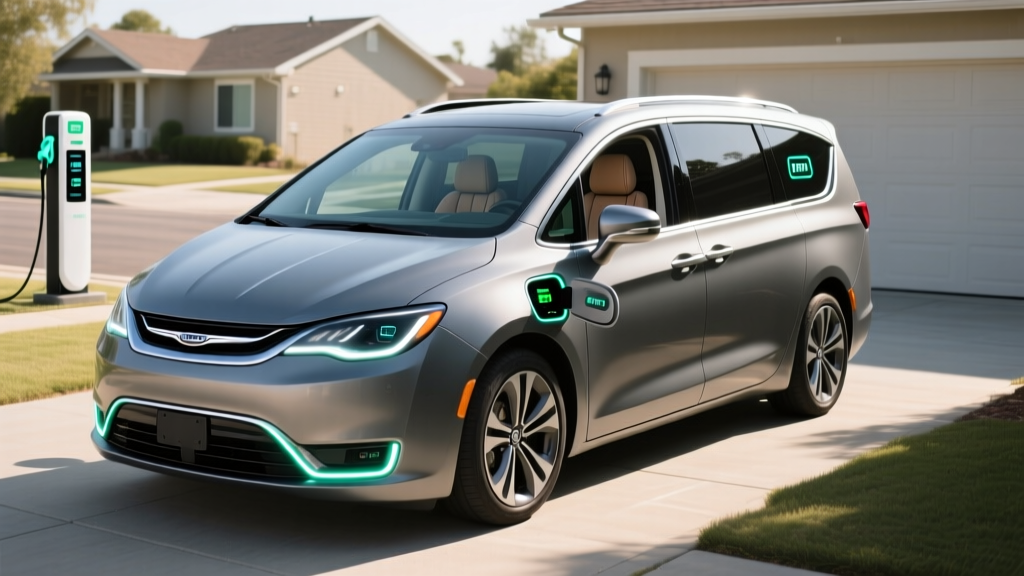
The Chrysler Pacifica Hybrid remains the only plug-in hybrid minivan on the US market, and for 2026 it continues to occupy a unique niche: a family hauler that can do school runs on electricity and cross-country road trips on gasoline. If you've been searching for a Chrysler Hybrid Pacifica, you're likely weighing whether a PHEV minivan makes more sense than a full EV SUV or a conventional hybrid. This guide breaks down every number that matters — from EPA range and MPGe to real-world efficiency, charging logistics, and federal tax credit eligibility under current IRS §30D rules.
HEV vs PHEV: Why the Pacifica Hybrid Is a Plug-In
Before diving into specs, it's worth clarifying what the Pacifica Hybrid actually is. Chrysler does not offer a conventional hybrid (HEV) Pacifica — the hybrid variant is exclusively a plug-in hybrid electric vehicle (PHEV). That distinction matters for your daily routine and your wallet.
| Feature | HEV (e.g., Toyota Sienna) | PHEV (Chrysler Pacifica Hybrid) |
|---|---|---|
| Plug in to charge? | No — regenerates via braking & engine | Yes — plug in for electric-only miles |
| Electric-only range | ~1 mile at low speed | 32 miles (EPA) |
| Battery size | ~1.6 kWh (small buffer) | 16 kWh usable |
| Fuel economy (gas mode) | 36 MPG combined | 30 MPG combined |
| Tax credit eligible? | No | Potentially up to $7,500 (§30D) |
The trade-off is straightforward: the Pacifica Hybrid's larger battery and plug-in capability give you meaningful electric-only driving, but the added weight of that battery reduces fuel economy when the gasoline engine takes over compared to a lighter conventional hybrid like the Toyota Sienna.
EPA Range, MPGe, and MPG: The Numbers That Matter
The Pacifica Hybrid carries two efficiency ratings depending on whether you're driving on electricity or gasoline. Understanding both is essential for estimating your real fuel costs.
| Metric | City | Highway | Combined |
|---|---|---|---|
| Electric mode (MPGe) | 84 MPGe | 80 MPGe | 82 MPGe |
| Gas-only mode (MPG) | 29 MPG | 30 MPG | 30 MPG |
Real-World MPG vs EPA: What Owners Actually See
PHEVs are uniquely sensitive to how often you charge. If you plug in nightly and your daily driving stays under 30 miles, you may use almost no gasoline for weeks. Chrysler Pacifica Hybrid owners on fueleconomy.gov report a wide spread:
- Frequent chargers (daily plug-in, short commutes): 60–100+ MPG equivalent in practice, with gas fill-ups once a month or less.
- Infrequent chargers (rarely plug in, mostly highway): 26–30 MPG — essentially driving a heavy minivan with a dead battery, which hurts efficiency.
- Highway road trips (battery depleted): 27–30 MPG at 70 mph, consistent with EPA highway estimates. The Pacifica Hybrid does not benefit from the city-boosting regenerative braking advantage that smaller hybrids show.
The bottom line: the Pacifica Hybrid's 30 MPG combined gas rating trails the Toyota Sienna hybrid's 36 MPG because the Pacifica carries roughly 600 extra pounds of battery and electric drivetrain. If you never plan to plug in, a conventional hybrid minivan is the more efficient choice.
Powertrain and Performance Specs
| Powertrain | 3.6L V6 Atkinson-cycle + 2 electric motors (eFlite CVT) |
| Combined horsepower | 260 hp |
| Gas engine output | 262 lb-ft torque |
| Battery (usable) | 16 kWh lithium-ion (NMC chemistry) |
| Electric-only range | 32 miles (EPA) |
| Total range | ~520 miles |
| Fuel tank | 16.5 gallons |
| 0–60 mph | ~7.1 seconds |
| Drivetrain | Front-wheel drive (FWD only) |
| Towing capacity | Not rated for towing (PHEV variant) |
| Cargo (behind 3rd row) | 32.3 cu ft |
| Cargo (max, seats folded) | 140.5 cu ft |
The dual-motor eFlite continuously variable transmission is a clever piece of engineering: one motor primarily drives the wheels while the other can generate electricity or assist propulsion. The system seamlessly blends electric and gas power without the rubber-band feel that older CVTs produced. Acceleration from a stop is brisk thanks to instant electric torque — the Pacifica Hybrid pulls away from stoplights with more urgency than its 260 hp figure suggests.
One important limitation: the Pacifica Hybrid is front-wheel drive only. Chrysler reserves all-wheel drive for the gas-only Pacifica trims. If AWD is a dealbreaker for snow-belt driving, you'll need to look at the gas Pacifica AWD or the Toyota Sienna AWD hybrid.
Charging the Pacifica Hybrid: Times, Levels, and Logistics
The Pacifica Hybrid's 16 kWh battery is small by full-EV standards, which makes charging straightforward — but there are some specifics you need to know.
| Level | Power | 0–100% Time | Where |
|---|---|---|---|
| Level 1 (120V household) | ~1.4 kW | ~14 hours | Standard outlet |
| Level 2 (240V) | ~6.6 kW (onboard charger max) | ~2 hours | Home wallbox or public L2 |
| DC Fast Charging | Not supported | N/A | N/A |
Critical detail: The Pacifica Hybrid cannot DC fast charge. It uses a J1772 connector for Level 1 and Level 2 AC charging only. The onboard charger caps at 6.6 kW, so even if you plug into a 48-amp Level 2 station capable of 11.5 kW, the Pacifica will only draw 6.6 kW.
For most PHEV owners, this isn't a practical problem. You plug in at home overnight, and 2 hours on Level 2 is more than enough to refill the battery before morning. A standard 120V outlet works too, but a full Level 1 charge takes roughly 14 hours — feasible only if the van sits unused for long stretches.
Home Charging Setup for the Pacifica Hybrid
Because the onboard charger maxes at 6.6 kW, you don't need the most expensive Level 2 home charger on the market. A 32-amp (7.7 kW capable) Level 2 unit on a 240V/40A circuit is more than sufficient and typically costs $300–$500 for the equipment. Professional installation by a licensed electrician runs $500–$1,500 depending on your panel capacity and run distance. Total home charging setup: roughly $800–$2,000.
Charging cost per full battery (16 kWh at the US average residential rate of ~$0.16/kWh): approximately $2.56 for 32 miles of electric driving, or about $0.08 per mile — roughly one-third the per-mile cost of gasoline at $3.50/gallon and 30 MPG.
Pricing, Trims, and Federal Tax Credit Eligibility
The 2026 Chrysler Pacifica Hybrid starts at an MSRP of approximately $51,095 (Select trim, including destination). Higher trims like the Pinnacle Hybrid push past $57,000. There is no entry-level budget trim for the PHEV — the hybrid powertrain is reserved for mid-to-upper Pacifica configurations.
Does the Chrysler Pacifica Hybrid Qualify for the Federal Tax Credit?
Under the IRS §30D Clean Vehicle Credit rules in effect for 2026, the Pacifica Hybrid may qualify for up to $7,500, but eligibility is not guaranteed and depends on several factors that change frequently:
- MSRP cap: Vans/minivans must have an MSRP at or below $80,000. The Pacifica Hybrid clears this easily.
- Buyer income cap: Modified adjusted gross income must not exceed $150,000 (single), $225,000 (head of household), or $300,000 (joint filers).
- Battery component sourcing: A percentage of battery components must be manufactured or assembled in North America, and critical minerals must meet sourcing thresholds. These thresholds tighten annually. Chrysler has historically met partial or full credit requirements for the Pacifica Hybrid, but you must verify current-year status.
- Point-of-sale transfer: As of 2024, buyers can transfer the credit to the dealer at purchase, reducing the vehicle's purchase price directly rather than waiting for a tax refund. This requires dealer participation.
Check the latest eligibility on the official IRS Clean Vehicle Credit page and confirm the specific VIN with your dealer before purchase. Battery sourcing requirements have disqualified several PHEVs in recent years — don't assume eligibility.
Battery Warranty, Reliability, and Replacement Cost
Is the Chrysler Hybrid Pacifica Reliable?
The Pacifica Hybrid's reliability record has been mixed across model years. Early 2017–2019 models experienced battery recall campaigns related to potential fire risk when the battery was fully charged — Chrysler issued software updates and, in some cases, battery replacements under recall. The 2021 refresh addressed many of these issues with updated battery management software and revised cell packaging.
For the 2024–2026 model years, owner-reported reliability has improved, though the Pacifica Hybrid still trails the Toyota Sienna hybrid in long-term dependability surveys. The complexity of the PHEV system — combining a V6 engine, two electric motors, a CVT, and a high-voltage battery — means more potential failure points than a conventional hybrid or a pure EV.
Battery Replacement Cost
If the high-voltage battery fails outside of warranty coverage, replacement cost is the top concern for PHEV buyers. Based on current dealer parts pricing and labor:
- Battery pack (parts): $7,000–$9,500
- Labor: $1,000–$2,000
- Total out-of-warranty replacement: $8,000–$11,500
In practice, PHEV batteries rarely fail catastrophically. Gradual degradation (loss of 10–20% capacity over 100,000+ miles) is more typical, meaning your 32-mile electric range might shrink to 26–28 miles after several years. The 10-year/100,000-mile warranty should cover premature degradation below Chrysler's threshold. For peace of mind, buying certified pre-owned or extending the powertrain warranty is worth considering.
Who Should Buy the Chrysler Hybrid Pacifica — and Who Shouldn't
Pros
- 32 miles electric-only covers most daily family driving
- Only PHEV minivan available in the US market
- Stow 'n Go second-row seating (unique to Pacifica Hybrid)
- 520-mile total range eliminates road-trip range anxiety
- Smooth, quiet electric driving around town
- Eligible for potential $7,500 federal tax credit
Cons
- 30 MPG gas-only lags Toyota Sienna hybrid (36 MPG)
- FWD only — no AWD option on the PHEV
- No DC fast charging capability
- Starts above $51,000 — expensive for a minivan
- Cannot tow (gas Pacifica can tow up to 3,600 lbs)
- Reliability history less proven than Toyota's hybrid system
Pacifica Hybrid vs Sienna Hybrid vs Full-EV SUV — Which Fits You?
Choose the Chrysler Pacifica Hybrid if: You need minivan space and sliding doors, you can charge at home nightly, your daily driving is mostly under 30 miles, and you want the option of gas-free school runs plus gas-powered road trips without range anxiety.
Choose the Toyota Sienna Hybrid if: You don't want to plug in, you prioritize maximum fuel economy (36 MPG), you need AWD, or you plan to tow. The Sienna is a conventional HEV — no plug, no electric-only range, but consistently excellent MPG.
Choose a full-EV three-row SUV (Kia EV9, Tesla Model X) if: You want zero gasoline, can install Level 2 home charging, mostly drive under 250 miles per trip, and want lower running costs long-term. Trade-offs include higher upfront price, charging logistics on road trips, and less cargo versatility than a minivan.
Frequently Asked Questions
How many MPG does the Chrysler Pacifica Hybrid get?
The EPA rates the Pacifica Hybrid at 29 MPG city, 30 MPG highway, and 30 MPG combined when running on gasoline. In electric mode, it achieves 82 MPGe combined. Real-world gas MPG typically falls between 27–30 MPG depending on driving style and conditions.
How far can the Pacifica Hybrid go on electric only?
The EPA-rated electric-only range is 32 miles on a full charge. Real-world range is typically 28–32 miles in moderate weather and 22–26 miles in cold conditions with cabin heat running. After the battery depletes, the gasoline engine engages seamlessly for unlimited range up to the 520-mile total.
Does the Chrysler Pacifica Hybrid qualify for a tax credit?
It may qualify for up to $7,500 under the IRS §30D Clean Vehicle Credit, subject to buyer income limits ($150K single / $300K joint), MSRP caps (under $80K for vans), and battery component/critical mineral sourcing requirements that change annually. Verify current eligibility on irs.gov and confirm with your dealer before purchase.
Is the Chrysler Pacifica Hybrid reliable?
Reliability has improved since the 2021 refresh, though it still trails the Toyota Sienna hybrid in long-term dependability data. Early model years (2017–2019) had battery recall campaigns. The 10-year/100,000-mile battery warranty provides coverage against premature failure. Expect the PHEV system to require more maintenance attention than a conventional hybrid due to its dual-powertrain complexity.
What does a Pacifica Hybrid battery replacement cost?
An out-of-warranty high-voltage battery replacement runs approximately $8,000–$11,500 (parts and labor). However, most PHEV batteries experience gradual degradation rather than sudden failure, and the 10-year/100,000-mile warranty covers capacity loss below the manufacturer's threshold. Many owners never need a full battery replacement during typical ownership.
Can the Pacifica Hybrid charge at a DC fast charger?
No. The Pacifica Hybrid supports only AC charging via a J1772 connector — Level 1 (120V, ~14 hours) and Level 2 (240V, ~2 hours at 6.6 kW). It cannot use CCS, NACS, or CHAdeMO DC fast chargers. For a PHEV with a 16 kWh battery, overnight Level 2 home charging is the practical standard.
Does the Pacifica Hybrid have all-wheel drive?
No. The Pacifica Hybrid is front-wheel drive only. Chrysler offers AWD on gas-only Pacifica trims but not on the PHEV variant. If AWD is essential, consider the gas Pacifica AWD or the Toyota Sienna hybrid, which offers AWD across all trims.
Sources: EPA fuel economy data via fueleconomy.gov, Chrysler official specifications, IRS §30D Clean Vehicle Credit guidelines at irs.gov. All specifications reflect 2025–2026 model year data available at time of publication. Tax credit eligibility is subject to change — verify with the IRS and your dealer.