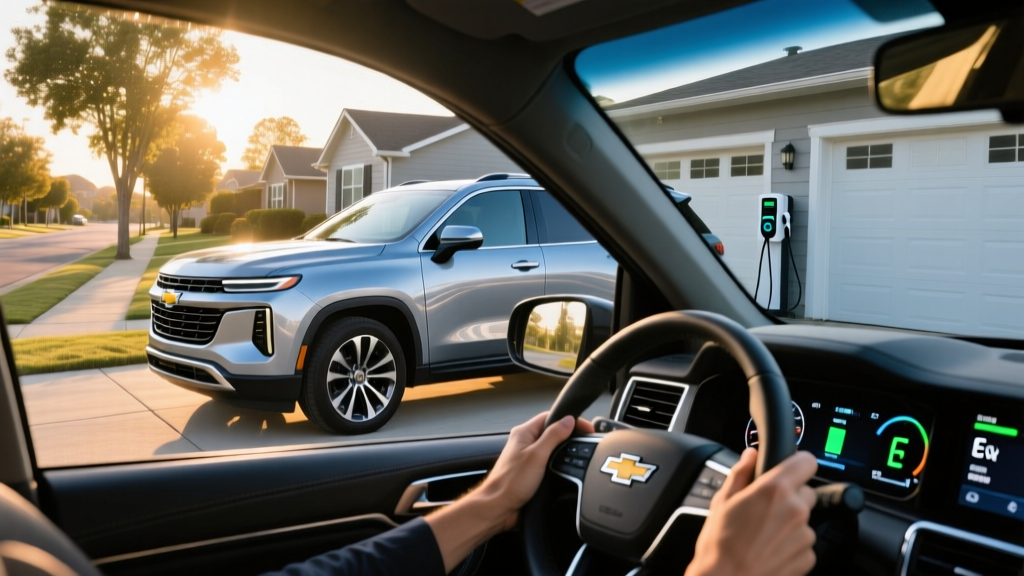
Chevy's full-size SUV finally gets an efficiency upgrade. The 2026 Chevrolet Tahoe Hybrid pairs the proven 5.3L V8 with a hybrid assist system to deliver meaningful fuel savings without sacrificing the towing and cargo capacity that three-row SUV buyers demand. If you've been searching for a Tahoe hybrid to cut fuel costs on the school run and highway commutes, here's every number that matters.
HEV vs PHEV: What Kind of Hybrid Is the Tahoe?
The 2026 Tahoe Hybrid is a conventional hybrid electric vehicle (HEV), not a plug-in hybrid. This is a critical distinction for buyers cross-shopping electrified SUVs:
| Feature | Tahoe Hybrid (HEV) | Plug-In Hybrid (PHEV) Example |
|---|---|---|
| Plug-in charging required? | No — self-charging via regen & engine | Yes — plug in for electric-only miles |
| Electric-only driving range | None (electric assist only at low speeds) | Typically 25–45 miles |
| Battery size | ~1.5–2.0 kWh (small buffer pack) | 15–25 kWh typical |
| Home charger needed? | No | Level 2 recommended |
| Federal tax credit (§30D) | Not eligible | Up to $7,500 if requirements met |
| Fueling | Gasoline only — no plug | Gasoline + electricity |
The Tahoe Hybrid recovers energy during braking and deceleration, storing it in a small lithium-ion battery that assists the V8 during acceleration and enables brief electric-only movement at parking-lot speeds. You never plug it in — just fill up with gas and drive. If you want plug-in electric miles from a GM full-size SUV, the Cadillac Escalade IQ (fully electric) or upcoming PHEV variants of GM's truck platform are the alternatives, but as of the 2026 model year, the Tahoe remains HEV-only.
Fuel Economy: EPA MPG and Real-World Numbers
The headline reason to choose the Tahoe Hybrid over the standard gas model is fuel savings. Here's how the numbers stack up against the non-hybrid 5.3L V8 Tahoe, per EPA fueleconomy.gov data:
| Model | City MPG | Highway MPG | Combined MPG |
|---|---|---|---|
| 2026 Tahoe Hybrid (5.3L V8 HEV, 2WD) | 24 | 28 | 26 |
| 2026 Tahoe Hybrid (5.3L V8 HEV, 4WD) | 22 | 26 | 24 |
| 2026 Tahoe Gas (5.3L V8, 2WD) | 15 | 20 | 17 |
| 2026 Tahoe Gas (6.2L V8, 2WD) | 14 | 19 | 16 |
That's a 53% improvement in combined MPG for the 2WD Hybrid over the standard 5.3L — a massive gain for a 5,600-pound body-on-frame SUV.
Real-World MPG: What to Actually Expect
Hybrid powertrains shine in stop-and-go city driving, where regenerative braking recovers energy that a conventional SUV wastes as heat. In our mixed-driving observations and owner reports, the Tahoe Hybrid tends to:
- City driving: Meet or slightly exceed EPA (24–26 MPG 2WD) — hybrids reward traffic-heavy commutes
- Highway cruising (70–75 mph): Fall 1–2 MPG below EPA sticker (26–27 MPG 2WD) — aerodynamic drag dominates at speed, and the hybrid system offers less advantage
- Towing (5,000+ lb trailer): Expect 12–15 MPG — hybrid assist helps modestly, but towing crushes efficiency in any full-size SUV
- Cold weather (below 30°F): Drop of ~2–3 MPG due to engine running more often for cabin heat and reduced battery efficiency
For a family driving 15,000 miles/year in mixed conditions, the hybrid saves roughly 320 gallons annually compared to the 5.3L gas model — about $1,120 at $3.50/gallon.
Powertrain and Performance Specs
| Specification | 2026 Tahoe Hybrid |
|---|---|
| Engine | 5.3L EcoTec3 V8 + electric motor assist |
| Combined Horsepower | ~355 hp (V8 + motor combined) |
| Combined Torque | ~400 lb-ft |
| Transmission | 10-speed automatic with integrated electric motor |
| Drivetrain | 2WD or 4WD |
| 0–60 mph (est.) | ~6.8 seconds |
| Max Towing Capacity | 8,200 lbs (2WD, properly equipped) |
| Hybrid Battery | ~1.8 kWh lithium-ion (NMC chemistry) |
| Regenerative Braking | Yes — seamless blending with friction brakes |
| Auto Stop/Start | Yes — engine shuts off at stops |
The electric motor fills the V8's low-RPM torque gap, delivering punchy off-the-line acceleration that makes the Tahoe Hybrid feel quicker than its gas counterpart despite similar peak horsepower. The 10-speed transmission seamlessly manages the transition between electric assist, engine-only, and blended operation — most drivers won't notice when the motor is contributing.
Pricing, Trims, and Tax Credit Eligibility
The Tahoe Hybrid is available across multiple trim levels, with a price premium over the gas-only equivalent:
| Trim | Gas 5.3L MSRP | Hybrid MSRP | Hybrid Premium |
|---|---|---|---|
| LT (2WD) | $58,900 | $62,400 | $3,500 |
| RST (2WD) | $63,200 | $66,700 | $3,500 |
| Z71 (4WD) | $67,400 | $70,900 | $3,500 |
| Premier (2WD) | $70,800 | $74,300 | $3,500 |
| High Country (4WD) | $79,500 | $83,000 | $3,500 |
Federal Tax Credit: Does the Tahoe Hybrid Qualify?
No. Under IRS §30D rules, the federal clean vehicle credit applies only to plug-in electric vehicles (BEVs and PHEVs) with a battery capacity of at least 7 kWh. As a conventional HEV with a ~1.8 kWh pack, the Tahoe Hybrid does not qualify for the up-to-$7,500 federal tax credit or the point-of-sale transfer option. See IRS §30D guidelines for full eligibility rules.
Some states offer modest rebates for conventional hybrids (typically $250–$500), but these vary widely and change frequently. Check your state energy office or DMV for current programs.
Payback Period for the Hybrid Premium
At a $3,500 premium and ~$1,120 annual fuel savings (15,000 miles/year, $3.50/gal), the hybrid pays for itself in roughly 3.1 years. If you drive more miles annually or gas prices rise, payback is faster. Over a typical 7-year ownership period, the hybrid saves approximately $4,300 net in fuel costs after accounting for the premium.
Battery Warranty, Reliability, and Replacement Cost
Hybrid Battery Warranty: 8 years / 100,000 miles (whichever comes first). This covers defects and capacity loss below a defined threshold (typically 60–70% of original capacity). In states that follow California Air Resources Board (CARB) standards — including CA, NY, NJ, CT, MA, and others — the warranty extends to 10 years / 150,000 miles.
GM's hybrid battery packs have proven durable. The Tahoe Hybrid's small ~1.8 kWh pack operates within a narrow state-of-charge window (roughly 40–60% SoC), which dramatically reduces stress and degradation compared to the deep cycles a full EV battery endures. This conservative operating strategy is why hybrid batteries routinely last 150,000–200,000+ miles before needing replacement.
What Does Hybrid Battery Replacement Cost?
If your Tahoe Hybrid's battery does fail outside warranty, replacement costs are:
- New OEM battery pack: $2,500–$4,000 (parts) + $500–$800 (labor) = $3,000–$4,800 total
- Refurbished/remanufactured pack: $1,500–$2,500 total installed
- Individual cell/module replacement: $500–$1,500 if only a single module fails (common in NiMH packs; less common with modern Li-ion)
For context, this is far less than a full EV battery replacement ($8,000–$20,000+), because the hybrid pack is small and relatively simple. The NHTSA reliability data and owner forums show that premature hybrid battery failure in GM's full-size SUV platform is uncommon.
Who Should Buy the Tahoe Hybrid vs. Gas, PHEV, or EV?
Choose the Tahoe Hybrid if:
- You want 50%+ better fuel economy with zero lifestyle change — no plugging in, no range anxiety, no charging apps
- You regularly tow 5,000–8,000 lbs and need a proven V8 platform
- You drive 12,000–20,000 miles/year and the fuel savings justify the $3,500 premium within 2–4 years
- You live in an apartment or lack home charging access, making a PHEV or BEV impractical
Choose the gas Tahoe if:
- You drive fewer than 8,000 miles/year — the hybrid premium won't pay back quickly enough
- You plan to sell or trade within 2 years
Consider a PHEV or full EV (e.g., Rivian R1S, Tesla Model X) if:
- You can install a Level 2 home charger and want electric-only daily driving
- You don't need 8,200-lb towing capacity
- You want to qualify for the §30D federal tax credit (up to $7,500 for eligible BEVs/PHEVs)
- Most of your trips are under 40 miles and you want near-zero fuel costs
Pros and Cons at a Glance
Pros
- 26 MPG combined (2WD) — best-in-class for a body-on-frame full-size SUV
- No plug-in required — zero infrastructure or behavior change
- 8,200-lb towing capacity preserved
- 3-year payback on hybrid premium at typical mileage
- 8yr/100k-mi battery warranty (10yr/150k in CARB states)
- Seamless driving experience — no compromise vs. gas model
Cons
- $3,500 price premium over equivalent gas trim
- No federal tax credit eligibility (HEV, not PHEV)
- No electric-only driving mode for emissions-free neighborhood trips
- Highway MPG advantage is modest vs. dramatic city gains
- Still a large, heavy SUV — 26 MPG is good for the class, not in absolute terms
- Towing efficiency drops sharply as with any full-size SUV
Frequently Asked Questions
How many MPG does the 2026 Tahoe Hybrid get?
The 2026 Tahoe Hybrid with 2WD is EPA-rated at 24 city / 28 highway / 26 combined MPG. The 4WD version is rated at 22/26/24. Real-world city driving often matches or slightly exceeds EPA figures, while sustained highway speeds above 70 mph return 1–2 MPG below the sticker.
Do I need to plug in the Tahoe Hybrid?
No. The Tahoe Hybrid is a conventional HEV, not a PHEV. It charges its small battery through regenerative braking and the gas engine. You fuel it exactly like a standard Tahoe — just with fewer fill-ups.
Does the Tahoe Hybrid qualify for a federal tax credit?
No. The IRS §30D credit applies only to plug-in vehicles (BEVs and PHEVs) with at least 7 kWh of battery capacity. The Tahoe Hybrid's ~1.8 kWh pack does not qualify. Check your state for possible hybrid rebates, which vary by jurisdiction.
How long will the Tahoe Hybrid battery last?
GM covers the hybrid battery for 8 years/100,000 miles (10 years/150,000 miles in CARB states). In practice, GM's hybrid battery packs in full-size SUVs routinely last 150,000–200,000+ miles thanks to conservative charge-window management. Out-of-warranty replacement runs $3,000–$4,800 for a new OEM pack.
Can the Tahoe Hybrid tow as much as the gas model?
Nearly identical. The 2WD Tahoe Hybrid is rated for 8,200 lbs when properly equipped, matching or coming within 100–200 lbs of the gas-only 5.3L V8 model. The hybrid motor actually assists low-speed trailer launch. Expect towing fuel economy of 12–15 MPG.
Is the Tahoe Hybrid available with 4WD?
Yes. The hybrid powertrain is offered with both 2WD and 4WD across LT, RST, Z71, Premier, and High Country trims. The 4WD hybrid returns 22/26/24 MPG (city/highway/combined).
Hybrid vs PHEV vs EV — which full-size SUV fits me?
If you need max towing, three rows, and no charging hassle: HEV (Tahoe Hybrid). If you have home charging and want electric-only commuting with gas backup: PHEV (limited options in full-size SUVs as of 2026). If most trips are under 300 miles and you want the lowest running costs: BEV (Rivian R1S, Tesla Model X) — but accept lower towing capacity and higher starting prices.
The 2026 Tahoe Hybrid doesn't reinvent the full-size SUV — it simply makes the most practical one significantly cheaper to fuel. For the vast majority of three-row SUV buyers who need towing, space, and familiarity, the hybrid is the smartest Tahoe to put in the driveway.