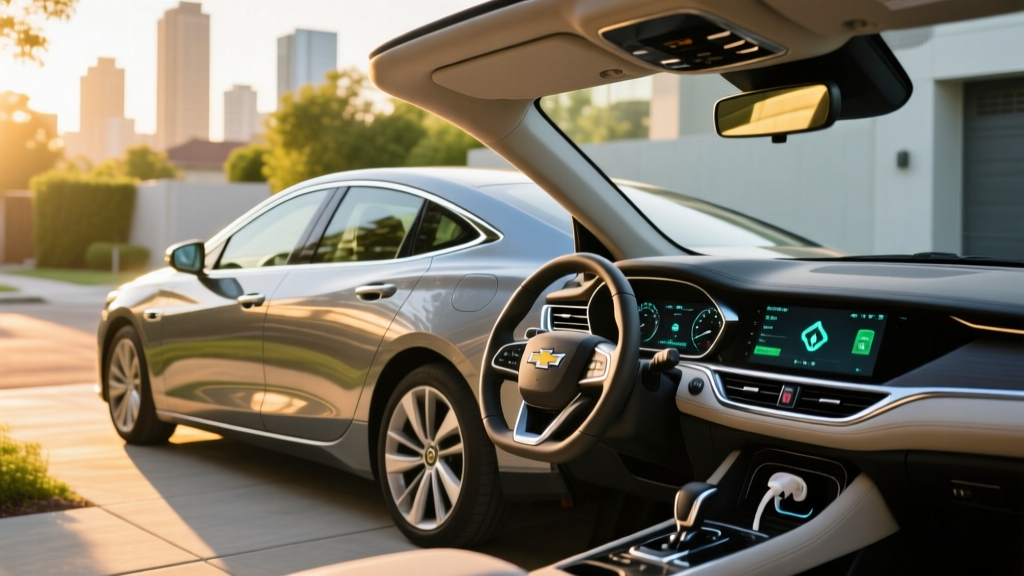
Chevrolet discontinued the Malibu nameplate after the 2024 model year as GM pivoted its sedan lineup toward electrification and crossovers. For shoppers searching for a Malibu Hybrid in 2026, the reality is that no new model exists — and no plug-in hybrid variant was ever produced for the U.S. market. But the used and certified pre-owned market still holds well-equipped Malibu Hybrid sedans from the 2016–2024 generation, and they remain compelling midsize commuters. This guide covers everything you need to know about buying a Malibu Hybrid today, plus what Chevrolet offers as alternatives if you want a new electrified sedan.
What the Malibu Hybrid Actually Is (HEV, Not PHEV)
The Chevrolet Malibu Hybrid is a conventional hybrid electric vehicle (HEV). It pairs a gasoline engine with an electric motor and a small battery pack that recharges through regenerative braking and engine operation. You never plug it in — the car manages energy flow automatically.
HEV vs. PHEV — Quick Distinction
Malibu Hybrid (HEV): No plug. ~1.5 kWh battery. Electric motor assists the gas engine at low speeds and during acceleration. You fuel it like a normal car and get better MPG.
Plug-in Hybrid (PHEV): Has a plug and a larger battery (typically 12–20 kWh). Offers 20–45 miles of electric-only driving before the gas engine kicks in. Examples: Toyota RAV4 Prime, Chrysler Pacifica Hybrid.
Chevrolet never offered a Malibu PHEV in the United States.
If you want plug-in capability from GM, you'd need to look at a different nameplate entirely — or consider the Malibu Hybrid strictly as a high-MPG gas-electric sedan that requires zero behavior change from a conventional car.
Fuel Economy: EPA MPG and Real-World Results
The Malibu Hybrid's headline number is its fuel efficiency. Across the 2016–2024 generation, EPA ratings stayed remarkably consistent. Here's what fueleconomy.gov reports for the most common model years:
| Model Year | City MPG | Highway MPG | Combined MPG |
|---|---|---|---|
| 2016–2019 Malibu Hybrid | 49 | 43 | 46 |
| 2020–2024 Malibu Hybrid (if equipped) | 47 | 42 | 44 |
Real-World MPG vs. EPA Sticker
In mixed suburban and city driving, many Malibu Hybrid owners report exceeding the EPA combined rating — frequently hitting 48–52 MPG in stop-and-go traffic where regenerative braking and electric-motor assist do the most work. Highway-only trips at 75+ mph tend to drop to 38–41 MPG, since the electric motor contributes less at sustained high speeds. Cold weather (below 30°F) typically knocks 3–5 MPG off combined figures due to reduced battery efficiency and increased engine warm-up time.
For context, a comparable gas-only midsize sedan averages 28–32 MPG combined. The Malibu Hybrid cuts fuel consumption roughly in half on city-heavy commutes.
Powertrain and Performance Specs
The Malibu Hybrid uses GM's Voltec-derived hybrid system — a setup that shares engineering DNA with the (now-discontinued) Chevy Volt, adapted for a non-plug-in application.
| Specification | Detail |
|---|---|
| Engine | 1.8L 4-cylinder direct-injection (122 hp) |
| Electric Motors | Two-motor drive unit (combined motor output ~114 hp) |
| Combined System Output | 182 hp |
| Hybrid Battery | 1.5 kWh lithium-ion (air-cooled) |
| Transmission | Continuously variable (eCVT, planetary gearset) |
| 0–60 mph | ~7.5 seconds |
| Drivetrain | Front-wheel drive |
| Regenerative Braking | Yes — blended with friction brakes, no one-pedal mode |
The dual-motor setup gives the Malibu Hybrid surprisingly smooth off-the-line acceleration — the electric motors provide instant torque before the gas engine spools up. At highway speeds, the system seamlessly blends engine and electric power. The eCVT avoids the rubber-band feeling common in older Toyota hybrids, thanks to GM's planetary gearset design that can mechanically lock at certain ratios for improved highway efficiency.
Battery Warranty, Lifespan, and Replacement Cost
Hybrid Battery Coverage
Original warranty: 8 years / 100,000 miles (whichever comes first) on the hybrid battery and all hybrid-specific components, per GM's standard powertrain coverage. In California Air Resources Board (CARB) states, emissions-related hybrid components may carry coverage up to 10 years / 150,000 miles.
Expected lifespan: The 1.5 kWh lithium-ion pack in the Malibu Hybrid is relatively small and operates within a conservative state-of-charge window (never fully depleted or fully charged). This shallow-cycling strategy dramatically extends cycle life. Most Malibu Hybrid batteries show minimal capacity loss at 100,000+ miles.
Replacement cost (if needed out of warranty): A new OEM hybrid battery for the Malibu Hybrid runs approximately $2,500–$3,800 including labor at a dealer. Independent hybrid specialists often offer refurbished packs for $1,500–$2,200. This is far less than a full EV battery replacement.
For buyers considering a used Malibu Hybrid, the key check is battery state of health. A pre-purchase inspection at a dealer can pull hybrid battery diagnostic codes and confirm the cells are balanced and within spec. If the vehicle is still within the 8-year/100,000-mile window, any hybrid battery failure is covered at no cost.
Pricing and Tax Credit Eligibility
Since the Malibu Hybrid is no longer produced as a new vehicle, pricing discussion shifts to the used and certified pre-owned (CPO) market:
- Used 2019–2021 Malibu Hybrid: $16,000–$22,000 depending on mileage and condition
- Used 2022–2024 Malibu Hybrid: $22,000–$28,000 (lower supply, as GM reduced hybrid trim availability in later years)
- CPO examples: Add roughly $1,500–$2,500 over private-party used pricing; includes extended powertrain warranty
Federal Tax Credit for Used Hybrids
Under the IRS Used Clean Vehicle Credit (§25E), you may qualify for up to $4,000 (30% of sale price, capped at $4,000) on a used Malibu Hybrid if:
- The vehicle is purchased from a licensed dealer (not private party)
- Sale price is $25,000 or less
- Your modified adjusted gross income falls below the cap ($75,000 single / $150,000 married filing jointly)
- The vehicle is at least 2 model years old
- You haven't claimed this credit in the prior 3 years
This credit can be applied at the point of sale as a down-payment reduction starting in 2024. Consult a tax professional to confirm your eligibility — rules are subject to change.
The Malibu Hybrid does not qualify for the new-vehicle §30D credit (up to $7,500) since it's a conventional HEV, not a BEV or PHEV, and is no longer sold new. If you're cross-shopping a new electrified sedan, see the alternatives section below.
Malibu Hybrid vs. Alternatives: Which Electrified Sedan Fits?
If the Malibu Hybrid's used-market status or lack of plug-in capability doesn't match your needs, here's how it compares to the main alternatives in 2026:
| Vehicle | Type | Combined MPG / Range | Starting Price (2026) |
|---|---|---|---|
| Malibu Hybrid (used) | HEV | 44–46 MPG | $16K–$28K (used) |
| Toyota Camry Hybrid | HEV | 51–52 MPG | ~$30,000 (new) |
| Honda Accord Hybrid | HEV | 44–48 MPG | ~$32,000 (new) |
| Hyundai Ioniq 6 | BEV | ~360 mi EPA range | ~$38,000 |
| Toyota Prius Prime | PHEV | 44 mi EV + 52 MPG | ~$34,000 |
Decision Framework
Choose the Malibu Hybrid (used) if: You want a proven, affordable hybrid sedan with strong city MPG, don't need plug-in capability, and are comfortable buying used or CPO with remaining hybrid warranty.
Choose a new Camry or Accord Hybrid if: You want a new-vehicle warranty, the latest safety tech, and the highest available MPG in a midsize sedan — and don't want to plug in.
Choose a PHEV like the Prius Prime if: You have home charging access, a short commute (under 40 miles), and want to drive mostly on electricity while keeping a gas engine for road trips.
Choose a full EV like the Ioniq 6 if: You have reliable home Level 2 charging, want zero tailpipe emissions, and your daily driving plus typical road trips fall within DC fast-charging infrastructure coverage.
Pros and Cons of the Malibu Hybrid
✓ Pros
- Excellent city MPG (49 EPA) — real-world often higher
- Smooth, quiet hybrid powertrain with adequate power (182 hp)
- No plug-in required — zero behavior change from a gas car
- Spacious midsize cabin with large trunk (15.8 cu ft)
- Hybrid battery warranty may still apply on newer used examples
- Low used-market pricing, especially with the $4,000 used-EV credit
✗ Cons
- Discontinued — no new models available after 2024
- Never offered as a PHEV — no electric-only driving mode
- Highway MPG drops noticeably at sustained 75+ mph
- Used-market supply is limited (hybrid trim was lower volume)
- Older infotainment and ADAS tech vs. 2026 competitors
- No eligibility for the new-vehicle $7,500 §30D tax credit
Frequently Asked Questions
How many MPG does the Malibu Hybrid get?
The EPA rates the 2016–2019 Malibu Hybrid at 49 city / 43 highway / 46 combined MPG. Later model years (2020–2024) are rated at 47/42/44 MPG when the hybrid trim was available. In real-world city driving, many owners report 48–52 MPG thanks to heavy regenerative braking and electric-motor assist.
Does the Malibu Hybrid have an electric-only mode?
No. The Malibu Hybrid is a conventional HEV, not a plug-in hybrid. It can creep short distances at low speeds on electric power alone, but it has no meaningful electric-only range. If you want 30–45 miles of pure EV commuting, you need a PHEV like the Toyota Prius Prime or a full BEV.
Is the Malibu Hybrid reliable and what does battery replacement cost?
The Malibu Hybrid's powertrain has proven reliable, with the hybrid battery designed for shallow cycling that extends its lifespan well past 100,000 miles. GM covers the hybrid battery for 8 years/100,000 miles. Out-of-warranty replacement runs $2,500–$3,800 at a dealer, or $1,500–$2,200 for a refurbished pack from an independent hybrid shop.
Does the Malibu Hybrid qualify for any tax credit?
As a used vehicle, the Malibu Hybrid may qualify for the IRS §25E Used Clean Vehicle Credit — up to $4,000 or 30% of the sale price (whichever is less) — if purchased from a dealer for $25,000 or less and your income falls below the threshold. It does not qualify for the new-vehicle §30D credit since it's a conventional HEV and no longer sold new. Always verify current rules at irs.gov.
Should I buy a used Malibu Hybrid or a new Camry Hybrid?
If budget is the priority, a used Malibu Hybrid at $18,000–$24,000 (potentially $14,000–$20,000 after the used-EV credit) delivers comparable MPG to a new Camry Hybrid at nearly half the price. If you want the latest safety features (Toyota Safety Sense 3.0), a full new-vehicle warranty, and the highest EPA rating in the segment (52 MPG combined), the new Camry Hybrid is the stronger pick. Both are excellent — it comes down to whether you value cost savings or new-vehicle peace of mind.
What should I check before buying a used Malibu Hybrid?
Request a hybrid battery diagnostic report from a GM dealer to confirm cell balance and state of health. Verify the remaining hybrid warranty coverage (8 years from the original in-service date). Check for any open recalls via NHTSA's recall lookup. And as with any used car, get an independent pre-purchase inspection and review the vehicle history report for accident or flood damage.