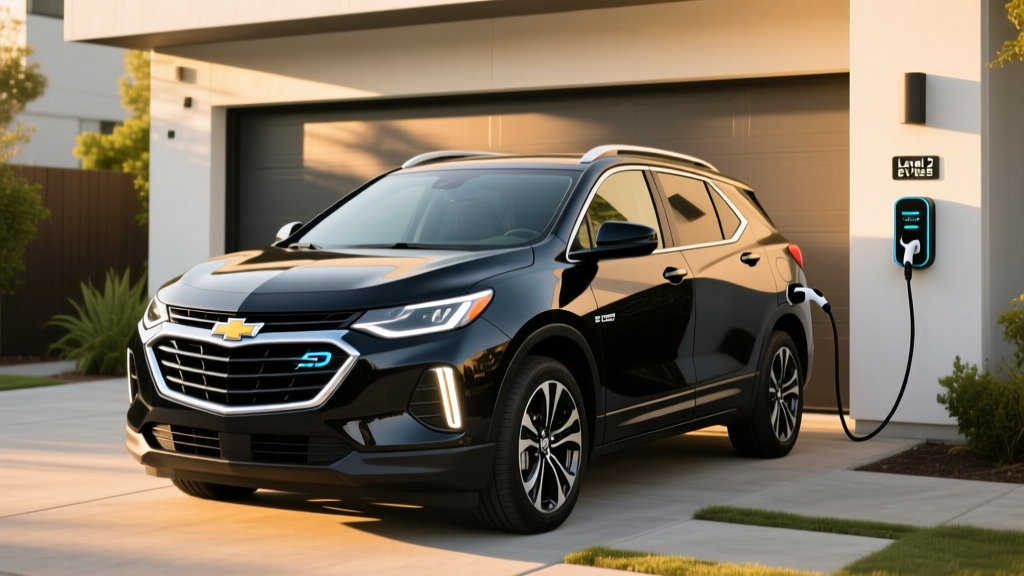
The 2026 Chevrolet Equinox Hybrid arrives as one of the few mainstream compact crossovers offering a conventional hybrid powertrain — no plug required — at a price point that undercuts most competitors. For buyers searching for a Chevy hybrid SUV that delivers meaningful fuel savings without the lifestyle adjustment of a plug-in hybrid or full EV, the Equinox Hybrid makes a compelling case. We break down the real numbers, from EPA fuel economy to long-term battery reliability, so you can decide if it earns a spot in your driveway.
What Is the 2026 Chevy Equinox Hybrid?
The 2026 Equinox Hybrid is a conventional hybrid electric vehicle (HEV), not a plug-in hybrid. That distinction matters: it charges its own battery through regenerative braking and the gasoline engine, meaning you never need to plug it in. It sits in Chevy's compact SUV lineup alongside the all-electric Equinox EV, giving buyers two very different electrification paths under one nameplate.
HEV vs. PHEV: What's the Difference?
| Feature | Conventional Hybrid (HEV) | Plug-In Hybrid (PHEV) |
|---|---|---|
| Plug-in charging? | No — self-charging | Yes — requires outlet/charger |
| Electric-only driving | Limited (low-speed, short bursts) | Full electric range (typically 20-40 mi) |
| Battery size | ~1.0-1.5 kWh | ~12-20+ kWh |
| Federal tax credit | Generally not eligible | May qualify (up to $7,500 under §30D) |
| Best for | No home charging access, want simplicity | Home charging available, short commutes |
The Equinox Hybrid targets the first group: drivers who want better fuel economy with zero change to their refueling habits. If you have access to home or workplace charging and a short commute, you may want to consider the Equinox EV or a PHEV competitor like the Toyota RAV4 Prime instead.
EPA Fuel Economy & Real-World MPG
Fuel economy is the headline spec for any hybrid buyer. The 2026 Equinox Hybrid is rated by the EPA as follows:
| Drivetrain | City | Highway | Combined |
|---|---|---|---|
| FWD | 38 MPG | 36 MPG | 37 MPG |
| AWD | 36 MPG | 34 MPG | 35 MPG |
Source: fueleconomy.gov, 2026 model year data.
Real-World MPG: What to Actually Expect
Conventional hybrids frequently exceed their EPA city rating in stop-and-go driving because regenerative braking recaptures energy that a gas car wastes as heat. In mixed suburban driving, owners of similar GM hybrid powertrains report 37-40 MPG in FWD trim during warm months. However, sustained highway driving at 75+ MPH and cold-weather operation (below 35°F) can drop efficiency by 3-5 MPG, bringing real-world highway figures closer to 32-34 MPG for AWD models.
Compared to the non-hybrid 2026 Equinox (rated around 26 MPG combined with the turbo 1.5L), the hybrid delivers roughly a 35-40% improvement in fuel economy. At 12,000 miles per year and $3.40/gallon, that translates to approximately $500-$650 in annual fuel savings over the gas model.
Powertrain & Performance Specs
| Specification | 2026 Equinox Hybrid |
|---|---|
| Engine | 1.5L turbocharged 4-cylinder |
| Electric motor | Integrated motor-generator unit |
| Combined horsepower | ~192 HP |
| Combined torque | ~236 lb-ft |
| Transmission | Continuously variable (eCVT) |
| Drivetrain options | FWD or AWD |
| 0-60 MPH (est.) | ~7.8 seconds (FWD) |
| Hybrid battery | ~1.3 kWh lithium-ion (self-charging) |
| Towing capacity | Up to 1,500 lbs |
The eCVT transmission is a hallmark of conventional hybrid design — it uses a planetary gearset to seamlessly blend engine and motor power, eliminating fixed gear shifts. The result is smooth, linear acceleration, though some drivers notice a slight "drone" under hard acceleration as the engine holds a steady RPM. This is normal hybrid behavior, not a defect.
The ~192 combined horsepower is adequate for daily driving and highway merging. The electric motor fills in the low-end torque gap that small turbo engines often exhibit, giving the Equinox Hybrid a more responsive feel off the line than its gas-only sibling.
Pricing, Trims & Tax Credit Eligibility
The 2026 Equinox Hybrid is available in three trims:
| Trim | Drivetrain | MSRP |
|---|---|---|
| LT | FWD | $31,900 |
| LT | AWD | $33,900 |
| RS | AWD | $36,400 |
| Activ | AWD | $37,900 |
Federal Tax Credit: Does the Equinox Hybrid Qualify?
No. Under current IRS §30D rules, the federal clean vehicle credit applies to plug-in electric vehicles (BEVs and PHEVs) with a battery capacity of at least 7 kWh. Because the Equinox Hybrid is a conventional HEV with a ~1.3 kWh battery that cannot be plugged in, it does not qualify for the federal tax credit of up to $7,500.
However, some states offer rebates or incentives for conventional hybrids. Check your state's energy office or Alternative Fuels Data Center for local programs. Additionally, if you're considering the all-electric Equinox EV, that model may qualify for the full §30D credit depending on your income, the vehicle's MSRP, and battery component/critical mineral sourcing requirements. Always verify current eligibility at IRS.gov or with a tax professional.
Hybrid Battery Warranty & Long-Term Reliability
Battery longevity is the number-one concern for hybrid buyers, and it's an area where GM has established a strong track record. The 2026 Equinox Hybrid's battery pack and hybrid-specific components are covered by:
Hybrid Battery & Powertrain Warranty
- Hybrid battery: 8 years / 100,000 miles (whichever comes first)
- Hybrid powertrain components: 8 years / 100,000 miles
- Limited vehicle warranty: 3 years / 36,000 miles bumper-to-bumper
- Powertrain warranty (non-hybrid): 5 years / 60,000 miles
GM's hybrid battery systems, refined over two decades since the original Chevrolet Tahoe Hybrid, have demonstrated exceptional longevity. The ~1.3 kWh battery in the Equinox Hybrid operates with a significant state-of-charge buffer — it never fully charges or fully depletes — which dramatically reduces cell stress and degradation. Real-world data from earlier GM hybrid systems shows capacity retention above 90% at 150,000+ miles.
Battery Replacement Cost
If the hybrid battery does fail outside of warranty, replacement cost for a compact hybrid battery of this size typically ranges from $2,000 to $3,500 including labor. This is substantially less than full EV battery replacement ($8,000-$20,000+) because the pack is small. Many independent hybrid-specialty shops can also refurbish or replace individual cells for $800-$1,500.
For context, the hybrid battery in the Equinox Hybrid is a fraction of the size of an EV battery and operates under far less stress. Catastrophic failure before 200,000 miles is exceedingly rare based on historical data from comparable GM hybrid systems.
Equinox Hybrid vs. the Competition
The compact hybrid SUV segment has grown considerably. Here's how the Equinox Hybrid stacks up against key rivals:
| Vehicle | Combined MPG | HP | Starting MSRP |
|---|---|---|---|
| 2026 Chevy Equinox Hybrid (FWD) | 37 MPG | ~192 | $31,900 |
| 2026 Toyota RAV4 Hybrid (AWD) | 39 MPG | 219 | $33,500 |
| 2026 Honda CR-V Hybrid (FWD) | 40 MPG | 204 | $34,200 |
| 2026 Hyundai Tucson Hybrid (AWD) | 38 MPG | 226 | $34,100 |
The Equinox Hybrid undercuts most competitors on price while delivering competitive (if not class-leading) fuel economy. The RAV4 Hybrid and CR-V Hybrid edge it out by 2-3 MPG combined, but the Equinox's lower entry price can offset that gap over several years unless you drive exceptionally high annual mileage.
One notable advantage: the Equinox Hybrid offers a conventional (non-turbo) hybrid option at a lower price point, while some competitors have moved exclusively to turbo-hybrid setups that can add complexity.
Who Should Buy the Equinox Hybrid — and Who Shouldn't
Choose the Equinox Hybrid If:
- You want better fuel economy with no change to your driving or refueling habits
- You don't have access to home or workplace EV charging
- Your daily driving involves a mix of city and highway miles
- You want a lower purchase price and don't need electric-only driving
- You plan to keep the vehicle 8+ years and value the hybrid battery warranty
Consider an EV or PHEV Instead If:
- You have Level 2 home charging and a commute under 30 miles (a PHEV like the RAV4 Prime could run mostly on electricity)
- You want to maximize fuel savings and qualify for the $7,500 federal tax credit (consider the Equinox EV)
- You drive primarily in the city where EVs and PHEVs deliver the largest efficiency advantage
- You want zero tailpipe emissions for environmental reasons
The Equinox Hybrid occupies a specific niche: maximum convenience with meaningful fuel savings. It's not the most efficient option in the Chevy lineup — that title belongs to the Equinox EV — but it's the option that demands the least adaptation from the buyer.
Pros & Cons at a Glance
Pros
- Competitive pricing starting at $31,900
- No plug-in charging required — zero lifestyle change
- Strong hybrid battery warranty (8 yr / 100k mi)
- ~35-40% fuel savings over gas Equinox
- Smooth eCVT driving experience
- Available AWD for all-weather buyers
Cons
- Not eligible for federal EV/PHEV tax credit
- Trails RAV4 Hybrid and CR-V Hybrid by 2-3 MPG
- eCVT drone under hard acceleration
- Limited electric-only capability (low-speed only)
- Towing capped at 1,500 lbs
Frequently Asked Questions
How many MPG does the 2026 Chevy Equinox Hybrid get?
The EPA rates the FWD model at 38 city / 36 highway / 37 combined MPG, and the AWD model at 36 city / 34 highway / 35 combined MPG. Real-world city driving often matches or slightly exceeds EPA estimates in hybrids, while sustained highway driving and cold weather can reduce efficiency by 3-5 MPG.
Does the Equinox Hybrid need to be plugged in?
No. The Equinox Hybrid is a conventional (self-charging) hybrid. It regenerates energy during braking and deceleration, and uses the gasoline engine to maintain battery charge. You refuel it exactly like a standard gas car.
Is the Chevy Equinox Hybrid reliable?
GM's hybrid systems have a long track record of reliability dating back to the mid-2000s. The small hybrid battery operates within a protective state-of-charge buffer, minimizing degradation. The 8-year/100,000-mile hybrid warranty provides strong coverage, and battery replacement costs (if ever needed) are relatively low at $2,000-$3,500 due to the small pack size.
Does the Equinox Hybrid qualify for any tax credit?
The Equinox Hybrid does not qualify for the federal §30D clean vehicle credit, which is reserved for plug-in vehicles with at least 7 kWh of battery capacity. Some state-level incentives may apply to conventional hybrids — check the Alternative Fuels Data Center for your state. The all-electric Equinox EV may qualify for the federal credit depending on income, MSRP caps, and sourcing requirements.
How does the Equinox Hybrid compare to the Equinox EV?
They serve different needs. The Equinox Hybrid offers 37 MPG combined with no plug-in requirement, starting at ~$31,900. The Equinox EV offers approximately 319 miles of EPA range, eligibility for the federal tax credit, and zero tailpipe emissions, but requires charging infrastructure and starts at a higher MSRP. If you can charge at home, the EV delivers lower operating costs; if you can't, the hybrid is the practical choice.
What is the hybrid battery replacement cost?
Out-of-warranty replacement for the Equinox Hybrid's ~1.3 kWh battery pack typically ranges from $2,000 to $3,500 including labor. Independent hybrid specialists may offer cell-level refurbishment for $800-$1,500. Given the battery's protected operating window and GM's track record, replacement before 200,000 miles is uncommon.