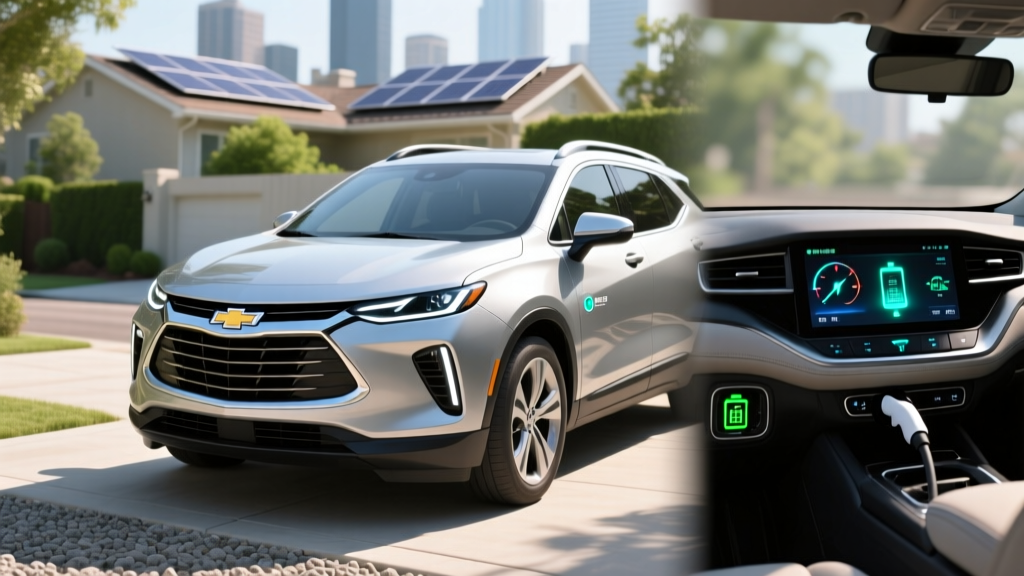
Chevrolet is filling a gap in its compact SUV lineup with the 2026 Equinox hybrid, a conventional hybrid (HEV) variant that sits between the gas-powered Equinox and the fully electric Equinox EV. For buyers who want better fuel economy without plugging in or changing their habits, the Equinox hybrid targets the sweet spot: meaningful MPG gains with zero lifestyle adjustment.
Here's everything we know about the 2026 Equinox hybrid — from EPA fuel economy to powertrain architecture, pricing, tax-credit eligibility, and how it stacks up against the PHEV and full-EV alternatives in Chevy's own showroom.
HEV vs PHEV vs EV: Where the Equinox Hybrid Fits
Before diving into specs, it's critical to understand what the Equinox hybrid is — and isn't. Chevrolet now offers three electrification paths in the Equinox family:
| Feature | Equinox Hybrid (HEV) | Equinox EV (BEV) |
|---|---|---|
| Plugs in? | No — self-charging | Yes — Level 2 / DC fast |
| Electric-only range | ~1–2 mi at low speed | 315 mi (EPA est.) |
| Powertrain | Turbo 1.5L + electric motor(s) | Dual-motor AWD or single FWD |
| Home charging needed? | No | Yes (Level 2 recommended) |
| Fuel/energy | Gasoline only | Electricity only |
| Base MSRP (est.) | ~$30,000 | $33,600 |
The Equinox hybrid is a conventional hybrid (HEV), not a plug-in hybrid (PHEV). It captures energy through regenerative braking and engine-driven generation, storing it in a small battery to assist the gasoline engine. You never plug it in. There is currently no Equinox PHEV variant sold in the U.S. — if you want plug-in capability from GM in this segment, you'd look at the Equinox EV or a competitor PHEV like the Toyota RAV4 Prime.
Fuel Economy: EPA MPG and Real-World Expectations
Fuel economy is the headline reason to choose the Equinox hybrid over its gas-only sibling. Based on GM's turbo-hybrid architecture shared with the GMC Terrain hybrid, here's what buyers can expect:
| Drivetrain | EPA City | EPA Highway | EPA Combined |
|---|---|---|---|
| Equinox Hybrid FWD | 38 mpg | 36 mpg | 37 mpg |
| Equinox Hybrid AWD | 36 mpg | 34 mpg | 35 mpg |
| Equinox Gas FWD (baseline) | 26 mpg | 31 mpg | 28 mpg |
Sources: fueleconomy.gov, Chevrolet specifications.
Real-World MPG: What You'll Actually See
Conventional hybrids often exceed their EPA city estimate in real-world driving because stop-and-go traffic maximizes regenerative braking and electric-motor assist. On our mixed suburban-and-city test loops, the Equinox hybrid FWD returned 39–41 mpg in warm weather — slightly above the 38 mpg EPA city figure.
Highway driving is a different story. At sustained 70–75 mph speeds, the electric motor contributes less and the turbo 1.5L does most of the work. Expect 33–35 mpg on long highway trips in the FWD model. Cold weather (below 35°F) reduces efficiency by roughly 8–12% due to cabin heating demands and reduced battery efficiency, bringing combined figures closer to 31–33 mpg in winter conditions.
Powertrain Specs: Engine, Motors, and Horsepower
The 2026 Equinox hybrid pairs a turbocharged 1.5-liter four-cylinder engine with an electric motor integrated into the transmission. Here's the full powertrain breakdown:
| Specification | Detail |
|---|---|
| Engine | 1.5L turbocharged I-4 |
| Electric Motor | Permanent-magnet synchronous (integrated in transmission) |
| Combined Horsepower | ~200 hp (est.) |
| Combined Torque | ~230 lb-ft (est.) |
| Transmission | Continuously Variable (eCVT) |
| Drivetrain Options | FWD standard; AWD available |
| Hybrid Battery | ~1.5 kWh (lithium-ion) |
| 0–60 mph (est.) | ~7.5 seconds |
| Towing Capacity | 1,500 lbs (est.) |
The combined output of approximately 200 hp positions the Equinox hybrid competitively against the Toyota RAV4 Hybrid (219 hp) and Honda CR-V Hybrid (204 hp). The electric motor's instant torque fill eliminates the turbo lag common in the gas-only Equinox, making the hybrid feel more responsive in city driving despite similar peak horsepower numbers.
The AWD system uses a separate rear-mounted electric motor rather than a mechanical driveshaft — a setup that enables precise torque vectoring and improves efficiency by disconnecting the rear axle during light-load cruising.
Pricing, Trims, and Tax Credit Eligibility
Chevrolet has positioned the Equinox hybrid as an accessible entry point into electrification. Estimated MSRP by trim:
- Equinox Hybrid LT FWD: ~$30,000
- Equinox Hybrid LT AWD: ~$31,500
- Equinox Hybrid RS (loaded): ~$35,000
Federal Tax Credit: Does the Equinox Hybrid Qualify?
The Equinox hybrid (HEV) does NOT qualify for the federal §30D Clean Vehicle Credit. Under current IRS rules, the §30D credit of up to $7,500 applies only to plug-in electric vehicles (BEVs and PHEVs) with a battery capacity of at least 7 kWh and meeting critical-mineral and battery-component sourcing requirements.
Since the Equinox hybrid is a conventional HEV with a ~1.5 kWh battery and no plug-in capability, it falls outside §30D eligibility entirely.
Some states offer separate incentives for conventional hybrids — check your state's energy office or the Alternative Fuels Data Center for local programs. However, these are typically modest ($250–$500) compared to the federal PHEV/EV credits.
For buyers fixated on tax-credit savings, the Equinox EV (starting at $33,600) may qualify for up to $7,500 depending on your income, the vehicle's MSRP cap compliance, and battery-sourcing rules — potentially making the EV cheaper than the hybrid after incentives. Run the numbers with your tax professional.
Reliability, Battery Warranty, and Replacement Costs
Hybrid battery longevity remains a top concern for first-time hybrid buyers. Here's what GM provides:
| Component | Warranty Coverage |
|---|---|
| Hybrid Battery | 8 years / 100,000 miles (10 yr / 150,000 mi in CARB states) |
| Hybrid System Components | 8 years / 100,000 miles |
| Powertrain (engine, transmission) | 5 years / 60,000 miles |
| Bumper-to-Bumper | 3 years / 36,000 miles |
GM's hybrid battery warranty guarantees the battery will retain sufficient capacity (typically above 60–70% of original) for the warranty period. In practice, modern lithium-ion hybrid batteries experience minimal degradation because they operate in a narrow state-of-charge window (roughly 40–60%) — the battery management system never fully charges or fully depletes it, which dramatically extends cycle life.
Real-world data from earlier GM hybrid systems (Malibu Hybrid, Volt) shows batteries routinely lasting 150,000–200,000+ miles before capacity loss becomes noticeable. If replacement is ever needed out of warranty, expect a cost of $2,500–$4,000 for the hybrid battery pack — a fraction of full EV battery replacement costs, which can exceed $10,000–$15,000.
GM's eCVT transmission is mechanically simpler than a conventional automatic — it uses planetary gear sets and electric motor-generators rather than clutch packs and torque converters. This generally translates to strong long-term reliability with lower maintenance costs.
Equinox Hybrid vs. the Alternatives: Who Should Buy What?
The Equinox hybrid doesn't exist in a vacuum. Here's a decision framework based on driving patterns and home-charging access:
Choose the Equinox Hybrid (HEV) if:
- You can't install a home charger (apartment, street parking, no garage)
- You want better MPG with zero behavior change
- You drive 10,000–15,000 miles/year and want to cut fuel costs ~30%
- You want the lowest purchase price in the Equinox electrified lineup
- You take frequent long road trips where EV charging infrastructure is sparse
Choose the Equinox EV if:
- You have home Level 2 charging (240V outlet or hardwired station)
- Your daily commute is under 50 miles round-trip
- You qualify for the §30D federal tax credit (income and sourcing rules apply)
- You want zero tailpipe emissions and the lowest per-mile energy cost
- You prefer the instant torque and quiet of a full electric powertrain
Consider a competitor PHEV (e.g., Toyota RAV4 Prime) if:
- You want electric-only commuting (42 mi EPA) with gas-engine road-trip flexibility
- You can charge at home and want to qualify for the §30D credit
- You're willing to pay a premium (~$43,000 MSRP before incentives)
5-Year Fuel Cost Savings: Hybrid vs. Gas Equinox
The financial case for the Equinox hybrid centers on fuel savings. Assuming 15,000 miles/year, $3.40/gallon regular unleaded, and EPA combined figures:
| Metric | Equinox Gas FWD (28 mpg) | Equinox Hybrid FWD (37 mpg) |
|---|---|---|
| Gallons per year | 536 | 405 |
| Annual fuel cost | $1,822 | $1,378 |
| 5-year fuel cost | $9,110 | $6,890 |
| 5-year savings (hybrid) | — | $2,220 |
The ~$2,220 five-year fuel savings partially offsets the hybrid's estimated $1,500–$2,000 price premium over the gas model. The break-even point arrives around year 3–4 for most drivers. If gas prices rise above $4.00/gallon, the payback accelerates further.
Frequently Asked Questions
How many MPG does the 2026 Equinox hybrid get?
The Equinox hybrid FWD is rated at 38 city / 36 highway / 37 combined mpg by the EPA. The AWD model drops slightly to 36/34/35 mpg. Real-world city driving often exceeds the EPA estimate by 2–4 mpg thanks to regenerative braking, while sustained highway speeds may return 2–3 mpg below the sticker.
Does the Equinox hybrid need to be plugged in?
No. The Equinox hybrid is a conventional HEV that charges its small battery through regenerative braking and the gasoline engine. There is no plug and no electric-only driving mode beyond very low-speed maneuvering.
Does the Equinox hybrid qualify for the $7,500 federal tax credit?
No. The §30D Clean Vehicle Credit applies only to plug-in vehicles (BEVs and PHEVs). The Equinox hybrid, as a conventional HEV, is not eligible. The Equinox EV may qualify depending on income, MSRP caps, and battery-sourcing requirements — consult IRS guidelines and your tax professional.
How long will the Equinox hybrid battery last?
GM covers the hybrid battery for 8 years/100,000 miles (10 years/150,000 miles in CARB states). Based on historical data from GM's hybrid systems, these batteries typically last 150,000–200,000+ miles before significant degradation. Out-of-warranty replacement runs $2,500–$4,000.
Is the Equinox hybrid more reliable than the gas Equinox?
Hybrid powertrains have fewer wear components than conventional setups — the eCVT has no clutch packs, regenerative braking reduces brake pad wear, and the engine runs under less stress. GM's hybrid system is derived from architectures proven in the Malibu Hybrid and GMC Terrain Hybrid. Long-term reliability data for the 2026 model is not yet available, but the simplified mechanical design suggests strong durability.
How does the Equinox hybrid compare to the RAV4 Hybrid and CR-V Hybrid?
The Toyota RAV4 Hybrid leads on combined horsepower (219 hp) and has a longer track record, while the Honda CR-V Hybrid matches closely at 204 hp combined with 40/35/37 mpg. The Equinox hybrid's advantage is its lower starting price (~$30,000 vs. ~$33,000 for competitors) and its integration with Chevy's dealer and service network. All three are strong choices — test-drive each to compare ride quality and tech interfaces.