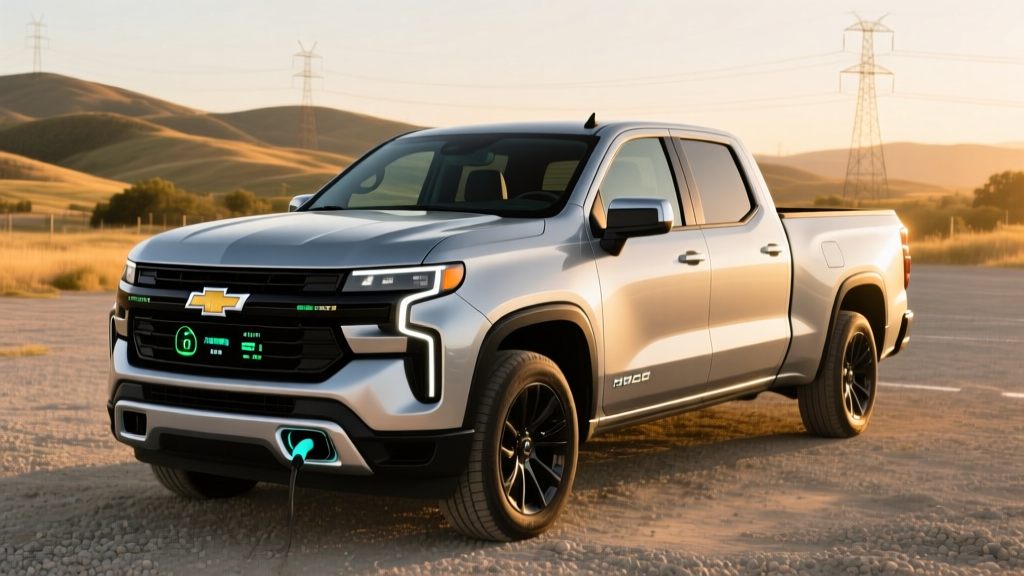
Truck buyers have more powertrain choices than ever, but the conventional hybrid remains the sweet spot for drivers who want better fuel economy without changing how they use their truck. The 2026 Chevrolet Silverado hybrid pickup truck slots into the full-size half-ton segment as a self-charging hybrid (HEV)—meaning no plug, no range anxiety, and no need to hunt for chargers on a job site. It pairs a turbocharged gasoline engine with an electric motor integrated into the transmission to deliver meaningful MPG gains, especially in city and stop-and-go driving, while retaining the towing and payload capability Silverado buyers expect.
This guide breaks down the Silverado hybrid's real-world efficiency, powertrain details, pricing, tax-credit eligibility, and long-term battery reliability. We'll also compare it against the plug-in hybrid and full-electric alternatives so you can choose the right electrified truck for your needs.
HEV vs PHEV: What Kind of Hybrid Is the Silverado?
Before examining specs, it's critical to understand what you're buying. The Silverado hybrid is a conventional hybrid (HEV), not a plug-in hybrid (PHEV). Here's how the two differ:
| Feature | Conventional Hybrid (HEV) | Plug-In Hybrid (PHEV) |
|---|---|---|
| Needs to be plugged in? | No — charges via regen braking & engine | Yes — plug in for electric-only range |
| Electric-only driving | Limited (low-speed, short bursts) | 20–50+ miles on battery alone |
| Battery size | ~1.0–2.0 kWh | ~15–30 kWh |
| Fuel economy improvement | 15–30% over gas-only | Major savings if charged daily |
| Federal tax credit (§30D) | Not eligible | Up to $7,500 (if requirements met) |
| Best for | Drivers who can't charge at home | Drivers with home charging & short commutes |
The Silverado hybrid uses a small battery pack that charges itself through regenerative braking and the gasoline engine. You fuel it exactly like a conventional truck. If you need plug-in electric-only range in a Chevy truck, you'd look at a different nameplate or wait for GM's upcoming PHEV truck programs.
Fuel Economy: How Many MPG Does the Silverado Hybrid Get?
The headline number for any hybrid truck buyer is fuel economy. Here's the EPA-estimated breakdown for the 2026 Chevrolet Silverado hybrid with 4WD (2WD figures are marginally higher):
| Drivetrain | City MPG | Highway MPG | Combined MPG |
|---|---|---|---|
| Silverado Hybrid 4WD | 23 | 24 | 23 |
| Silverado Gas 4WD (5.3L V8) | 15 | 20 | 17 |
| Silverado Gas 4WD (2.7L Turbo) | 18 | 21 | 19 |
Source: fueleconomy.gov (EPA estimates). Actual mileage will vary.
Real-World MPG vs. EPA Sticker
Hybrid trucks consistently outperform their EPA city estimates in real-world stop-and-go driving, where regenerative braking recaptures the most energy. In mixed suburban driving with frequent stops, owners report 24–26 MPG—a meaningful bump over the sticker. However, highway-heavy driving at 75+ MPH tends to return numbers closer to or slightly below the EPA highway estimate (22–24 MPG), since the electric motor provides less assist at sustained high speeds and the truck's aerodynamic profile works against it.
Cold weather reduces hybrid efficiency by roughly 8–12% due to engine warm-up cycles drawing fuel and reduced battery efficiency in low temperatures. Expect 20–21 MPG combined in winter conditions if you live in a cold climate.
Compared to the 5.3L V8 gas model, the hybrid delivers roughly 35% better combined fuel economy. For a driver covering 15,000 miles per year at $3.40/gallon, that translates to approximately $700–$900 in annual fuel savings.
Powertrain Specs: Engine, Motor, and Horsepower
| Specification | 2026 Silverado Hybrid 4WD |
|---|---|
| Engine | 2.7L TurboMax I4 + electric motor |
| Combined Horsepower | ~340 hp (combined system output) |
| Combined Torque | ~430 lb-ft |
| Transmission | 10-speed automatic with integrated motor |
| Battery Type | Lithium-ion, ~1.5 kWh (self-charging) |
| 0–60 mph | ~6.8 seconds (est.) |
| Max Towing Capacity | ~9,300 lbs (properly equipped) |
| Max Payload | ~1,870 lbs |
| Drivetrain | 4WD standard on hybrid trims |
The hybrid system pairs Chevrolet's TurboMax inline-four with an electric motor sandwiched between the engine and the 10-speed automatic transmission. The motor fills in torque during the turbo's spool-up phase, eliminating the lag that some drivers notice in the non-hybrid 2.7L. The result is smooth, linear acceleration from a stop—exactly the kind of driving where trucks burn the most fuel.
Towing capacity drops slightly compared to the available 6.2L V8 (which can tow up to ~13,300 lbs), but the hybrid still handles boat trailers, campers, and equipment trailers in the 8,000–9,000 lb range without issue. The hybrid system also enables low-speed electric-only creep in traffic and during parking-lot maneuvers, reducing fuel consumption in those scenarios to near zero.
Pricing, Trims, and Tax Credit Eligibility
The Silverado hybrid is typically offered on mid-to-upper trims (LT, RST, LTZ), with pricing starting around $55,000–$57,000 MSRP for a crew-cab 4WD configuration. Fully loaded LTZ or High Country hybrid builds can push past $68,000.
Does the Silverado Hybrid Qualify for a Federal Tax Credit?
No. The federal §30D Clean Vehicle Credit applies only to plug-in electric vehicles (BEVs and PHEVs) with battery capacities of at least 7 kWh that meet critical-mineral and battery-component sourcing requirements. Because the Silverado hybrid is a conventional HEV with a ~1.5 kWh battery, it does not qualify for the federal EV tax credit.
Some states offer separate incentives for hybrid vehicles, but these are typically modest ($250–$1,000) and vary widely. Check your state's energy or DMV website for current programs. The IRS publishes updated credit eligibility rules at irs.gov.
Battery & Powertrain Warranty Coverage
| Component | Coverage |
|---|---|
| Hybrid Battery | 8 years / 100,000 miles |
| Powertrain (engine, transmission, motor) | 5 years / 60,000 miles |
| Bumper-to-Bumper | 3 years / 36,000 miles |
California-emissions states may extend the hybrid battery warranty to 10 years / 150,000 miles under PZEV rules.
Reliability and Battery Replacement Cost
Chevrolet's hybrid system in the Silverado is derived from the architecture used in the Tahoe and Sierra hybrids, which have accumulated years of real-world data. The conventional hybrid battery is small (~1.5 kWh) and operates within a narrow state-of-charge window (typically 40–60%), which dramatically reduces degradation compared to full EV batteries that cycle through wider ranges.
How Long Will the Hybrid Battery Last?
Based on historical data from GM's hybrid platforms, the Silverado's hybrid battery is designed to last the life of the vehicle—typically 150,000–200,000+ miles—without significant capacity loss. The battery management system keeps the pack in its optimal charge window at all times, avoiding the deep discharge and full charge cycles that accelerate degradation.
Battery Replacement Cost
If the hybrid battery does fail outside of warranty, replacement costs for a Silverado-class conventional hybrid battery typically range from $2,000 to $4,000 (parts and labor). This is substantially less than a full EV battery replacement ($10,000–$20,000+) because the pack is small and the chemistry less expensive. Third-party refurbishers also offer rebuilt hybrid batteries for $1,200–$2,500, providing a lower-cost option for high-mileage trucks.
The 8-year/100,000-mile hybrid battery warranty provides strong coverage during the years when failures, though rare, are most likely to occur.
Silverado Hybrid vs. Full EV vs. Gas Truck: Which Fits You?
Choosing between a hybrid, a full-electric truck (like the Silverado EV or Ford F-150 Lightning), and a conventional gas truck depends on your driving pattern, charging access, and budget.
Silverado Hybrid (HEV)
Pros:
- No plug needed — fuel it like any gas truck
- 23 MPG combined vs. 17 MPG for V8 (35% savings)
- Full towing and payload capability retained
- Lower upfront cost than EV trucks
- Proven hybrid reliability with 8-yr battery warranty
Cons:
- No federal tax credit
- No electric-only driving range
- Modest MPG gains on highway-heavy commutes
- Still burns gasoline — no zero-tailpipe-emission driving
Full EV Truck (Silverado EV / F-150 Lightning)
Pros:
- Up to $7,500 federal tax credit (if eligible)
- 230–400+ miles EPA range, zero tailpipe emissions
- Dramatically lower fueling cost (~$0.04–$0.08/mile on home charging)
- Instant torque, quiet operation, V2L/V2H capability
Cons:
- Higher MSRP ($55,000–$90,000+)
- Requires home Level 2 charger for practical ownership
- Towing cuts range by 40–50%
- DC fast charging on road trips adds time
Decision Framework
Choose the Silverado Hybrid if: You can't install a home charger, you tow regularly and can't afford the range penalty of EV towing, you drive a mix of city and highway, and you want lower fuel costs without changing your refueling habits.
Choose a full EV truck if: You have reliable home Level 2 charging, your daily driving is under 200 miles, you rarely tow heavy loads long-distance, and you want to maximize fuel savings and qualify for federal tax credits.
Choose a gas-only Silverado if: You drive very low annual miles (under 8,000/year), you frequently tow near max capacity on highways, or you want the lowest possible purchase price and don't mind higher fuel costs.
Frequently Asked Questions
How many MPG does the Chevrolet Silverado hybrid get?
The 2026 Silverado hybrid 4WD earns an EPA-estimated 23 city / 24 highway / 23 combined MPG. Real-world city driving often yields 24–26 MPG thanks to regenerative braking, while sustained highway driving at high speeds may return 22–24 MPG. This represents roughly a 35% improvement over the 5.3L V8 gas model.
Does the Silverado hybrid need to be plugged in?
No. The Silverado hybrid is a conventional HEV, not a plug-in hybrid. Its small lithium-ion battery charges through regenerative braking and the gasoline engine. You never need to plug it in—just fill it with gas as usual.
Is the Silverado hybrid reliable?
GM's hybrid truck powertrain has proven reliable over multiple model years and platforms (Tahoe, Sierra, Silverado). The hybrid battery is warrantied for 8 years/100,000 miles and is designed to outlast 150,000+ miles. The small battery pack operates in a narrow charge window, minimizing degradation. Replacement cost, if needed out of warranty, is $2,000–$4,000.
Does the Silverado hybrid qualify for a federal tax credit?
No. The §30D federal Clean Vehicle Credit applies only to plug-in vehicles (BEVs and PHEVs) meeting specific battery sourcing and capacity requirements. The Silverado hybrid's ~1.5 kWh battery and conventional hybrid architecture make it ineligible. Some state-level hybrid incentives may apply—check your local programs.
Can the Silverado hybrid tow as much as the gas version?
The hybrid's max towing capacity is approximately 9,300 lbs when properly equipped, which is competitive with the 2.7L turbo gas model but lower than the 6.2L V8 (up to ~13,300 lbs). For most boat trailers, utility trailers, and travel campers in the 7,000–9,000 lb range, the hybrid is fully capable.
How far can the Silverado hybrid drive on electric power alone?
As a conventional HEV, the Silverado hybrid can creep at very low speeds (under ~25 MPH) on electric power for short distances—typically a few hundred yards in parking lots or heavy traffic. It cannot sustain highway speeds on electric power alone. If you need meaningful electric-only range (20–50 miles), you need a plug-in hybrid (PHEV), which the Silverado does not currently offer.
What is the total driving range of the Silverado hybrid?
With a 24-gallon fuel tank and 23 MPG combined, the Silverado hybrid delivers approximately 550 miles of total range on a single tank—roughly 130 miles more than the V8 gas model on the same tank size.