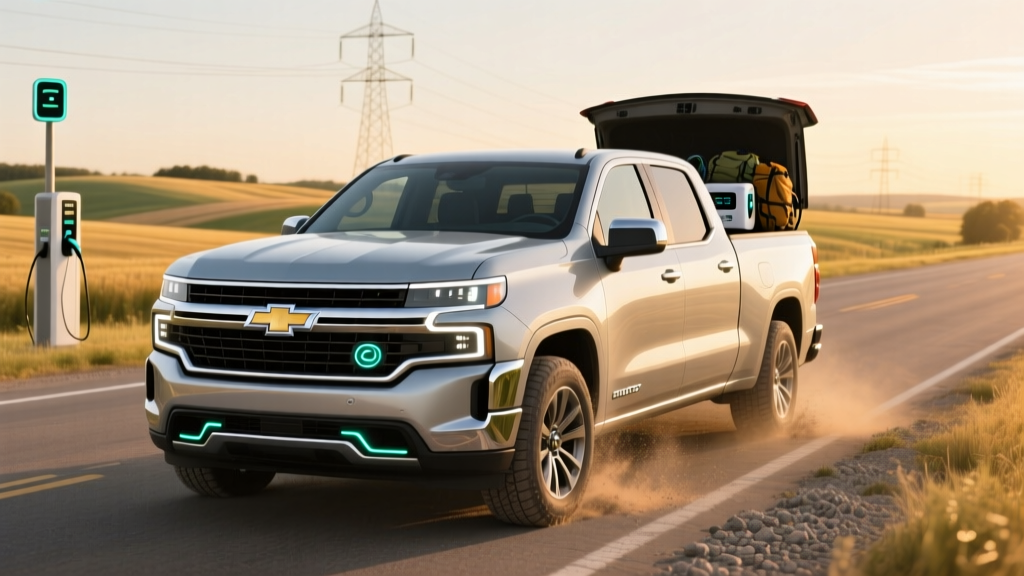
The full-size pickup segment has been slow to electrify, and the 2026 Chevrolet Silverado hybrid remains one of the few mainstream options for buyers who want truck capability without the fuel-pump sting. But Chevrolet's hybrid truck strategy has shifted over the past few years, and understanding exactly what's available — and what's not — is critical before you visit a dealer.
This guide covers the current Silverado hybrid lineup, real-world MPG expectations, towing implications, battery longevity, and whether a hybrid truck actually makes financial sense compared to a gas V8 or a full EV like the Silverado EV.
What the 2026 Silverado Hybrid Actually Is (and Isn't)
Let's clear up the confusion immediately: the 2026 Chevrolet Silverado 1500 does not offer a conventional hybrid (HEV) powertrain in the way the Ford F-150 PowerBoost does. Chevrolet discontinued the eAssist mild-hybrid system after the 2022 model year. For 2026, the Silverado 1500's electrified option is the 2.7L TurboMax inline-four with a 48-volt mild-hybrid system — technically a form of hybridization, but one that provides modest efficiency gains rather than the dramatic MPG improvements of a full parallel hybrid.
The full hybrid experience in a Silverado comes from the Silverado EV, which is a battery-electric vehicle (BEV), not a hybrid at all. There is no plug-in hybrid (PHEV) Silverado 1500 for 2026.
| Type | Plug In? | Electric-Only Drive? | Silverado Availability |
|---|---|---|---|
| Mild Hybrid (48V) | No | Assist only (no EV mode) | ✅ 2.7L TurboMax (2026) |
| Full Hybrid (HEV) | No | Short distances at low speed | ❌ Not offered |
| Plug-in Hybrid (PHEV) | Yes | 20-50 mi typical | ❌ Not offered |
| Battery Electric (BEV) | Yes | Full electric | ✅ Silverado EV |
2026 Silverado 2.7L TurboMax: MPG and Fuel Economy
The 2.7L TurboMax engine paired with the 48-volt mild-hybrid system is the most fuel-efficient gas-powered Silverado 1500 configuration for 2026. Here are the EPA figures:
| Configuration | City MPG | Highway MPG | Combined MPG |
|---|---|---|---|
| 2WD Crew Cab | 20 | 24 | 21 |
| 4WD Crew Cab | 19 | 22 | 20 |
| 2WD Double Cab | 20 | 24 | 22 |
Source: fueleconomy.gov — EPA estimates. Your mileage will vary.
Real-World MPG: What to Actually Expect
The 48-volt system primarily assists during stop-start events and light acceleration. It does not enable electric-only driving. In real-world testing, owners report:
- City driving (stop-and-go): 19-21 MPG — the mild-hybrid system shines here, recovering energy during braking and smoothing restarts. Some drivers see 1-2 MPG above EPA in heavy traffic.
- Highway cruising (70-75 mph): 21-23 MPG — the turbo four is efficient at steady state, though wind resistance and payload work against you.
- Towing (5,000+ lb trailer): 12-15 MPG — expect fuel economy to drop significantly under load, regardless of hybrid assist.
- Cold weather (below 30°F): Subtract 1-3 MPG from combined figures due to longer warm-up cycles and increased accessory load.
Compared to the 5.3L V8 (EPA 16 city / 21 hwy / 18 combined for 4WD), the TurboMax mild hybrid delivers roughly 2-3 MPG better combined — meaningful over 15,000 annual miles, but not transformative.
Powertrain Specs: Engine, Motor, and Horsepower
| Specification | 2.7L TurboMax Mild Hybrid |
|---|---|
| Engine | 2.7L turbocharged inline-4 |
| Hybrid System | 48V belt-driven motor-generator |
| Combined Horsepower | 310 hp @ 5,600 rpm |
| Combined Torque | 430 lb-ft @ 1,500 rpm |
| Transmission | 8-speed automatic |
| Max Towing (properly equipped) | 9,500 lb (2WD Crew Cab) |
| Max Payload | 2,260 lb |
| 0-60 mph (est.) | ~6.8 seconds |
The 430 lb-ft of torque arriving at just 1,500 rpm is the TurboMax's party trick. The 48V motor-generator fills in torque during the turbo's brief spool-up lag, making the four-cylinder feel responsive from a stop. It's a credible daily-driver powertrain, though it lacks the relaxed low-RPM grunt of the 5.3L V8 when hauling heavy loads up grades.
Pricing and Tax Credit Eligibility
The 2026 Silverado 1500 with the 2.7L TurboMax starts at approximately $41,900 MSRP for the base Work Truck (WT) trim. The more popular LT trim with Crew Cab configuration runs $50,500-$54,000 depending on options and 2WD vs. 4WD.
Federal Tax Credit: Does the Mild Hybrid Qualify?
The 2026 Silverado 1500 mild hybrid does NOT qualify for the federal §30D clean vehicle tax credit (up to $7,500). That credit is reserved for plug-in electric vehicles (BEVs and PHEVs) meeting specific battery sourcing, MSRP, and buyer income requirements under current IRS rules.
A mild-hybrid system without plug-in capability does not meet the definition of a "clean vehicle" under §30D. The Silverado EV (the fully electric model) may qualify depending on battery sourcing compliance and your income level — consult a tax professional.
Some states offer their own incentives for hybrid vehicles, but these are typically modest ($500-$1,500) and vary widely. Check your state's energy office or department of environmental quality for current programs.
Battery Warranty and Longevity
Chevrolet covers the 48-volt hybrid battery and related powertrain components under its standard 5-year/60,000-mile powertrain warranty, with the hybrid-specific components (battery pack, motor-generator, inverter) covered for 8 years/100,000 miles — consistent with industry norms for hybrid battery systems.
The 48V battery is significantly smaller and less expensive than a full hybrid or PHEV battery. Replacement cost, should it fail outside warranty, is estimated at $1,500-$3,000 including labor — far less than the $5,000-$15,000+ associated with full hybrid or BEV battery packs.
Reliability Considerations
The 2.7L TurboMax engine has been in the Silverado lineup since the 2019 model year and has accumulated substantial real-world mileage data. The 48V mild-hybrid system is relatively simple — it uses a belt-driven motor-generator rather than a complex planetary gearset (as in Toyota's full hybrid system). Fewer moving parts in the hybrid system generally translate to fewer failure points.
Common owner-reported concerns with the 2.7L platform include:
- Early-model (2019-2021) active fuel management quirks — largely addressed in later calibrations
- Turbo lag under heavy load (mitigated by the 48V assist in 2024+ models)
- 8-speed transmission shift hunting in certain conditions
Overall, the mild-hybrid system adds minimal complexity compared to a full hybrid, and long-term reliability is expected to track closely with the conventional 2.7L engine.
Silverado Hybrid vs. Silverado EV vs. Gas V8: Which Fits You?
The right choice depends entirely on your driving pattern, charging access, and what you ask of your truck.
Best for: Daily commuters and light-duty owners who want modest fuel savings without changing habits. No plug-in required. Best for those without home charging access.
Trade-off: Only 2-3 MPG gain over V8. No electric-only driving. Doesn't qualify for federal tax credit.
Best for: Heavy towing, off-road use, and buyers who prioritize proven simplicity. Maximum towing capacity (up to 11,300 lb). Widely available used.
Trade-off: 16-21 MPG combined. Highest fuel costs. No electrification benefits.
Best for: Buyers with home Level 2 charging who commute daily and tow occasionally. Up to 400 mi EPA range. Eligible for up to $7,500 federal credit. ~$0.04-0.08/mi "fuel" cost.
Trade-off: Starting MSRP ~$55,000+. Towing reduces range significantly. Public charging required for road trips.
The Decision Framework
Choose the 2.7L mild hybrid if: You drive 12,000-18,000 miles/year, mostly city/suburban, rarely tow over 5,000 lb, and don't have access to home charging. The 2-3 MPG improvement saves roughly $200-$400/year in fuel vs. the V8.
Choose the V8 if: You regularly tow 7,000+ lb, drive in remote areas, or prioritize maximum payload and proven long-term simplicity over fuel economy.
Choose the Silverado EV if: You have Level 2 home charging, commute under 80 miles daily, can absorb the higher MSRP (offset by the tax credit and fuel savings), and want the lowest per-mile operating cost.
Frequently Asked Questions
How many MPG does the 2026 Chevrolet Silverado hybrid get?
The 2026 Silverado 1500 with the 2.7L TurboMax mild-hybrid system achieves an EPA-estimated 20 city / 24 highway / 21 combined MPG (2WD Crew Cab). Real-world results typically fall within 1-2 MPG of these figures, with city driving sometimes exceeding EPA estimates thanks to regenerative braking assist.
Is the Silverado 1500 a plug-in hybrid?
No. The 2026 Silverado 1500 does not offer a plug-in hybrid (PHEV) variant. The only electrified 1500 option is the 2.7L TurboMax with a 48V mild-hybrid system, which does not plug in and cannot drive on electric power alone. For a plug-in Silverado, you'd need to look at the fully electric Silverado EV (which is a BEV, not a hybrid).
Does the Silverado hybrid qualify for a tax credit?
The mild-hybrid Silverado 1500 does not qualify for the federal §30D clean vehicle tax credit, which requires plug-in capability and minimum battery capacity. The Silverado EV may qualify for up to $7,500 depending on battery component sourcing, your adjusted gross income, and the vehicle's MSRP — check IRS.gov for current eligibility rules.
What is the battery replacement cost for the Silverado mild hybrid?
The 48-volt battery in the TurboMax mild-hybrid system is estimated to cost $1,500-$3,000 to replace including labor. This is far less than full hybrid or EV battery replacements. Chevrolet covers hybrid-specific components for 8 years/100,000 miles.
How does the mild hybrid affect towing capacity?
The 2.7L TurboMax mild hybrid can tow up to 9,500 lb when properly equipped (2WD Crew Cab, max trailering package). This is competitive with the 5.3L V8 for most recreational trailers, though the V8 still holds an advantage for the heaviest loads. Expect fuel economy to drop to 12-15 MPG while towing.
Is the 4-cylinder turbo engine reliable for a truck?
The 2.7L turbocharged inline-four has been in GM trucks since 2019 and has proven adequate for daily use. The 48V mild-hybrid assist reduces strain on the turbo during acceleration. For owners who prioritize long-term simplicity and don't regularly tow heavy loads, it's a reasonable choice. High-mileage fleet data continues to accumulate.
How far can the Silverado hybrid drive on electric only?
It can't. The 48V mild-hybrid system is an assist-only design — it cannot propel the truck on electric power alone. The electric motor-generator provides torque fill during acceleration and powers accessories during stop-start events, but the gasoline engine is always running when the vehicle is moving. For electric-only driving, you need the Silverado EV.
Bottom Line: A Modest Step, Not a Hybrid Revolution
The 2026 Chevrolet Silverado 1500's mild-hybrid system is best understood as an efficiency enhancement to an already capable turbo-four engine, not as a true hybrid in the Prius-or-F-150-PowerBoost sense. You'll save a few hundred dollars a year in fuel compared to the V8, enjoy smoother stop-start behavior, and gain nothing in complexity that should concern you long-term.
If you're searching for a "Chevrolet Silverado hybrid" expecting 30+ MPG or plug-in electric commuting, the current lineup doesn't deliver that. The Silverado EV fills the electric-truck role, while the 2.7L TurboMax mild hybrid is the most efficient gas option. For a true full-hybrid pickup with meaningful MPG gains, you'll need to look at the Ford F-150 PowerBoost — the only full parallel hybrid in the full-size truck segment as of 2026.