The Silverado's Electrification Story: Where Things Stand
If you've been searching for a Chevrolet Silverado 1500 hybrid, you've likely noticed the results are thin. That's not an accident. As of the current model year, Chevrolet does not offer a conventional hybrid (HEV) or plug-in hybrid (PHEV) version of the Silverado 1500. The electrified Silverado lineup has focused on the fully electric Silverado EV — a dedicated battery-electric truck built on GM's Ultium platform — rather than a hybrid variant of the traditional body-on-frame Silverado 1500.
This guide breaks down exactly what Chevrolet does offer, why a Silverado 1500 hybrid doesn't currently exist, what the Silverado EV delivers, and which powertrain actually makes sense for truck buyers weighing gas, hybrid, and fully electric options.
HEV vs. PHEV vs. EV: What Each Term Means for Truck Buyers
Before evaluating the Silverado lineup, it's critical to understand the distinctions between electrified powertrains — because Chevrolet's strategy treats them very differently.
| Powertrain | How It Works | Plug In? | Typical Benefit |
|---|---|---|---|
| HEV (Conventional Hybrid) | Small battery + electric motor assist the gas engine; recharges via regenerative braking | No | 10–30% better MPG, no behavior change needed |
| PHEV (Plug-in Hybrid) | Larger battery provides 20–50 miles electric-only; gas engine takes over after depletion | Yes (Level 1/2) | Gas-free daily driving + long road-trip range |
| BEV (Battery Electric) | No gas engine; large battery powers electric motors exclusively | Yes (Level 1/2/DC) | Zero tailpipe emissions, lowest fuel cost per mile |
Competitors like Ford offer the F-150 PowerBoost (a conventional HEV), and the F-150 Lightning (a BEV). Ram previously offered the 1500 eTorque mild hybrid (discontinued) and is transitioning to the Ramcharger EREV. Chevrolet, however, skipped the HEV/PHEV step for the Silverado 1500 and went straight to a full BEV with the Silverado EV.
The Silverado EV: Specs, Range, and What It Replaces
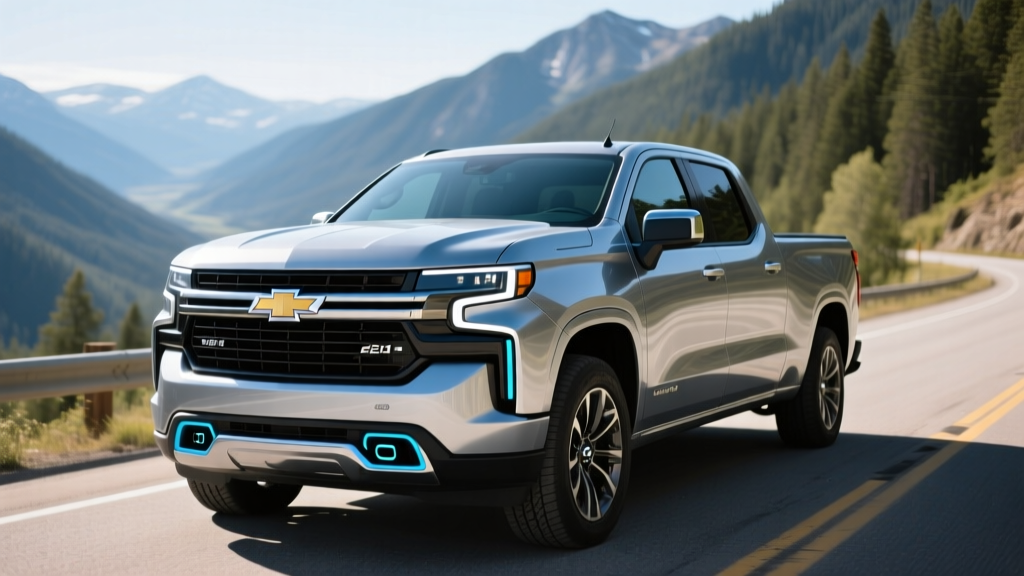
The Chevrolet Silverado EV is a dedicated electric truck — not a converted Silverado 1500. It rides on GM's Ultium platform (shared with the GMC Sierra EV and Cadillac Escalade IQ) and is a fundamentally different vehicle from the ICE Silverado 1500. Here's what the current lineup delivers:
| Spec | Silverado EV 4WT (Work Truck) | Silverado EV RST |
|---|---|---|
| Drivetrain | AWD (dual motor) | AWD (dual motor) |
| Horsepower | 510 hp | 664 hp (Max Range) |
| Torque | 615 lb-ft | 780 lb-ft (Max Range) |
| Battery (usable) | ~200 kWh (Ultium, NMC) | ~200 kWh (Ultium, NMC) |
| EPA Range | ~392 miles (est.) | ~440 miles (Max Range est.) |
| Max DC Fast Charge | Up to 350 kW | Up to 350 kW |
| 10–80% DC Charge | ~30 minutes (at 350 kW station) | ~30 minutes (at 350 kW station) |
| Level 2 Home Charge | Up to 19.2 kW (~41 mi/hr) | Up to 19.2 kW (~41 mi/hr) |
| 0–60 mph | ~5.5 sec | ~4.5 sec |
| Towing Capacity | Up to 10,000 lbs (12,500 w/ max tow pkg) | Up to 10,000 lbs |
| Starting MSRP | ~$55,000 | ~$87,300 |
Real-World Range Note: The Silverado EV's massive ~200 kWh battery provides class-leading EPA range estimates. However, expect real-world highway range to drop 10–15% at sustained 75+ mph speeds, and cold-weather driving (below 30°F) can reduce range by 20–30% due to battery heating demands and cabin climate load. Towing heavy loads will cut range by 40–50%.
Silverado EV Efficiency: MPGe and Cost Per Mile
Because the Silverado EV is a battery-electric vehicle, efficiency is measured in MPGe (miles per gallon equivalent) and kWh/100 miles rather than traditional MPG. MPGe translates electricity consumption into the energy equivalent of a gallon of gasoline (33.7 kWh = 1 gallon).
| Metric | Silverado EV (Estimated) | Silverado 1500 Gas (5.3L V8) |
|---|---|---|
| EPA Combined MPGe | ~60–65 MPGe (est.) | N/A (gas) |
| EPA City MPG / MPGe | ~65 MPGe (est.) | 15 MPG |
| EPA Highway MPG / MPGe | ~55 MPGe (est.) | 20 MPG |
| Energy Use | ~50–55 kWh/100 mi | 5.0 gal/100 mi |
| Fuel/Energy Cost (per mile) | ~$0.06–$0.09 (home charging at $0.14/kWh) | ~$0.20 (at $3.50/gal) |
Charging at home on Level 2 is dramatically cheaper per mile than gasoline. Public DC fast charging at $0.40–$0.60/kWh narrows the gap, bringing per-mile cost to roughly $0.12–$0.18 — still below gasoline for most drivers.
Federal Tax Credits: Does the Silverado EV Qualify?
The Silverado EV may qualify for the IRS §30D federal clean vehicle tax credit, but eligibility depends on several factors that change frequently:
- MSRP Cap: Trucks/vans/SUVs must have an MSRP at or below $80,000. This excludes the Silverado EV RST Max Range (~$87,300) but the 4WT and lower trims may qualify.
- Buyer Income Limits: Modified adjusted gross income must not exceed $150,000 (single), $225,000 (head of household), or $300,000 (joint filing).
- Battery Sourcing Requirements: Critical minerals and battery components must meet escalating domestic-content thresholds. The exact credit amount ($3,750 or $7,500) depends on whether the vehicle meets one or both sourcing requirements.
- Point-of-Sale Transfer: Eligible buyers can transfer the credit to the dealer at purchase, reducing the purchase price upfront rather than waiting for tax filing.
Because sourcing rules tighten annually and specific VIN eligibility can change, always verify credit status using the IRS's official list at fueleconomy.gov before purchasing. Consult a tax professional for your specific situation.
Why No Silverado 1500 Hybrid? GM's Strategy Explained
Chevrolet's decision to skip a Silverado 1500 HEV/PHEV and move directly to the Silverado EV reflects GM's corporate strategy to invest in dedicated EV platforms rather than adapting ICE architectures. The traditional Silverado 1500's body-on-frame platform was not engineered for hybrid battery packaging, and GM determined that the investment required to engineer a hybrid variant would be better directed toward the Ultium-based Silverado EV.
That said, the gas-powered Silverado 1500 continues with conventional powertrains — the turbo 2.7L four-cylinder, 5.3L V8, 6.2L V8, and 3.0L Duramax diesel. The diesel, in particular, delivers strong highway efficiency:
| Silverado 1500 Powertrain | HP | EPA City | EPA Highway | EPA Combined |
|---|---|---|---|---|
| 2.7L Turbo I-4 | 310 hp | 18 MPG | 21 MPG | 19 MPG |
| 5.3L V8 | 355 hp | 15 MPG | 20 MPG | 17 MPG |
| 6.2L V8 | 420 hp | 14 MPG | 18 MPG | 16 MPG |
| 3.0L Duramax Diesel I-6 | 277 hp | 23 MPG | 29 MPG | 25 MPG |
The Duramax diesel is the closest the current Silverado 1500 comes to hybrid-like efficiency, achieving 25 MPG combined and over 500 miles of highway range on a tank — rivaling what a hybrid V8 might deliver.
Silverado EV Battery Warranty and Longevity
GM Ultium Battery Warranty: 8 years / 100,000 miles (whichever comes first), covering defects and capacity loss below 70% of original capacity. This is standard across the Ultium platform and aligns with federal requirements for EV battery coverage.
GM's Ultium batteries use NMC (nickel-manganese-cobalt) chemistry, which offers high energy density but is more sensitive to sustained 100% state-of-charge than LFP (lithium iron phosphate) chemistry. For maximum longevity:
- Charge to 80–90% for daily driving; reserve 100% for long trips
- Use DC fast charging sparingly — frequent 350 kW sessions accelerate degradation
- Precondition the battery before fast charging in cold weather
- Avoid leaving the truck at very low SoC (below 10%) for extended periods
Full Ultium battery replacement cost is not yet publicly listed by GM, but industry estimates for a ~200 kWh pack place it in the $20,000–$30,000+ range out of warranty — a significant sum, though the 8-year warranty and gradual degradation curve mean most owners will never face this expense.
Who Should Choose What: Decision Framework
Choose the Silverado EV if:
- You have reliable home Level 2 charging (240V, 40–80A circuit)
- Your daily driving is under 200 miles and you rarely tow more than 8,000 lbs
- You want the lowest per-mile fuel cost and qualify for the federal tax credit
- You value instant torque, quiet operation, and V2L (vehicle-to-load) capability
Choose the gas Silverado 1500 (especially Duramax diesel) if:
- You regularly tow over 10,000 lbs or drive in remote areas with sparse charging
- You cannot install a home Level 2 charger
- You need the traditional Silverado 1500's body style, bed configurations, and aftermarket support
- You want a lower upfront purchase price (base WT starts around $36,300)
Wait for a Silverado hybrid if:
- You want a conventional Silverado 1500 with improved MPG but no plug-in requirement
- GM announces a hybrid variant in the future — as of now, no such model is confirmed
Competitor Hybrids: What You Can Actually Buy Today
If a full-size hybrid pickup is a priority, here's what's currently available:
| Model | Type | HP | EPA Combined | Starting MSRP |
|---|---|---|---|---|
| Ford F-150 PowerBoost | HEV | 430 hp | ~23–25 MPG | ~$58,000 |
| Toyota Tundra i-FORCE MAX | HEV | 437 hp | ~20–22 MPG | ~$57,000 |
| Ram 1500 (mild hybrid discontinued) | — | — | — | — |
The Ford F-150 PowerBoost remains the only full-size conventional hybrid pickup, delivering 23–25 MPG combined with 430 hp and 7,200 lbs of towing. The Toyota Tundra i-FORCE MAX hybrid offers similar power but lower MPG gains. Neither requires plug-in charging.
Silverado EV Pros
- Class-leading ~440-mile max range (RST Max Range)
- Up to 350 kW DC fast charging
- Massive torque (up to 780 lb-ft) for towing and acceleration
- V2L capability — power tools, campsite, or home backup
- Low per-mile energy cost with home charging
Silverado EV Cons
- High starting price ($55K+ for WT, $87K+ for RST)
- Not a traditional Silverado 1500 — different bed, dimensions, and platform
- Real-world range drops significantly when towing or in cold weather
- No conventional hybrid Silverado 1500 option exists
- Public charging infrastructure still limited in rural areas
Frequently Asked Questions
Does a Chevrolet Silverado 1500 hybrid exist?
No. As of the current model year, Chevrolet does not offer a hybrid (HEV) or plug-in hybrid (PHEV) version of the Silverado 1500. The electrified Silverado option is the Silverado EV, a fully battery-electric truck on a separate platform.
How many MPG does the Silverado EV get?
The Silverado EV doesn't use MPG — it's measured in MPGe. Estimated efficiency is approximately 60–65 MPGe combined, translating to roughly 50–55 kWh per 100 miles. For comparison, the gas Silverado 1500 with the 5.3L V8 gets 17 MPG combined.
How far can the Silverado EV go on a single charge?
The Silverado EV RST Max Range targets approximately 440 miles of EPA-estimated range. The Work Truck variant targets around 392 miles. Real-world highway and cold-weather driving will reduce these figures by 10–30%.
Does the Silverado EV qualify for the $7,500 federal tax credit?
It may, depending on trim MSRP (must be ≤$80,000 for trucks), buyer income, and battery-sourcing requirements. The lower-priced WT trims are more likely to qualify than the $87,000+ RST. Always check fueleconomy.gov for the latest eligibility by VIN.
Is the Silverado EV battery reliable, and what does replacement cost?
GM covers the Ultium battery with an 8-year/100,000-mile warranty (minimum 70% capacity retention). NMC chemistry is proven but benefits from careful charging habits. Out-of-warranty replacement is estimated at $20,000–$30,000+, though most owners won't need this within the warranty period.
Should I buy a Silverado EV or wait for a hybrid Silverado 1500?
There's no announced timeline for a Silverado 1500 hybrid. If you need a hybrid truck now, the Ford F-150 PowerBoost (23–25 MPG combined, no plug-in needed) is the only full-size option. If you can charge at home and your driving patterns suit an EV, the Silverado EV offers superior efficiency and performance.
Can I charge the Silverado EV at home?
Yes. Level 2 home charging at up to 19.2 kW adds approximately 41 miles of range per hour. A full overnight charge (10–12 hours on a 60A circuit) replenishes the entire battery. Professional installation of a 240V circuit typically costs $800–$2,500 depending on your electrical panel.