If you drive a Toyota Camry Hybrid and the dashboard suddenly illuminates a "Check Hybrid System" warning, your first instinct is probably panic. What does it mean? How much will it cost? Is the car safe to drive? This warning is one of the most searched issues among Camry Hybrid owners, and understanding it requires knowing both the diagnostic process and the underlying hybrid architecture.
In this guide, we walk through what triggers the Check Hybrid System message, what to do immediately, real repair-cost data, and how Toyota's hybrid battery warranty protects you. We also benchmark the current 2026 Toyota Camry Hybrid powertrain so you know exactly what you're working with.
What Does "Check Hybrid System" Actually Mean?
The "Check Hybrid System" message on a Toyota Camry is a general fault indicator for the hybrid powertrain. It does not point to a single specific failure. Instead, it tells you the vehicle's computer has detected an anomaly somewhere in the high-voltage system — which includes the hybrid battery pack, inverter, electric motors (MG1 and MG2), regenerative braking circuit, or associated sensors.
Common triggers include:
- Hybrid battery cell imbalance or degradation — one or more modules in the NiMH pack falls below voltage thresholds
- Inverter/coolant pump failure — the power electronics overheat or lose coolant circulation
- 12V auxiliary battery failure — a weak 12V battery can confuse the hybrid control ECU and throw phantom hybrid-system codes
- Blown inverter fuse or HV cable fault — rare but documented on higher-mileage units
- Brake actuator/regen sensor fault — the hybrid system interfaces with regenerative braking, so ABS actuator issues can cascade
When the warning appears, the Camry typically enters a fail-safe or "limp" mode. You can still drive the car, but acceleration is reduced, regenerative braking may be disabled, and fuel economy will drop noticeably because the gasoline engine runs continuously.
2026 Toyota Camry Hybrid: Powertrain and MPG Specs
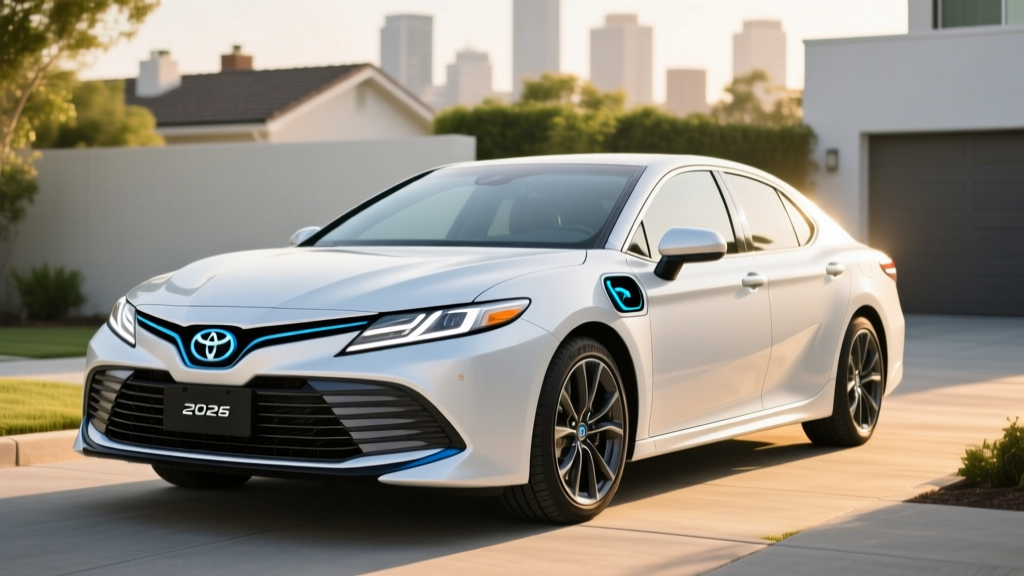
Before diagnosing a fault, it helps to understand the system you're dealing with. The 2026 Toyota Camry Hybrid uses Toyota's fifth-generation hybrid system (THS V), which pairs a 2.5-liter Dynamic Force four-cylinder engine with two motor-generators and a lithium-ion hybrid battery pack (upgraded from the NiMH pack used in prior generations for most trims).
| Spec | 2026 Camry Hybrid (FWD) | 2026 Camry Hybrid (AWD) |
|---|---|---|
| Combined Horsepower | 225 hp | 232 hp |
| Engine | 2.5L 4-cyl + MG1/MG2 | 2.5L 4-cyl + MG1/MG2 + rear motor |
| Hybrid Battery | ~1.6 kWh Li-ion | ~1.6 kWh Li-ion |
| EPA City MPG | 53 mpg | 51 mpg |
| EPA Highway MPG | 50 mpg | 49 mpg |
| EPA Combined MPG | 51 mpg | 50 mpg |
| 0-60 mph | ~7.1 sec | ~6.7 sec |
| Base MSRP (LE) | $29,995 | $31,395 |
Source: fueleconomy.gov and Toyota Motor Corporation specifications.
Real-World MPG vs. EPA Sticker
Toyota's hybrid system is one of the few powertrains where real-world fuel economy often matches or exceeds the EPA estimate — particularly in city driving. The Camry Hybrid's city-dominant EPA cycle (53 mpg FWD) reflects how the electric motor handles low-speed propulsion while the engine shuts off at stops. In mixed suburban commuting, owners routinely report 48-54 mpg. Highway-only driving at 75+ mph tends to drop to 42-46 mpg, as aerodynamic drag overwhelms the hybrid system's efficiency advantage.
HEV vs. PHEV: The Camry Is a Conventional Hybrid
A common source of confusion is whether the Camry Hybrid needs to be plugged in. It does not. The Camry Hybrid is a conventional hybrid electric vehicle (HEV), meaning it charges its small battery pack entirely through regenerative braking and the gasoline engine. There is no plug, no charging port, and no electric-only driving range to speak of (the EV mode allows roughly 0.5–1 mile at very low speeds).
Conventional Hybrid (HEV)
Example: Toyota Camry Hybrid
- No plug-in required
- Small battery (~1.6 kWh)
- Gas engine + electric motor assist
- 50+ mpg combined
- No federal EV tax credit
Plug-In Hybrid (PHEV)
Example: Toyota RAV4 Prime
- Plugs in to charge (Level 1/2)
- Larger battery (~18.1 kWh)
- 42 miles electric-only range
- Gas engine for longer trips
- May qualify for §30D federal credit (up to $7,500)
If you want plug-in capability in a Toyota sedan, the closest option is no longer available in the US market — Toyota discontinued the Prius Prime's sedan-form-factor competition. For PHEV sedans, look at the Hyundai Sonata PHEV or consider stepping into a RAV4 Prime SUV.
Diagnosing the Check Hybrid System Warning
When you bring the Camry to a dealer or hybrid specialist, the technician will pull OBD-II diagnostic trouble codes (DTCs) specific to the hybrid system. The most frequently encountered codes include:
- P0A80 — Replace Hybrid Battery Pack (general pack failure)
- P0A7F — Hybrid Battery Pack Deterioration (cell imbalance)
- P0A09 — DC/DC Converter Circuit Low (12V charging circuit)
- P0AFA — Hybrid System Voltage Low
- P3190 / P3191 — Engine insufficient power (can trigger hybrid warning as secondary)
The code alone does not dictate the repair. A P0A80, for instance, could mean a full battery replacement or, in some cases, a single failed module that can be replaced individually by a specialist. This is why a proper diagnosis at a Toyota dealer or a dedicated hybrid repair shop is essential.
Common Fixes and Cost Ranges
| Issue | Typical Repair | Estimated Cost |
|---|---|---|
| 12V auxiliary battery failure | Replace 12V battery | $180–$320 |
| Inverter coolant pump failure | Replace pump, refill coolant | $400–$800 |
| Single hybrid battery module degradation | Module replacement + rebalance | $500–$1,500 (specialist) |
| Full hybrid battery pack failure | New OEM battery pack | $2,000–$4,000 (dealer) |
| Inverter assembly failure | Replace inverter | $1,500–$3,000 |
| Blown HV fuse | Replace fuse, inspect circuit | $200–$600 |
Costs vary significantly by region and whether you use a Toyota dealer or an independent hybrid specialist. Independent shops that specialize in hybrid battery reconditioning can often save $1,000+ on pack-level repairs.
Toyota Hybrid Battery Warranty: What's Covered
Toyota covers the hybrid battery pack and hybrid system components for 10 years or 150,000 miles (whichever comes first) on all 2020 and newer Camry Hybrids. This is one of the strongest hybrid battery warranties in the industry. Prior to 2020, coverage was 8 years/100,000 miles in most states and 10 years/150,000 miles in California Air Resources Board (CARB) states.
If your Camry Hybrid is within this window and the Check Hybrid System warning traces to a battery or hybrid-component defect, the repair should be covered at no cost to you. Contact your Toyota dealer with your VIN to confirm eligibility.
It is worth noting that the warranty covers defects and premature failures — not normal gradual capacity loss that does not trigger a fault code. In practice, however, Toyota's hybrid batteries have demonstrated exceptional longevity. Data from fleet operators and consumer reports show many Camry and Prius hybrid packs lasting 180,000–250,000+ miles before requiring replacement.
Does the Camry Hybrid Qualify for Any Tax Credit?
No. The conventional Toyota Camry Hybrid (HEV) does not qualify for the federal §30D Clean Vehicle Credit. Under current IRS rules, only battery electric vehicles (BEVs) and plug-in hybrid electric vehicles (PHEVs) with a minimum battery capacity of 7 kWh are eligible. The Camry Hybrid's ~1.6 kWh pack falls far short of this threshold.
- ✅ Vehicle must be a BEV or PHEV (not a conventional HEV)
- ✅ Battery capacity ≥ 7 kWh
- ✅ Final assembly in North America
- ✅ MSRP caps: $55,000 (sedans) / $80,000 (SUVs, trucks, vans)
- ✅ Buyer income caps: $150K single / $300K joint (AGI)
- ✅ Critical minerals and battery component sourcing requirements apply
- ❌ Toyota Camry Hybrid (HEV): Not eligible
Source: IRS.gov — verify current-year rules before purchasing.
Some states offer their own incentives for hybrid vehicles, but these are increasingly rare as state programs shift focus to zero-emission BEVs. Check your state's energy office or Alternative Fuels Data Center for local programs.
Camry Hybrid vs. Full EV vs. Gas: Which Fits You?
Choose Camry Hybrid If:
- You want 50+ mpg with zero behavior change
- No home charging access (apartment, street parking)
- You take frequent long road trips
- Budget is ~$30K–$38K
- You want proven reliability and low risk
Choose a Full EV If:
- You can install a Level 2 home charger
- Daily commute is under 250 miles
- You want $0 gas and minimal maintenance
- Federal $7,500 tax credit applies to you
- You want the lowest per-mile fuel cost
Choose Gas-Only If:
- Upfront cost is the top priority
- You drive very few miles per year
- You live in an area with minimal charging infrastructure and no hybrid service options
For the vast majority of drivers who cannot install home charging, the Camry Hybrid represents the best balance of efficiency, cost, and convenience. The 51 mpg combined rating translates to roughly $700–$900 in annual fuel costs (15,000 miles/year at $3.20/gallon), compared to $1,800+ for a comparable 28 mpg gas-only midsize sedan.
Pros and Cons: 2026 Toyota Camry Hybrid
✅ Pros
- 51 mpg EPA combined — class-leading for a midsize sedan
- Standard Toyota Safety Sense 3.0 (ADAS suite)
- Smooth, quiet powertrain transitions
- 10-year/150,000-mile hybrid battery warranty
- Strong resale value and reliability track record
- Available AWD for snow-belt states
❌ Cons
- No plug-in / no electric-only range to speak of
- No federal tax credit eligibility
- CVT-like driving feel under hard acceleration
- Hybrid battery replacement cost ($2,000–$4,000) after warranty
- AWD model loses 1 mpg vs. FWD
- Check Hybrid System warnings can be expensive out of warranty
Frequently Asked Questions
How many MPG does the Toyota Camry Hybrid get?
The 2026 Toyota Camry Hybrid FWD is EPA-rated at 53 city / 50 highway / 51 combined mpg. The AWD variant rates at 51/49/50 mpg. Real-world city driving often matches or slightly exceeds these figures, while sustained highway driving above 75 mph typically yields 42–46 mpg.
Can I drive the Camry Hybrid if the Check Hybrid System light is on?
You can drive short distances in fail-safe mode, but performance is significantly reduced. The gasoline engine will run continuously, fuel economy drops, and regenerative braking may be disabled. Schedule a diagnostic appointment immediately — prolonged driving in limp mode can stress other components.
How much does it cost to replace a Camry Hybrid battery?
A new OEM hybrid battery pack from a Toyota dealer typically costs $2,000–$4,000 including labor. Independent hybrid specialists may offer reconditioned packs or individual module replacements for $500–$1,500. If your Camry is within the 10-year/150,000-mile hybrid warranty window, the replacement is covered at no charge.
Is the Toyota Camry Hybrid reliable long-term?
Yes. Toyota's hybrid system is among the most proven in the industry, with millions of units on the road globally. The hybrid battery pack commonly lasts 180,000+ miles. The 2026 Camry Hybrid carries a 10-year/150,000-mile hybrid system warranty. IIHS and Consumer Reports consistently rate the Camry Hybrid as above average for predicted reliability.
Does the Camry Hybrid qualify for any tax credit?
No. The conventional Camry Hybrid (HEV) does not qualify for the federal §30D Clean Vehicle Credit, which requires a plug-in vehicle with at least 7 kWh of battery capacity. Some states may offer minor hybrid incentives — check your local programs.
What's the difference between the Camry Hybrid and a plug-in hybrid?
The Camry Hybrid is a conventional HEV — it never plugs in and uses a small ~1.6 kWh battery charged by the engine and regenerative braking. A PHEV like the Toyota RAV4 Prime has a much larger battery (~18.1 kWh), a charging port, and 40+ miles of electric-only range before the gas engine kicks in. PHEVs can qualify for federal tax credits; conventional HEVs cannot.