Quick Verdict: The Cayenne E-Hybrid's Efficiency Story
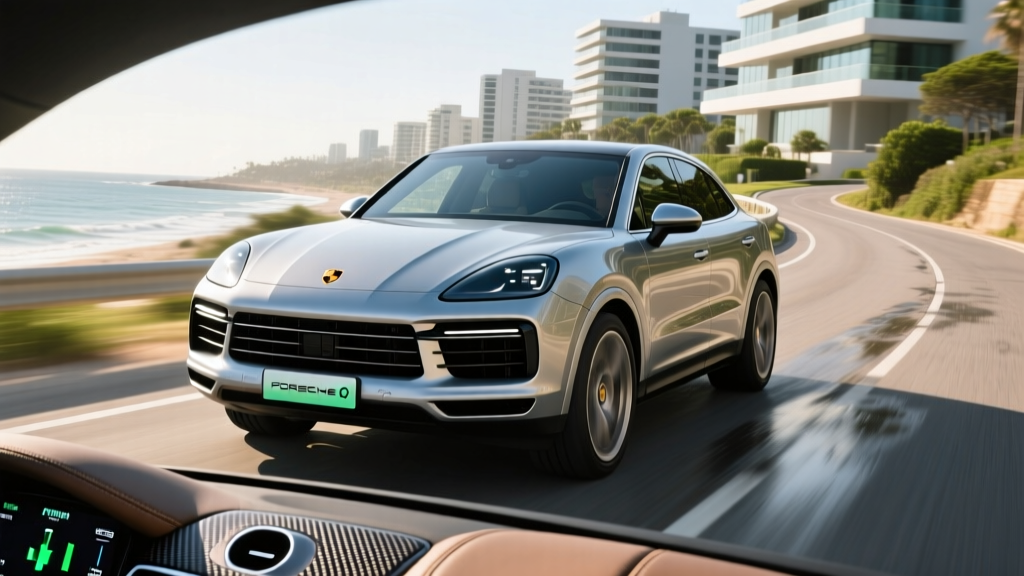
The Porsche Cayenne E-Hybrid occupies a specific niche: a performance luxury SUV that lets you commute on electricity and hit the canyons on weekends without range anxiety. For 2026, the Cayenne E-Hybrid pairs a turbocharged V6 with a more powerful electric motor than its predecessor, yielding an EPA-estimated 21 MPG combined once the battery depletes and a usable electric-only range of roughly 27 miles. If Cayenne hybrid MPG is on your research list, the real story is how that number shifts depending on whether you're driving in E-Power mode through the city or blending gas and electric on the highway.
This guide covers the full efficiency picture — EPA figures, real-world expectations, charging logistics, powertrain output, pricing, tax-credit eligibility, and battery longevity — so you can decide whether the plug-in hybrid Cayenne fits your garage or whether a full BEV or conventional gas Cayenne makes more sense.
HEV vs PHEV: What the Cayenne Hybrid Actually Is
Important distinction: Porsche does not sell a conventional hybrid (HEV) Cayenne in the U.S. market. The Cayenne E-Hybrid is a plug-in hybrid electric vehicle (PHEV), meaning it carries a larger battery than a standard hybrid, can be plugged in to recharge, and offers a meaningful electric-only driving range. A conventional HEV (like a Toyota RAV4 Hybrid) recharges its small battery solely through regenerative braking and the engine — you never plug it in. The Cayenne E-Hybrid does both: you can plug it in for ~27 miles of zero-emission driving, or simply drive it as a hybrid once the battery is depleted.
This matters for your expectations. If you can charge at home nightly, the Cayenne E-Hybrid functions as a short-range EV for daily commutes. If you can't charge regularly, it operates as a powerful — but not especially fuel-thrifty — hybrid SUV.
Cayenne Hybrid MPG: EPA Numbers and Real-World Results
Here's the official efficiency breakdown from fueleconomy.gov for the 2026 Porsche Cayenne E-Hybrid:
| Metric | EPA Estimate | Real-World Expectation |
|---|---|---|
| Combined MPG (charge-sustaining / hybrid mode) | 21 MPG | 19–23 MPG depending on driving style |
| City MPG (hybrid mode) | 20 MPG | 21–24 MPG (regen helps in stop-and-go) |
| Highway MPG (hybrid mode) | 22 MPG | 19–21 MPG (aerodynamic drag hurts at 75+ mph) |
| Combined MPGe (with full battery) | 46 MPGe | Varies heavily with electric miles driven |
| Electric-only range | 27 miles | 22–26 miles (climate control and hills reduce it) |
| Total combined range (gas + electric) | ~380 miles | ~340–370 miles real-world |
Real-world context: The 21 MPG combined figure applies once the 25.9 kWh battery is depleted and the Cayenne operates purely as a hybrid. In practice, if you charge nightly and your commute is under 25 miles round-trip, you may burn almost no gasoline during the workweek. On a long road trip where the battery depletes in the first 27 miles and the remaining 300 miles are gas-powered, expect fuel economy closer to 19–20 MPG at highway speeds — this is a 5,200-pound luxury SUV, after all. City driving in hybrid mode can actually push slightly above the EPA estimate thanks to aggressive regenerative braking recapturing energy at low speeds.
Electric-Only Range, Battery, and Charging Specs
The 2026 Cayenne E-Hybrid uses a 25.9 kWh battery pack (gross capacity, with a usable buffer of approximately 22–23 kWh to protect longevity). Here's what that translates to in daily use:
| Specification | Detail |
|---|---|
| Battery capacity (gross) | 25.9 kWh |
| Electric-only range (EPA) | 27 miles |
| Top speed in E-Power mode | 84 mph |
| Level 1 charging (120V / 1.4 kW) | ~18 hours for full charge |
| Level 2 charging (240V / 7.2 kW onboard charger) | ~3.5 hours for full charge |
| DC fast charging | Not available |
| Charge port | J1772 (Level 2 AC) |
The Cayenne E-Hybrid does not support DC fast charging. This is typical for PHEVs — the battery is small enough that Level 2 AC charging overnight fully replenishes it. At the onboard charger's maximum rate of 7.2 kW, a full 0–100% charge takes roughly 3.5 hours on a 240V Level 2 circuit. On a standard 120V household outlet (Level 1), expect an overnight-plus timeline of around 18 hours, which is impractical for daily top-ups. Plan on installing a Level 2 home charger if you want to maximize the electric-only benefit.
Battery warranty: Porsche covers the Cayenne E-Hybrid's high-voltage battery for 8 years or 100,000 miles, whichever comes first. This is the standard PHEV/EV battery warranty mandated for emissions-related components and aligns with competitors like BMW and Mercedes. If the battery's capacity drops below a defined threshold (typically 70% state of health) within that period, Porsche will repair or replace it. Out-of-warranty replacement costs for PHEV battery packs in this class generally range from $8,000 to $14,000 including labor, though real-world failures within the warranty period are uncommon based on current degradation data.
Powertrain: Where 463 Horsepower Meets Efficiency
The Cayenne E-Hybrid's powertrain is a collaboration between a turbocharged internal-combustion engine and an electric motor integrated into the transmission:
- Engine: 3.0-liter turbocharged V6 producing 348 hp and 369 lb-ft of torque
- Electric motor: Integrated into the 8-speed Tiptronic S transmission, producing 174 hp and 339 lb-ft
- Combined system output: 463 hp and 479 lb-ft of torque
- 0–60 mph: 4.6 seconds (with Launch Control)
- Top speed: 157 mph
- Drivetrain: All-wheel drive (AWD)
The electric motor doesn't just boost acceleration — it enables silent, zero-emission driving at low speeds and fills in torque while the turbo spools up. This is the PHEV advantage: you get EV-like smoothness around town and the sustained power of a turbo V6 on the highway. The combined 463 hp puts the E-Hybrid between the base Cayenne (348 hp) and the Cayenne S (468 hp) in output, with the added benefit of electric-only capability.
Pricing, Trims, and Tax Credit Eligibility
The 2026 Porsche Cayenne E-Hybrid starts at an MSRP of approximately $91,900 (including destination). Well-optioned examples with Premium Plus packages, adaptive air suspension, and larger wheels routinely cross the $110,000–$120,000 mark.
Federal §30D tax credit eligibility for the Cayenne E-Hybrid:
- The Cayenne E-Hybrid's MSRP falls under the SUV cap of $80,000 — however, many build configurations exceed this threshold, which disqualifies them from the credit. Check your specific build.
- Buyer income caps apply: $300,000 joint / $225,000 head of household / $150,000 individual (modified AGI).
- Battery component and critical mineral sourcing requirements must be met per current IRS rules. As of 2026, strict foreign-entity-of-concern (FEOC) restrictions significantly limit which vehicles qualify.
- The credit can be transferred to the dealer as a point-of-sale rebate if eligible, reducing your purchase price at signing.
- Bottom line: Given Porsche's European supply chain and MSRP positioning, the Cayenne E-Hybrid's eligibility for the full $7,500 credit is uncertain for most configurations. Consult a tax professional and verify on the IRS clean vehicle credit list before counting on it.
At the state level, several states offer additional PHEV rebates or HOV lane access (notably California, Colorado, and New York), though amounts and eligibility vary by jurisdiction. Check your state's energy office or DMV for current programs.
Who Should Buy the Cayenne E-Hybrid vs. a Full EV or Gas Model
Pros
- 27 miles of silent, zero-emission electric commuting
- 463 hp with seamless torque fill from the electric motor
- No range anxiety — gas engine covers road trips effortlessly
- Home charging is sufficient; no dependency on public DC chargers
- Porsche build quality, ride refinement, and driving dynamics
- 8-year/100,000-mile high-voltage battery warranty
Cons
- 21 MPG combined in hybrid mode is modest for a PHEV
- No DC fast charging capability
- Level 1 (120V) charging is impractically slow
- Federal tax credit eligibility is uncertain for most builds
- High starting MSRP; options escalate cost quickly
- Electric-only range covers only shorter commutes
Choose the Cayenne E-Hybrid if: You have home Level 2 charging, your daily round-trip commute is under 30 miles, you want a performance luxury SUV with electric weekday driving and gas-powered weekend freedom, and you value Porsche driving dynamics over maximum efficiency.
Choose a full EV (like the Porsche Taycan Cross Turismo or BMW iX) if: You want zero gasoline use, have reliable home and/or workplace charging, your road trips are within DC fast-charging network coverage, and you want lower per-mile energy costs.
Choose the gas Cayenne if: You lack home charging access, your commute is long and highway-heavy (where the PHEV's electric advantage disappears), and you want a lower purchase price without the weight penalty of a large battery pack.
Reliability and Long-Term Ownership Outlook
Porsche's PHEV powertrains have demonstrated solid reliability in recent model years, with the Cayenne E-Hybrid's battery and electric motor adding fewer failure points than some owners expect. The 8-speed Tiptronic transmission is a proven ZF unit used across the industry. The primary long-term cost concern is the high-voltage battery once the 8-year/100,000-mile warranty expires. Based on current PHEV battery degradation data, most owners see 8–12% capacity loss over the first 8 years — meaning your 27-mile electric range might drop to ~24 miles by year eight. That's livable. A full out-of-warranty battery replacement, should it become necessary, is estimated at $8,000–$14,000 depending on labor rates and parts availability.
For broader reliability context, IIHS crash-test ratings and Porsche's position in J.D. Power dependability studies are worth reviewing before purchase. Porsche typically ranks mid-pack among luxury brands in long-term dependability — not class-leading, but acceptable given the performance-oriented engineering.
Frequently Asked Questions
How many MPG does the Porsche Cayenne Hybrid get?
The 2026 Cayenne E-Hybrid is EPA-rated at 21 MPG combined (20 city / 22 highway) in charge-sustaining hybrid mode. In real-world driving, expect 19–23 MPG depending on conditions. When factoring in electric-only miles driven on a full battery, the combined MPGe rating is 46 MPGe.
How far can the Cayenne E-Hybrid go on electric only?
The EPA rates the Cayenne E-Hybrid at 27 miles of electric-only range. In real-world conditions — with climate control running, hills, or cold weather — expect 22 to 26 miles. Highway speeds above 70 mph will deplete the battery faster than the EPA test cycle suggests.
Does the Cayenne E-Hybrid qualify for a tax credit?
Eligibility for the federal §30D clean vehicle credit is uncertain for most Cayenne E-Hybrid builds. The MSRP must stay under the $80,000 SUV cap, and battery sourcing requirements must be met. Many optioned-up Cayenne E-Hybrids exceed the MSRP cap. Check the IRS clean vehicle credit page and consult a tax professional for your specific situation.
Is the Cayenne E-Hybrid battery reliable and what does replacement cost?
Porsche covers the high-voltage battery for 8 years or 100,000 miles. PHEV batteries in this class have shown moderate degradation (8–12% over 8 years) rather than catastrophic failure. Out-of-warranty replacement is estimated at $8,000–$14,000. Most owners will not need a replacement within the warranty period.
Hybrid vs PHEV vs EV — which Cayenne should I buy?
The Cayenne E-Hybrid (PHEV) is best if you want electric commuting plus gas-powered road-trip range. A full EV (like the Macan Electric or Taycan) suits you if you have reliable charging and want zero gasoline. The conventional gas Cayenne makes sense if you lack charging access and prioritize lower upfront cost. Porsche does not sell a non-plug-in HEV Cayenne in the U.S.
Can I charge the Cayenne E-Hybrid at a DC fast charger?
No. The Cayenne E-Hybrid supports only AC charging via a J1772 port — Level 1 (120V) or Level 2 (240V, up to 7.2 kW). A full charge on Level 2 takes about 3.5 hours. This is standard for PHEVs, whose smaller batteries are designed for overnight home charging.