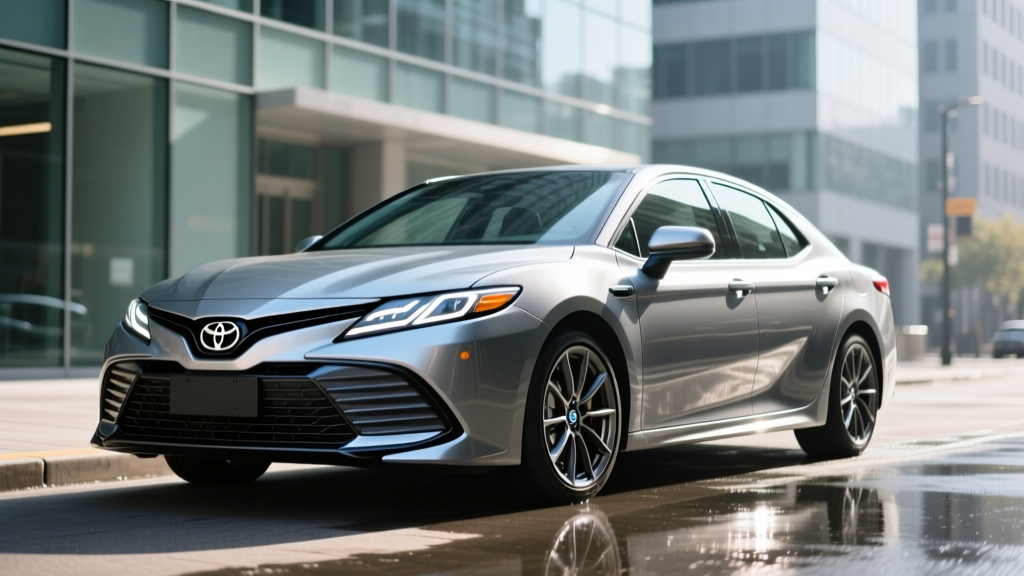
The 2026 Toyota Camry XSE Hybrid occupies a narrow but appealing lane: it's the sportiest trim in a lineup that now runs exclusively on Toyota's fifth-generation hybrid powertrain. There is no gas-only Camry anymore. For the XSE buyer, that means you get the aggressive styling, sport-tuned suspension, and available all-wheel drive — paired with an EPA-estimated 47 MPG combined. The question isn't whether this car is efficient; it's whether the sport-oriented hybrid package delivers enough engagement to justify its premium over the SE and LE Hybrid trims.
Camry XSE Hybrid Powertrain: 225 HP With AWD
Every 2026 Camry Hybrid uses Toyota's 2.5-liter four-cylinder Dynamic Force engine mated to electric motors and a lithium-ion traction battery. The XSE Hybrid comes standard with electronic all-wheel drive (AWD), which adds a rear-mounted electric motor. This configuration produces a combined 225 horsepower — 208 hp in front-wheel-drive trims.
| Specification | Detail |
|---|---|
| Engine | 2.5L 4-cylinder Dynamic Force (184 hp / 163 lb-ft) |
| Front Electric Motor | Permanent magnet synchronous (integrated in transaxle) |
| Rear Electric Motor (AWD) | 40 hp independent rear motor |
| Combined System Output | 225 hp |
| Traction Battery | Lithium-ion, ~1.6 kWh (self-charging HEV) |
| Transmission | eCVT (electronically controlled continuously variable) |
| Drivetrain | Electronic AWD (standard on XSE Hybrid) |
| 0–60 mph | ~7.1 seconds (est.) |
Because this is a conventional hybrid (HEV), not a plug-in hybrid (PHEV), the battery recharges through regenerative braking and the gasoline engine. You never plug it in. The 1.6 kWh battery is small by electrified-vehicle standards — it exists to buffer energy for electric assist, low-speed EV-mode crawling, and regen capture, not to provide meaningful electric-only driving range.
Fuel Economy: EPA Ratings and Real-World MPG
The 2026 Camry XSE Hybrid with AWD carries EPA estimates of 44 MPG city, 51 MPG highway, and 47 MPG combined, according to fueleconomy.gov. These numbers are slightly lower than the FWD LE Hybrid's 53/50/52 rating, a trade-off for the XSE's larger 19-inch wheels, sport-tuned suspension, and the parasitic loss of the rear AWD motor.
| Trim | Drivetrain | City MPG | Highway MPG | Combined MPG |
|---|---|---|---|---|
| LE Hybrid | FWD | 53 | 50 | 52 |
| SE Hybrid | FWD | 48 | 47 | 47 |
| XSE Hybrid | AWD | 44 | 51 | 47 |
| XLE Hybrid | AWD | 44 | 51 | 47 |
Real-world expectation: Toyota's hybrid system excels in stop-and-go city driving, where the electric motor handles low-speed propulsion and the engine shuts off at stops. Many owners report exceeding EPA city estimates in warm-weather urban commuting — 50+ MPG is achievable on flat terrain with moderate acceleration. Highway driving at sustained 75–80 mph speeds will typically yield 43–48 MPG. In cold weather (below 35°F), expect a 5–10% reduction as the engine runs more frequently to maintain cabin heat and battery temperature.
HEV vs. PHEV vs. Full EV: Which Powertrain Fits You?
The Camry is offered only as a conventional hybrid (HEV). Toyota discontinued the Prius Prime-style PHEV approach for the Camry. If you're cross-shopping electrified sedans, here's how the three powertrain types compare:
Conventional Hybrid (HEV) — Camry XSE Hybrid
How it works: Small battery (~1.6 kWh) charged by the engine and regen braking. No plug-in required.
Electric-only range: Less than 1 mile at very low speeds (EV mode).
Best for: Drivers without home charging access, high-mileage commuters, those who want zero behavior change from a gas car.
Fuel cost: At $3.50/gal and 47 MPG combined, roughly $0.074 per mile.
Plug-In Hybrid (PHEV) — e.g., Toyota Prius Prime
How it works: Larger battery (~13.6 kWh) that plugs in for electric-only driving, then operates as a hybrid.
Electric-only range: 35–44 miles (Prius Prime).
Best for: Drivers with home Level 2 charging and a commute under 40 miles who want electric daily driving plus gas flexibility for road trips.
Fuel cost: Near-zero on electric commute days; hybrid MPG on longer trips.
Full Battery Electric (BEV) — e.g., Tesla Model 3, Hyundai Ioniq 6
How it works: Large battery (60–80+ kWh), electric motor only. Must plug in to recharge.
Range: 250–360+ miles EPA.
Best for: Drivers with reliable home or workplace charging, those who want minimal maintenance and the lowest per-mile energy cost.
Fuel cost: At $0.15/kWh and 4 mi/kWh, roughly $0.038 per mile.
The Camry XSE Hybrid makes sense if you want the simplicity of a gas-car routine (fill up at any station, no charging infrastructure dependency) with dramatically better fuel economy. If you have garage charging and a short commute, a PHEV like the Prius Prime or a BEV may save more on energy — but at higher purchase prices.
Pricing, Trims, and Tax Credit Eligibility
The 2026 Camry XSE Hybrid starts at an MSRP of approximately $35,995, including destination charge. This positions it roughly $2,500–$3,000 above the SE Hybrid and $4,000+ above the LE Hybrid base.
| Trim | Drivetrain | Starting MSRP |
|---|---|---|
| LE Hybrid | FWD | ~$30,495 |
| SE Hybrid | FWD | ~$33,495 |
| XSE Hybrid | AWD | ~$35,995 |
| XLE Hybrid | AWD | ~$36,495 |
Federal tax credit status: The Camry Hybrid does not qualify for the federal §30D clean vehicle tax credit (up to $7,500). Per IRS guidelines, the §30D credit applies only to plug-in electric vehicles (BEVs and PHEVs) that meet battery capacity, critical-mineral sourcing, MSRP cap, and buyer income requirements. A conventional hybrid like the Camry — with its small, non-plug-in battery — does not meet the plug-in requirement.
Some states offer their own incentives for hybrid vehicles, though these are far less common than EV incentives. Check your state's energy office or department of revenue for current programs. Toyota also periodically offers manufacturer loyalty or lease cash that can reduce the effective price.
Hybrid Battery Warranty and Replacement Cost
Hybrid battery longevity is consistently the top concern for first-time hybrid buyers. Toyota addresses this with one of the strongest hybrid battery warranties in the industry.
Hybrid Battery Warranty
Coverage: 10 years or 150,000 miles (whichever comes first), applicable to the original owner and all subsequent owners.
What's covered: Hybrid traction battery, hybrid control module, and related hybrid system components.
Capacity threshold: Toyota warrants against abnormal degradation and defects — if the battery fails to hold sufficient charge for normal hybrid operation, it's covered.
Source: Toyota Warranty Information
Real-world lifespan data: Toyota's hybrid battery packs in the Camry and Prius have demonstrated exceptional longevity. Independent fleet data and owner surveys consistently show these batteries lasting 150,000–200,000+ miles before requiring replacement. The smaller, less stressed lithium-ion pack in the Camry Hybrid faces far fewer charge cycles than a BEV battery, which is a key factor in its durability.
Replacement cost if out of warranty: A replacement hybrid battery for the Camry Hybrid typically ranges from $2,500 to $4,000 including labor at a Toyota dealership. Third-party reconditioned battery options can reduce this to $1,500–$2,500. For context, this is a fraction of a BEV traction battery replacement ($8,000–$20,000+), and most Camry Hybrid owners will never face this expense within the vehicle's useful life.
Driving Impressions: Does the XSE Feel Sporty?
The XSE trim adds specific hardware that distinguishes it from the comfort-oriented XLE and the value-focused LE. You get a sport-tuned suspension with stiffer damping, 19-inch alloy wheels with lower-profile tires, paddle shifters, and a more aggressive front fascia. The result is noticeably firmer ride quality and sharper turn-in compared to the XLE — though it's important to frame this correctly. This is a midsize sedan with a CVT, not a sports car.
The eCVT eliminates the gear-shift drama of a traditional automatic, delivering smooth, linear acceleration. Toyota has programmed simulated shift points under hard throttle to reduce the "drone" effect that CVTs are known for, and it works reasonably well. The AWD system's rear motor engages automatically under acceleration and in low-traction conditions, providing confident launches from stops and added stability in rain or light snow.
At 225 hp combined, the Camry XSE Hybrid is adequately quick for merging and passing — the 0–60 mph time of approximately 7.1 seconds is competitive with turbocharged four-cylinder rivals. The regenerative braking feel has been improved over prior generations, with a more natural pedal transition between regen and friction braking, though the pedal still feels slightly firmer at the top of its travel than a conventional brake.
Interior, Technology, and Cargo
The 2026 Camry XSE Hybrid features a 12.3-inch touchscreen (8.0-inch on lower trims) running Toyota's latest Audio Multimedia system with wireless Apple CarPlay and Android Auto. The XSE adds sport SofTex-trimmed seats with fabric inserts, a leather-wrapped steering wheel, ambient lighting, and dual-zone automatic climate control.
The Toyota Safety Sense 3.0 suite is standard across all trims, including Pre-Collision System with Pedestrian Detection, Full-Speed Range Dynamic Radar Cruise Control, Lane Departure Alert with Steering Assist, Lane Tracing Assist, and Proactive Driving Assist. Note: these are SAE Level 1–2 driver-assistance features — they require constant driver attention and do not constitute self-driving capability.
Cargo volume stands at 15.1 cubic feet in the trunk, unchanged from the non-hybrid Camry of prior generations. The hybrid battery sits under the rear seat, preserving full trunk space. There is no frunk (front trunk), as the engine bay is fully occupied by the gasoline engine and hybrid transaxle.
Who Should Buy the Camry XSE Hybrid?
Choose the Camry XSE Hybrid if:
- You want 45+ MPG without ever plugging in
- You need AWD for rain or snow but don't want an SUV
- You prefer sport-tuned ride and aggressive styling over luxury comfort
- You drive 15,000+ miles annually and fuel cost matters
- You want Toyota's proven hybrid reliability with a 10-year battery warranty
- You don't have access to home or workplace EV charging
Look elsewhere if:
- You want electric-only daily commuting — consider a PHEV or BEV
- You prioritize ride comfort over handling — choose the XLE Hybrid instead
- You want eligibility for the $7,500 federal tax credit — look at BEVs or qualifying PHEVs
- You want a manual or traditional automatic transmission — the eCVT is the only option
- You need more than 15 cu-ft of cargo space — consider a RAV4 Hybrid or Venza
Frequently Asked Questions
How many MPG does the Camry XSE Hybrid actually get?
The EPA rates the 2026 Camry XSE Hybrid AWD at 44 city / 51 highway / 47 combined MPG. In real-world mixed driving, most owners report 44–50 MPG combined. City-heavy routes in warm weather can push above 50 MPG, while sustained highway speeds above 75 mph and cold-weather driving will reduce economy to the low-to-mid 40s.
Does the Camry XSE Hybrid need to be plugged in?
No. The Camry Hybrid is a conventional hybrid (HEV). Its small lithium-ion battery charges entirely through regenerative braking and the gasoline engine. You fuel it like any other car at a gas station — there is no plug, no charging cable, and no electric-only range to manage.
Is the Camry Hybrid battery reliable, and what does replacement cost?
Toyota's hybrid batteries have an excellent long-term reliability record, commonly lasting 150,000–200,000+ miles. The battery is warranted for 10 years / 150,000 miles. If replacement is needed out of warranty, expect $2,500–$4,000 at a dealer or $1,500–$2,500 with a reconditioned unit.
Does the 2026 Camry Hybrid qualify for any tax credit?
The Camry Hybrid does not qualify for the federal §30D clean vehicle credit (up to $7,500), which is reserved for plug-in vehicles (BEVs and PHEVs) meeting specific battery-sourcing and income requirements. Some states may offer smaller hybrid incentives — check your state's energy office. Manufacturer incentives and dealer discounts may also apply.
Camry XSE Hybrid vs. RAV4 Hybrid: which is more efficient?
The Camry XSE Hybrid (47 MPG combined) is significantly more fuel-efficient than the RAV4 Hybrid AWD (approximately 39–41 MPG combined), owing to its lower weight and more aerodynamic sedan profile. The RAV4 offers more cargo space (37.6 cu-ft) and a higher seating position. Your choice depends on whether fuel economy or utility is the higher priority.