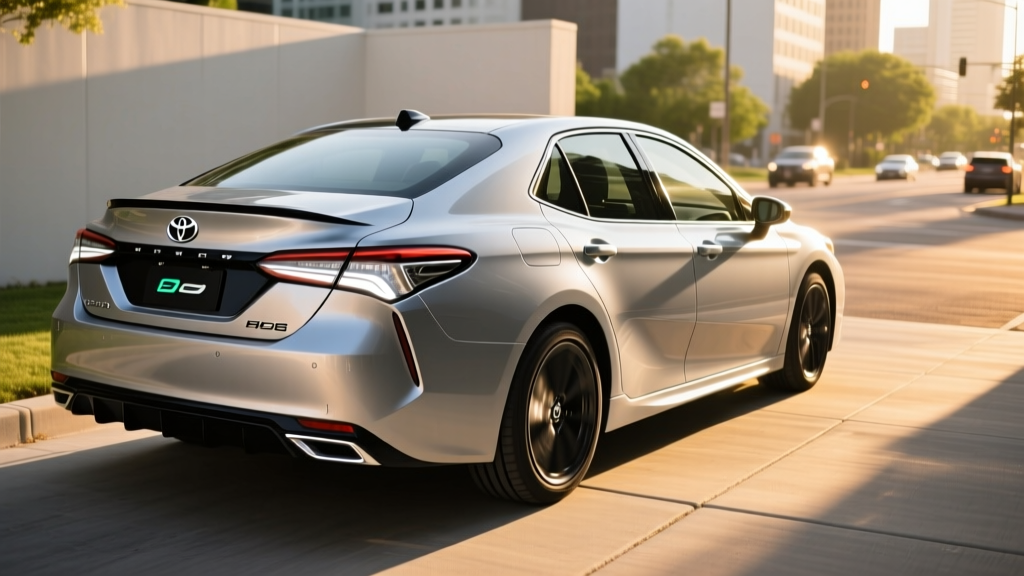
The 2026 Toyota Camry Hybrid has become one of the most compelling midsize sedans for drivers who want electric-motor responsiveness without ever plugging in. With a fifth-generation Toyota Hybrid System (THS) under the hood, the Camry Hybrid delivers a 0-60 mph time of approximately 7.2 seconds — quick enough to merge confidently onto any interstate — while returning EPA-estimated fuel economy that embarrasses many compact cars. This guide covers every performance and efficiency number that matters, from real-world MPG to battery longevity and total cost of ownership.
Camry Hybrid 0-60 and Powertrain Specs
For the 2026 model year, Toyota equips every Camry Hybrid with a 2.5-liter four-cylinder engine paired with one or two electric motors, depending on drivetrain. The front-wheel-drive (FWD) setup uses a single front motor, while the available Electronic On-Demand All-Wheel Drive (AWD) adds a second, independent rear motor. Combined system output lands at 225 horsepower for FWD and 232 horsepower for AWD trims.
| Spec | FWD Trims | AWD Trims |
|---|---|---|
| Combined Horsepower | 225 hp | 232 hp |
| Engine | 2.5L 4-cyl + 1 electric motor | 2.5L 4-cyl + 2 electric motors |
| 0-60 mph | ~7.2 seconds | ~7.0 seconds |
| Transmission | eCVT | eCVT |
| Drivetrain | Front-wheel drive | Electronic On-Demand AWD |
| Towing Capacity | Not rated | Not rated |
The Camry Hybrid's 0-60 time of roughly 7.0–7.2 seconds puts it ahead of most turbocharged four-cylinder competitors in the midsize sedan segment, including the Honda Accord Hybrid (approximately 7.5 seconds) and the Hyundai Sonata Hybrid (approximately 7.8 seconds). The electric motor's instant torque — available from 0 RPM — gives the Camry Hybrid a punchy off-the-line feel that the stopwatch confirms. Unlike turbocharged engines that lag before building boost, the hybrid system delivers linear, predictable acceleration.
The eCVT (electronically controlled continuously variable transmission) deserves specific mention. Unlike belt-driven CVTs found in some competitors, Toyota's eCVT uses a planetary gearset that manages power flow between the engine and motors with no rubber-band effect. Under hard acceleration, the engine revs to its power band and holds there, but the result is smooth and progressive rather than droning.
EPA Fuel Economy vs. Real-World MPG
Fuel efficiency is where the Camry Hybrid makes its strongest case. The EPA at fueleconomy.gov rates the 2026 Camry Hybrid as follows:
| Drivetrain | City MPG | Highway MPG | Combined MPG |
|---|---|---|---|
| FWD (LE) | 53 | 50 | 51 |
| FWD (SE/XLE/XSE) | 48 | 47 | 47 |
| AWD (SE/XLE/XSE) | 46 | 46 | 46 |
The LE trim's 51 MPG combined figure is exceptional. The higher trims sacrifice a few miles per gallon due to larger 18- or 19-inch wheels, wider tires, and additional weight from premium features.
Real-World MPG: What Owners Actually See
Hybrid vehicles frequently exceed their EPA city estimates in real-world driving because city conditions — frequent stops, low speeds — maximize regenerative braking and electric-motor usage. Many Camry Hybrid owners report 52–56 MPG in mixed suburban and city driving during mild weather. Highway-only driving at 75+ mph typically yields 42–46 MPG for the LE trim, slightly below the EPA highway sticker, which is normal for any vehicle due to aerodynamic drag scaling with the square of speed.
Cold weather impacts hybrid fuel economy too. In sub-freezing temperatures, expect a 5–10% MPG reduction as the engine runs more frequently to maintain cabin heat and keep the hybrid battery at optimal operating temperature. This is a minor penalty compared to the 20–30% range loss a full EV experiences in the same conditions.
HEV vs. PHEV vs. Full EV: Which Powertrain Fits You?
The Camry Hybrid is a conventional hybrid (HEV) — it does not plug in. Toyota does not currently offer a Camry plug-in hybrid (PHEV) variant. Understanding the difference matters before you buy:
| Feature | HEV (Camry Hybrid) | PHEV (e.g., RAV4 Prime) | BEV (e.g., Tesla Model 3) |
|---|---|---|---|
| Plugs In? | No | Yes | Yes |
| Electric-Only Range | ~1 mile at low speed | 25–42 miles | 250–360 miles |
| Total Range | 570+ miles | 400–500 miles | 250–360 miles |
| Fuel/Energy Cost | Gas only (~$0.08/mi) | Gas + electricity | Electricity only (~$0.04/mi) |
| Home Charging Needed? | No | Recommended | Required |
| Federal Tax Credit | Not eligible (§30D) | Up to $7,500 if eligible | Up to $7,500 if eligible |
| Maintenance | Oil changes + standard | Oil changes + standard | Minimal (no oil changes) |
Choose the Camry Hybrid (HEV) if: You lack access to home or workplace charging, you want maximum simplicity with zero behavior change from a gas car, and you prioritize low fuel cost without range planning. The Camry Hybrid's 13-gallon tank and 51 MPG combined give it a real-world driving range exceeding 570 miles between fill-ups — more than double most EVs.
Consider a PHEV if: You can charge at home and most daily trips fall under 30 miles, but you still want a gas engine for road trips. Toyota's RAV4 Prime (42 miles electric-only) is the closest PHEV alternative in the Toyota lineup, though it's an SUV, not a sedan.
Choose a full EV (BEV) if: You have reliable home Level 2 charging, want the lowest per-mile energy cost, and your typical trips stay within 250 miles or you're comfortable with DC fast-charging stops on road trips.
Pricing, Trims, and Tax Credit Eligibility
The 2026 Toyota Camry Hybrid starts at a competitive MSRP and offers four primary trims:
| Trim | Drivetrain | Approx. MSRP |
|---|---|---|
| LE | FWD | $30,495 |
| SE | FWD / AWD | $32,095 / $33,495 |
| XLE | FWD / AWD | $34,595 / $35,995 |
| XSE | FWD / AWD | $35,495 / $36,895 |
Does the Camry Hybrid Qualify for a Federal Tax Credit?
No. The Camry Hybrid is a conventional hybrid (HEV), not a plug-in vehicle. The IRS §30D Clean Vehicle Credit applies only to battery electric vehicles (BEVs) and plug-in hybrids (PHEVs) with a minimum battery capacity of 7 kWh that meet critical-mineral and battery-component sourcing requirements. The Camry Hybrid's small traction battery (approximately 1.6 kWh, NiMH) does not qualify for any federal purchase incentive.
Some states offer their own incentives for hybrid vehicles, though these are increasingly rare as state programs shift focus to plug-in vehicles. Check your state's energy office or department of environmental quality for current programs. A few states still offer reduced registration fees or HOV lane access for hybrids, but these benefits vary by jurisdiction and change frequently.
Hybrid Battery Warranty, Lifespan, and Replacement Cost
Battery longevity is the number-one concern for first-time hybrid buyers. Here's what the data shows:
2026 Camry Hybrid Battery Warranty
- Hybrid Battery: 10 years / 150,000 miles (whichever comes first), covering defects and capacity loss below a defined threshold
- Hybrid System Components: 8 years / 100,000 miles (inverter, electric motors, control modules)
- Limited Powertrain: 5 years / 60,000 miles
- California Emissions States: Hybrid battery coverage extends to 10 years / 150,000 miles under PZEV warranty provisions in CARB-adopting states
Real-World Battery Longevity
Toyota's hybrid battery packs have an outstanding track record. The Camry Hybrid uses a nickel-metal hydride (NiMH) battery pack — a mature, proven chemistry that sacrifices some energy density compared to lithium-ion but offers exceptional cycle-life durability. Data from fleet operators, taxi services, and long-term owners consistently shows Camry Hybrid batteries lasting 150,000–200,000+ miles before any significant capacity loss.
The hybrid system manages battery health through several mechanisms: it never allows the battery to fully charge or fully discharge (maintaining a roughly 40–80% state-of-charge window), and it uses active thermal management to keep cell temperatures within an optimal range. This shallow-cycling strategy is the primary reason Toyota hybrid batteries outlast the vehicles themselves in most cases.
Battery Replacement Cost
If a hybrid battery does fail outside of warranty, replacement costs for a Camry Hybrid typically range from $2,500 to $4,000 including parts and labor at a Toyota dealer. Independent hybrid specialists often offer refurbished battery packs for $1,500–$2,500. Individual cell module replacement is sometimes possible for $500–$1,000 if only a few modules have degraded. Given that most Camry Hybrids will see 200,000+ miles on the original battery, the replacement-cost risk is minimal for most owners.
Reliability and Ownership Costs
Toyota's hybrid powertrains consistently rank among the most reliable in the industry. The eCVT planetary gearset has no belts, clutches, or bands to wear out — it's essentially a set of gears in constant mesh, making it more durable than conventional automatic or belt-driven CVT transmissions. The regenerative braking system also reduces wear on the friction brakes, with many owners reporting original brake pads lasting 80,000–100,000 miles.
According to IIHS ratings data, the Camry carries top safety scores, and the hybrid variant shares the same structural platform. Toyota Safety Sense 3.0 comes standard on every trim, including pre-collision braking, adaptive cruise control, lane-keeping assist, and automatic high beams — all Level 1 and Level 2 driver-assistance features that require the driver to remain engaged at all times.
Five-Year Cost of Ownership Estimate
Here's a realistic five-year / 75,000-mile ownership cost comparison for the Camry Hybrid LE versus a comparable gas-only midsize sedan averaging 30 MPG combined, assuming $3.50/gallon gasoline:
| Vehicle | MPG Combined | Gallons Used (75k mi) | Fuel Cost (@$3.50/gal) |
|---|---|---|---|
| Camry Hybrid LE | 51 | 1,471 | $5,148 |
| Gas Midsize Sedan | 30 | 2,500 | $8,750 |
| 5-Year Fuel Savings (Hybrid) | $3,602 | ||
The Camry Hybrid's fuel savings of roughly $3,600 over five years partially offsets its modest price premium over a gas-only equivalent. Factor in reduced brake wear and strong resale value — Toyota Hybrids hold their value exceptionally well — and the total cost of ownership case strengthens further.
Pros and Cons of the 2026 Camry Hybrid
Pros
- Quick 0-60 time (~7.2 sec) with smooth, linear acceleration
- Class-leading 51 MPG combined (LE trim)
- No plug-in required — zero behavior change from gas car ownership
- 570+ mile total driving range per tank
- Proven hybrid battery with 10yr/150k-mile warranty
- Available AWD with independent rear electric motor
- Standard Toyota Safety Sense 3.0 on all trims
Cons
- No federal tax credit (HEV, not PHEV)
- AWD trims drop to 46 MPG combined
- No plug-in / electric-only driving mode for emissions-free short trips
- eCVT engine drone under sustained hard acceleration
- Rear seat space slightly tighter than some competitors
- No DC fast charging capability (not applicable to HEVs)
Who Should Buy the Camry Hybrid?
The 2026 Camry Hybrid is the right choice if you want dramatically lower fuel costs without altering your driving or refueling habits. It's ideal for apartment dwellers without charging access, high-mileage commuters who rack up 20,000+ miles annually, and buyers who plan to own their vehicle for 10+ years and want Toyota's proven hybrid reliability.
It's not the right pick if you want zero-emission electric-only driving for short trips (consider a PHEV), if you want the lowest possible per-mile energy cost (a BEV charged at home on off-peak electricity wins), or if you need a large cargo area (look at the RAV4 Hybrid or Highlander Hybrid).
Frequently Asked Questions
How fast is the Camry Hybrid from 0 to 60 mph?
The 2026 Camry Hybrid reaches 0-60 mph in approximately 7.2 seconds (FWD) or 7.0 seconds (AWD). The electric motor's instant torque gives it strong initial acceleration that feels quicker than the numbers suggest in everyday driving.
How many MPG does the Camry Hybrid actually get?
The EPA rates the Camry Hybrid LE at 53 city / 50 highway / 51 combined MPG. In real-world mixed driving, many owners report 50–55 MPG. Highway-only driving at high speeds drops this to the low-to-mid 40s. Cold weather reduces efficiency by approximately 5–10%.
Does the Camry Hybrid need to be plugged in?
No. The Camry Hybrid is a conventional hybrid (HEV). It charges its own small battery through regenerative braking and the gasoline engine. You simply fill it with gas like any other car.
How long will the Camry Hybrid battery last?
Toyota's hybrid batteries routinely last 150,000–200,000+ miles based on long-term ownership data. The battery is warranted for 10 years / 150,000 miles. If replacement is ever needed, expect to pay $2,500–$4,000 at a dealer, or less through an independent hybrid specialist.
Does the Camry Hybrid qualify for any tax credit?
No federal tax credit is available for the Camry Hybrid because it is not a plug-in vehicle. The IRS §30D credit applies only to BEVs and PHEVs meeting specific battery-sourcing and MSRP/income requirements. Some states may offer minor incentives — check your local jurisdiction.
Is the Camry Hybrid faster than the gas-only Camry?
Yes. The previous-generation gas-only Camry with the 2.5L four-cylinder posted 0-60 times around 7.6–8.0 seconds. The Camry Hybrid's 7.0–7.2 second time is quicker, thanks to the electric motor filling in torque during the engine's lower RPM range. Note that for the 2025+ model year, Toyota transitioned the Camry lineup to hybrid-only powertrains in the US market, making the hybrid the default Camry.
Camry Hybrid vs. RAV4 Hybrid — which is more efficient?
The Camry Hybrid LE (51 MPG combined) significantly outperforms the RAV4 Hybrid (approximately 40 MPG combined) due to its lower weight, more aerodynamic sedan body, and smaller frontal area. If efficiency is your priority and you don't need SUV cargo space, the Camry Hybrid wins decisively.
The 2026 Toyota Camry Hybrid occupies a specific and valuable position in the electrified-vehicle landscape: it delivers measurable fuel savings, real acceleration performance, and decade-long battery reliability without requiring a single change in how you refuel or drive. For buyers not yet ready for a plug-in vehicle — whether due to charging access, budget, or preference — the Camry Hybrid remains the benchmark midsize sedan to beat.