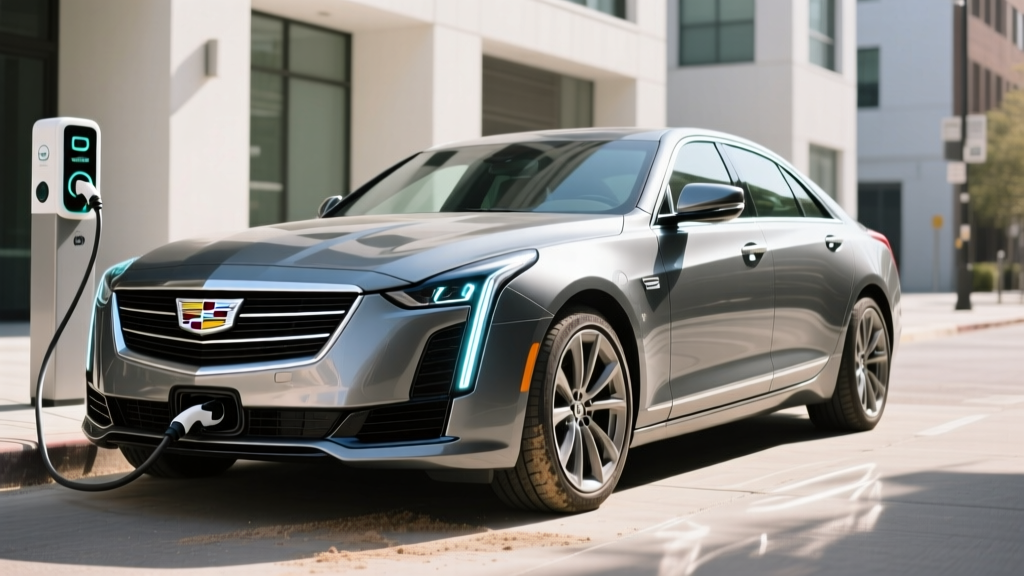
Quick Verdict: The Cadillac CT6 Plug-In was a bold luxury PHEV experiment — pairing a 2.0L turbo with twin electric motors for 335 combined horsepower and an EPA-rated 31 miles of electric-only range. Discontinued after the 2019 model year, it remains a compelling used PHEV option for luxury sedan buyers who want electric commuting with gas-engine road-trip flexibility. If you're shopping the used market in 2026, understanding its real-world efficiency, battery health, and warranty status is critical before signing.
What Exactly Is the Cadillac CT6 Plug-In?
The Cadillac CT6 Plug-In (officially badged as the CT6 PHEV) was Cadillac's entry into the luxury plug-in hybrid sedan segment, sold in the U.S. for the 2017 through 2019 model years. It competed against the BMW 530e, Mercedes S 560e, and Volvo S90 T8 — offering a distinctly American take on electrified luxury.
Unlike a conventional hybrid (HEV) such as the Toyota Prius, which generates all its electricity from the engine and regenerative braking and never plugs in, the CT6 Plug-In is a plug-in hybrid electric vehicle (PHEV). That means it carries a larger battery pack you can charge from a wall outlet or charging station, enabling a meaningful electric-only driving range before the gasoline engine kicks in.
HEV vs. PHEV — The Key Difference
| Feature | Conventional Hybrid (HEV) | Plug-In Hybrid (PHEV) |
|---|---|---|
| Plugs in to charge? | No | Yes |
| Battery size | ~1–2 kWh | ~8–25 kWh |
| Electric-only range | 0–2 miles (low speed only) | 20–50+ miles at full speed |
| Federal tax credit | No (discontinued for most) | Was eligible; now expired for new, possible used credit |
| Example | Toyota Camry Hybrid | Cadillac CT6 Plug-In |
Powertrain Specs: Engine, Motors, and Combined Output
The CT6 PHEV powertrain is a sophisticated three-motor setup that was genuinely innovative for its time. Here's the full breakdown:
| Specification | Detail |
|---|---|
| Gasoline Engine | 2.0L Turbocharged 4-Cylinder (265 hp / 295 lb-ft) |
| Electric Motors | Twin motor integrated into transmission (Voltec-derived) |
| Combined System Output | 335 hp / 432 lb-ft torque |
| Transmission | Electrically Variable Transmission (EVT) |
| Drive Type | Rear-Wheel Drive |
| 0–60 mph | ~5.2 seconds |
| Battery Capacity (gross) | 18.4 kWh (Lithium-Ion, NMC chemistry) |
| Battery Capacity (usable) | ~14.4 kWh |
| Battery Location | Between rear seats and trunk (reduces cargo space) |
The Voltec-derived drivetrain shares DNA with the Chevrolet Volt's system but is reengineered for a larger, heavier luxury sedan. The twin electric motors are integrated directly into the transmission housing, enabling seamless transitions between EV mode, hybrid mode, and engine-only operation. Cadillac programmed four drive modes: Tour (default hybrid), Sport (aggressive throttle and shift mapping), Hold (saves battery for later use), and Electric (EV-only until battery depletes).
Electric-Only Range and Total Driving Range
The EPA rated the CT6 Plug-In at 31 miles of electric-only range on a full charge. That's enough to cover the average American's one-way commute (roughly 16 miles each way, per Census Bureau data) entirely on electricity — assuming you charge at home or work.
Real-World Range vs. EPA Sticker
EPA Electric-Only: 31 miles
Real-World Expectation: 24–29 miles in mixed driving; as low as 20–22 miles in cold weather (below 40°F) or sustained highway speeds above 70 mph. Battery heating and cabin climate draw significantly from the 14.4 kWh usable pack.
Total Combined Range (electric + gas): EPA rated at approximately 440 miles. With the 18.5-gallon fuel tank and combined operation, expect 380–420 miles real-world on a full charge plus full tank.
One practical advantage of the PHEV layout: once the battery depletes, the CT6 operates as a conventional hybrid. You're never stranded — the gasoline engine and regenerative braking keep you moving indefinitely. This eliminates the range anxiety some buyers feel with battery-electric vehicles (BEVs).
Fuel Economy: EPA MPG and MPGe Breakdown
Because the CT6 Plug-In operates in two distinct modes — charge-depleting (electric) and charge-sustaining (hybrid) — the EPA reports two separate efficiency figures:
| Mode | City | Highway | Combined |
|---|---|---|---|
| Charge-Depleting (EV + Hybrid blend) | 62 MPGe combined | ||
| Charge-Sustaining (Hybrid Only, battery depleted) | 23 MPG | 31 MPG | 26 MPG |
MPGe explained: Miles Per Gallon Equivalent converts electricity consumption into a gasoline-equivalent figure (33.7 kWh of electricity = 1 gallon of gasoline). The 62 MPGe figure applies when you're driving on a mix of battery charge and hybrid operation after a full charge. Once the battery is depleted and you're running purely on gasoline, the 26 MPG combined figure is what you'll see.
According to fueleconomy.gov, the CT6 PHEV consumes approximately 0.54 gallons of gasoline per 25 miles of mixed driving when starting with a full charge. Annual fuel cost is estimated at roughly $1,550 (based on 15,000 miles/year, 55% city driving, and current fuel/electricity prices — your results will vary).
Real-world MPG note: Owners who charge nightly and commute under 30 miles round-trip often report using very little gasoline for weeks at a time. Those who rarely charge and drive primarily on the highway will see the charge-sustaining figure of 25–28 MPG — respectable for a 4,400-pound luxury sedan but not class-leading versus the BMW 530e's 29 MPG combined in hybrid mode.
Charging: How Long and What Equipment You Need
The CT6 Plug-In uses a standard J1772 connector for AC charging. Here's what to expect:
| Charging Level | Power | Time to Full (from empty) | Miles of EV Range Added/Hour |
|---|---|---|---|
| Level 1 (120V household outlet) | ~1.4 kW | ~10–12 hours | ~3–4 miles/hr |
| Level 2 (240V home charger) | ~3.6 kW | ~4.5 hours | ~8–9 miles/hr |
| DC Fast Charging | Not supported — no DC fast-charge capability | ||
The onboard charger is limited to approximately 3.6 kW, which means even on a Level 2 home charger (which can deliver 7.2 kW or more), the car will only accept 3.6 kW. A full charge from empty takes about 4.5 hours on Level 2 — easily achievable overnight. Level 1 charging from a standard 120V outlet works but is slow; plan for 10+ hours, which means you'll want to plug in when you get home from work to be full by morning.
Important: The CT6 PHEV does not support DC fast charging. You won't find a CCS or CHAdeMO port on this vehicle. All charging is AC-only via the J1772 inlet on the driver's side rear quarter panel.
If you're installing a Level 2 home charger, expect to pay $500–$1,200 for the charger unit and $800–$2,500 for professional electrical installation (assuming your panel has capacity and no upgrade is needed). Consult a licensed electrician for a site-specific quote.
Used Market Pricing and Tax Credit Eligibility in 2026
The Cadillac CT6 Plug-In is no longer sold new — production ended after the 2019 model year. On the used market in 2026, expect to find examples priced between $22,000 and $35,000 depending on mileage, condition, trim (Luxury or Premium Luxury), and battery health.
Original MSRP when new ranged from approximately $76,090 (Luxury trim) to $80,090 (Premium Luxury) before any incentives — positioning it as a premium luxury offering.
Federal Tax Credit Status
When new: The CT6 PHEV qualified for a federal tax credit of approximately $6,785 under the pre-2023 rules (based on battery capacity). This credit was available to original purchasers who had sufficient tax liability.
In 2026 (used purchase): Under the Inflation Reduction Act's §25E Used Clean Vehicle Credit, qualifying buyers may be eligible for a credit of up to $4,000 (30% of sale price, capped at $4,000) on a used PHEV purchase from a licensed dealer, subject to:
- Sale price must be $25,000 or less
- Buyer income caps: $75,000 single / $112,500 head of household / $150,000 joint
- Vehicle must be at least 2 model years old (CT6 PHEV qualifies)
- Vehicle must have a battery capacity of at least 7 kWh (CT6's 18.4 kWh qualifies)
- Must purchase from a licensed dealer (private-party sales don't qualify)
- Credit is non-refundable — you must have tax liability to use it
Consult a tax professional to confirm your specific eligibility. Rules are subject to change.
Reliability, Battery Health, and Warranty Coverage
The CT6 PHEV's Voltec-derived powertrain has proven generally reliable, benefiting from GM's extensive experience with the Chevrolet Volt's similar architecture. However, as a low-volume luxury model, some CT6-specific components (suspension, interior electronics) follow typical Cadillac reliability patterns — adequate but not class-leading.
Battery and Powertrain Warranty
Hybrid Battery Warranty (when new): 8 years / 100,000 miles (whichever comes first), covering defects and capacity loss below 60% of original capacity.
Powertrain Warranty: 6 years / 70,000 miles.
Bumper-to-Bumper: 4 years / 50,000 miles.
2026 Reality Check: A 2017 model's 8-year battery warranty expired in 2025. A 2018 model's warranty expires in 2026. A 2019 model's battery warranty runs through 2027 or 100,000 miles. If you're buying used, verify the remaining warranty by VIN with a Cadillac dealer.
Battery replacement cost: If the 18.4 kWh lithium-ion pack needs replacement out of warranty, expect a dealer-quoted price of approximately $4,000–$7,000 for the battery module assembly plus labor. Independent EV battery repair shops may offer module-level repair (replacing individual degraded cells rather than the full pack) for $1,500–$3,500. GM's modular battery design makes partial repair feasible.
Battery degradation in practice: Owners on Volt/PHEV forums report typical degradation of 8–15% over 5–7 years and 60,000–80,000 miles. A CT6 PHEV with 70,000 miles might see its electric-only range drop from 31 miles to approximately 26–28 miles — a modest reduction. The liquid-cooled thermal management system helps preserve battery health compared to passively cooled packs.
To assess battery health on a used example, ask the seller or dealer for a State of Health (SoH) reading. Some OBD-II scanners and apps (such as myChevrolet or third-party tools compatible with GM's Global B/C architecture) can read battery capacity data. A SoH above 85% is considered healthy for a 5–8 year-old PHEV battery.
Who Should Choose the CT6 Plug-In — and Who Shouldn't
Decision Framework
Choose the CT6 Plug-In if:
- Your daily commute is under 30 miles round-trip and you can charge at home
- You want a full-size luxury sedan with genuine electric commuting capability
- You take occasional road trips and don't want to plan around charging infrastructure
- You're shopping the used market and want PHEV technology at a depreciated price
- You value the quiet, torque-rich EV driving experience for city and suburban driving
Consider a full EV (BEV) instead if:
- You have reliable home charging and rarely drive more than 250 miles in a day
- You want to eliminate gasoline entirely (no oil changes, no fuel stops)
- You prefer a newer vehicle with current warranty coverage and the latest tech
Consider a conventional HEV (no plug) instead if:
- You cannot charge at home or at work (apartment, street parking)
- You want maximum simplicity — no charging cables, no plug-in routine
- Your driving is mostly highway miles where PHEV electric-range advantage diminishes
Skip the CT6 PHEV if:
- You need a large trunk — the battery placement significantly reduces cargo volume to approximately 10.1 cubic feet (vs. 15.3 cu ft in the gas-only CT6)
- You prioritize the latest infotainment and driver-assist technology (2017–2019 tech is dated by 2026 standards)
- You want all-wheel drive — the CT6 PHEV is rear-wheel drive only
Pros
- 31 miles EPA electric-only range covers most commutes
- 335 combined HP delivers confident acceleration (5.2s to 60)
- Voltec-derived powertrain is proven and serviceable
- Luxury sedan comfort with electric quietness in EV mode
- No range anxiety — gas engine provides 440+ mile total range
- Used pricing offers luxury PHEV value at steep depreciation
Cons
- Trunk space severely compromised (10.1 cu ft)
- 3.6 kW onboard charger is slow by modern standards
- No DC fast charging capability
- Rear-wheel drive only — no AWD option
- Discontinued model — parts availability may narrow over time
- 2017–2019 infotainment and ADAS tech is dated
- Battery warranty expiring or expired on most examples
Frequently Asked Questions
How many MPG does the Cadillac CT6 Plug-In get?
The EPA rates the CT6 PHEV at 62 MPGe combined when operating in charge-depleting mode (blending battery and gasoline). Once the battery is depleted, it operates as a conventional hybrid rated at 23 city / 31 highway / 26 combined MPG. Real-world results depend heavily on how often you charge — daily chargers with short commutes may use gasoline only a few times per month.
How far can the CT6 Plug-In go on electric only?
The EPA rates it at 31 miles of electric-only range. In real-world conditions, expect 24–29 miles in moderate weather and mixed driving, dropping to 20–22 miles in cold weather or at sustained highway speeds above 70 mph.
Is the Cadillac CT6 Plug-In reliable?
The Voltec-derived powertrain is generally reliable, sharing architecture with the well-proven Chevrolet Volt. Cadillac-specific electronics and air suspension (if equipped) are more common failure points. Check for open recalls and verify battery State of Health before purchasing a used example.
What does a CT6 PHEV battery replacement cost?
Out-of-warranty replacement runs approximately $4,000–$7,000 at a dealer. Independent shops may offer module-level repair for $1,500–$3,500. Most owners report only 8–15% degradation over 5–7 years, making full replacement uncommon at typical mileages.
Does the CT6 Plug-In qualify for a tax credit in 2026?
It no longer qualifies for the new-vehicle §30D credit (discontinued). However, under the §25E Used Clean Vehicle Credit, eligible buyers purchasing from a dealer for $25,000 or less may qualify for up to $4,000, subject to income limits ($75K single / $150K joint). Consult a tax professional for your specific situation.
Can the CT6 Plug-In charge at public fast-charging stations?
No. The CT6 PHEV only supports AC charging via a J1772 connector at up to 3.6 kW. It has no DC fast-charge port. Public Level 2 chargers (ChargePoint, EVgo Level 2, etc.) will work, but expect a full charge to take approximately 4.5 hours.
How does the CT6 PHEV compare to a full EV like the Tesla Model S?
The CT6 PHEV offers luxury sedan comfort with 31 miles of electric range plus unlimited gas-engine range. A Model S provides 400+ miles of pure electric range, faster charging, and no gasoline dependency — but at a significantly higher purchase price. The CT6 PHEV makes sense if you need gas-engine flexibility for long trips and find a good deal on the used market.
Sources: EPA fueleconomy.gov — 2019 Cadillac CT6 PHEV, IRS §25E Used Clean Vehicle Credit, Cadillac/GM archived specification sheets.