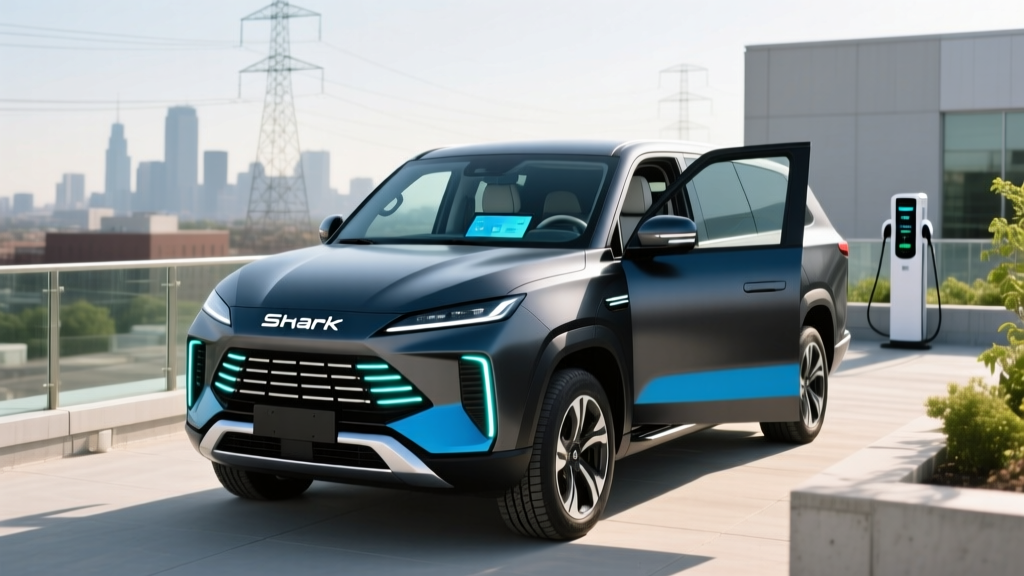
The BYD Shark 6 plug-in hybrid pickup has generated relentless forum chatter and YouTube speculation since its 2024 global debut. With a turbocharged 1.5-liter engine paired with dual electric motors, all-wheel drive, and a claimed electric-only range exceeding 60 miles, the Shark looks like the midsize truck a lot of American buyers have been waiting for. But there's one persistent problem: you cannot buy a BYD Shark in the United States, and as of early 2026, there is no confirmed timeline for when — or if — that will change.
This profile breaks down everything we know about the BYD Shark's powertrain, battery, charging, and pricing from international markets, then gives you an honest assessment of the regulatory, tariff, and strategic barriers standing between this truck and an American driveway. If you've been searching for BYD Shark USA availability, this is the reality check.
BYD Shark 6: What It Actually Is
The BYD Shark 6 (badged simply "Shark" in some markets) is a midsize, body-on-frame plug-in hybrid pickup built on BYD's DMO (Dual Mode Off-Road) platform. It competes globally against the Toyota Hilux, Ford Ranger, and Isuzu D-Max but differentiates itself with a series-parallel PHEV architecture that can operate as a pure EV for daily commuting and a hybrid for long hauls.
BYD launched the Shark first in Mexico in mid-2024, followed by Australia, New Zealand, and select South American and Southeast Asian markets in 2025. The United States, Canada, and Western Europe remain conspicuously absent from the rollout map.
Powertrain, Battery, and Electric-Only Range
The Shark 6 pairs a 1.5-liter turbocharged four-cylinder engine with two electric motors — one on each axle — for standard all-wheel drive. Here is the spec breakdown based on BYD's international press materials and Australian-market testing data:
| Specification | BYD Shark 6 (International) |
|---|---|
| Powertrain Type | Plug-in Hybrid (PHEV), series-parallel |
| Engine | 1.5L turbocharged I4 |
| Combined System Output | ~430 hp (320 kW) |
| Drivetrain | AWD (dual electric motor) |
| Battery Capacity | 29.58 kWh (BYD Blade, LFP chemistry) |
| EV-Only Range (WLTP) | ~62 miles (100 km) |
| EV-Only Range (EPA est.) | Not rated — estimated ~50-55 miles |
| Total Combined Range | ~590 miles (950 km) WLTP |
| 0-60 mph (claimed) | ~5.7 seconds |
| Towing Capacity | ~5,500 lbs (2,500 kg, braked) |
| Payload | ~1,760 lbs (800 kg) |
The 29.58 kWh BYD Blade battery uses lithium iron phosphate (LFP) chemistry, which trades some energy density for superior thermal stability and longer cycle life compared to NMC cells. For a PHEV, this is a large battery — roughly double the capacity of the Ford Maverick Hybrid's traction pack and significantly larger than the Toyota Tacoma i-FORCE MAX's hybrid battery. It's the reason the Shark can credibly serve as a daily EV commuter with a gas backup.
Charging: DC Fast Charge and Level 2 at Home
PHEV charging speeds are often an afterthought, but the Shark's large battery makes this a legitimate consideration — if you plan to commute on electricity, you'll want to recharge that 29.58 kWh pack daily.
| Charging Level | Power (kW) | Estimated Time (10-80%) | Notes |
|---|---|---|---|
| Level 1 (120V household) | ~1.4 kW | ~15 hours (full charge) | Trickle — overnight only, won't fully refill in 8 hrs |
| Level 2 (240V home/public) | ~7 kW (estimated) | ~3.5 hours (full charge) | Standard J1772/Type 2; adequate for overnight top-up |
| DC Fast Charge | Not officially confirmed; estimated ~40-50 kW peak | ~30-35 min (10-80% est.) | Some markets report CCS capability; BYD has not published a peak DC rate |
The critical gap here is DC fast-charging. BYD has not published an official peak DC charge rate for the Shark 6 in any market. Given the LFP battery size and BYD's PHEV charging patterns on the Sealion 6 (which peaks around 40 kW DC), expect modest fast-charging speeds — adequate for a highway lunch stop but nowhere near the 150+ kW rates of dedicated BEVs. For daily use, a home Level 2 charger is the practical solution: plug in when you get home, wake up to a full battery.
Why the BYD Shark Isn't Sold in the USA — and When It Might Be
This is the section that matters most if you've been Googling "BYD Shark USA." The truck's absence from American showrooms isn't a matter of BYD forgetting about the world's largest auto market. It's a deliberate calculation shaped by three hard barriers:
1. The 27.5% "Chicken Tax" on Imported Light Trucks
Since 1964, the United States has imposed a 27.5% tariff on imported light-duty pickup trucks — a retaliatory tariff originally targeting European potato starch and dextrin that has outlived its trade dispute and now functions as a permanent protection wall for domestic truck makers. BYD has no US manufacturing facility, meaning every Shark imported would carry this surcharge, instantly adding thousands of dollars to the sticker price and erasing the cost advantage that makes BYD vehicles compelling globally.
2. Escalating China-Specific Tariffs (2024-2026)
In May 2024, the Biden administration raised tariffs on Chinese-made EVs to 100% under Section 301, and extended significant duties to PHEVs and battery components as well. These tariffs, which remain in effect under the current administration through 2026, make importing a Chinese-built plug-in vehicle economically prohibitive. BYD would need to manufacture the Shark in Mexico, South America, or a yet-to-be-announced US plant to sidestep these duties — and BYD's Mexico factory plans have drawn intense political scrutiny from US lawmakers.
3. Federal Tax Credit Sourcing Rules (IRS §30D)
Even if BYD could physically deliver the Shark to US dealers, the truck would almost certainly fail to qualify for the §30D federal EV tax credit. Current rules require that battery components and critical minerals be sourced from the US or free-trade-agreement partners — and explicitly exclude vehicles containing battery components from a "foreign entity of concern" (FEOC), a category that effectively encompasses Chinese manufacturers like BYD. A Shark buyer would pay full MSRP with no $7,500 offset.
Bottom line on US availability: BYD executives have stated publicly that the US market is "under study," but no timeline, factory plan, or regulatory pathway has been announced as of early 2026. Industry analysts consider a US Shark launch before 2028 unlikely at best.
International Pricing and What a US Price Might Look Like
The Shark 6 launched in Mexico at approximately MXN $899,900 (roughly $48,000-$50,000 USD at launch exchange rates) and in Australia at AUD $59,990 (roughly $38,000-$40,000 USD). These prices position the Shark as a value-oriented alternative to the Ranger and Hilux in those markets.
Translating that to a hypothetical US MSRP requires adding the 27.5% Chicken Tax, Section 301 duties, US-spec compliance modifications (lighting, crash standards, OBD-II emissions certification), and dealer margin. A realistic US sticker, if BYD ever clears these hurdles, would likely land between $55,000 and $65,000 before any incentives — putting it in direct competition with a well-equipped Ford Ranger PHEV or Toyota Tacoma rather than undercutting them.
| Market | Local MSRP | Approx. USD | Federal EV Credit Eligible? |
|---|---|---|---|
| Mexico (2025 launch) | ~MXN $899,900 | ~$48,000-$50,000 | N/A (no US-equivalent credit) |
| Australia (2025) | AUD $59,990 | ~$38,000-$40,000 | N/A |
| USA (hypothetical) | $55,000-$65,000 est. | $55,000-$65,000 | No — FEOC battery sourcing exclusion |
How the Shark 6 Would Stack Up Against US Midsize Trucks
If BYD found a way to sell the Shark in America, here is the competitive landscape it would face:
- Ford Maverick Hybrid: Smaller unibody truck, HEV only (no plug), 42 MPG combined, starts around $28,000. Far cheaper but no EV-only commuting.
- Ford Ranger PHEV: Announced for global markets; US availability uncertain. Similar concept but backed by Ford's US dealer network and likely US production.
- Toyota Tacoma i-FORCE MAX: Mild hybrid (not a PHEV), no electric-only range, starts ~$40,000. Proven reliability, no plug-in capability.
- Chevrolet Colorado / GMC Canyon: Turbo gas only, no hybrid variant as of 2026. Strong towing, no electric commute mode.
- Rivian R1T: Fully electric (BEV), 270-420 mile EPA range, starts ~$70,000+. Premium segment, no gas backup.
The Shark's unique proposition — a body-on-frame midsize truck with 50+ miles of electric commuting range and a gas engine for long hauls — has no direct US rival today. That gap is precisely why interest persists despite the unavailability.
Tech, Interior, and Safety Features
International-market Shark 6 models come equipped with:
- Infotainment: 12.8-inch rotating center touchscreen (a BYD signature), 10.25-inch digital instrument cluster, wireless Apple CarPlay and Android Auto
- Driver Assist: Adaptive cruise control, lane-keep assist, blind-spot monitoring, 360-degree camera, automatic emergency braking — all SAE Level 1-2 driver assistance (the driver must remain fully engaged)
- Utility: 2,200W V2L (vehicle-to-load) power output via bed and cabin outlets — enough to run power tools, a campsite, or tailgate electronics
- Off-Road: Selectable terrain modes, electronic locking rear differential, ~9.4 inches of ground clearance
- Cabin: Crew cab with seating for five; rear legroom appears competitive with the Ranger class (~35-37 inches estimated) though US-spec measurements are unavailable
Notable drawbacks reported by international reviewers include a firm, truck-like ride when unloaded (expected for a body-on-frame leaf-spring rear axle), a turbo engine that sounds coarse under hard acceleration, and an infotainment system whose translation and UX polish lag behind Ford and Toyota's current offerings.
Warranty and Long-Term Battery Outlook
BYD offers varying warranty terms by market, but the typical international coverage for the Shark 6 is:
- Vehicle: 6 years / 150,000 km (~93,000 miles)
- Battery (HV): 8 years / 160,000 km (~100,000 miles), with capacity retention guaranteed above 70%
- Powertrain: 6 years / 150,000 km
The LFP Blade battery is a longevity positive. LFP chemistry typically sustains 3,000+ full charge cycles before reaching 80% state of health — far more than most owners will accumulate in a decade. For a PHEV with a ~30 kWh pack, that means the battery should outlast the truck's useful life under normal use. The 70% retention threshold in BYD's warranty is industry-standard but less generous than Hyundai's 70% at 10 years/100,000 miles or Tesla's 70% at 8 years/120,000 miles.
Should You Wait for the BYD Shark or Buy What's Available?
- Buy a Ford Maverick Hybrid if you want a fuel-efficient compact truck today and don't need electric-only commuting or serious towing.
- Buy a Toyota Tacoma if you want a proven midsize body-on-frame truck with strong resale value and don't need a plug.
- Buy a Rivian R1T if you want an electric truck with genuine range and can charge at home.
- Watch the Ford Ranger PHEV — if Ford brings it to the US (still unconfirmed), it would be the closest domestic analog to the Shark's concept, with dealer support and likely tax-credit eligibility.
Pros (If It Were Available)
- 50+ mile electric-only range — genuine EV commuting in a truck
- LFP Blade battery: long cycle life, thermal safety
- 430 hp combined with AWD — quick and capable
- V2L capability for job sites and camping
- Body-on-frame durability with 5,500-lb towing
Cons
- Not available in the USA — no confirmed timeline
- Would not qualify for §30D federal tax credit due to FEOC battery sourcing
- Chicken Tax + Section 301 duties would push US price to $55K-$65K+
- Unproven US service/parts network
- DC fast-charge speed unconfirmed and likely modest (~40-50 kW)
- Firm unloaded ride typical of leaf-spring trucks
Frequently Asked Questions
Can I buy a BYD Shark in the United States in 2026?
No. BYD does not sell any vehicles in the United States as of early 2026, and the Shark 6 has not been announced for the US market. The combination of the 27.5% Chicken Tax on imported trucks, 100%+ Section 301 tariffs on Chinese-made electrified vehicles, and FEOC battery-sourcing exclusions from the federal tax credit make a near-term US launch economically unviable.
What is the real-world electric range of the BYD Shark 6?
The Shark 6 carries a 29.58 kWh LFP battery with a WLTP-rated EV range of approximately 62 miles. An EPA-equivalent estimate would likely fall around 50-55 miles. Real-world highway driving at 70 mph should yield 40-48 electric miles; cold-weather driving (below freezing) may drop that to 30-35 miles. City commuting at moderate temperatures is where you'll see the best EV range.
How fast does the BYD Shark charge?
On a 240V Level 2 home charger, expect roughly 7 kW and a full charge in about 3.5 hours. DC fast-charging specs have not been officially published by BYD for any market; based on comparable BYD PHEVs, peak DC rates are estimated at 40-50 kW, meaning a 10-80% charge in roughly 30-35 minutes. This is modest compared to BEVs but typical for PHEVs.
Would the BYD Shark qualify for the $7,500 federal EV tax credit?
Almost certainly not. Under current IRS §30D rules, vehicles with battery components manufactured by a "foreign entity of concern" (FEOC) — a designation that effectively covers Chinese companies including BYD — are excluded from the credit regardless of MSRP or buyer income. Even if the Shark met the MSRP cap ($80,000 for trucks) and the buyer met income limits ($150K single / $300K joint), the battery sourcing rule would disqualify it.
Is the BYD Shark better than a Ford Ranger or Toyota Tacoma?
On paper, the Shark's PHEV powertrain offers something neither the Ranger nor Tacoma currently provides in the US: meaningful electric-only commuting range (50+ miles) in a body-on-frame truck. However, without US availability, a dealer network, crash-test ratings from NHTSA or IIHS, or tax-credit eligibility, it's impossible to make a fair comparison. If Ford brings the Ranger PHEV to the US, that would be the true head-to-head test.
What is BYD's Blade battery, and is LFP chemistry a good thing?
The Blade battery is BYD's proprietary cell-to-pack design using LFP (lithium iron phosphate) chemistry. LFP offers excellent thermal stability (very low risk of thermal runaway), long cycle life (3,000+ cycles to 80% SoH), and lower cost. The trade-off is lower energy density than NMC chemistry, meaning a heavier and bulkier pack for the same kWh. For a PHEV truck where weight is less critical than in a long-range BEV, LFP is a strong choice.
Will BYD ever build a factory in the US or Mexico?
BYD has explored manufacturing in Mexico, but as of 2026, those plans have stalled amid intense political pressure from US lawmakers concerned about Chinese auto manufacturing near the border. BYD has announced or opened passenger-vehicle factories in Thailand, Brazil, Hungary, Indonesia, and Turkey — but no North American facility. Without local production, the tariff barriers to selling trucks in the US remain insurmountable.
Sources: BYD international press materials; fueleconomy.gov for comparable PHEV EPA data; IRS §30D clean vehicle credit guidelines; Australian-market Shark 6 reviews and spec sheets from drive.com.au and carsales.com.au.