Quick Verdict: The Luxury PHEV That Actually Makes Sense
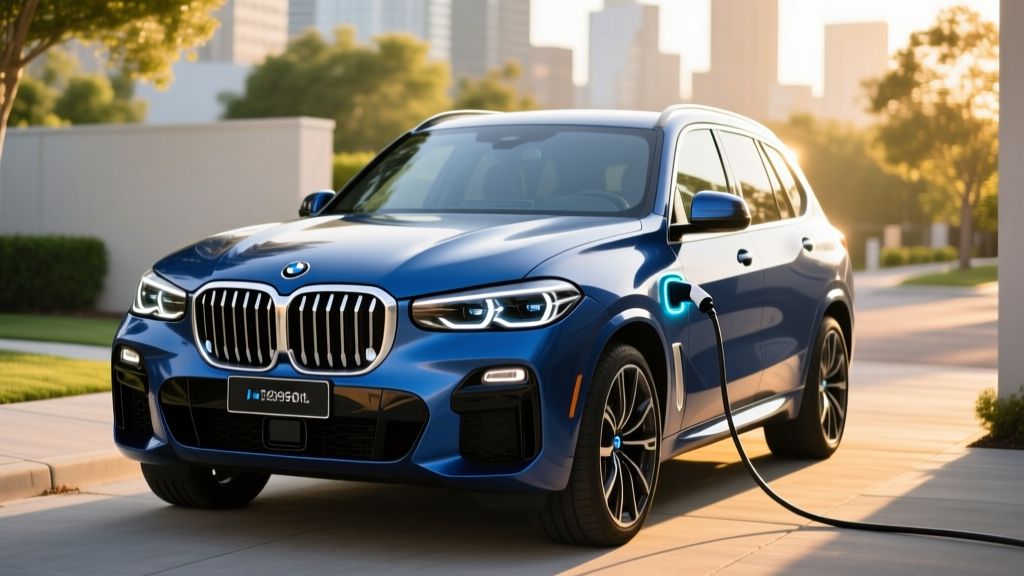
The BMW X5 xDrive50e occupies a specific and increasingly popular niche: a midsize luxury SUV that can handle your daily commute on electricity alone, then fire up its inline-six for cross-country road trips without a second thought. For the 2026 model year, BMW continues with the powertrain architecture introduced for this generation — a turbocharged 3.0-liter inline-six paired with a more powerful electric motor integrated into the transmission, yielding 483 combined horsepower and an EPA-estimated 38 miles of electric-only range.
If you can charge at home and your weekday driving stays under 35 miles, the xDrive50e operates as an EV most of the time. When the battery depletes, it seamlessly transitions to a conventional hybrid, returning respectable fuel economy for a 5,300-pound luxury SUV. This dual personality is the PHEV promise done right — but it comes at a premium price, and the federal tax credit situation is complicated.
| Spec | Value |
|---|---|
| EPA Electric-Only Range | 38 miles |
| Total Combined Range | ~440 miles (est.) |
| Battery (Usable) | 25.7 kWh (NMC lithium-ion) |
| Combined Horsepower | 483 hp / 516 lb-ft torque |
| 0–60 mph | 4.6 seconds |
| EPA MPGe (EV Mode) | 56 MPGe combined |
| EPA MPG (Hybrid Mode) | 27 combined (25 city / 29 hwy) |
| Level 2 Charge Time (0–100%) | ~3.5 hours at 7.4 kW |
| DC Fast Charging | Not available |
| Drivetrain | AWD (xDrive), 8-speed automatic |
| Base MSRP (xDrive50e) | $74,400 (+ $995 destination) |
| Battery Warranty | 8 years / 80,000 miles |
HEV vs. PHEV: Why the xDrive50e Is the Plug-In Variant
BMW sells the X5 in several flavors, and it is important to understand where the xDrive50e fits. A conventional hybrid (HEV), like the Toyota RAV4 Hybrid, uses a small battery recharged exclusively through regenerative braking and the engine — you never plug it in. A plug-in hybrid (PHEV) like the xDrive50e carries a much larger battery (25.7 kWh usable here) that you charge from an external power source, enabling meaningful electric-only driving before the engine kicks in.
| Feature | Conventional Hybrid (HEV) | Plug-In Hybrid (PHEV) |
|---|---|---|
| Plug in to charge? | No | Yes |
| Electric-only range | 0–2 miles (low-speed only) | 20–45 miles typical |
| Battery size | 1–2 kWh | 13–30+ kWh |
| Federal tax credit | No (discontinued for most) | Potentially, per §30D rules |
| Home charging needed | No | Strongly recommended |
| Example | Toyota Highlander Hybrid | BMW X5 xDrive50e |
The xDrive50e is exclusively a PHEV. If you see references to an "X5 hybrid" that does not plug in, that would be the mild-hybrid (MHEV) system on the xDrive40i, which uses a 48-volt system for stop-start smoothing and minor efficiency gains — not the same category at all. The xDrive50e is the genuine plug-in article.
Fuel Economy: EPA Numbers and Real-World MPG
The EPA rates the 2026 BMW X5 xDrive50e at 56 MPGe combined when operating in electric mode (this metric converts electricity consumption into a gasoline-equivalent figure for comparison). Once the battery is depleted and the inline-six takes over, the rating drops to 27 MPG combined, split as 25 city and 29 highway, per fueleconomy.gov.
| Mode | City | Highway | Combined |
|---|---|---|---|
| Electric (MPGe) | 55 MPGe | 57 MPGe | 56 MPGe |
| Gas Hybrid (MPG) | 25 MPG | 29 MPG | 27 MPG |
Real-World MPG: What to Actually Expect
These EPA figures assume you start with a full charge and blend electric and gas driving. In practice, your results depend heavily on your routine:
- Commuter with home charging (under 35 miles/day): You may use almost no gasoline for weeks. Real-world electricity consumption runs about 35–38 kWh/100 miles in mixed driving, which translates to roughly $0.04–$0.07 per mile depending on your local electricity rate.
- Long highway trips (battery depleted): Expect 25–28 MPG at 70–75 mph. The inline-six is efficient for its displacement, but aerodynamic drag and the 5,300-pound curb weight work against it. In cold weather (below 30°F), highway fuel economy can dip to 22–24 MPG as the engine works harder for cabin heat and the battery provides less assist.
- City driving after battery depletion: PHEVs often exceed their EPA city MPG in stop-and-go traffic because regenerative braking recaptures energy. Owners report 27–30 MPG in urban hybrid-mode driving, which is impressive for this weight class.
Compared to the gas-only X5 xDrive40i (24 MPG combined), the PHEV saves fuel primarily when you charge regularly. If you never plug in, you are carrying 600+ pounds of battery and motor for marginal gains over the conventional model.
Electric-Only Range and Charging: 38 Miles, No DC Fast Charge
The xDrive50e's 25.7 kWh usable battery (gross capacity is approximately 29.5 kWh; BMW reserves a buffer top and bottom to protect long-term health) delivers an EPA-estimated 38 miles of electric-only range. In real-world conditions, expect 32–38 miles in mild weather with moderate driving, and 25–30 miles in cold weather or at sustained highway speeds above 70 mph. Electric motors are less efficient at high speeds, and cold temperatures reduce battery output.
The electric motor alone produces 194 hp, which is sufficient for confident merging and highway cruising up to 84 mph in EV mode. The transition from electric to hybrid is nearly imperceptible — BMW's integration here is among the smoothest in the PHEV segment.
Charging: Level 2 Only, and That's a Limitation
The xDrive50e accepts a maximum 7.4 kW on Level 2 (240V AC), meaning a full 0–100% charge takes approximately 3.5 hours using a dedicated home wallbox. On a standard 120V household outlet (Level 1, roughly 1.4 kW), a full charge takes around 18 hours — functional for overnight top-ups if you only use 20–25 miles of range daily, but slow for a complete recharge.
No DC fast charging is available. This is a significant limitation for road-trip scenarios. Unlike some competitors (the Jeep Grand Cherokee 4xe supports DC fast charging, for instance), the X5 PHEV cannot accept a quick charge at a highway rest stop. On a long trip, once the battery is depleted, you are running on gasoline until you reach a destination with Level 2 access.
For most PHEV owners, this is a minor issue — you charge at home overnight and start each day with a full battery. But if your lifestyle involves frequent multi-day road trips with hotel-hopping, the lack of DC fast charging means you will rarely recover electric range en route.
Powertrain: 483 HP From Inline-Six + Electric Motor
The xDrive50e's powertrain is a substantial upgrade over the previous-generation xDrive45e. The turbocharged 3.0-liter inline-six produces 312 hp on its own, while the electric motor integrated into the 8-speed automatic transmission adds 194 hp. Combined system output is 483 horsepower and 516 lb-ft of torque, routed through BMW's xDrive all-wheel-drive system.
The result is a 0–60 mph time of 4.6 seconds — quick by any measure, and particularly impressive for a luxury SUV focused on efficiency. The inline-six is one of the best engines in the segment: smooth, refined, and responsive. The electric motor fills in the low-end torque gap that turbocharged engines typically exhibit, delivering immediate thrust from a stop.
Driving modes include Electric (pure EV), Hybrid (automatic blending), Sport (maximum combined output), and Adaptive (learns your route to optimize battery usage). The Adaptive mode is particularly clever on commutes with known patterns — it can save battery for city driving where EV mode is most efficient.
Pricing, Trims, and Federal Tax Credit Eligibility
The 2026 BMW X5 xDrive50e starts at $74,400 (plus $995 destination), placing it roughly $7,000 above the gas-only xDrive40i. BMW typically packages the xDrive50e with a generous standard equipment list including the Curved Display with iDrive 8.5, heated front seats, panoramic moonroof, and the Driving Assistant Professional suite.
Options can push a well-equipped xDrive50e past $85,000–$90,000 quickly. Key packages include the Executive Package (soft-close doors, glass controls, remote parking), the Premium Package (ventilated seats, gesture control), and standalone options like the Bowers & Wilkins surround sound ($3,400) and 22-inch wheels ($2,100).
Federal Tax Credit: The §30D Situation
Under the current IRS §30D Clean Vehicle Credit rules, PHEVs can qualify for a federal tax credit of up to $7,500 — but eligibility is complex and depends on multiple factors:
- MSRP cap: SUVs must have an MSRP at or below $80,000. The xDrive50e's base price of $74,400 qualifies, but adding options that push the sticker above $80,000 will disqualify that specific vehicle.
- Buyer income limits: Adjusted gross income must not exceed $150,000 (single), $225,000 (head of household), or $300,000 (married filing jointly).
- Battery sourcing requirements: A portion of the credit depends on critical minerals and battery components being sourced from the U.S. or free-trade-agreement countries. These requirements tighten annually, and BMW's supply chain compliance varies by production batch.
- Point-of-sale transfer: If eligible, you can transfer the credit to the dealer at purchase, reducing your out-of-pocket cost immediately rather than waiting for tax filing.
- Battery capacity minimum: The vehicle must have at least 7 kWh of battery capacity — the xDrive50e's 25.7 kWh easily clears this bar.
Important: Tax credit eligibility can change with IRS guidance and supply-chain shifts. Always verify the specific VIN's eligibility on fueleconomy.gov and consult a tax professional before relying on the credit in your purchase decision.
Battery Warranty, Reliability, and Long-Term Costs
Battery Warranty: BMW covers the xDrive50e's high-voltage battery for 8 years or 80,000 miles (whichever comes first), guaranteeing it will retain at least 70% of its original capacity during that period. This aligns with the federal minimum mandated by the EPA/CARB for PHEV and EV battery systems.
BMW's inline-six engines have a strong reliability track record, and the B58 variant used here is widely regarded as one of the most durable modern BMW powerplants. The electric motor and power electronics add complexity, but they have fewer moving parts than a conventional transmission and typically experience minimal wear.
PHEV battery degradation is generally modest in the first 5–8 years. Based on data from the previous-generation xDrive45e (which used a similar NMC chemistry), owners typically see 5–10% capacity loss over the first 60,000 miles — meaning the 38-mile electric range might reduce to 34–36 miles after several years of use. This is normal and within warranty tolerance.
Battery Replacement Cost
Out-of-warranty high-voltage battery replacement for the X5 PHEV is estimated at $12,000–$18,000 including parts and labor at a BMW dealership. This is a significant expense, but it is important to note that complete battery failure outside the warranty period is rare. More commonly, individual modules can sometimes be replaced rather than the entire pack, reducing cost. BMW's 8-year/80,000-mile warranty provides substantial coverage during the typical first-ownership period.
Who Should Choose the X5 xDrive50e — and Who Shouldn't
Pros
- 38 miles of electric-only range covers most daily commutes
- 483 hp with seamless EV-to-hybrid transitions
- No range anxiety — inline-six handles long trips effortlessly
- Refined ride quality and premium interior
- Potential federal tax credit (up to $7,500 if eligible)
- Strong resale value relative to full EVs
Cons
- No DC fast charging — road-trip EV range is limited
- Starting MSRP near $75K; options push past $85K easily
- Electric range drops to ~25–30 miles in cold weather
- Tax credit eligibility is complex and not guaranteed
- Heavier than the gas X5, affecting tire wear and braking feel
- 7.4 kW Level 2 max is slower than some PHEV competitors
Decision Framework: Is This Your Vehicle?
Choose the BMW X5 xDrive50e if:
- You can install a Level 2 home charger (240V/30A+ circuit)
- Your daily round-trip commute is under 35 miles
- You want luxury SUV comfort without committing to full EV charging infrastructure
- You take road trips 4+ times per year and don't want to plan around DC fast chargers
- You value the inline-six refinement over a 4-cylinder PHEV alternative
Consider a full EV (like the BMW iX) if:
- You drive more than 50 miles daily and want to avoid gasoline entirely
- DC fast charging is important for your road-trip habits
- You have reliable home and workplace charging access
- You want lower long-term maintenance (no oil changes, no engine)
Consider the gas X5 xDrive40i if:
- You cannot charge at home (apartment, street parking, no garage)
- Your budget is closer to $65,000 and the PHEV premium doesn't pencil out
- You drive very few miles annually, making fuel savings negligible
5-Year Ownership Cost Snapshot
| Cost Category | xDrive50e (PHEV) | xDrive40i (Gas) |
|---|---|---|
| Purchase price (base + dest.) | $75,395 | $68,595 |
| Estimated tax credit | –$3,750 to –$7,500* | $0 |
| Fuel / electricity (5 yr) | $4,800–$6,500** | $9,500–$11,000 |
| Maintenance (5 yr) | $3,200–$4,000 | $3,500–$4,500 |
| Insurance (5 yr est.) | $11,000–$14,000 | $10,000–$12,500 |
| Estimated depreciation | $28,000–$32,000 | $27,000–$31,000 |
*Credit amount depends on battery sourcing compliance and buyer income. **Assumes 70%+ of driving on electricity with home charging at $0.14/kWh.
The PHEV's fuel savings are substantial when you charge regularly — potentially $4,000–$5,000 less than the gas model over five years. Combined with a partial or full tax credit, the effective price premium narrows significantly. However, insurance costs tend to run 8–12% higher on the PHEV due to the more complex powertrain and higher repair costs.
Frequently Asked Questions
How many MPG does the BMW X5 xDrive50e get?
The EPA rates it at 56 MPGe combined in electric mode and 27 MPG combined (25 city / 29 highway) in hybrid mode after the battery is depleted. Real-world results vary: expect 25–30 MPG in hybrid mode depending on driving style, speed, and temperature. If you charge daily and drive under 35 miles, your effective gasoline consumption may be near zero on most days.
How far can the X5 xDrive50e go on electric only?
The EPA estimates 38 miles of electric-only range. In real-world driving, expect 32–38 miles in mild weather and 25–30 miles in cold conditions or sustained highway speeds above 70 mph. The electric motor alone can propel the X5 up to 84 mph, so highway driving in EV mode is entirely possible, though it consumes range faster.
Does the BMW X5 PHEV qualify for a federal tax credit?
It may qualify for up to $7,500 under the IRS §30D Clean Vehicle Credit, but eligibility depends on the vehicle's MSRP (must be at or below $80,000 for SUVs), your income (caps apply), and battery-component/critical-mineral sourcing requirements that tighten each year. The base xDrive50e at $74,400 clears the MSRP cap, but an options-loaded example above $80,000 would not qualify. Verify the specific VIN on fueleconomy.gov and consult a tax professional.
Is the BMW X5 xDrive50e reliable? What about battery replacement?
BMW's B58 inline-six is well-regarded for reliability, and the PHEV powertrain adds an electric motor with minimal moving parts. The high-voltage battery is warrantied for 8 years / 80,000 miles with a 70% capacity retention guarantee. Out-of-warranty battery replacement is estimated at $12,000–$18,000, but full pack failure is uncommon — most degradation is gradual and stays within warranty thresholds during the coverage period.
Hybrid vs. PHEV vs. EV — which should I choose?
If you can charge at home and your daily driving is under 40 miles, a PHEV like the xDrive50e gives you EV-like daily operation with gas-engine flexibility for road trips — the best of both worlds. A conventional hybrid (HEV) is better if you cannot plug in at all. A full EV (like the BMW iX) is ideal if you want zero gasoline use, have reliable charging access, and are comfortable planning road trips around DC fast-charging stations. The PHEV is the transitional choice for buyers not yet ready to commit to electric-only driving.
Can the X5 xDrive50e DC fast charge?
No. The X5 PHEV supports Level 1 (120V, ~1.4 kW) and Level 2 (240V, up to 7.4 kW) AC charging only. A full charge on Level 2 takes about 3.5 hours. There is no DC fast charging capability, which is a notable limitation compared to some competitors and means you cannot quickly add electric range during road trips.
Do I need to charge the X5 PHEV every night?
For maximum benefit, yes — plugging in nightly ensures you start each day with a full battery and maximize your electric-only miles. However, the vehicle operates perfectly as a conventional hybrid if you skip charging. You will simply use more gasoline. PHEV batteries benefit from regular cycling, and BMW's battery management system handles charge limits automatically, so nightly charging does not harm battery longevity.