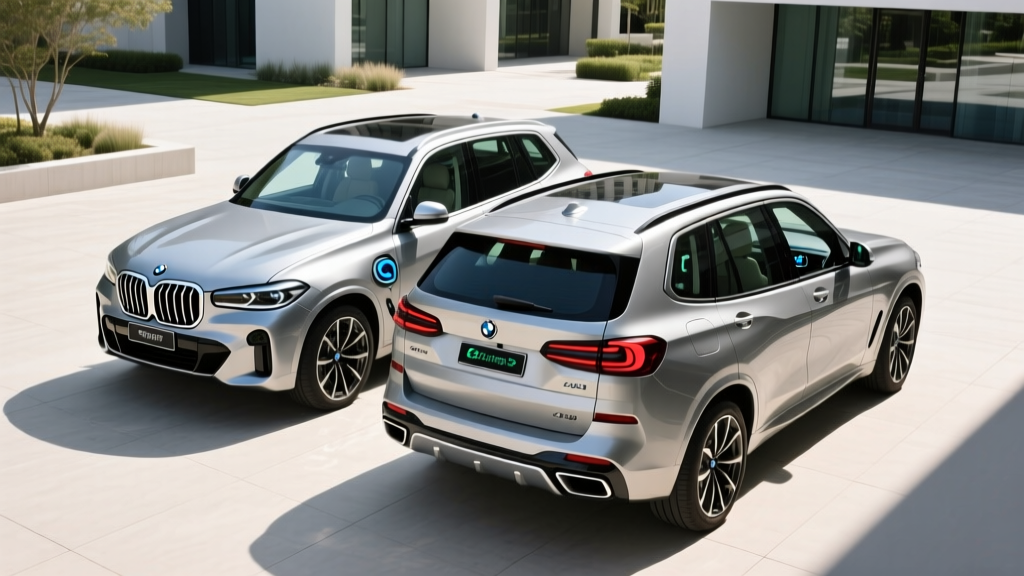
BMW's U.S. plug-in hybrid lineup centers on two SUVs for 2026: the midsize X5 xDrive50e and the compact X3 xDrive30e. Both pair turbocharged gasoline engines with electric motors and batteries large enough for meaningful electric-only commutes. Neither is a conventional hybrid (HEV) — BMW dropped non-plug-in hybrid SUVs from the U.S. market years ago. If you're researching BMW hybrid SUVs, you're looking at PHEVs, and the decision comes down to size, budget, and how far your daily driving stretches on battery power alone.
A conventional hybrid (HEV) like the Toyota RAV4 Hybrid uses a small battery charged only by regenerative braking and the engine. You never plug it in, and electric-only driving is limited to brief low-speed moments. A plug-in hybrid (PHEV) has a larger battery you charge from a wall outlet or public charger, enabling 30–40 miles of full electric driving before the gas engine takes over. Both BMW hybrid SUVs below are PHEVs.
2026 BMW X5 xDrive50e: The Flagship PHEV
The X5 xDrive50e pairs a 3.0-liter turbocharged inline-six with an electric motor integrated into the eight-speed automatic transmission. Combined output is 483 horsepower and 516 lb-ft of torque, enough for a 0–60 mph sprint in approximately 4.6 seconds. The battery pack holds 25.7 kWh usable (29.5 kWh gross), which the EPA rates for 38 miles of electric-only range.
| Spec | Value |
|---|---|
| Powertrain | 3.0L turbo I-6 + electric motor |
| Combined Horsepower | 483 hp / 516 lb-ft |
| Battery (usable) | 25.7 kWh |
| EV Range (EPA) | 38 miles |
| MPGe (combined) | 56 MPGe |
| Gas-only MPG (combined) | 22 MPG |
| 0–60 mph | 4.6 seconds |
| Level 2 Charge Time (0–100%) | ~4.25 hours at 7.4 kW |
| DC Fast Charging | Not supported |
| Base MSRP | $74,275 |
Fuel Economy: Real-World vs EPA
The EPA rates the X5 xDrive50e at 56 MPGe in combined driving when the battery is charged, and 22 MPG combined once the battery depletes and the inline-six operates solo. In real-world testing, owners who charge nightly and commute under 35 miles report burning gasoline on fewer than 20% of their trips. On longer highway drives with a depleted battery, expect closer to 24–26 MPG in mild weather — slightly above the EPA gas-only figure, because regenerative braking recovers energy in rolling terrain.
Charging the X5 PHEV
The X5 xDrive50e accepts up to 7.4 kW on Level 2 AC charging (using a J1772 connector or NACS with adapter). A full 0–100% charge takes roughly 4.25 hours. On a standard 120V household outlet (Level 1), expect about 12–14 hours for a full charge. DC fast charging is not available on the X5 PHEV — a common limitation among plug-in hybrids, since the battery is small enough that AC charging suffices for overnight replenishment.
2026 BMW X3 xDrive30e: The Compact PHEV Entry
Redesigned for the 2025 model year and carried into 2026, the X3 xDrive30e uses a 2.0-liter turbocharged four-cylinder paired with an electric motor for a combined 288 horsepower. The usable battery capacity is 19.7 kWh, delivering an EPA-rated 35 miles of electric-only range. The smaller footprint makes it a more practical daily commuter for urban drivers who don't need three rows of cargo space.
| Spec | Value |
|---|---|
| Powertrain | 2.0L turbo I-4 + electric motor |
| Combined Horsepower | 288 hp / 332 lb-ft |
| Battery (usable) | 19.7 kWh |
| EV Range (EPA) | 35 miles |
| MPGe (combined) | 60 MPGe |
| Gas-only MPG (combined) | 27 MPG |
| 0–60 mph | 6.0 seconds |
| Level 2 Charge Time (0–100%) | ~3.0 hours at 7.4 kW |
| DC Fast Charging | Not supported |
| Base MSRP | $52,575 |
X3 Real-World Efficiency
The X3 xDrive30e's lighter weight and smaller engine translate to better gas-only fuel economy once the battery is empty: the EPA rates it at 27 MPG combined, and real-world highway driving in fair conditions yields 28–30 MPG. For drivers with short commutes and reliable home charging, gasoline consumption can drop to a few gallons per month. The 35-mile EV range covers the majority of U.S. daily commutes — the Bureau of Transportation Statistics puts the average one-way commute at roughly 16 miles.
Side-by-Side: X5 vs X3 PHEV
| Attribute | X5 xDrive50e | X3 xDrive30e |
|---|---|---|
| EV Range | 38 mi | 35 mi |
| Battery (usable) | 25.7 kWh | 19.7 kWh |
| Horsepower | 483 hp | 288 hp |
| Gas-only MPG | 22 combined | 27 combined |
| MPGe | 56 | 60 |
| 0–60 mph | 4.6 sec | 6.0 sec |
| Cargo (rear seats up) | 33.9 cu ft | 31.5 cu ft |
| Towing Capacity | 5,950 lbs | 4,400 lbs |
| Base MSRP | $74,275 | $52,575 |
| §30D Tax Credit Eligible | No (MSRP/income/sourcing) | Potentially (see below) |
Choose the X5 xDrive50e if:
- You need towing capacity above 5,000 lbs
- You want inline-six performance (483 hp, sub-5-sec 0–60)
- Cargo volume and rear-seat space are priorities
- Budget exceeds $75,000 after options
Choose the X3 xDrive30e if:
- Your daily commute is under 35 miles round-trip
- You want better gas-only MPG for road trips
- Budget is closer to $55,000
- You don't need more than 4,400 lbs of towing
Tax Credits and Incentives for BMW PHEVs
Federal tax credit eligibility for PHEVs falls under IRS §30D Clean Vehicle Credit, which provides up to $7,500 for qualifying new plug-in hybrids. However, eligibility depends on several factors that frequently disqualify BMW's current PHEV lineup:
- MSRP Cap: SUVs must have an MSRP at or below $80,000. The X5 xDrive50e starts at $74,275, but common option packages push it above the cap. The X3 xDrive30e at $52,575 clears this threshold.
- Income Cap: Modified adjusted gross income must not exceed $150,000 (single), $225,000 (head of household), or $300,000 (joint filers).
- Battery Sourcing: Critical minerals and battery components must meet phased-in domestic-content requirements. BMW sources battery cells from suppliers with significant Chinese supply-chain exposure, which has historically restricted credit eligibility for their PHEVs.
- Assembly: The vehicle must undergo final assembly in North America. Both the X5 and X3 for the U.S. market are assembled at BMW's Spartanburg, South Carolina plant, satisfying this requirement.
Battery Warranty, Reliability, and Replacement Costs
BMW covers the high-voltage battery in both the X5 and X3 PHEVs for 8 years or 80,000 miles (whichever comes first), with a capacity-retention threshold of 70%. This is consistent with the federal mandate for PHEV battery warranties. If the battery degrades below 70% of its original capacity within the warranty period, BMW will repair or replace it at no cost.
BMW's reliability record for its current PHEV powertrains is generally solid. The inline-six and eight-speed transmission in the X5 are proven components, and the electric motor adds minimal complexity since it's integrated into the transmission housing. The X3's four-cylinder is equally well-established. According to IIHS, both models carry top safety ratings in their respective classes.
Who Should Buy a BMW PHEV — and Who Shouldn't
A BMW plug-in hybrid makes sense if you want electric commuting without range anxiety on longer trips. The 35–38 mile EV range covers most daily driving, and the gasoline engine eliminates the need to plan around charging infrastructure on road trips. You get a premium interior, strong acceleration, and the ability to drive past broken chargers without a second thought.
A full battery-electric vehicle (BEV) like the BMW iX or a competitor such as the Tesla Model Y is a better fit if you have reliable home charging, rarely drive more than 250 miles in a day, and want to eliminate gasoline entirely. BEVs have lower per-mile energy costs, fewer moving parts, and — in many cases — lower total cost of ownership over five years despite higher upfront prices.
A conventional gas vehicle makes financial sense only if you lack access to any plug (home or workplace) and drive long distances regularly. Without charging, a PHEV becomes a heavier, less efficient gas car — you're paying for a battery you never use.
Frequently Asked Questions
How many MPG does a BMW hybrid SUV get?
The 2026 X5 xDrive50e achieves 56 MPGe combined when the battery is charged, and 22 MPG combined on gasoline alone. The X3 xDrive30e delivers 60 MPGe and 27 MPG gas-only. Real-world highway MPG on gas tends to run 1–3 MPG above EPA estimates in fair weather.
How far can BMW PHEVs drive on electric only?
The X5 xDrive50e provides 38 miles of EPA-rated EV range; the X3 xDrive30e offers 35 miles. In cold weather (below 32°F), expect a 20–30% reduction, bringing real-world EV range to roughly 25–30 miles. Highway speeds above 70 mph also reduce EV range compared to city driving.
Do BMW hybrid SUVs need to be plugged in?
Yes — these are plug-in hybrids. You don't have to plug them in (the engine will recharge the battery partially through regenerative braking), but without regular charging, you forfeit the EV range and the fuel-cost savings that justify the PHEV premium.
Can BMW PHEVs use DC fast chargers?
No. Neither the X5 xDrive50e nor the X3 xDrive30e supports DC fast charging. They charge on Level 2 (240V) at up to 7.4 kW, which fully replenishes the battery in 3–4.25 hours. This is standard for PHEVs — the batteries are small enough that overnight AC charging is sufficient.
Is the BMW PHEV battery reliable, and what does replacement cost?
BMW's PHEV batteries have demonstrated strong longevity in real-world use, with most retaining over 85% capacity after 100,000 miles. The warranty covers 8 years/80,000 miles at a 70% capacity threshold. Out-of-warranty replacement runs $8,000–$14,000, but this is a rare expense given typical degradation curves.
Hybrid vs PHEV vs EV — which BMW is right for me?
BMW does not sell conventional hybrids (HEVs) in the U.S. Your choice is between a PHEV (X5 xDrive50e or X3 xDrive30e) and a full EV (iX or i4). Choose a PHEV if you need road-trip flexibility and can charge at home nightly. Choose a full EV if your daily driving stays under 250 miles, you have reliable home charging, and you want the lowest operating cost and zero tailpipe emissions.