Quick Verdict: The BMW X5 Plug-In Hybrid Explained
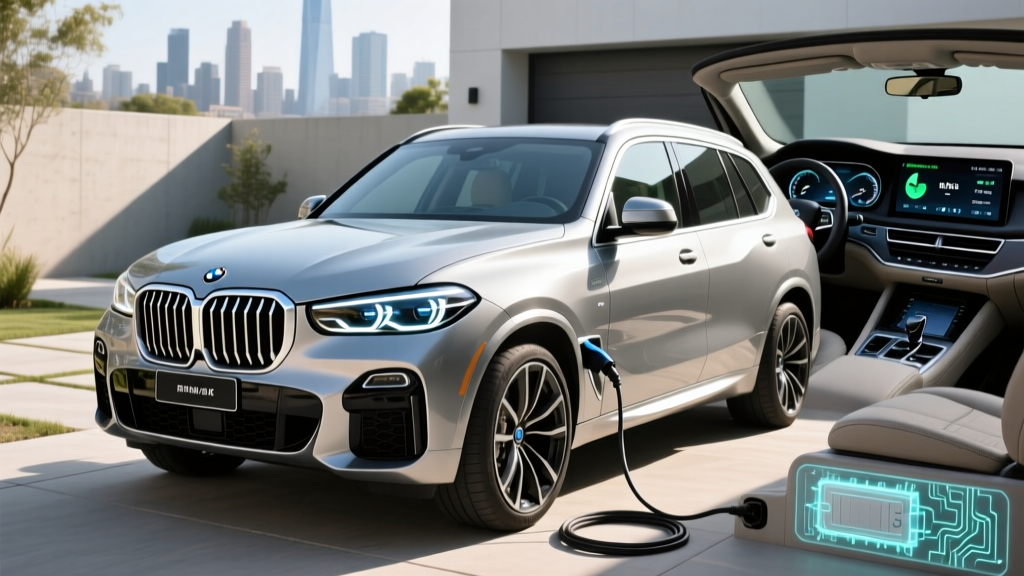
The BMW X5 xDrive50e is a luxury plug-in hybrid electric vehicle (PHEV) that pairs a turbocharged inline-six with a powerful electric motor for a combined 483 horsepower. Unlike a conventional hybrid, the X5 plug-in offers a usable electric-only range of up to 38 miles on the EPA cycle — enough for most daily commutes without burning a drop of gasoline. For buyers who want electric driving around town but the flexibility of a gas engine for road trips, the X5 PHEV occupies a compelling middle ground.
This review covers the current-generation X5 xDrive50e (introduced for the 2024 model year and carried forward into 2026), breaking down its real-world efficiency, charging practicality, powertrain behavior, and whether it qualifies for federal tax incentives under IRS §30D rules.
HEV vs PHEV: What's the Difference?
Before diving into the X5 specifically, it's critical to distinguish between two fundamentally different powertrain types that buyers often conflate:
| Feature | Conventional Hybrid (HEV) | Plug-In Hybrid (PHEV) |
|---|---|---|
| Plug-in charging? | No — charges via regenerative braking and engine | Yes — has a larger battery you plug in to charge |
| Electric-only range | 0–2 miles at very low speeds | 20–50+ miles at highway speeds |
| Battery size | 1–2 kWh | 15–30+ kWh usable |
| Fuel economy (gas mode) | Typically better than gas-only equivalent | Similar to or slightly worse than HEV once battery depleted |
| Federal tax credit | No | Potentially — depends on battery sourcing, MSRP, income |
| Example | Toyota RAV4 Hybrid | BMW X5 xDrive50e |
The BMW X5 is available only as a PHEV in its electrified form (the xDrive50e). BMW does not currently sell a conventional HEV version of the X5 in the U.S. market. If you see references to the older xDrive45e, that was the previous-generation PHEV with a smaller battery and less electric range — it was replaced by the xDrive50e.
Fuel Economy and Electric-Only Range
The X5 xDrive50e's efficiency story splits into two chapters: electric mode and hybrid (gas) mode.
EPA Efficiency Figures
| Metric | EPA Estimate | Real-World Expectation |
|---|---|---|
| Combined MPGe (electric + gas) | 50 MPGe | 45–52 MPGe depending on charging habits |
| Electric-only range | 38 miles | 30–36 miles (highway/cold weather reduces to ~25–28 mi) |
| Gas-only combined MPG (battery depleted) | 22 MPG combined | 20–23 MPG (city can be slightly better with regen assist) |
| City MPG (gas mode) | 23 MPG | 22–25 MPG |
| Highway MPG (gas mode) | 21 MPG | 19–22 MPG |
| Total combined range (electric + gas) | ~440 miles | ~380–430 miles |
Source: fueleconomy.gov
Real-World MPG: What Owners Actually See
Your actual fuel economy with the X5 PHEV depends almost entirely on how often you charge. If you plug in nightly and your commute is under 35 miles round-trip, you may burn gasoline only a handful of times per month — effectively achieving 100+ MPGe in practice. If you never plug in and drive it like a conventional vehicle, expect 20–23 MPG combined, which is unremarkable for a 5,400-pound luxury SUV.
In cold weather (below 35°F), expect electric-only range to drop by 20–30% due to battery chemistry limitations and cabin heating demands. The X5 uses a heat pump for cabin climate, which helps mitigate this loss compared to resistive heating systems, but winter range will still fall to roughly 25–30 miles on electricity alone.
Powertrain: Engine, Motor, and Performance
| Specification | BMW X5 xDrive50e |
|---|---|
| Engine | 3.0L turbocharged inline-6 (BMW B58) |
| Engine output | 312 hp / 330 lb-ft torque |
| Electric motor | Integrated in 8-speed automatic transmission |
| Motor output | 184 hp / 207 lb-ft torque |
| Combined system output | 483 hp / 516 lb-ft torque |
| 0–60 mph | 4.6 seconds |
| Drivetrain | xDrive all-wheel drive |
| Transmission | 8-speed automatic (ZF) |
| Curb weight | ~5,430 lbs |
| Towing capacity | 5,000 lbs (with factory hitch) |
The B58 inline-six is one of BMW's most refined engines — smooth, torquey, and reliable by modern turbocharged standards. Paired with the electric motor integrated into the transmission housing, the result is seamless power delivery. The electric motor fills in torque at low RPMs before the turbo spools, eliminating any perceptible lag. In Sport mode with both powertrains active, the X5 PHEV hits 60 mph in 4.6 seconds — genuinely quick for a luxury SUV of this size.
The system intelligently manages power sources. In Electric mode, only the motor drives the wheels (up to ~84 mph). In Hybrid mode, the car decides when to engage the engine based on throttle input, battery state, and navigation data. When you enter a destination, the X5 can pre-plan battery usage to save electric range for urban sections of your route.
Battery, Charging, and Electric Infrastructure
| Battery & Charging Spec | Value |
|---|---|
| Battery chemistry | NMC (nickel manganese cobalt) |
| Total battery capacity | 29.5 kWh |
| Usable battery capacity | ~25.7 kWh |
| AC Level 1 charging (120V) | ~1.4 kW — full charge in ~18 hours |
| AC Level 2 charging (240V) | 7.4 kW — full charge in ~4 hours |
| DC fast charging | Not available |
| Charge connector | J1772 (Level 1/2 AC) |
No DC fast charging. This is a significant limitation for road-trip-heavy owners. The X5 PHEV can only accept AC charging, peaking at 7.4 kW on a Level 2 home or public charger. On a standard 240V/32A Level 2 circuit, a full 0–100% charge takes roughly 4 hours. On a 120V household outlet (Level 1), it takes about 18 hours — meaning you'll recover roughly 3–4 miles of electric range per hour of Level 1 charging.
For daily use, this isn't a dealbreaker. Plug in when you get home, and the battery is full by morning. But if you're relying on public charging during a road trip, you won't be able to quickly top up at a DC fast charger — the vehicle simply doesn't have the hardware. Once the battery is depleted on the highway, the gasoline engine takes over seamlessly.
Battery Warranty and Replacement Cost
BMW covers the X5 PHEV's high-voltage battery under its standard hybrid battery warranty:
- Duration: 8 years or 80,000 miles (whichever comes first)
- Capacity retention threshold: BMW warrants the battery against defects and excessive capacity loss. If the battery falls below approximately 70% of original capacity during the warranty period, BMW will repair or replace it.
- Out-of-warranty replacement cost: Estimated $12,000–$18,000 for the battery pack plus labor, based on current BMW parts pricing. This figure may decrease as battery costs continue to decline industry-wide.
- Real-world degradation: PHEV batteries typically lose 10–15% capacity over 8 years with normal use. BMW's battery management system maintains a buffer (roughly 3.8 kWh of the 29.5 kWh total is reserved) to protect long-term health.
The 12V auxiliary battery in the X5 PHEV is a conventional lithium-ion unit that may need replacement every 4–6 years at a cost of $300–$500 — unrelated to the high-voltage traction battery.
Pricing, Trims, and Tax Credit Eligibility
| Trim / Configuration | 2026 MSRP (estimated) |
|---|---|
| X5 xDrive50e (base) | $74,700 |
| With Premium Package | ~$78,500 |
| With Executive + M Sport Package | ~$85,000+ |
Note: BMW has not published final 2026 model-year pricing at time of writing. Figures above reflect current trajectory from 2025 MSRP plus estimated adjustments. Verify with your dealer.
Federal Tax Credit (§30D) Eligibility
Under current IRS rules, the BMW X5 xDrive50e does not qualify for the full $7,500 federal plug-in electric vehicle tax credit. Here's why:
- Battery sourcing requirement: The §30D credit requires that a percentage of critical minerals and battery components be sourced from the U.S. or free-trade-agreement countries. The X5's battery is manufactured outside the U.S., and BMW's supply chain does not currently meet the critical-minerals threshold.
- MSRP cap: SUVs must have an MSRP at or below $80,000 to qualify. The base X5 xDrive50e clears this cap, but optioned-up examples may exceed it.
- Buyer income cap: Adjusted gross income must not exceed $150,000 (single), $225,000 (head of household), or $300,000 (joint filing).
- Assembly location: The X5 is assembled at BMW's Spartanburg, South Carolina plant, which satisfies the North American final assembly requirement.
Some buyers may still qualify for a partial credit if BMW's battery component sourcing meets one of the two thresholds (components or critical minerals). Check the latest eligibility list on fueleconomy.gov and consult a tax professional before relying on credit amounts for purchase decisions. The point-of-sale transfer option (§30D(g)) allows eligible buyers to apply the credit as a down-payment reduction at the dealer, but only if the vehicle qualifies.
Who Should Buy the X5 Plug-In Hybrid?
Decision Framework: X5 PHEV vs Full EV vs Gas
Choose the BMW X5 xDrive50e (PHEV) if:
- Your daily commute is under 35 miles round-trip and you can charge at home
- You take road trips of 300+ miles several times per year and don't want to plan around charging infrastructure
- You want a luxury midsize SUV with genuine performance (483 hp, 4.6s 0–60)
- You're not ready to commit to a full EV but want meaningful electric driving
- You need towing capability (5,000 lbs)
Choose a full EV (like the BMW iX or Tesla Model X) if:
- You can charge at home and your daily driving is under 250 miles
- You want to eliminate gasoline entirely and reduce maintenance (no oil changes, fewer moving parts)
- You want access to DC fast charging for road trips
- You want the lowest per-mile fuel cost (electricity is typically $0.04–$0.06/mile vs. $0.15–$0.20/mile for gasoline)
Choose a conventional gas SUV (like the BMW X5 xDrive40i) if:
- You cannot charge at home (apartment, no garage, street parking only)
- Your daily commute exceeds 50+ miles and you don't want to plug in nightly
- You want a lower purchase price — the xDrive40i starts roughly $10,000 less than the PHEV
- You drive primarily highway miles where the PHEV's electric advantage is minimal
Pros
- 38-mile EPA electric range covers most daily commutes without gasoline
- 483 hp combined output delivers sports-SUV acceleration
- Seamless transitions between electric and gas power — no compromise in refinement
- 5,000-lb towing capacity retained (unlike some EVs that lose towing when battery is low)
- BMW's B58 inline-six has a strong reliability track record
- Heat pump included for efficient cold-weather cabin heating
- Qualifies for HOV lane access in several states (check local rules)
Cons
- No DC fast charging — AC only at 7.4 kW max
- Likely does not qualify for the $7,500 federal tax credit due to battery sourcing
- $74,700+ starting price is steep; fully optioned examples exceed $85,000
- Gas-only fuel economy (22 MPG combined) is mediocre when battery is depleted
- Cargo space slightly reduced compared to gas X5 due to battery placement (~5 cu ft loss)
- Level 1 charging is impractically slow (~18 hours for full charge)
Ownership Costs and Long-Term Value
Over a 5-year ownership period, the X5 PHEV's economics depend heavily on your charging discipline and electricity rates.
| Cost Category | X5 xDrive50e (PHEV) | X5 xDrive40i (Gas) |
|---|---|---|
| Purchase price (base MSRP) | $74,700 | $65,200 |
| Estimated fuel cost (5 yrs, 60k mi) | $5,200–$7,800* | $10,500–$12,000 |
| Maintenance (5 yrs) | $3,500–$4,500 | $4,000–$5,000 |
| Insurance (5 yrs, avg) | $9,000–$11,000 | $8,000–$10,000 |
| Estimated depreciation (5 yrs) | $28,000–$33,000 | $25,000–$30,000 |
| Estimated 5-yr total | $120,400–$131,000 | $112,700–$122,000 |
*Fuel cost range depends on percentage of miles driven on electricity vs. gasoline. Assumes $0.14/kWh electricity and $3.80/gallon gasoline. PHEV savings are maximized when 70%+ of miles are electric.
The PHEV commands a purchase premium of roughly $9,500 over the gas X5. Fuel savings can recover $3,000–$5,000 of that over five years if you charge regularly. The remaining gap is offset by intangibles: electric-mode refinement, instant torque, HOV lane access, and reduced tailpipe emissions. If fuel savings alone are your primary motivation, the math favors the gas X5 unless electricity in your area is very cheap and gasoline is expensive.
Reliability and What History Tells Us
BMW's B58 3.0L inline-six engine — the heart of the X5 PHEV's powertrain — has earned a reputation as one of the most reliable modern BMW engines. Introduced in 2015, it has been used across the BMW lineup with few systemic issues. Common maintenance items include coolant system components and valve cover gaskets at higher mileages, but catastrophic failures are rare.
The electric motor and power electronics have fewer moving parts and historically show strong durability in BMW's PHEV lineup. The previous-generation X5 xDrive45e (2021–2023) has not shown widespread battery or motor failures. BMW's 8-year/80,000-mile high-voltage battery warranty provides a safety net, and the NHTSA has not issued major recalls for the X5 PHEV powertrain.
For long-term ownership beyond the warranty period, budget for potential high-voltage battery replacement at $12,000–$18,000. However, PHEV batteries experience less stress than full EV batteries because they cycle through a smaller portion of their total capacity (the buffer is proportionally larger). Many PHEV batteries retain 80%+ capacity at 150,000 miles in real-world use.
Frequently Asked Questions
How many MPG does the BMW X5 plug-in hybrid get?
The EPA rates the X5 xDrive50e at 50 MPGe combined when using both electric and gasoline power. Once the battery is depleted, it operates as a conventional hybrid at an EPA-rated 22 MPG combined (23 city / 21 highway). Real-world results vary: owners who charge daily report using gasoline only for longer trips, while those who never plug in see 20–23 MPG.
How far can the BMW X5 PHEV go on electric only?
The EPA estimates 38 miles of electric-only range. In real-world mixed driving, expect 30–36 miles. Highway driving at 70+ mph reduces this to roughly 28–32 miles. In cold weather (below 35°F), plan for 25–30 miles due to battery efficiency loss and heating demand.
Does the BMW X5 plug-in hybrid qualify for a federal tax credit?
Under current IRS §30D rules, the X5 xDrive50e likely does not qualify for the full $7,500 credit due to battery component and critical mineral sourcing requirements. It may qualify for a partial credit ($3,750) if it meets one of the two sourcing thresholds. Always verify current eligibility on fueleconomy.gov and consult a tax professional.
Can the BMW X5 PHEV use DC fast chargers?
No. The X5 xDrive50e only supports AC charging (Level 1 and Level 2) via a J1772 connector. Maximum charge rate is 7.4 kW on Level 2, which fills the battery in about 4 hours. There is no CCS or NACS DC fast-charging port on this vehicle.
Is the BMW X5 plug-in hybrid reliable?
The B58 inline-six engine has a strong reliability record. The electric motor and power electronics have shown good durability in BMW's PHEV lineup. The high-voltage battery is warranted for 8 years/80,000 miles. Out-of-warranty battery replacement costs an estimated $12,000–$18,000. Overall, the X5 PHEV is considered average to above-average in reliability for the luxury midsize SUV segment.
Should I buy the X5 PHEV or a full EV like the BMW iX?
If you can charge at home, drive under 250 miles daily, and want the lowest operating costs, a full EV like the BMW iX (300+ mile range, DC fast charging) makes more sense. If you regularly take long road trips, can't reliably access DC fast chargers on your routes, or want to avoid range planning entirely, the X5 PHEV gives you electric commuting with gasoline flexibility. The PHEV is a bridge solution; the EV is a destination.
Do I need to plug in the X5 PHEV every night?
You don't need to — the car operates as a conventional hybrid when the battery is depleted. However, you'll only realize the fuel-cost savings and electric-driving benefits if you charge regularly. A Level 2 home charger (240V) is strongly recommended to make daily charging convenient (4-hour full charge vs. 18 hours on a 120V outlet).