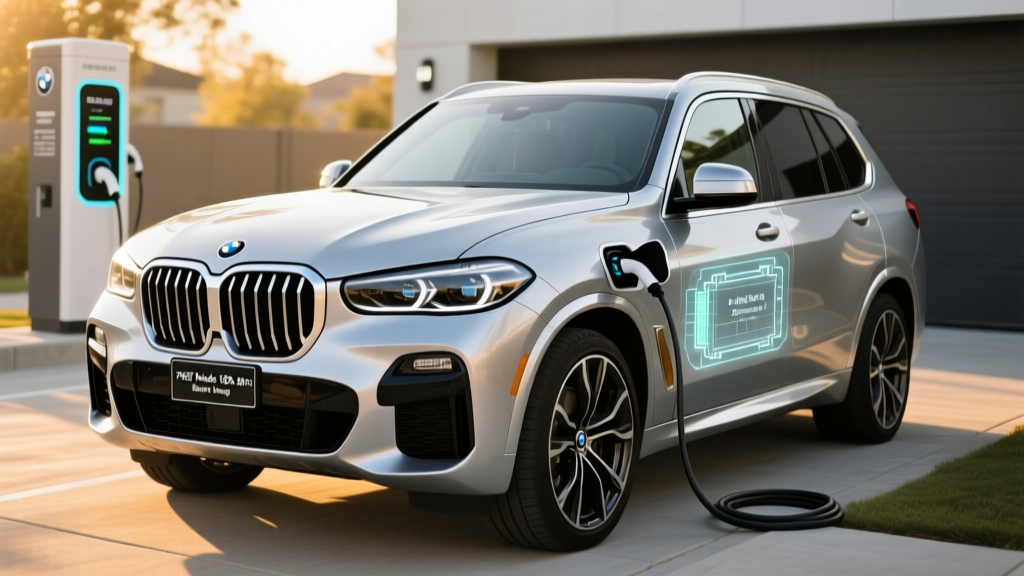
The BMW X5 has long been the benchmark midsize luxury SUV, but the xDrive50e plug-in hybrid variant asks a specific question: Can you keep the inline-six soul, eliminate most daily fuel stops, and still tow 7,200 pounds? For 2026, the answer leans heavily yes — provided you understand exactly what a PHEV delivers and where its limits sit. This guide breaks down the BMW X5 plug-in hybrid with the numbers that actually matter to buyers cross-shopping it against the Porsche Cayenne E-Hybrid, Mercedes-Benz GLE 350e, and full-electric rivals like the BMW iX.
HEV vs PHEV: What the X5 xDrive50e Actually Is
Before diving into specs, it is worth drawing a hard line between a conventional hybrid (HEV) and a plug-in hybrid (PHEV), because the distinction changes ownership behavior entirely.
Conventional Hybrid (HEV)
- No plug; battery recharges via regenerative braking and engine
- Small battery (~1–2 kWh usable)
- No electric-only driving beyond low-speed creep
- Example: Toyota RAV4 Hybrid, Honda CR-V Hybrid
Plug-In Hybrid (PHEV) — BMW X5 xDrive50e
- Plugs into a wall or Level 2 charger; larger battery (~25.7 kWh usable)
- True electric-only range: EPA-rated 38 miles
- Gas engine kicks in seamlessly when battery depletes or under hard acceleration
- Can also operate as a conventional hybrid once the electric buffer is spent
The X5 xDrive50e is strictly a PHEV. BMW does not offer a non-plug HEV version of the current-generation X5 in the US market. If you want a self-charging hybrid in this segment, you are looking at a Lexus RX 350h or the Toyota Grand Highlander Hybrid instead — very different vehicles.
Powertrain, Horsepower, and 0–60 Performance
The xDrive50e pairs BMW's B58 3.0-liter turbocharged inline-six with an electric motor integrated into the ZF 8-speed automatic transmission housing. The result is a combined 483 horsepower and 516 lb-ft of torque, routed through xDrive all-wheel drive.
| Specification | BMW X5 xDrive50e (2026) |
|---|---|
| Engine | 3.0L turbo I6 + integrated electric motor |
| Combined Output | 483 hp / 516 lb-ft |
| Electric Motor (standalone) | ~184 hp |
| 0–60 mph | 4.6 seconds (BMW est.) |
| Transmission | 8-speed automatic (ZF) |
| Drivetrain | xDrive AWD |
| Towing Capacity | 7,200 lbs (with factory hitch) |
| Battery (usable) | 25.7 kWh (NMC chemistry) |
| Onboard Charger | 7.4 kW (Level 2 AC only, no DC fast charge) |
| Fuel Tank | 18.5 gallons |
| Base MSRP | ~$74,900 (before destination) |
The inline-six is the star here. Unlike the four-cylinder PHEV competition from Mercedes (GLE 350e) and Volvo (XC90 Recharge), the B58 delivers linear, turbine-smooth power even after the battery depletes. In hybrid mode with a depleted pack, the engine never feels strained — a common complaint in smaller-displacement PHEVs when they are asked to move 5,400 pounds of SUV.
Electric-Only Range and Total Range
The EPA rates the X5 xDrive50e at 38 miles of electric-only range. In real-world mixed driving at 65–70 mph with climate control on, expect 30–34 miles before the gas engine wakes up. Cold weather (below 35°F) can compress that to roughly 24–28 miles due to cabin heating loads and reduced battery efficiency — a reality for all PHEVs with NMC chemistry.
EPA electric range: 38 miles
Real-world expectation: 30–34 mi (temperate), 24–28 mi (cold/highway)
Total combined range (electric + gas): ~440 miles EPA-rated
Once the electric buffer is spent, the X5 operates as a conventional hybrid and returns an EPA-rated 27 MPG combined on gasoline alone. That 18.5-gallon tank yields roughly 500 miles of gasoline range after the electric miles are used — meaning a full tank plus full charge delivers well over 500 total miles, a figure that matters for road-trip buyers who refuse to plan around charging infrastructure.
Fuel Economy: EPA MPG and MPGe Breakdown
| Metric | City | Highway | Combined |
|---|---|---|---|
| Charge-depleting (MPGe) | — | — | 56 MPGe |
| Charge-sustaining (MPG, gas only) | 25 MPG | 29 MPG | 27 MPG |
Two separate numbers matter here. When the battery is charged, the EPA's combined figure is 56 MPGe — useful for comparing against full EVs on the fueleconomy.gov label. But the more honest number for PHEV buyers who forget to plug in, or who drive more than 38 miles between charges, is the 27 MPG combined on gasoline alone.
Real-world MPG vs EPA: In city driving with frequent regenerative braking opportunities, owners routinely report 29–31 MPG in charge-sustaining mode, beating the EPA city estimate. Highway driving at 75+ mph drops that closer to 25 MPG. The key insight: PHEVs reward stop-and-go driving with regen gains, just like conventional hybrids.
Charging the X5 PHEV: What You Actually Need at Home
The xDrive50e uses a 7.4 kW onboard AC charger. There is no DC fast charging capability — a deliberate BMW engineering choice, since the 25.7 kWh pack is small enough that DCFC infrastructure adds cost and weight without meaningfully reducing charge times for a vehicle designed to charge overnight.
| Level | Source | Power | 0–100% Time | Miles Added per Hour |
|---|---|---|---|---|
| Level 1 | Standard 120V outlet | ~1.4 kW | ~18 hours | ~2 miles/hr |
| Level 2 | 240V home charger (e.g., ChargePoint Home Flex, BMW Wallbox) | 7.4 kW (vehicle-limited) | ~3.75 hours | ~10 miles/hr |
Level 1 charging is effectively unusable for daily PHEV ownership unless your commute is under 10 miles. A Level 2 home installation is non-negotiable for extracting real value from this vehicle. Budget $500–$1,200 for a quality Level 2 EVSE (BMW's Wallbox or third-party options like the Emporia V2 or ChargePoint Home Flex) plus $800–$2,500 for electrician labor and permitting if you have a 200-amp panel with capacity. A panel upgrade to 200A can add $1,500–$3,500 — factor this in before purchase if your home has an older 100-amp service.
At typical residential electricity rates ($0.13–$0.18/kWh nationally), a full 25.7 kWh charge costs roughly $3.35–$4.65. That buys you 30–34 real-world electric miles, or about $0.11–$0.15 per mile — roughly one-third the per-mile fuel cost of the gasoline-only X5 xDrive40i at current fuel prices.
Federal Tax Credit and State Incentives
The BMW X5 xDrive50e is assembled at BMW's Spartanburg, South Carolina plant, which helps it clear the North American final assembly requirement under IRS §30D. However, eligibility for the full $7,500 federal tax credit depends on battery component and critical-mineral sourcing thresholds that shift annually. As of 2026, many BMW PHEVs qualify for $3,750 (meeting one of the two sourcing thresholds but not both), though buyers should verify current-year eligibility on IRS.gov before purchase.
§30D eligibility checklist (2026 rules):
- MSRP must not exceed $80,000 for SUVs (X5 xDrive50e base qualifies; heavily optioned units may breach the cap)
- Buyer AGI limits: $150,000 (single), $225,000 (head of household), $300,000 (married filing jointly)
- North American final assembly: ✓ (Spartanburg, SC)
- Battery sourcing: verify current-year critical minerals and component thresholds at IRS.gov
- Credit is non-refundable but can be transferred to the dealer as a point-of-sale discount under §30D(g)
Several states layer additional rebates on top — California's CVRP, Colorado's innovative motor vehicle credit, and New York's Drive Clean Rebate have historically applied to PHEVs meeting battery-capacity thresholds. Check your state energy office or fueleconomy.gov for current state-specific programs.
Battery Warranty, Reliability, and Replacement Cost
BMW High-Voltage Battery Warranty: 8 years / 80,000 miles, whichever comes first. Coverage triggers if the battery falls below 70% of original usable capacity (state of health). This is the federal minimum mandated by CARB and EPA for PHEVs and is standard across BMW's electrified lineup.
BMW's B58 inline-six is widely regarded as one of the most reliable modern turbocharged engines, and the ZF 8HP transmission it mates to has an excellent long-term track record. The electric motor, being integrated into the transmission housing and having far fewer moving parts than the engine, is generally a low-failure component.
The high-voltage battery uses NMC (nickel manganese cobalt) chemistry. NMC offers higher energy density than LFP but is more sensitive to sustained high states of charge and extreme heat. BMW's thermal management system is liquid-cooled and actively manages battery temperature, which mitigates degradation. Based on data from earlier-generation X5 PHEVs (the 45e, which used a smaller 21.5 kWh pack), typical degradation after 5 years and 60,000 miles is in the 8–12% range, meaning an owner might see electric range drop from 38 miles to roughly 33–35 miles over that period — well within the warranty threshold.
Battery replacement cost: Out of warranty, a full high-voltage battery replacement for the X5 PHEV currently runs in the range of $12,000–$16,000 including labor at a BMW dealer. This is the number that haunts PHEV and EV buyers, but it is worth noting that catastrophic battery failure before 150,000 miles is statistically rare in liquid-cooled BMW packs. Module-level repairs (replacing individual degraded cells rather than the full pack) are increasingly available through independent EV specialists for $4,000–$7,000.
X5 PHEV vs Full EV vs Gas: Which Fits You?
Choose the BMW X5 xDrive50e PHEV if:
- Your daily round-trip commute is under 35 miles and you can charge at home
- You regularly tow (7,200 lbs capacity) or take long road trips where charging infrastructure is sparse
- You want electric daily driving but refuse range anxiety on ski trips or rural drives
- You value the inline-six's refinement over the silent-but-different character of a full EV
Choose a full EV (BMW iX, Tesla Model X, Rivian R1S) if:
- You have reliable home charging and your longest regular drive is under 250 miles
- You want to eliminate oil changes, transmission fluid, and spark plugs entirely
- You prioritize the lowest per-mile energy cost and qualify for the full $7,500 federal credit on eligible EVs
Choose a conventional gas X5 (xDrive40i) or HEV (not offered in US X5) if:
- You cannot install a Level 2 charger at home or in your building
- Your daily mileage regularly exceeds 60 miles, erasing the PHEV's electric advantage
- You want the lowest purchase price and simplest long-term maintenance profile
The PHEV's sweet spot is narrow but real: home-charging-capable owners whose daily driving stays under the electric range but who need the gas engine's flexibility a few weekends a month. Outside that use case, you are either paying a premium for a battery you rarely use (high-mileage drivers) or carrying dead weight you never plug in (apartment dwellers without charging access).
Pricing and Trim Context
The 2026 BMW X5 xDrive50e starts at approximately $74,900 before destination and options. The xDrive40i (gas-only six-cylinder) starts around $67,000, making the PHEV premium roughly $7,900 at base. After a potential $3,750 federal credit, that gap narrows to about $4,150 — a figure that can be recovered in fuel savings over 3–5 years depending on electricity rates and driving patterns.
BMW typically packages the xDrive50e with a higher standard equipment level than the 40i (including the Live Cockpit Pro curved display, heated front seats, and the Driving Assistant Professional suite), which partially offsets the sticker premium. Options like the Executive Package, Bowers & Wilkins audio, and 22-inch wheels can push the as-tested price past $90,000 — at which point the MSRP cap for the §30D credit becomes a real concern.
Pros, Cons, and the Honest Verdict
Pros
- 38-mile electric range covers most daily commutes gasoline-free
- B58 inline-six is the best engine in the segment — smooth, powerful, proven
- 7,200-lb towing with no EV range-collapse anxiety on long hauls
- Charge-sustaining MPG (27 combined) beats the gas X5 by ~5 MPG
- No DC fast-charge dependency — Level 2 overnight is sufficient
- Qualifies for at least partial federal tax credit (verify current year)
Cons
- ~$7,900 premium over gas xDrive40i at base; options can breach $80k MSRP cap
- 38-mile electric range trails rivals like the Volvo XC90 Recharge (extended-range update)
- No DC fast charging — public charging is impractical for quick top-ups
- Cold-weather electric range drops to ~25 miles, limiting winter EV-mode utility
- Cargo space slightly reduced vs gas X5 due to battery placement
- Out-of-warranty battery replacement cost ($12k–$16k) is a long-term risk
The X5 xDrive50e is not a compromise vehicle; it is a highly specific tool. If your life fits its envelope — home charging, sub-35-mile days, regular long trips or towing — it is arguably the best-executed PHEV in the luxury midsize segment. If your life does not, you are better served by either the gas X5 or a full EV like the iX. The data makes the call straightforward; the marketing does not.
Frequently Asked Questions
How many MPG does the BMW X5 plug-in hybrid get?
The EPA rates the X5 xDrive50e at 56 MPGe combined when factoring in electric driving, and 27 MPG combined (25 city / 29 highway) on gasoline alone once the battery is depleted. Real-world city driving in charge-sustaining mode often returns 29–31 MPG thanks to regenerative braking.
How far can the BMW X5 PHEV go on electric only?
EPA-rated electric range is 38 miles. Real-world expectation is 30–34 miles in temperate conditions and 24–28 miles in cold weather or sustained highway driving above 70 mph.
Does the BMW X5 plug-in hybrid qualify for a tax credit?
It qualifies for at least a partial federal §30D credit (typically $3,750 as of recent model years, depending on battery-sourcing rules) thanks to US assembly. Full $7,500 eligibility depends on current-year critical-mineral and battery-component thresholds — verify at IRS.gov. State rebates may stack on top.
Is the BMW X5 PHEV reliable and what does battery replacement cost?
The B58 engine and ZF transmission have strong reliability records. The high-voltage battery is warranted for 8 years/80,000 miles with a 70% capacity retention threshold. Out-of-warranty replacement runs $12,000–$16,000, though module-level repairs are increasingly available for less. Typical 5-year degradation is 8–12%.
Can the BMW X5 PHEV fast-charge on road trips?
No. The X5 xDrive50e supports only AC charging up to 7.4 kW (Level 2). There is no DC fast-charge port. This is by design — the 25.7 kWh battery is small enough that overnight Level 2 charging is sufficient for daily use. On road trips, the vehicle operates as a conventional hybrid on gasoline.
Hybrid vs PHEV vs EV — which should I buy?
Choose a conventional hybrid (HEV) if you cannot plug in at home. Choose a PHEV like the X5 xDrive50e if you can plug in at home, drive under 35 miles daily, but need gas-engine flexibility for road trips and towing. Choose a full EV (iX, Model X) if you want the lowest running cost, have home charging, and rarely exceed 250 miles between stops. See the decision framework above for specifics.
Does the X5 PHEV sacrifice cargo space vs the gas version?
Yes, slightly. The high-voltage battery sits under the cargo floor, reducing under-floor storage and raising the load floor marginally. Expect roughly 1–2 cubic feet less usable volume than the gas X5 — a minor trade-off for most buyers but worth measuring if you regularly haul large items.