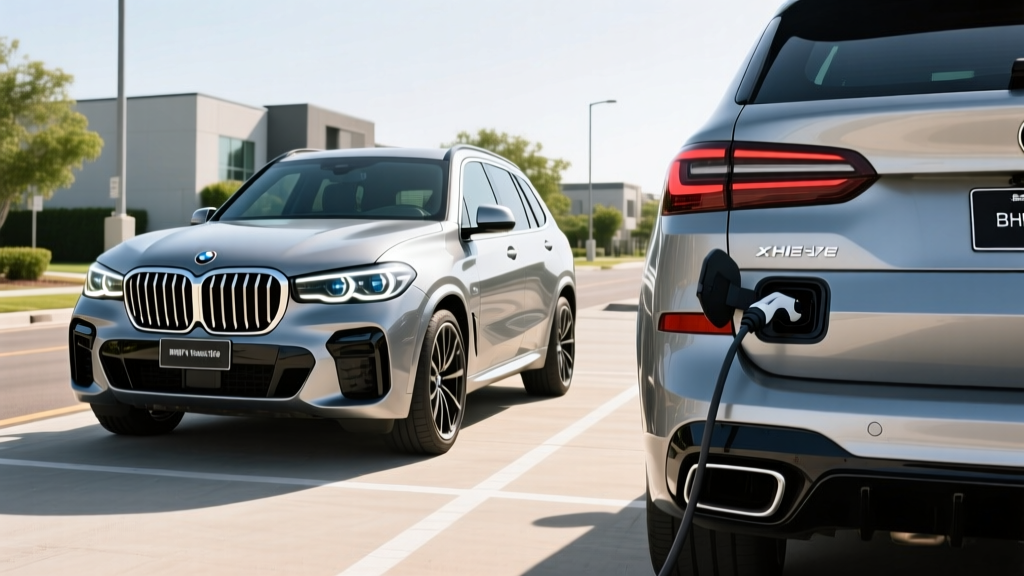
The BMW X5 xDrive50e is one of the few luxury midsize SUVs that genuinely bridges the gap between a battery-electric vehicle and a conventional gas burner. With 38 miles of EPA-rated electric-only range, a combined 56 MPGe, and 483 horsepower on tap, this plug-in hybrid (PHEV) targets buyers who want daily electric commuting without sacrificing road-trip flexibility. But the sticker price starts above $74,000, and the federal tax credit situation is nuanced. Here is everything you need to know before signing the paperwork.
HEV vs PHEV: What the BMW X5 Actually Is
Before diving into specs, it is worth clarifying the distinction because BMW sells multiple electrified SUVs and the terminology trips up many shoppers.
| Feature | Conventional Hybrid (HEV) | Plug-in Hybrid (PHEV) — BMW X5 xDrive50e |
|---|---|---|
| Needs to plug in? | No — regenerative braking charges the small battery | Yes — plug in to unlock full electric range |
| Electric-only driving | Very limited, low-speed assist only | 38 miles EPA at highway-capable speeds |
| Battery size | ~1–2 kWh | 25.7 kWh usable (29.5 kWh gross) |
| Fuel savings mechanism | Engine runs more efficiently with motor assist | Engine off entirely for short trips; motor assist on long trips |
| Tax credit eligible? | No | Varies by sourcing and buyer income (see below) |
The X5 xDrive50e is strictly a PHEV. If you never plug it in, you are carrying around 600+ pounds of battery and electric motor hardware you are not using, and your fuel economy drops to roughly 27 MPG combined — still respectable for a 5,400-pound luxury SUV, but far from its potential. BMW does not currently offer a conventional HEV version of the X5 in the United States.
Powertrain and Performance Specs
The xDrive50e pairs a 3.0-liter turbocharged inline-six engine with an electric motor integrated into the eight-speed automatic transmission. Combined output is 483 horsepower and 516 lb-ft of torque, routed through BMW's xDrive all-wheel-drive system.
| Specification | BMW X5 xDrive50e (2025–2026) |
|---|---|
| Engine | 3.0L turbo I6 (312 hp / 332 lb-ft) |
| Electric Motor | 184 hp / 295 lb-ft (integrated in transmission) |
| Combined Output | 483 hp / 516 lb-ft |
| 0–60 mph | 4.6 seconds (manufacturer) |
| Battery (usable / gross) | 25.7 kWh / 29.5 kWh (NMC lithium-ion) |
| EPA Electric-Only Range | 38 miles |
| Total Combined Range | ~440 miles (electric + 18.5-gal tank) |
| EPA MPGe (combined) | 56 MPGe |
| EPA MPG (gas-only, combined) | 27 MPG |
| Drivetrain | xDrive AWD, 8-speed automatic |
| Towing Capacity | 5,000 lbs (with factory hitch) |
| Cargo Volume | 33.9 cu ft (rear seats up) / 74.9 cu ft (folded) |
The inline-six is notably smooth — one of the best engines in the luxury midsize segment — and the electric motor fills in torque at low RPMs so there is zero turbo lag off the line. In EV mode, acceleration is brisk enough for merging and passing, though you will hear the engine fire up if you floor it. The transition between electric and gas power is among the most seamless in the PHEV market, a meaningful differentiator versus competitors where you can feel a clunk during the handoff.
Electric-Only Range and Real-World Efficiency
The EPA rates the X5 xDrive50e at 38 miles of electric-only range. In mixed suburban driving at moderate temperatures (60–75°F), owners typically see 34–40 miles before the engine engages. Push that number to 42–44 miles in gentle city driving under 45 mph. On the highway at 75 mph, expect the electric range to drop to roughly 28–30 miles.
Once the battery depletes, the X5 operates as a conventional hybrid. The EPA gas-only rating is 27 MPG combined (25 city / 29 highway). In real-world driving, city MPG often exceeds the EPA figure thanks to regenerative braking recapturing energy at low speeds — expect 28–31 MPG in stop-and-go traffic. Highway cruising at 75+ mph typically returns 25–27 MPG. These are strong numbers for a 5,400-pound AWD SUV with a turbocharged six-cylinder.
| Driving Scenario | EPA Estimate | Real-World Expectation |
|---|---|---|
| Electric-only range | 38 miles | 28–44 miles depending on speed/weather |
| City MPG (gas-only) | 25 MPG | 28–31 MPG (regen helps in stop-and-go) |
| Highway MPG (gas-only) | 29 MPG | 25–27 MPG at 75+ mph |
| Combined MPG (gas-only) | 27 MPG | 26–29 MPG mixed driving |
| Combined MPGe (electric + gas) | 56 MPGe | Varies widely with charge frequency |
The MPGe figure of 56 is meaningful only if you charge regularly. If you plug in nightly and your commute is under 35 miles round-trip, you may go months without visiting a gas station. If you never charge, ignore MPGe entirely — your relevant number is 27 MPG combined.
Charging: Speeds, Connectors, and Home Setup
The X5 xDrive50e uses a standard J1772 connector for AC charging. It does not support DC fast charging — no CCS, no CHAdeMO, no NACS. This is typical for PHEVs in this class; the battery is small enough that DC fast-charging hardware would add cost and weight without meaningful benefit.
| Charging Level | Power (kW) | Time to Full (0–100%) | Miles of Range Added Per Hour |
|---|---|---|---|
| Level 1 (120V household outlet) | ~1.4 kW | ~18–20 hours | ~2 miles/hour |
| Level 2 (240V, 32A circuit) | 7.4 kW | ~3.5–4 hours | ~10 miles/hour |
| DC Fast Charge | Not supported | N/A | N/A |
The onboard charger maxes out at 7.4 kW. On a standard 240V Level 2 home charger, a full charge takes roughly 3.5 to 4 hours. This is fast enough that an overnight charge on a home wallbox easily tops up the battery — you do not need to rush home to plug in. A Level 1 trickle charge from a standard 120V outlet technically works but adds only about 2 miles of range per hour, meaning a full charge takes nearly a full day. For PHEV owners who drive more than 20 electric miles daily, Level 1 is impractical as a primary charging method.
Home Level 2 installation typically costs $800–$2,000 depending on your electrical panel capacity and the distance from the panel to your garage or driveway. If your panel needs an upgrade to 200A service, add $1,500–$3,000. See our Level 2 home charger installation guide for a detailed cost breakdown.
Pricing, Trims, and Federal Tax Credit Eligibility
The 2026 BMW X5 xDrive50e starts at approximately $74,900 (including destination). Well-equipped examples with the Premium Package, Driving Assistance Professional, and upgraded wheels push the price to $82,000–$88,000.
Federal tax credit eligibility for the X5 PHEV is a moving target under current IRS §30D rules. The vehicle must meet critical-mineral and battery-component sourcing requirements that change annually, and the buyer must fall within income caps ($150,000 single / $300,000 joint modified adjusted gross income). The MSRP cap for SUVs is $80,000, which means a base X5 xDrive50e qualifies on price but an optioned-up model may exceed the cap.
- MSRP cap (SUVs): $80,000 — base xDrive50e qualifies; loaded models may not
- Buyer income cap: $150K single / $225K head of household / $300K joint MAGI
- Battery sourcing: Critical minerals and component requirements tighten annually — check the latest fueleconomy.gov listing for the specific model year
- Point-of-sale transfer: If eligible, you can transfer the credit to the dealer at purchase for an immediate price reduction
- Maximum credit: Up to $7,500 if both critical-mineral and battery-component requirements are met; $3,750 if only one is satisfied
Check the VIN-specific eligibility on fueleconomy.gov before purchasing. State incentives vary widely — some states like California, Colorado, and New York offer additional rebates for PHEVs, while others do not. Consult your state energy office or a tax professional for current local programs.
Battery Longevity, Warranty, and Replacement Cost
PHEV batteries are smaller and typically experience less stress than full BEV packs because they operate in a narrower state-of-charge window — the vehicle's software maintains a buffer at the top and bottom to protect longevity. BMW's NMC chemistry in the xDrive50e is managed by an active liquid thermal system, which keeps the battery in its ideal temperature range during charging and discharging.
Based on data from earlier-generation X5 PHEVs (the xDrive45e, introduced for the 2021 model year), owners report minimal degradation — typically 3–6% capacity loss over the first 60,000 miles. If the battery does need replacement out of warranty, expect a cost in the range of $8,000–$14,000 including parts and labor at a BMW dealership. However, PHEV battery failures before 100,000 miles are rare, and most degradation-related claims fall within the 8-year/80,000-mile warranty window.
To maximize battery life, avoid leaving the vehicle at 100% state of charge for extended periods in hot weather. The X5's charging settings allow you to set a target charge limit (e.g., 80%) for daily use — use this feature if your commute fits within 30 electric miles.
Who Should Choose the X5 PHEV vs. a Full EV or Gas SUV?
Choose the BMW X5 xDrive50e PHEV if:
- Your daily round-trip commute is under 35 miles and you can charge at home
- You take road trips of 200+ miles several times a year and do not want to plan around charging stops
- You want luxury-brand refinement, AWD capability, and 5,000-lb towing without going full electric
- You are not ready for full EV ownership due to apartment living or unreliable public charging in your area
Choose a full BEV (like the BMW iX or Tesla Model X) if:
- You have reliable home Level 2 charging and your daily driving rarely exceeds 250 miles
- You want zero tailpipe emissions and lower per-mile fuel costs
- You want to eliminate oil changes, spark plugs, and transmission-fluid service entirely
Choose a gas-only SUV if:
- You cannot charge at home or at work
- Your budget is firmly under $55,000 and you need a three-row SUV
- You drive more than 30,000 miles per year mostly on highways (where PHEV electric advantage is minimal)
The X5 PHEV occupies a narrow but practical sweet spot. If your commute is 30 miles and you plug in every night, you are essentially driving an EV on weekdays and a capable gas SUV on weekends. The total cost of ownership can rival a gas-only X5 xDrive40i once you factor in fuel savings and any applicable tax credits, though the higher upfront price and premium insurance costs narrow the gap.
Pros and Cons
Pros
- 38 miles electric-only covers most daily commutes
- 483 hp with seamless gas-electric transitions
- 27 MPG combined as a hybrid (impressive for its class)
- Luxury interior with top-tier build quality
- 5,000-lb towing with AWD capability
- Smooth turbocharged inline-six — no CVT drone
Cons
- Starts at ~$74,900; options push past $80K MSRP cap
- No DC fast charging — AC only at 7.4 kW
- Cargo space slightly reduced vs. gas X5 (battery under floor)
- Tax credit eligibility uncertain due to sourcing rules
- Premium insurance costs higher than gas X5
- Two-row only — no third seat available
Frequently Asked Questions
How many MPG does the BMW X5 PHEV get?
The EPA rates the X5 xDrive50e at 27 MPG combined (25 city / 29 highway) when operating on gasoline after the battery is depleted. In real-world city driving, regenerative braking often pushes actual MPG to 28–31. Highway driving at 75+ mph typically yields 25–27 MPG. When factoring in electric driving, the combined rating is 56 MPGe — but this number only reflects your experience if you charge regularly.
How far can the BMW X5 PHEV go on electric only?
The EPA rates it at 38 miles of electric-only range. Real-world results range from about 28 miles (highway at 75 mph, cold weather) to 44 miles (gentle city driving under 45 mph, moderate temperatures). For most suburban commuters, 34–38 miles is achievable in normal conditions.
Does the BMW X5 PHEV qualify for a federal tax credit?
It may, depending on the specific model year's battery sourcing compliance and your income. Under current IRS §30D rules, the buyer must have a MAGI below $150,000 (single) or $300,000 (joint), and the vehicle MSRP must not exceed $80,000 (SUV cap). Battery-component and critical-mineral sourcing requirements also apply and change annually. Always verify on fueleconomy.gov before purchasing. The credit can be transferred to the dealer at point of sale for an immediate price reduction.
Is the BMW X5 PHEV reliable, and what does battery replacement cost?
BMW's PHEV powertrain has proven reliable based on data from the previous-generation xDrive45e. The high-voltage battery is warrantied for 8 years / 80,000 miles against defects and capacity loss below 70%. Out-of-warranty battery replacement is estimated at $8,000–$14,000, though premature failures are uncommon. The inline-six engine and eight-speed transmission are well-established components with long service histories.
Can the BMW X5 PHEV charge at Tesla Superchargers?
No. The X5 xDrive50e uses a J1772 connector for AC Level 2 charging only. It does not have a DC fast-charge port, so it cannot use Tesla Superchargers, Electrify America, or any other DC fast-charging network. Public Level 2 chargers at shopping centers, workplaces, and hotels (J1772) work fine.
Should I get the X5 PHEV or the fully electric BMW iX?
If you can charge at home, rarely drive more than 250 miles in a day, and want the lowest operating costs, the BMW iX (EPA range up to 324 miles) is the stronger long-term choice. Choose the X5 xDrive50e if you frequently take long road trips, tow a trailer, or lack reliable charging access. The PHEV gives you flexibility; the BEV gives you efficiency.
Does the X5 PHEV battery reduce cargo space?
Yes, slightly. The high-voltage battery is mounted under the rear cargo floor, raising the load floor by approximately 1.5 inches. Cargo volume is 33.9 cu ft behind the rear seats and 74.9 cu ft with seats folded — roughly 1–2 cu ft less than the gas-only X5. The difference is barely noticeable in daily use.