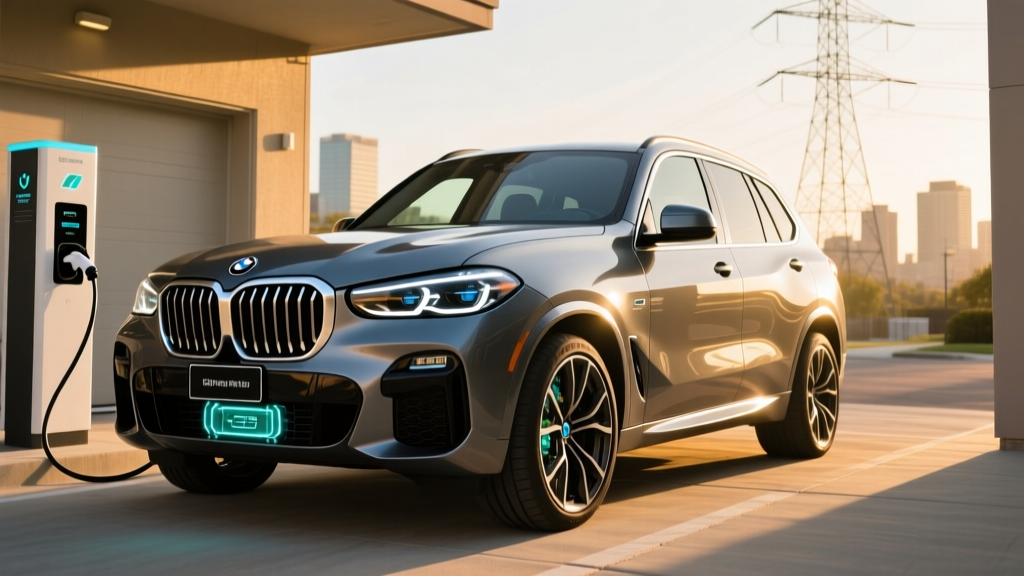
If you've been searching for BMW X5 hybrid fuel economy data before committing to Munich's plug-in luxury SUV, the numbers tell a nuanced story. The 2026 BMW X5 xDrive50e pairs a turbocharged inline-six with a more powerful electric motor and a larger battery than its predecessor, delivering up to 38 miles of electric-only driving and a combined 485 horsepower. But as with every PHEV, your actual fuel economy hinges entirely on how — and whether — you plug it in.
This guide breaks down the EPA figures, real-world MPG expectations, charging logistics, battery longevity, and federal tax credit eligibility for the current X5 PHEV, so you can decide whether it fits your driving pattern better than a full EV or a conventional hybrid.
HEV vs. PHEV: What the BMW X5 Actually Is
Before diving into the numbers, a critical distinction: the BMW X5 is offered exclusively as a plug-in hybrid (PHEV) in its electrified form — the xDrive50e. It is not a conventional hybrid (HEV) like a Toyota RAV4 Hybrid that charges its small battery solely through regenerative braking and engine power.
Conventional Hybrid (HEV) vs. Plug-In Hybrid (PHEV)
| Feature | HEV (e.g., Toyota RAV4 Hybrid) | PHEV (BMW X5 xDrive50e) |
|---|---|---|
| Battery size | 1.0–1.6 kWh | 25.7 kWh (usable) |
| Electric-only range | 0–1 miles at low speed | 38 miles (EPA) |
| Plug-in charging | Not required or possible | Required for EV benefits |
| DC fast charging | No | No (AC Level 2 only) |
| Gas engine | Always available | Always available |
| Federal tax credit | None | Potential partial (§30D) |
A PHEV like the X5 xDrive50e is essentially two cars in one: a short-range EV for daily commutes and a turbocharged six-cylinder SUV for road trips. If you never plug it in, you're just hauling 600+ pounds of dead battery weight around — and your fuel economy suffers accordingly.
BMW X5 xDrive50e Fuel Economy: EPA Numbers and Real-World MPG
The EPA rates the 2026 BMW X5 xDrive50e with two sets of figures: an MPGe rating that accounts for electric driving, and a standard MPG rating for gas-only operation once the battery is depleted.
| Metric | City | Highway | Combined |
|---|---|---|---|
| MPGe (with EV driving) | 58 MPGe | 54 MPGe | 56 MPGe |
| Gas-only MPG (battery depleted) | 37 MPG | 40 MPG | 39 MPG |
| Electric-only range | 38 miles (EPA est.) | ||
| Total combined range | ~440 miles (EV + gas tank) | ||
Source: fueleconomy.gov
Real-World MPG: What Owners Actually See
EPA estimates are a starting point, not a guarantee. In real-world use, the X5 xDrive50e's fuel economy varies dramatically based on your charging habits:
- Daily commuter who charges every night: If your round-trip commute is under 38 miles and you charge at home, you may burn zero gasoline for weeks. Observed gas-only consumption in this pattern drops to effectively infinite MPG.
- Highway-heavy driver who rarely charges: Expect 33–37 MPG combined on the highway at 70–80 mph. The inline-six is efficient for its displacement, but aerodynamic drag and the PHEV weight penalty (curb weight: ~5,500 lbs) take a toll.
- Cold-weather drivers: Electric-only range drops 20–30% in freezing temperatures due to battery chemistry limitations and cabin heating demands. Expect ~27–30 miles of EV range in winter, with gas-only MPG dipping to roughly 32–35 MPG combined.
- City drivers in EV mode: Regenerative braking in stop-and-go traffic actually extends real-world electric range slightly beyond EPA estimates in mild weather — some owners report 40–42 miles in city conditions at 25–40 mph.
Powertrain, Battery, and Charging Specs
The 2026 X5 xDrive50e represents the second generation of BMW's current PHEV architecture, with meaningful upgrades over the older xDrive45e.
| Specification | 2026 BMW X5 xDrive50e |
|---|---|
| Engine | 3.0L turbocharged inline-6 (312 hp) |
| Electric motor | Integrated in transmission (184 hp) |
| Combined system output | 485 hp / 516 lb-ft torque |
| 0–60 mph | 4.6 seconds |
| Battery chemistry | NMC (nickel manganese cobalt) |
| Battery capacity (usable) | 25.7 kWh |
| AC Level 2 charging (max) | 7.4 kW |
| DC fast charging | Not available |
| Level 2 charge time (0–100%) | ~3.5 hours |
| Level 1 (120V) charge time | ~18–20 hours |
| Drivetrain | xDrive AWD |
| Transmission | 8-speed automatic (ZF) |
Charging in Practice: What You Need to Know
The X5 xDrive50e uses a standard J1772 connector for AC charging. It does not support DC fast charging — a limitation common among PHEVs, since the battery is small enough that Level 2 charging fills it reasonably quickly.
At the maximum 7.4 kW Level 2 rate, you'll go from empty to full in about 3.5 hours. This means a dedicated home Level 2 charger (240V, 32A circuit minimum) is practically essential. Relying on a standard 120V outlet (Level 1) technically works but requires nearly a full day — making it impractical for daily use unless your driving is minimal.
Pro tip: BMW includes a flexible charger with the vehicle that supports both 120V and 240V outlets. However, for consistent daily charging, a hardwired Level 2 station (such as a ChargePoint Home Flex or BMW's own Wallbox) installed on a 40A or 50A circuit will deliver the fastest, most reliable home charging experience.
Pricing, Trims, and Federal Tax Credit Eligibility
The 2026 BMW X5 xDrive50e starts at $72,975 (including destination charge). BMW does not break the PHEV into multiple trims — instead, it offers a single well-equipped xDrive50e model with extensive options packages.
Typical option packages that push the price higher include:
- Premium Package (heated steering wheel, head-up display, gesture control): ~$2,400
- Executive Package (glass controls, soft-close doors, heated rear seats): ~$2,600
- Driving Assistance Professional (highway assistant, lane change): ~$1,700
- M Sport Package (aesthetic and suspension upgrades): ~$4,500
A realistically optioned X5 xDrive50e typically lands between $78,000 and $88,000.
Federal Tax Credit Under IRS §30D
PHEV tax credit eligibility is more complex than many buyers realize. Under current IRS rules, the BMW X5 xDrive50e may qualify for a partial or full $7,500 federal tax credit, but eligibility depends on multiple factors that change frequently due to battery sourcing requirements.
- Battery component sourcing: A percentage of battery components must be manufactured or assembled in North America (threshold increases annually).
- Critical minerals: A percentage of critical minerals must be sourced from the U.S. or a free-trade-agreement country.
- Buyer income cap: Modified adjusted gross income must not exceed $150,000 (single), $225,000 (head of household), or $300,000 (joint).
- MSRP cap: The vehicle MSRP must not exceed $80,000 for SUVs — and the X5 xDrive50e's base price of $72,975 qualifies, but options can push it over.
- Point-of-sale transfer: Eligible buyers can now transfer the credit to the dealer at purchase for an immediate price reduction.
Critical caveat: Battery sourcing requirements tighten each year. A vehicle that qualified for the full $7,500 in 2024 may qualify for $3,750 or nothing in 2026 depending on BMW's supply chain adjustments. Always verify current eligibility on fueleconomy.gov and consult a tax professional before relying on the credit. See also the IRS clean vehicle credit page for the latest rules.
Battery Warranty, Reliability, and Long-Term Costs
Battery longevity is consistently the top concern among PHEV buyers, and the X5 xDrive50e addresses it with BMW's standard hybrid battery warranty.
Realistic Battery Degradation
The 25.7 kWh NMC battery in the X5 xDrive50e benefits from BMW's thermal management system, which actively heats and cools the pack to minimize degradation. Based on data from the previous-generation xDrive45e and broader NMC chemistry performance:
- Year 1–3: Expect 2–5% capacity loss (normal settling period)
- Year 4–8: Degradation slows; total loss typically 8–12% by year 8
- Beyond warranty: Most NMC PHEV batteries retain 80–85% capacity at 100,000+ miles with proper thermal management
Out-of-warranty replacement cost: If the battery does need replacement after the warranty expires, expect $8,000–$14,000 for the pack plus labor, based on current BMW PHEV battery pricing. This is significantly less than a full EV battery replacement (which can exceed $20,000), reflecting the smaller pack size.
Overall Reliability
BMW's inline-six engines have a strong long-term reliability record, and the ZF 8-speed transmission is widely regarded as one of the most durable automatics in the industry. The electric motor adds minimal complexity since it has far fewer moving parts than a mechanical drivetrain component.
The main reliability watch items for the X5 PHEV are:
- Charging port and onboard charger electronics (occasional software glitches)
- Air suspension (if equipped — costly to replace at high mileage)
- iDrive infotainment system (software-dependent; generally stable in current generation)
Who Should Buy the X5 PHEV vs. a Full EV or Gas SUV
The X5 xDrive50e occupies a specific niche. It's not the right choice for everyone, but for the right buyer, it's arguably the most versatile vehicle in BMW's lineup.
Pros
- 38-mile EV range covers most daily commutes gasoline-free
- 485 hp with smooth inline-six refinement — no range anxiety on road trips
- 39 MPG gas-only is excellent for a 5,500-lb luxury SUV
- Premium interior, excellent ride quality, strong resale value
- No charging infrastructure dependency for long trips
Cons
- High base price ($72,975) before options
- No DC fast charging — public charging is slow
- Requires daily home charging to realize EV benefits
- Cargo space slightly reduced vs. gas X5 (battery under floor)
- Tax credit eligibility uncertain and subject to change
Decision Framework: Which Powertrain Is Right for You?
Choose the BMW X5 xDrive50e (PHEV) if: You can charge at home nightly, your daily driving is under 40 miles, but you take regular road trips where EV charging infrastructure is sparse or unreliable.
Choose a full EV (e.g., BMW iX) if: You have reliable home charging, your daily driving is under 250 miles, and you're comfortable planning road trips around DC fast-charging stops.
Choose a conventional hybrid (HEV) if: You cannot charge at home (apartment, no garage) and want better fuel economy without any plug-in routine.
Stick with a gas X5 (xDrive40i) if: Your annual mileage is low, the PHEV price premium isn't justified by fuel savings, and you want maximum cargo space and simplicity.
Ownership Economics: 5-Year Cost Snapshot
To understand whether the PHEV premium pays off, consider a simplified 5-year ownership comparison assuming 12,000 miles/year, $3.80/gallon gas, and $0.14/kWh electricity:
| Cost Category | X5 xDrive50e (PHEV) | X5 xDrive40i (Gas) |
|---|---|---|
| Purchase price (base) | $72,975 | $66,875 |
| Est. federal tax credit | –$3,750 to –$7,500 | $0 |
| Fuel cost (5 years) | ~$5,200 (mixed EV/gas) | ~$11,400 (22 MPG combined) |
| Maintenance (5 years) | ~$3,800 | ~$4,200 |
| Insurance (5 years) | ~$12,000 | ~$11,200 |
| Est. 5-year total | ~$90,225–$93,975 | ~$93,675 |
The PHEV breaks even or comes out slightly ahead over 5 years when the tax credit applies, with the advantage growing substantially if electricity costs are low (e.g., solar-charged home) or gas prices rise. Without the tax credit, the gas model wins on pure cost — making the PHEV a choice driven as much by driving experience and emissions reduction as by economics.
Frequently Asked Questions
How many MPG does the BMW X5 hybrid get?
The 2026 BMW X5 xDrive50e is EPA-rated at 56 MPGe combined when factoring in electric driving, and 39 MPG combined in gas-only operation (37 city / 40 highway). Real-world gas-only MPG ranges from 32–37 combined depending on speed, temperature, and terrain.
How far can the BMW X5 PHEV go on electric only?
The EPA rates the X5 xDrive50e at 38 miles of electric-only range. In real-world conditions, expect 30–35 miles at highway speeds, up to 42 miles in city driving during mild weather, and as low as 25–28 miles in freezing temperatures with cabin heating active.
Does the BMW X5 PHEV qualify for a federal tax credit?
It may qualify for a partial or full $7,500 credit under IRS §30D, depending on current battery-sourcing requirements, the buyer's income, and whether the configured MSRP stays under $80,000. Eligibility changes as sourcing rules tighten annually. Always check fueleconomy.gov for the latest status and consult a tax professional.
Is the BMW X5 hybrid reliable and what does battery replacement cost?
BMW's inline-six and ZF transmission are proven reliable. The high-voltage battery is warranted for 8 years/80,000 miles at 70% capacity retention. Out-of-warranty battery replacement costs approximately $8,000–$14,000. Real-world degradation data from similar BMW PHEVs suggests 80–85% capacity retention at 100,000+ miles.
Can the BMW X5 PHEV DC fast charge?
No. The X5 xDrive50e supports only AC charging — up to 7.4 kW on Level 2 (240V), taking about 3.5 hours for a full charge. DC fast charging is not available, which is typical for PHEVs given their smaller battery sizes.
Should I get the X5 PHEV or the BMW iX (full EV)?
Choose the X5 xDrive50e if you need road-trip flexibility without charging stops and your daily commute fits within ~38 miles. Choose the BMW iX (EPA range ~324 miles, DC fast charging to 200 kW) if you have home charging, rarely exceed 250 miles between stops, and want zero tailpipe emissions with lower per-mile fuel costs.
Do I need to charge the X5 PHEV every day?
You don't need to — the gas engine works independently. But to realize the fuel economy and cost benefits, daily charging is strongly recommended. Without regular plug-in charging, you'll get roughly 33–39 MPG and negate the PHEV's primary advantage over the gas-only X5.