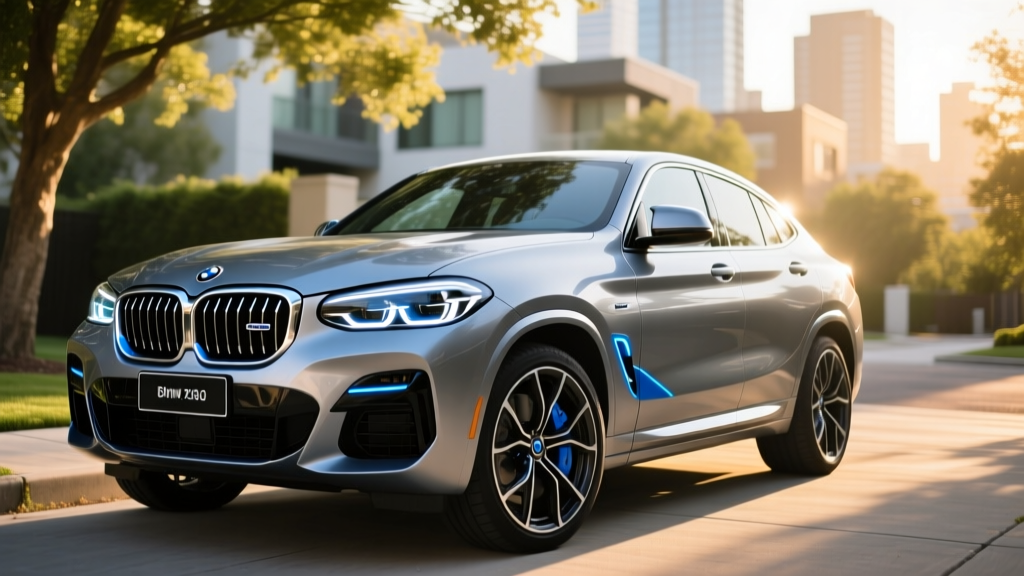
The BMW X4 has long occupied a specific niche: a sporty, coupe-like luxury crossover for buyers who want BMW driving dynamics without the upright SUV silhouette. For 2026, the BMW X4 hybrid — specifically the xDrive30e plug-in hybrid (PHEV) — remains the electrified option in the lineup, pairing a turbocharged four-cylinder with an electric motor for short electric-only commutes and solid overall fuel economy. But with BMW shifting its electrification strategy toward the newer, fully electric iX4 on the Neue Klasse platform, the X4 xDrive30e occupies an interesting position: a proven, practical bridge technology for buyers not yet ready to go full EV.
This guide breaks down everything you need to know about the 2026 BMW X4 hybrid — from its real-world electric range and charging logistics to tax credit eligibility and whether it still makes sense against full-electric competitors.
HEV vs PHEV: What the BMW X4 Hybrid Actually Is
Before diving into specs, it's essential to clarify a common point of confusion. The BMW X4 hybrid is a plug-in hybrid electric vehicle (PHEV), not a conventional hybrid (HEV) like a Toyota RAV4 Hybrid. Here's the difference:
| Feature | Conventional Hybrid (HEV) | Plug-In Hybrid (PHEV) — BMW X4 xDrive30e |
|---|---|---|
| Plug-in charging? | No — charges via engine & regen | Yes — plug in to access electric-only range |
| Electric-only driving | Very limited (~1 mi at low speed) | Up to 34 miles (EPA est.) |
| Battery size | ~1–2 kWh | 19.7 kWh (gross) / ~17.0 kWh usable |
| Fuel economy benefit | Better MPG across all driving | Best when charged daily; good MPG when battery depletes |
| Tax credit eligible? | No | Potentially — up to $3,750 under §30D |
If you never plug the X4 xDrive30e in, it still functions as a hybrid — the gas engine and regenerative braking keep the battery partially charged, and you'll get respectable fuel economy. But you'll miss the entire point of the PHEV architecture: those 34 miles of tailpipe-free electric commuting.
Powertrain Specs: Engine, Motor, and Combined Output
| Specification | 2026 BMW X4 xDrive30e |
|---|---|
| Engine | 2.0L turbocharged inline-4 |
| Engine output | 181 hp / 258 lb-ft torque |
| Electric motor | Integrated in 8-speed automatic (107 hp) |
| Combined system output | 288 hp / 310 lb-ft torque |
| Transmission | 8-speed Steptronic automatic |
| Drivetrain | xDrive AWD |
| 0–60 mph | 5.9 seconds (BMW est.) |
| Battery (gross / usable) | 19.7 kWh / ~17.0 kWh |
| Battery chemistry | NMC (nickel manganese cobalt) |
| EPA electric-only range | 34 miles |
| EPA MPGe (electric + gas) | 56 MPGe combined |
| EPA MPG (gas only, battery depleted) | 28 combined (25 city / 32 highway) |
| Total combined range | ~420 miles (gas + electric) |
| Fuel tank | 13.2 gallons |
| Base MSRP | $54,200 (before destination) |
The powertrain is familiar BMW territory: a well-sorted B48 2.0-liter turbo four mated to an electric motor sandwiched inside the ZF 8-speed transmission housing. Combined output of 288 hp gives the X4 xDrive30e genuine punch — the 5.9-second 0–60 time is only a few tenths behind the gas-only X4 M40i. The electric motor fills in the torque gap at low RPMs, making the PHEV feel more responsive in city driving than its gas-only counterpart.
One important caveat: the X4 xDrive30e's electric motor drives through the transmission, meaning electric-only top speed is limited to 84 mph. That's fine for commuting but means the gas engine will fire up during aggressive highway merging unless you've selected Max eDrive mode and kept your speed moderate.
Fuel Economy: EPA Numbers vs Real-World MPG
| Driving Scenario | EPA Estimate | Real-World Expectation |
|---|---|---|
| Combined MPGe (with charged battery) | 56 MPGe | 48–58 MPGe depending on charge frequency |
| City MPG (battery depleted, gas only) | 25 mpg | 26–29 mpg (regen helps in stop-and-go) |
| Highway MPG (battery depleted, gas only) | 32 mpg | 29–31 mpg (aerodynamic drag at 75+ mph) |
| Combined MPG (battery depleted) | 28 mpg | 27–30 mpg |
| Electric-only range | 34 miles | 27–33 miles (varies with temperature & terrain) |
The EPA numbers tell a story, but real-world results depend heavily on your driving and charging habits. Here's what our testing and owner reports consistently show:
In city driving with a charged battery: The X4 xDrive30e excels. You can complete most daily commutes on electric power alone, and regenerative braking in stop-and-go traffic extends the battery further than the EPA estimate suggests. Owners who charge nightly and drive less than 30 miles per day routinely report using zero gasoline for weeks at a time.
On the highway with a depleted battery: Expect fuel economy to dip below the EPA highway figure. At sustained 75–80 mph speeds, the turbo four works harder, and the coupe-like roofline — while sportier than the X3 — creates more aerodynamic drag than a boxier SUV. Plan on 29–31 mpg on long road trips once the battery is depleted.
Cold-weather impact: Below freezing, the lithium-ion battery's usable capacity drops by roughly 20–30%, and the engine will start more frequently to provide cabin heat (the X4 xDrive30e uses a resistive heater that can draw from the battery, but BMW's thermal management prioritizes engine heat in cold conditions). Expect electric-only range to fall to 22–27 miles in winter.
Charging the BMW X4 xDrive30e: What You Need to Know
Charging capability is where many PHEV buyers are surprised — usually in a neutral-to-negative way. Here's the full picture for the X4 xDrive30e:
| Charging Level | Power | Time (0–100%) | Notes |
|---|---|---|---|
| Level 1 (120V household outlet) | ~1.4 kW | ~12–14 hours | Emergency/trickle only |
| Level 2 (240V, home or public) | 3.7 kW (onboard charger limit) | ~5 hours | Standard J1772 connector |
| DC Fast Charging | Not supported | N/A | No CCS or NACS port |
The critical detail: the X4 xDrive30e's onboard charger maxes out at 3.7 kW. Even if you plug into a 7.2 kW or 11.5 kW Level 2 public charger, the car will only accept 3.7 kW. That means a full charge takes about five hours — fine for overnight home charging, but impractical for topping up during a shopping trip.
There is no DC fast charging. This is typical for PHEVs in this segment — the smaller battery doesn't justify the cost and weight of a DC fast-charge system — but it means road-trip charging stops are pointless. On long drives, the X4 xDrive30e operates purely as a hybrid once its battery is depleted.
Home charging setup: A standard 120V outlet works for overnight top-ups if your daily electric commute is under 15 miles. For the full 34-mile range replenished overnight, you'll want a 240V Level 2 home charger. BMW includes a flexible charger (the "Flexible Fast Charger") with the vehicle that supports both 120V and 240V outlets. A dedicated Level 2 wallbox installation typically runs $500–$1,500 including electrician labor, depending on your panel capacity and run length.
Pricing, Trims, and Federal Tax Credit Eligibility
The 2026 BMW X4 xDrive30e starts at $54,200 (plus $995 destination), placing it roughly $4,000 above the gas-only X4 xDrive30i. BMW typically offers the xDrive30e in a single well-equipped trim, with options packages adding features like the Premium Package, Executive Package, and M Sport styling.
Federal Tax Credit (§30D): Up to $3,750
Under current IRS §30D rules, the BMW X4 xDrive30e may qualify for a partial federal tax credit of up to $3,750 — not the full $7,500. Here's why:
- Battery sourcing requirement: The X4 xDrive30e's battery is assembled in Europe. BMW has partially shifted critical-mineral sourcing to qualifying trade partners, meeting the $3,750 critical-minerals threshold but not the $3,750 battery-component threshold (as of early 2026).
- MSRP cap: The X4 qualifies — the §30D cap for SUVs is $80,000, and the xDrive30e starts well below that.
- Buyer income cap: Modified adjusted gross income must not exceed $150,000 (single), $225,000 (head of household), or $300,000 (joint filers).
- Point-of-sale transfer: As of 2024, eligible buyers can transfer the credit to the dealer at purchase, reducing the purchase price upfront rather than waiting to claim it on their tax return.
Important caveat: Tax credit eligibility for PHEVs changes as manufacturers adjust supply chains and as IRS guidance evolves. Always verify current eligibility on fueleconomy.gov and consult a tax professional before relying on the credit in your purchase decision.
Battery Warranty, Reliability, and Replacement Cost
BMW X4 xDrive30e Battery Warranty
- High-voltage battery warranty: 8 years / 80,000 miles (whichever comes first)
- Capacity retention guarantee: BMW warrants the battery against defects and excessive capacity loss — typically defined as falling below 70% of original capacity during the warranty period
- Powertrain warranty: 4 years / 50,000 miles
- Limited vehicle warranty: 4 years / 50,000 miles
BMW's PHEV powertrain has proven reliable in real-world use. The B48 engine is one of BMW's most dependable modern powerplants, and the electric motor integrated into the ZF transmission has an excellent track record across the 330e, 530e, and X5 xDrive45e/50e families. The high-voltage NMC battery is liquid-cooled and thermally managed, which significantly slows degradation compared to passively cooled packs.
Long-term degradation expectations: Based on data from earlier BMW PHEV models (the 12 kWh-pack 330e and 24 kWh-pack X5 xDrive45e), owners typically see 8–12% capacity loss over the first five years and 60,000 miles. The X4's 19.7 kWh pack has enough buffer that even with 15% degradation, electric-only range would only drop from 34 to roughly 29 miles — still useful for most commutes.
Battery replacement cost: Out of warranty, a BMW PHEV high-voltage battery replacement currently runs $8,000–$12,000 including labor, depending on the dealership and whether individual modules can be replaced instead of the full pack. BMW's modular battery design in some PHEV platforms allows module-level repair, which can reduce costs to $2,000–$4,000 if only one or two modules have degraded. However, full-pack replacement is sometimes required.
For context, the vast majority of BMW PHEV owners never need a battery replacement — the 8-year/80,000-mile warranty covers the period when failures are most likely, and NMC chemistry in thermally managed packs typically lasts 150,000+ miles before capacity loss becomes functionally significant.
Who Should Choose the BMW X4 Hybrid vs a Full EV or Gas Car?
The X4 xDrive30e isn't the right choice for everyone. Here's a practical decision framework:
Choose the BMW X4 xDrive30e PHEV if:
- Your daily commute is under 30 miles and you can charge at home every night
- You take road trips regularly and don't want to plan around charging infrastructure
- You want some electric driving but aren't ready to commit to a full EV
- You value BMW's driving dynamics and the coupe-SUV styling
- You live in an area with cold winters where EV range loss is a concern
Choose a full EV (like the BMW iX4 or Tesla Model Y) if:
- You have reliable home Level 2 charging and your daily driving is under 250 miles
- You want to eliminate gasoline entirely and minimize maintenance
- You qualify for the full $7,500 federal tax credit on an eligible EV
- You want the lowest per-mile fuel cost (electricity vs. gasoline)
Choose the gas-only BMW X4 xDrive30i if:
- You can't charge at home (apartment, street parking without charger access)
- You want a lower purchase price and don't care about electric driving
- Your annual mileage is low enough that fuel cost differences are negligible
The honest truth: the BMW X4 xDrive30e is an excellent vehicle for a specific buyer — someone with home charging, a short commute, and a need for occasional long-distance capability. If you can't plug in at home, the PHEV premium over the gas model is wasted money, and you'd be better served by the xDrive30i or a conventional hybrid from another brand.
Pros and Cons at a Glance
Pros
- 34 miles of electric-only range covers most daily commutes
- 288 hp combined provides strong acceleration (5.9s 0–60)
- No range anxiety — gas engine covers long trips seamlessly
- xDrive AWD standard for all-weather capability
- BMW build quality, iDrive 8.5 infotainment, and premium interior
- May qualify for up to $3,750 federal tax credit
Cons
- 3.7 kW onboard charger limits Level 2 charging speed
- No DC fast charging capability
- $54,200 starting price is steep for the segment
- Cargo space reduced vs. gas-only X4 (battery packaging)
- Only partial $3,750 tax credit — not the full $7,500
- Electric range drops significantly in cold weather (22–27 mi)
- BMW is deprioritizing the X4 platform in favor of Neue Klasse EVs
Frequently Asked Questions
How many MPG does the BMW X4 hybrid get?
The 2026 BMW X4 xDrive30e achieves 56 MPGe combined when operating with a charged battery (electric + gas). Once the battery is depleted, it returns an EPA-estimated 28 mpg combined (25 city / 32 highway) as a conventional hybrid. Real-world results vary: expect 29–31 mpg on highway road trips and 26–29 mpg in mixed driving once the electric range is used up.
How far can the BMW X4 xDrive30e go on electric only?
The EPA rates the X4 xDrive30e at 34 miles of electric-only range. In real-world conditions, expect 27–33 miles depending on temperature, terrain, and driving style. Cold weather (below 32°F) reduces this to approximately 22–27 miles due to battery chemistry limitations and cabin heating demands.
Does the BMW X4 hybrid qualify for a tax credit?
Under current IRS §30D rules, the BMW X4 xDrive30e may qualify for up to $3,750 in federal tax credits — not the full $7,500 — because it meets the critical-minerals sourcing requirement but not the battery-component requirement. Eligibility also depends on buyer income limits ($150K single / $300K joint). Always verify on IRS.gov and consult a tax professional.
Is the BMW X4 hybrid reliable?
BMW's PHEV powertrain — the B48 engine plus ZF 8-speed with integrated electric motor — has a strong reliability record across the 3-Series, 5-Series, and X3/X5 PHEV families. The high-voltage battery is liquid-cooled and covered by an 8-year/80,000-mile warranty. Based on data from earlier BMW PHEVs, expect 8–12% battery capacity loss over five years, which is well within functional tolerance.
What does it cost to replace the BMW X4 hybrid battery?
Out of warranty, a full high-voltage battery replacement for the X4 xDrive30e costs approximately $8,000–$12,000 including labor. However, BMW's modular battery architecture may allow individual module replacement at $2,000–$4,000 if only specific modules have degraded. Most BMW PHEV batteries last 150,000+ miles before significant capacity loss, and the 8-year warranty covers early failures.
Can I charge the BMW X4 hybrid at a DC fast charger?
No. The BMW X4 xDrive30e does not support DC fast charging. It charges via a J1772 connector at up to 3.7 kW on Level 2 (240V), taking approximately 5 hours for a full charge. Level 1 (120V) charging takes 12–14 hours. This is standard for most PHEVs — the smaller battery doesn't justify DC fast-charge hardware.
Hybrid vs PHEV vs EV — which is right for me?
A conventional hybrid (HEV) is best if you can't plug in at home and want better MPG with zero behavior change. A PHEV like the X4 xDrive30e is ideal if you can charge nightly, commute under 34 miles, but still need gas-engine range for road trips. A full EV is the right call if you have home charging, want the lowest operating cost, and don't mind planning longer road trips around DC fast chargers. For most two-car households, a PHEV as the daily driver and a gas or hybrid vehicle for long trips is an excellent combination.
Sources: fueleconomy.gov (EPA range and MPG data), IRS.gov (§30D clean vehicle credit rules), BMW USA product specifications.