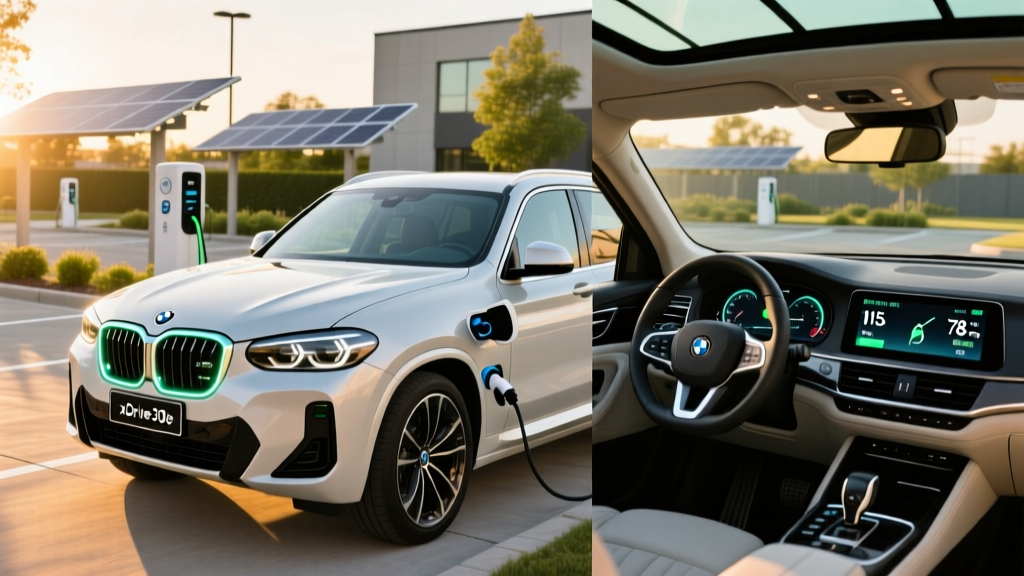
The BMW X3 has long been a benchmark compact luxury crossover, and the 2026 BMW X3 xDrive30e plug-in hybrid (PHEV) aims to bridge the gap between a conventional gas X3 and a full battery-electric iX3. For buyers searching for a hybrid X3, this is currently the only electrified option BMW offers in the X3 lineup in the United States. It pairs a turbocharged four-cylinder engine with an electric motor and a modest battery pack, delivering short electric-only commutes and strong combined fuel economy.
But does the math actually work? Below, we break down the X3 xDrive30e's real-world efficiency, electric range, charging requirements, powertrain specs, pricing, and federal tax credit eligibility — plus how it compares to going full EV or sticking with a conventional hybrid.
HEV vs PHEV: Which Hybrid X3 Are You Looking At?
Before diving into specs, it's critical to clarify what's available. BMW does not sell a conventional hybrid (HEV) X3 in the US market. The only electrified X3 is the xDrive30e plug-in hybrid. Here's what that distinction means:
| Feature | Conventional Hybrid (HEV) | Plug-In Hybrid (PHEV) — X3 xDrive30e |
|---|---|---|
| Plugs in to charge? | No — self-charging via regen and engine | Yes — plug in for electric-only miles |
| Electric-only range | 0–2 miles at low speed | ~35 miles (EPA est.) |
| Battery size | ~1–2 kWh | 19.7 kWh (gross) / ~17.0 kWh usable |
| Federal tax credit | None | Up to $3,750 (if eligible, see below) |
| Gas engine still present? | Yes | Yes |
If you've been searching for a "hybrid X3" expecting a self-charging, no-plug-needed setup, the xDrive30e will require a change in habit — but one that pays off with meaningful electric-only commuting.
Fuel Economy: EPA MPG, MPGe, and Real-World Numbers
The X3 xDrive30e carries two efficiency ratings: MPGe (miles-per-gallon-equivalent, measuring combined electric + gas efficiency) and standard MPG (when operating purely as a hybrid after the battery is depleted).
| Metric | City | Highway | Combined |
|---|---|---|---|
| MPGe (charge-sustaining + electric) | — | — | 38 MPGe (EPA est.) |
| MPG (gas-only, battery depleted) | 27 MPG | 33 MPG | 29 MPG |
Real-world expectation: PHEVs reward city driving and short commutes. If your daily round trip is under 35 miles and you charge nightly, you may use almost no gasoline for weeks. On a long highway road trip with a depleted battery, expect roughly 27–29 MPG — respectable for a 4,500-lb luxury AWD crossover, but not class-leading. According to fueleconomy.gov, the combined gas-only MPG lands in line with competitors like the Volvo XC60 Recharge but trails the Lexus NX 450h+.
Cold-weather note: Electric-only range drops 20–30% in freezing temperatures due to cabin heating demands and reduced battery efficiency. Plan on ~25 miles of EV range in January, not 35.
Electric-Only Range and Total Driving Range
EPA Electric-Only Range: ~35 miles
Real-World Electric Range: ~28–35 miles (varies with temperature, speed, terrain)
Total Combined Range (electric + full tank): ~420 miles
Fuel Tank: 13.2 gallons (premium required)
The 35-mile electric range covers a significant portion of American commutes — the US Census Bureau reports the average one-way commute is roughly 16 miles. If you have Level 2 charging at home or work, the X3 xDrive30e can function as a weekday EV and a weekend road-trip vehicle without range anxiety.
For PHEVs, the total combined range matters more than any single number. With a full charge and a full tank, you're looking at roughly 420 miles before needing to stop — comparable to a gas-only X3 sDrive30i.
Battery, Charging Speed, and Home Setup
| Charging Level | Power (kW) | Time (0–100%) | Notes |
|---|---|---|---|
| Level 1 (120V household) | ~1.4 kW | ~12–14 hours | Emergency/top-up only |
| Level 2 (240V home/public) | 7.4 kW | ~2.5–3 hours | Standard overnight charge |
| DC Fast Charge | Not supported | N/A | No CCS/CHAdeMO capability |
The X3 xDrive30e uses a 19.7 kWh gross lithium-ion battery pack (~17.0 kWh usable, with a buffer to protect longevity). It charges via a J1772 connector (standard for non-Tesla PHEVs in the US) at up to 7.4 kW on Level 2.
Critical limitation: This PHEV does not support DC fast charging. You won't be able to use Electrify America or Tesla Supercharger stations to top up the battery on a road trip. For a PHEV with a 35-mile battery, this is typical — most PHEVs skip DC capability — but it means public charging is limited to Level 2 destinations.
Home charging recommendation: A 240V Level 2 home charger (like a ChargePoint Home Flex or Emporia Level 2) installed on a 40A circuit will fully replenish the battery in about 2.5 hours. Installation costs typically range from $500–$1,500 depending on panel capacity and run length. Consult a licensed electrician for your specific setup.
Powertrain: Combined Horsepower and Performance
| Spec | 2026 BMW X3 xDrive30e |
|---|---|
| Engine | 2.0L turbocharged inline-4 |
| Engine output | 184 HP / 258 lb-ft torque |
| Electric motor | Integrated in 8-speed auto, 184 HP |
| Combined system output | 312 HP / 345 lb-ft torque |
| 0–60 MPH | 5.9 seconds (BMW est.) |
| Drivetrain | xDrive AWD |
| Transmission | 8-speed automatic |
| Towing capacity | 3,500 lbs (braked) |
| Cargo volume (rear seats up) | 28.7 cu ft |
| Cargo volume (rear seats folded) | 63.0 cu ft |
The combined 312 HP makes the xDrive30e the quickest non-M X3 variant, beating the gas-only xDrive30i (248 HP) to 60 MPH by over a second. The electric motor's instant torque fills in the low-end gap that turbocharged four-cylinders typically exhibit, and the transition between electric and gas power is well-managed by BMW's powertrain software.
One trade-off: the battery pack sits under the rear seat and cargo floor, which slightly reduces cargo volume compared to the gas X3 (by roughly 2–3 cu ft). You won't notice it day-to-day, but it matters if you regularly haul large items.
Pricing, Trims, and Federal Tax Credit Eligibility
| Trim | MSRP (2026 est.) |
|---|---|
| X3 xDrive30e (base) | $52,575 |
| X3 xDrive30e w/ Premium Package | ~$56,500 |
| X3 xDrive30e w/ M Sport Package | ~$58,900 |
BMW prices the X3 xDrive30e at a premium over the gas-only xDrive30i (starting ~$47,775), reflecting the added electric powertrain. The roughly $4,800 upcharge is the key calculation: if you save $1,200–$1,800 annually on fuel by commuting on electricity, the PHEV pays for itself in 3–4 years before any incentives.
Federal Tax Credit (§30D) — Current 2026 Rules:
- Maximum credit: Up to $3,750 (partial — depends on critical minerals and battery component sourcing requirements)
- MSRP cap: SUVs must be under $80,000 — the X3 xDrive30e qualifies
- Buyer income cap: Modified AGI must not exceed $150K (single) / $300K (joint)
- Battery sourcing: Critical minerals and battery components must meet phased-in domestic/FTEA content thresholds per IRS guidance
- Point-of-sale transfer: Eligible buyers can transfer the credit to the dealer for an upfront price reduction
Note: Tax credit eligibility changes frequently based on battery sourcing rules. Verify current status on irs.gov before purchasing. Consult a tax professional for your specific situation.
The full $7,500 credit is increasingly difficult to qualify for as battery-sourcing rules tighten. The X3 xDrive30e may qualify for the partial $3,750 credit depending on the model year's battery component sourcing. This is a crucial variable — confirm eligibility with your dealer and cross-reference the IRS clean vehicle list before signing.
Reliability, Battery Warranty, and Replacement Cost
High-Voltage Battery Warranty: 8 years / 80,000 miles (whichever comes first), covering defects and capacity loss below 70% of original capacity.
Powertrain Warranty: 4 years / 50,000 miles
Limited Vehicle Warranty: 4 years / 50,000 miles
BMW's hybrid battery warranty meets the federal minimum mandated by the EPA and CARB for emissions-related components. The 70% capacity retention threshold is standard — if your battery drops below 70% of its original 19.7 kWh capacity within 8 years/80,000 miles, BMW will repair or replace it at no cost.
Longevity data: Modern PHEV lithium-ion packs with active thermal management (like the X3's) typically degrade 10–15% over 10 years with normal use. Because the X3's usable battery is relatively small (~17 kWh), the system uses a generous buffer (the difference between gross and usable capacity) to reduce deep-cycle stress. Many BMW PHEV owners report minimal degradation at the 5-year mark.
Out-of-warranty replacement cost: If the battery fails after the warranty period, expect a replacement cost of $5,000–$8,000 (parts and labor) based on current BMW PHEV battery pricing. This is significantly less than a full BEV battery replacement ($12,000–$20,000) because the pack is smaller.
General reliability: BMW's B48 turbocharged inline-4 is a well-proven engine with a strong reliability track record since 2016. The electric motor and 8-speed automatic add fewer failure points than a traditional transmission. According to IIHS, the X3 continues to earn top safety ratings, which matters for family-oriented buyers.
Hybrid X3 vs Full EV vs Gas: Which Should You Choose?
Choose the X3 xDrive30e PHEV if:
- Your daily commute is under 35 miles round-trip and you can charge at home
- You want electric weekday driving but gas flexibility for road trips
- You're not ready to commit to a full EV due to apartment living or unreliable public charging
- You want the quickest non-M X3 variant with AWD
Choose the gas-only X3 xDrive30i if:
- You can't charge at home (no garage, no outlet access)
- You drive mostly highway miles where the PHEV battery adds weight without benefit
- You want the lowest upfront price and don't care about electric driving
Choose a full EV (BMW iX3 or competitor like Tesla Model Y, Genesis GV70 Electrified) if:
- You have reliable Level 2 home charging
- Your daily driving rarely exceeds 200 miles
- You want zero tailpipe emissions, minimal maintenance, and the lowest per-mile fuel cost
- You're eligible for the full $7,500 federal tax credit on a qualifying BEV
The PHEV X3 occupies a specific niche: it's the right answer for households that want to electrify most daily miles but can't eliminate gas entirely. If your lifestyle is already 95% compatible with a full EV, the X3 xDrive30e's premium over a gas model is better spent on a BEV with longer range and lower running costs.
Pros and Cons at a Glance
Pros
- 35 miles electric-only covers most commutes
- 312 HP makes it the quickest standard X3
- No range anxiety — gas engine covers road trips
- Qualifies for partial federal tax credit (up to $3,750)
- Strong build quality, premium interior, top safety scores
Cons
- No DC fast charging — Level 2 only
- Premium over gas X3 takes 3–4 years to recoup
- Cargo volume slightly reduced vs gas model
- Real-world highway MPG (battery depleted) is unremarkable at ~27 MPG
- Requires home Level 2 charging to maximize value
Frequently Asked Questions
How many MPG does the hybrid BMW X3 get?
The 2026 BMW X3 xDrive30e achieves an EPA-estimated 38 MPGe combined when factoring in electric operation, and 29 MPG combined (27 city / 33 highway) when running on gasoline alone after the battery is depleted. Real-world city MPG can exceed the EPA estimate because regenerative braking recovers energy in stop-and-go traffic.
How far can the X3 PHEV go on electric only?
The EPA estimates ~35 miles of electric-only range. In real-world conditions — particularly in cold weather or at sustained highway speeds — expect 25–35 miles. This is sufficient for most daily commutes if you charge at home overnight.
Does the BMW X3 hybrid qualify for a tax credit?
The X3 xDrive30e may qualify for a partial federal tax credit of up to $3,750 under IRS §30D rules, depending on battery sourcing compliance, buyer income (under $150K single / $300K joint), and the vehicle's MSRP (under the $80,000 SUV cap). Always verify current eligibility on irs.gov before purchasing.
Is the BMW X3 hybrid reliable, and what does a battery replacement cost?
BMW's B48 engine and PHEV drivetrain have proven reliable since their introduction. The high-voltage battery is warrantied for 8 years/80,000 miles. Out-of-warranty replacement runs approximately $5,000–$8,000. Most owners report minimal battery degradation within the warranty period thanks to active thermal management and conservative buffer sizing.
Can I charge the X3 xDrive30e at a DC fast charger?
No. The X3 xDrive30e only supports Level 1 (120V) and Level 2 (240V) AC charging via a J1772 connector, at a maximum rate of 7.4 kW. DC fast charging is not available on this PHEV, which is typical for plug-in hybrids with smaller battery packs.
Do I need to plug in the X3 xDrive30e, or does it self-charge?
You should plug it in to get the full benefit. While the X3 xDrive30e can recover some charge through regenerative braking and the gas engine, you'll only access the full 35 miles of electric range by plugging into a Level 2 charger. Without plugging in, it functions as a heavy, less-efficient conventional hybrid.