Quick Verdict: The BMW X3 PHEV at a Glance
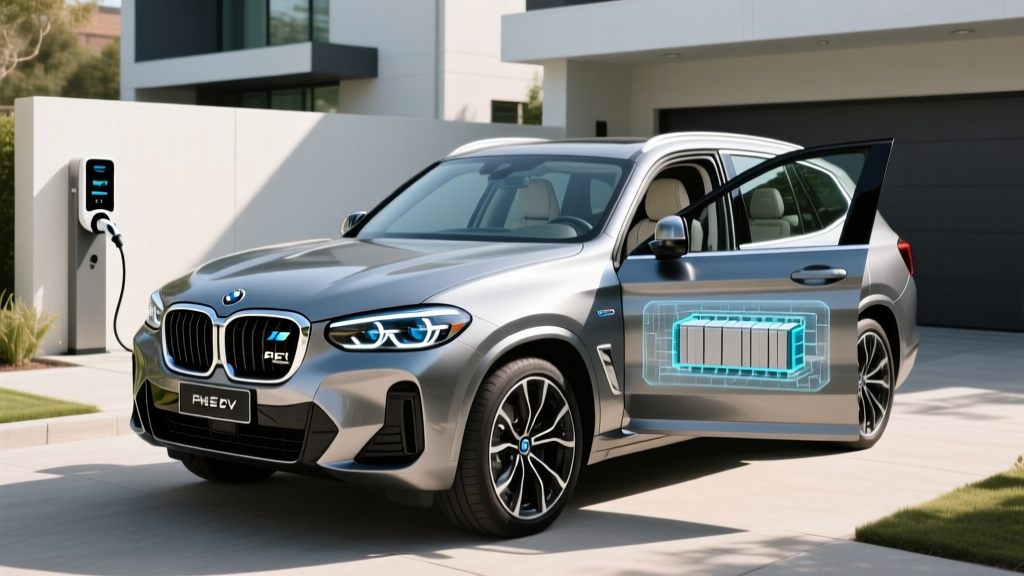
The 2026 BMW X3 xDrive50e is a plug-in hybrid (PHEV) luxury compact SUV that bridges the gap between a conventional gas car and a full battery-electric vehicle. With an EPA-estimated 38 miles of electric-only range, 56 MPGe combined when running on its battery, and a combined 345 horsepower from its turbocharged four-cylinder engine and electric motor, the X3 PHEV targets buyers who want EV-like commuting without range anxiety on longer trips. It is not a conventional hybrid (HEV) — it has a larger battery you plug in to charge — and that distinction matters for both daily driving and tax-credit eligibility.
| Spec | Value |
|---|---|
| Powertrain | 2.0L turbo I-4 + electric motor (PHEV) |
| Combined Horsepower | 345 hp / 350 lb-ft torque |
| Battery Capacity | 22.0 kWh (gross) / ~18.5 kWh usable |
| EPA Electric-Only Range | 38 miles |
| Total Combined Range | ~430 miles (electric + gas) |
| EPA MPGe (EV Mode) | 56 MPGe combined |
| EPA MPG (Gas Only) | 28 city / 33 highway / 30 combined |
| 0–60 mph | 5.9 seconds |
| Level 2 AC Charging | 7.4 kW (0–100% in ~2 hr 45 min) |
| DC Fast Charging | Not available |
| Drivetrain | xDrive AWD |
| Base MSRP | $58,300 (incl. destination) |
| Battery Warranty | 8 years / 80,000 miles |
HEV vs PHEV: What the X3 xDrive50e Actually Is
BMW does not sell a conventional hybrid (HEV) version of the X3 in the US market. The xDrive50e is strictly a plug-in hybrid, meaning it carries a substantially larger battery than a standard hybrid and must be plugged in to unlock its full electric range. Here is how the two architectures compare:
| Feature | HEV (e.g., Toyota RAV4 Hybrid) | PHEV (BMW X3 xDrive50e) |
|---|---|---|
| Battery Size | ~1.5–2.0 kWh | 22.0 kWh gross |
| Electric-Only Range | 0–1 mile at low speed | 38 miles (EPA) |
| Plug-In Required? | No — self-charges via regen & engine | Yes — plug in for EV range |
| Fuel Economy Benefit | Better MPG across all driving | Best when charged daily; good MPG on gas |
| Tax Credit Eligible? | No | Potentially (see §30D rules below) |
If you never plug in the X3 PHEV, it still operates as a hybrid — the engine and motor work together, and regenerative braking recovers energy. But you will forfeit the 38-mile electric range and the efficiency gains that make the PHEV worthwhile. Think of it this way: a PHEV rewards you for charging, while an HEV rewards you passively.
Fuel Economy: EPA Numbers vs Real-World MPG
| Mode | City | Highway | Combined |
|---|---|---|---|
| EV Mode (MPGe) | 62 MPGe | 51 MPGe | 56 MPGe |
| Gas-Only Mode (MPG) | 28 MPG | 33 MPG | 30 MPG |
According to fueleconomy.gov, the X3 xDrive50e achieves 56 MPGe combined when leveraging its battery charge. Once the battery is depleted, the 2.0L turbo four-cylinder takes over with 30 MPG combined — respectable for a 4,500-pound AWD luxury SUV, though not class-leading.
Real-world expectations: In city driving with a charged battery, owners commonly report using zero gasoline for commutes under 35 miles. On the highway at 75 mph with a depleted battery, expect closer to 27–29 MPG — the turbo engine works harder at sustained speeds with the added weight of the battery pack. In cold weather (below 30°F), electric-only range typically drops 15–25%, meaning your 38-mile EPA figure may shrink to 28–32 miles in winter. This is consistent with lithium-ion chemistry behavior and not unique to BMW.
Electric-Only Range, Charging, and Battery Details
The X3 xDrive50e's 22.0 kWh battery (approximately 18.5 kWh usable, with the rest serving as a protective buffer to reduce degradation) delivers an EPA-rated 38 miles of pure electric driving. That is enough to cover the average American's one-way commute, which the US Census Bureau pegs at roughly 16 miles — meaning most owners can complete daily round trips on electricity alone.
Charging speed and connectors:
- Level 1 (120V household outlet): ~1.4 kW — adds roughly 4–5 miles of range per hour; full charge in ~13 hours. Fine for overnight top-ups if you drive less than 30 miles daily.
- Level 2 (240V home charger or public station): 7.4 kW — full charge from empty in approximately 2 hours 45 minutes. This is the recommended daily charging method.
- DC fast charging: Not available. The X3 PHEV does not support CCS or NACS DC fast charging. This is typical for PHEVs — the battery is small enough that Level 2 charging is sufficient, but it means you cannot top up quickly on a road trip.
The charging port uses a standard J1772 connector for Level 1 and Level 2 AC charging. If you are installing a home Level 2 charger, expect to spend $500–$1,200 on the unit plus $800–$2,500 for electrician installation depending on your panel capacity and run length. A 240V/32A circuit is adequate for the X3's 7.4 kW onboard charger.
Powertrain and Performance
The xDrive50e pairs a 2.0-liter turbocharged inline-four engine (producing roughly 190 hp on its own) with an electric motor integrated into the eight-speed automatic transmission. Combined output is 345 hp and 350 lb-ft of torque, routed through BMW's xDrive all-wheel-drive system.
The 0–60 mph sprint takes 5.9 seconds — quicker than the gas-only X3 xDrive30 (which runs around 6.2 seconds) and noticeably more responsive in city driving thanks to the electric motor's instant torque. In EV mode, the X3 PHEV can reach speeds up to 87 mph on electric power alone, though sustained highway speeds will drain the battery faster than the EPA test cycle suggests.
One practical note: the PHEV's battery pack reduces cargo capacity slightly compared to the gas X3. Expect roughly 28.7 cubic feet behind the rear seats (vs. 31.5 in the gas model) and about 60 cubic feet with seats folded. The battery is positioned under the rear floor, so there is no frunk, and the cargo floor is slightly higher.
Pricing, Trims, and Federal Tax Credit Eligibility
The 2026 BMW X3 xDrive50e starts at an MSRP of $58,300 including destination charge. BMW offers it in a single well-equipped trim with optional packages (Premium, M Sport, Executive) that can push the price into the mid-$60,000s.
Federal tax credit (§30D): The BMW X3 xDrive50e may qualify for a partial or full federal plug-in hybrid tax credit, but eligibility depends on several factors that change frequently. Under current IRS §30D rules:
- MSRP cap: SUVs must be under $80,000 MSRP — the X3 PHEV clears this threshold.
- Buyer income cap: Modified adjusted gross income must not exceed $150,000 (single), $225,000 (head of household), or $300,000 (joint filers).
- Battery sourcing requirements: A percentage of critical minerals and battery components must be sourced from the US or free-trade-agreement countries. BMW's supply chain partially meets these requirements, but the qualifying credit amount (up to $7,500, split between a $3,750 critical-minerals credit and a $3,750 battery-components credit) varies by model year and production batch.
- Point-of-sale transfer: As of 2024, buyers can transfer the credit to the dealer at purchase, reducing the purchase price upfront rather than waiting for a tax refund.
Because BMW manufactures the X3 in South Carolina (Spartanburg), some domestic-content requirements are partially satisfied. However, battery cell sourcing is the variable that determines whether you receive $3,750 or the full $7,500. Check the DOE's qualifying vehicle list at the time of purchase, as eligibility can shift with supply-chain changes.
Always consult a tax professional before relying on credit eligibility for your purchase decision.
Battery Warranty, Reliability, and Replacement Cost
Battery Warranty: BMW covers the X3 xDrive50e's high-voltage battery for 8 years or 80,000 miles (whichever comes first), warranting it against capacity loss below 70% of its original capacity. This is the industry-standard PHEV/EV battery warranty mandated by California Air Resources Board (CARB) regulations and adopted nationwide.
Reliability: BMW's turbocharged four-cylinder engines have a solid track record in the X3 lineage, and the PHEV powertrain adds complexity (an electric motor, inverter, and high-voltage battery) that has proven durable across BMW's PHEV lineup since the 2016 X5 xDrive40e. The eight-speed ZF automatic transmission is widely regarded as one of the most reliable in the industry.
That said, the X3 PHEV has more components that can potentially fail than either a pure EV or a conventional gas car. Owners should budget for standard BMW maintenance costs, which run higher than mainstream brands. BMW includes 3 years/36,000 miles of complimentary scheduled maintenance.
Battery replacement cost: If the high-voltage battery fails outside of warranty, replacement is estimated at $8,000–$12,000 including parts and labor. However, PHEV batteries are smaller and less stressed than full EV batteries (they operate in a narrower state-of-charge window thanks to the larger buffer), so catastrophic failure before 150,000+ miles is uncommon based on data from BMW's earlier PHEV models. Most degradation is gradual — expect to retain 85–90% of original capacity after 5 years of daily charging.
Who Should Choose the X3 PHEV vs a Full EV or Gas Car
Choose the BMW X3 PHEV if:
- You can charge at home (Level 1 or Level 2) and your daily commute is under 40 miles round-trip
- You want EV-like driving for daily errands but regularly take road trips exceeding 200 miles
- You live in an area with limited public DC fast-charging infrastructure
- You want luxury-badge quality and AWD without committing to a full BEV
Choose a full EV (like the BMW iX or Tesla Model Y) if:
- You have reliable home Level 2 charging and your trips rarely exceed 250 miles
- You want to eliminate gasoline purchases and oil changes entirely
- You prioritize maximum cargo space (no engine, more flexible packaging)
- You want the lowest per-mile fuel cost (electricity at $0.13/kWh ≈ $0.04/mile vs. gas at ~$0.15/mile)
Choose the gas-only X3 xDrive30 if:
- You cannot charge at home or at work (apartment without EV infrastructure)
- Your budget is under $50,000 and you don't qualify for the federal tax credit
- You prefer simpler mechanicals with fewer high-voltage components
Pros
- 38 miles electric covers most daily commutes gas-free
- 345 hp with instant electric torque makes it genuinely quick
- No range anxiety — 430+ total miles with gas tank
- Eligible for partial or full §30D federal tax credit
- BMW build quality, iDrive infotainment, and luxury appointments
- AWD standard for snow and rain confidence
Cons
- No DC fast charging — road trips run on gas only
- $58,300 starting price is steep before options
- Cargo space slightly reduced vs. gas X3
- Real-world highway MPG (27–29) lags EPA estimate
- Electric range drops 15–25% in cold weather
- Maintenance costs higher than mainstream PHEV competitors
Frequently Asked Questions
How many MPG does the BMW X3 PHEV get?
The EPA rates the 2026 X3 xDrive50e at 56 MPGe combined in electric mode and 30 MPG combined (28 city / 33 highway) once the battery is depleted. In real-world driving, expect 27–29 MPG on sustained highway trips with an empty battery, and potentially zero gas consumption on sub-38-mile commutes when the battery is charged.
How far can the BMW X3 PHEV go on electric only?
The EPA estimates 38 miles of electric-only range. In warm weather with moderate driving, some owners report 40–42 miles. In cold weather (below 30°F) or at sustained highway speeds, expect 28–32 miles before the gasoline engine engages.
Does the BMW X3 PHEV qualify for a federal tax credit?
It may qualify for up to $7,500 under IRS §30D, depending on battery-sourcing requirements, your income level, and the MSRP cap (the X3 PHEV clears the $80,000 SUV limit). The credit can be transferred to the dealer at point of sale. Check the DOE's qualifying vehicle list and consult a tax professional at time of purchase, as eligibility rules update periodically.
Is the BMW X3 PHEV reliable, and what does battery replacement cost?
BMW's PHEV powertrain has proven durable since 2016, and the high-voltage battery is warranted for 8 years/80,000 miles against capacity loss below 70%. Out-of-warranty battery replacement is estimated at $8,000–$12,000, though premature failure is uncommon. The ZF 8-speed transmission and turbo engine have strong reliability records.
Can the BMW X3 PHEV charge at a DC fast charger?
No. The X3 xDrive50e only supports AC charging — Level 1 (120V) at 1.4 kW and Level 2 (240V) at 7.4 kW. It cannot use CCS, NACS, or CHAdeMO DC fast chargers. This is standard for PHEVs, whose smaller batteries charge fully in under 3 hours on Level 2.
What happens if I never plug in the X3 PHEV?
The vehicle will operate as a conventional hybrid, using the engine and regenerative braking to manage the battery. You will get approximately 30 MPG combined — decent, but you forfeit the 38-mile electric range, the MPGe advantage, and much of the PHEV's economic rationale. If you cannot charge regularly, a conventional hybrid or the gas-only X3 xDrive30 may be a better fit.
How does the X3 PHEV compare to the Toyota RAV4 Prime?
The RAV4 Prime offers 42 miles of electric range and starts around $44,000 — significantly less than the X3 PHEV. However, the BMW delivers more power (345 hp vs. 302 hp), a more refined interior, and luxury-brand amenities. The RAV4 Prime is the value and efficiency pick; the X3 PHEV is the performance and luxury pick in the compact PHEV SUV segment.