BMW's Plug-In Hybrid Sedans in 2026: A Quick-Reference Guide
If you're shopping for a BMW sedan hybrid in 2026, you're actually shopping for a plug-in hybrid (PHEV). BMW discontinued its conventional mild-hybrid-only sedan offerings years ago and now equips every electrified sedan in its US lineup with a larger traction battery and a charge port. That means every BMW sedan hybrid can run on electricity alone for a meaningful distance before the gasoline engine ever fires — a critical distinction that changes how you fuel, how you save, and whether you qualify for federal incentives.
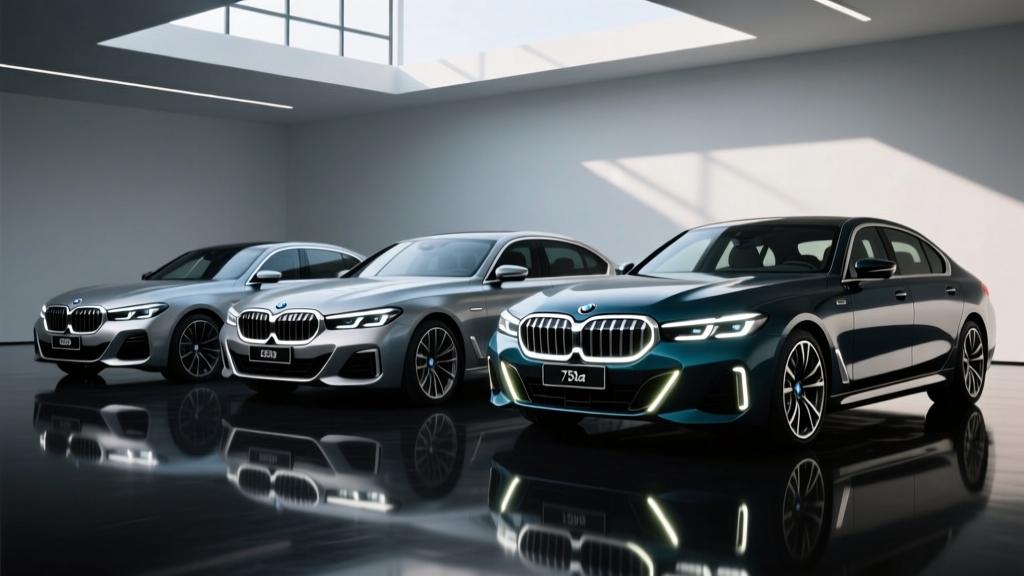
The current lineup spans three nameplates: the compact 330e (3 Series), the midsize 550e xDrive (5 Series), and the flagship 750e xDrive (7 Series). All three share BMW's fifth-generation eDrive architecture, pairing a turbocharged four- or six-cylinder engine with an electric motor integrated into the transmission housing. None are mild hybrids. None are self-charging hybrids. They're all plug-ins.
HEV vs PHEV — What BMW Sedan Buyers Need to Know
| Feature | Conventional Hybrid (HEV) | Plug-In Hybrid (PHEV) |
|---|---|---|
| Charge port | No | Yes |
| Battery size | ~1–2 kWh | 18–22 kWh usable (BMW 2026 sedans) |
| Electric-only driving | Brief assist only | 20–40 miles |
| Plug in at home? | Never | Recommended nightly |
| Federal tax credit | No | Up to $3,750 (BMW PHEVs, 2026 rules) |
Every BMW sedan hybrid sold in the US for 2026 is a PHEV. If you see "hybrid" on a BMW sedan badge, it plugs in.
Spec Table: 330e vs 550e xDrive vs 750e xDrive
| Specification | 2026 BMW 330e | 2026 BMW 550e xDrive | 2026 BMW 750e xDrive |
|---|---|---|---|
| Powertrain | 2.0L turbo I4 + e-motor | 3.0L turbo I6 + e-motor | 3.0L turbo I6 + e-motor |
| Combined HP / lb-ft | 288 hp / 310 lb-ft | 483 hp / 516 lb-ft | 483 hp / 516 lb-ft |
| Drivetrain | RWD (xDrive optional) | xDrive AWD | xDrive AWD |
| Battery (usable) | 19.5 kWh (NMC) | 18.7 kWh (NMC) | 18.7 kWh (NMC) |
| EPA electric-only range | 23 mi | 36 mi | 34 mi |
| Total combined range | ~420 mi | ~480 mi | ~460 mi |
| EPA MPG (gas, combined) | 28 city / 34 hwy / 30 comb | 25 city / 30 hwy / 27 comb | |
| MPGe (electric + gas) | 75 MPGe | 64 MPGe | 62 MPGe |
| Level 2 charge rate | 7.4 kW | 7.4 kW | 7.4 kW |
| Level 2 time (0–100%) | ~2.8 hours | ~2.7 hours | ~2.7 hours |
| DC fast charging | No | No | No |
| 0–60 mph | 5.6 sec | 4.2 sec | 4.1 sec |
| Base MSRP | $47,095 | $68,795 | $107,995 |
Sources: fueleconomy.gov (EPA), BMW USA product pages. Specs reflect 2026 model year.
Electric-Only Range: How Far Can a BMW Sedan Hybrid Go Without Gas?
The headline number for any PHEV is electric-only range — the distance you can cover on battery power before the engine engages. For the 2026 BMW sedan hybrid lineup, here's what EPA testing shows:
- 330e: 23 miles EPA electric-only
- 550e xDrive: 36 miles EPA electric-only
- 750e xDrive: 34 miles EPA electric-only
Real-World Electric Range Expectations
EPA electric-only figures assume moderate temperatures and mixed driving. In practice:
- City / mild weather: Expect to match or slightly exceed EPA (e.g., 550e may deliver 37–40 mi at 35 mph average)
- Highway at 70+ mph: Expect ~15–20% reduction; 550e drops to roughly 29–31 mi
- Cold weather (below 32°F): Battery chemistry and cabin heating cut range 25–35%; 330e may deliver only 15–17 mi
BMW's preconditioning feature (via the iDrive app or scheduled departure timer) warms the battery while still plugged in, recovering some of that cold-weather loss if you plan ahead.
For context, the average American drives roughly 37 miles per day (FHWA data). That puts the 550e and 750e squarely in "electric commute" territory for most owners who charge nightly — with the gas engine reserved for longer trips and weekends.
Fuel Economy: EPA MPG and Real-World Numbers
Once the battery is depleted, a PHEV operates as a conventional hybrid. Here's how the BMW sedan hybrid lineup performs in gas-only mode:
| Model | City MPG | Highway MPG | Combined MPG | MPGe (combined) |
|---|---|---|---|---|
| 330e | 28 | 34 | 30 | 75 |
| 550e xDrive | 25 | 30 | 27 | 64 |
| 750e xDrive | 24 | 29 | 26 | 62 |
Real-World MPG: Where Hybrids Overperform
Hybrid powertrains — including PHEVs in charge-sustaining (gas) mode — tend to exceed their EPA city ratings in stop-and-go traffic because regenerative braking recaptures energy that a gas-only car wastes as heat. Owners who do heavy city driving after battery depletion often report 1–3 MPG above the EPA city figure. Highway driving, by contrast, typically runs 1–2 MPG below sticker, especially at speeds above 70 mph where aerodynamic drag dominates.
If your commute is 25 miles each way and you charge at home overnight, the 550e's 36-mile electric range means you may use gasoline only on weekends — translating to effective "MPG" in the triple digits over a typical work week.
Charging: What It Takes to Plug In a BMW PHEV
All three 2026 BMW sedan hybrids use a J1772/CCS1 charge port and accept Level 2 AC charging at up to 7.4 kW. None support DC fast charging — a deliberate engineering choice by BMW, which reserves DC capability for its full EV (i4, i5, i7) lineup.
| Charging Level | Power | Approx. Time (0–100%) | Miles of EV Range per Hour |
|---|---|---|---|
| Level 1 (120V household) | ~1.4 kW | 13–15 hours | ~5–6 mi/hr |
| Level 2 (240V, 32A) | 7.4 kW | ~2.7–2.8 hours | ~25–28 mi/hr |
| DC Fast Charge | Not supported | N/A | N/A |
The practical takeaway: A Level 2 home charger is strongly recommended. At 7.4 kW, a full overnight charge takes under three hours — meaning even if you plug in at 10 PM, you'll have a full battery well before morning. Level 1 (standard 120V outlet) works in a pinch but won't fully replenish the battery overnight, limiting your daily electric range to roughly 15–18 miles.
Home Charging Setup Cost
Expect to budget $500–$1,200 for a quality Level 2 EVSE (ChargePoint Home Flex, Emporia Level 2, or BMW's own Wallbox) and $800–$2,500 for professional electrician installation, depending on whether your panel needs an upgrade. Total home charging setup typically lands between $1,300 and $3,700. For PHEVs with smaller batteries, a 32-amp circuit is more than sufficient — no need for the 48-amp circuits that full EVs with larger batteries benefit from.
Pricing, Tax Credits, and Total Cost of Ownership
| Model | Base MSRP | Est. Federal Credit | Effective Price |
|---|---|---|---|
| 2026 BMW 330e | $47,095 | Up to $3,750* | ~$43,345 |
| 2026 BMW 550e xDrive | $68,795 | Up to $3,750* | ~$65,045 |
| 2026 BMW 750e xDrive | $107,995 | $0 (MSRP cap) | $107,995 |
*Credit amounts reflect 2026 IRS §30D rules. BMW PHEVs with qualifying battery sourcing may receive up to $3,750 (critical minerals component). The 750e exceeds the $55,000 sedan MSRP cap and does not qualify. Buyer income caps also apply. Confirm eligibility at irs.gov or with your tax professional. Point-of-sale transfer is available for qualifying purchases.
§30D Federal Tax Credit Checklist for BMW PHEVs
- MSRP cap: Sedans must be ≤ $55,000 (disqualifies 550e and 750e)
- Buyer income cap: ≤ $150,000 single / $225,000 head of household / $300,000 joint (MAGI)
- Battery sourcing: Critical minerals and component requirements phase in annually; BMW's supply chain qualifies for partial credit on the 330e
- Assembly: Vehicle must undergo final assembly in North America — BMW's Spartanburg, SC plant produces some PHEV models; verify your VIN at fueleconomy.gov
- Transfer option: Eligible buyers can transfer the credit to the dealer at point of sale for an upfront price reduction
Five-Year Ownership Cost Snapshot
A 330e owner driving 12,000 miles per year, charging nightly at home ($0.14/kWh national average), and using premium gasoline ($4.20/gal) for longer trips can expect roughly $1,100–$1,500 in annual fuel/energy costs — compared to $2,000–$2,400 for a gas-only BMW 330i. Over five years, that's $4,500–$6,500 in fuel savings, partially offsetting the 330e's higher MSRP.
Battery Warranty, Reliability, and Replacement Cost
BMW PHEV Battery Warranty
All 2026 BMW sedan hybrids carry BMW's standard high-voltage battery warranty:
- Duration: 8 years or 80,000 miles (whichever comes first)
- Capacity retention guarantee: Battery must retain ≥ 70% of original usable capacity
- Coverage: Defects, excessive degradation, and module replacement
BMW's NMC (nickel manganese cobalt) battery chemistry in these PHEVs has demonstrated strong longevity in real-world use. Because PHEV batteries are smaller and the vehicle's battery management system maintains a generous top and bottom buffer, most owners experience only 8–12% degradation over the first five years. Out-of-warranty replacement for a BMW PHEV battery module currently ranges from $6,000 to $9,000 including labor — but full replacements are rare within the first decade of ownership.
General Reliability
BMW's fifth-generation eDrive system (introduced for the 2023 model year and carried forward) has proven more reliable than earlier PHEV powertrains. The integration of the electric motor within the transmission housing eliminates a separate motor assembly and reduces failure points. BMW's overall brand reliability has improved in recent JD Power and Consumer Reports surveys, though it still trails Toyota/Lexus and Honda in long-term dependability rankings. For PHEV-specific components, the main risk area remains the charging port and onboard charger electronics — not the battery itself.
BMW Sedan Hybrid vs Full EV vs Gas: Which Fits You?
Decision Framework
Choose a BMW PHEV (330e / 550e / 750e) if:
- You can charge at home nightly (Level 2 strongly recommended)
- Your daily commute is under 35 miles round-trip
- You take road trips of 200+ miles several times per year and don't want to plan around charging stops
- You want a BMW sedan without committing to full EV infrastructure
Choose a full BMW EV (i4, i5, i7) if:
- You have reliable home charging and access to DC fast chargers for road trips
- You want to eliminate gasoline entirely and reduce maintenance (no oil changes, no spark plugs)
- You want DC fast charging (up to 205 kW on the i5) for road-trip convenience
- You qualify for the full $7,500 federal EV credit (BMW i4 and some i5 trims may qualify)
Choose a gas-only BMW sedan (330i, 540i, 740i) if:
- You cannot charge at home (apartment, street parking, no garage)
- Your annual mileage is low enough that fuel savings won't offset the PHEV price premium
- You prefer the lighter weight and slightly lower starting price of the ICE variant
Pros of the BMW Sedan Hybrid Lineup
- 36-mile EV range on the 550e covers most daily commutes gas-free
- Seamless transitions between electric and gas — no range anxiety on road trips
- Strong combined horsepower (483 hp on 550e/750e) with instant electric torque
- Level 2 charging fully replenishes in under 3 hours
- 8-year/80,000-mile battery warranty
- 330e qualifies for partial federal tax credit (up to $3,750)
Cons to Consider
- No DC fast charging on any BMW PHEV sedan — limits road-trip EV driving
- Electric-only range (23–36 mi) is shorter than competitors like the Toyota Prius Prime (44 mi)
- 550e and 750e exceed the federal tax credit MSRP cap
- Trunk space reduced vs gas-only variants due to battery placement
- Premium fuel required for optimal performance
- Insurance premiums run 10–15% higher than gas-only BMW sedans
Frequently Asked Questions
How many MPG does a BMW sedan hybrid get?
In gas-only (charge-sustaining) mode: the 330e achieves 30 MPG combined (28 city / 34 highway), the 550e xDrive gets 27 combined, and the 750e xDrive gets 26 combined. When factoring in electric-only driving, MPGe ratings range from 62 to 75 MPGe depending on model.
How far can a BMW PHEV go on electric only?
The 2026 BMW 330e delivers 23 miles EPA electric-only, the 550e xDrive achieves 36 miles, and the 750e xDrive reaches 34 miles. Real-world highway and cold-weather driving will reduce these figures by 15–35%.
Does the BMW sedan hybrid qualify for a tax credit?
The 2026 BMW 330e may qualify for up to $3,750 under IRS §30D, subject to buyer income limits and battery-sourcing requirements. The 550e and 750e exceed the $55,000 sedan MSRP cap and do not qualify for the federal credit. Always verify current eligibility at irs.gov.
Is the BMW PHEV battery reliable and what does replacement cost?
BMW's high-voltage batteries are warrantied for 8 years / 80,000 miles with a 70% capacity retention guarantee. Real-world degradation averages 8–12% over five years. Out-of-warranty replacement costs range from $6,000 to $9,000 but full replacements within the first decade are uncommon.
Do I need to plug in a BMW hybrid every night?
You don't need to — the car will operate as a conventional hybrid on gasoline alone. But to get the fuel savings and electric-only driving you paid for, nightly Level 2 charging is strongly recommended. A full charge takes under 3 hours at 7.4 kW.
Can a BMW PHEV DC fast charge?
No. None of BMW's 2026 PHEV sedans support DC fast charging. They accept up to 7.4 kW on Level 2 AC. If DC fast charging is a priority, BMW's i4, i5, and i7 full-electric sedans offer 205+ kW DC capability.
Hybrid vs PHEV vs EV — which BMW sedan is right for me?
If you can charge at home and drive under 35 miles daily but take occasional long road trips, a BMW PHEV (330e or 550e) is the sweet spot. If you want zero gasoline and have DC charging access, go full EV (i4/i5). If you can't charge at home at all, a gas-only 330i or 540i is more practical — a PHEV's battery is dead weight without regular plug-in charging.