Quick Verdict: A Super Sedan With a Plug
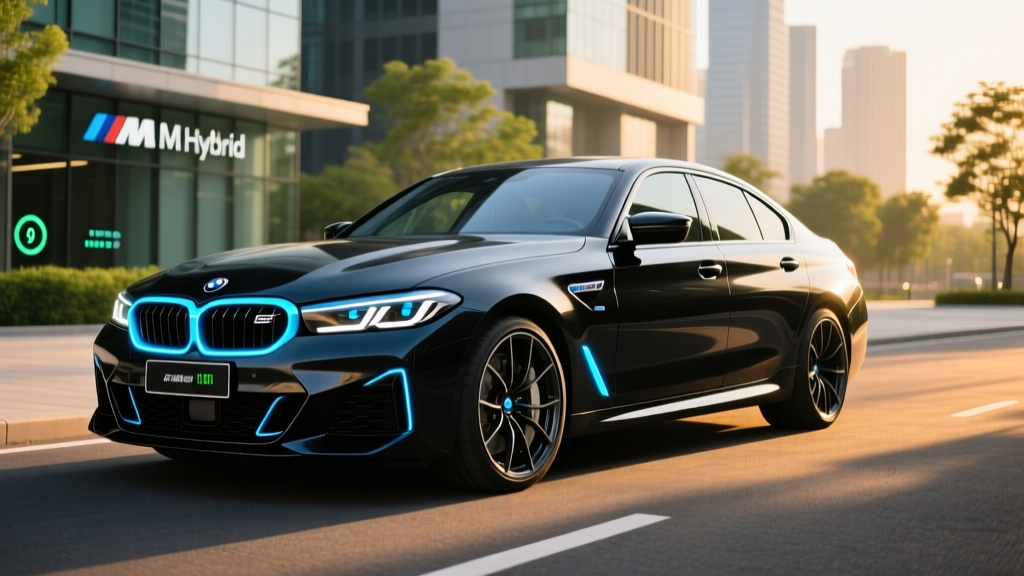
The 2026 BMW M5 is no longer a pure internal-combustion brute. BMW's latest M5 pairs a twin-turbo 4.4-liter V8 with a plug-in hybrid (PHEV) system, producing a combined 717 horsepower and 738 lb-ft of torque. It's a plug-in hybrid performance sedan first and a luxury daily driver second — one that can silently creep through your neighborhood on electric power before unleashing supercar-rivaling acceleration on the open road.
But does adding a battery and electric motor to BMW's most iconic sports sedan actually make sense for real-world ownership? Below, we break down the M5 hybrid's EPA fuel economy, electric-only range, charging logistics, powertrain details, and whether you can claim any federal tax credit.
The BMW M5 is a plug-in hybrid (PHEV), meaning it has a larger battery you charge from a wall outlet or charging station, enabling a meaningful electric-only driving range. A conventional hybrid (HEV), like the Toyota Camry Hybrid, uses a small battery charged only by regenerative braking and the engine — you never plug it in, and electric-only driving is limited to very low speeds for short distances. The M5's PHEV system lets you drive up to 25 miles on electricity alone before the V8 kicks in.
Powertrain: 717 Horsepower From a V8 and Electric Motor
The 2026 M5 uses BMW's fifth-generation eDrive technology integrated into an 8-speed M Steptronic transmission. Here's the full powertrain breakdown:
| Component | Specification |
|---|---|
| Engine | 4.4L Twin-Turbo V8 (S68) |
| Engine Output | 523 hp / 553 lb-ft |
| Electric Motor | Integrated in transmission, 194 hp / 207 lb-ft |
| Combined System Output | 717 hp / 738 lb-ft |
| Transmission | 8-speed M Steptronic automatic |
| Drivetrain | M xDrive AWD (RWD-selectable) |
| 0–60 mph | 3.4 seconds (manufacturer) |
| Top Speed | 155 mph (electronically limited); 190 mph w/ M Driver's Package |
The electric motor fills in torque at low RPM where turbo lag would otherwise exist, giving the M5 an immediacy of response that the previous-generation V8-only model couldn't match. In Electric mode, the M5 is rear-drive only (the motor drives the rear axle); engage the V8 and M xDrive distributes torque to all four wheels.
Fuel Economy: EPA MPG and Real-World Expectations
PHEV fuel economy is tricky to interpret because it depends entirely on how often you charge. The EPA publishes two numbers for plug-in hybrids: MPGe (which includes electric driving) and charge-depleting gasoline-only MPG.
| Metric | City | Highway | Combined |
|---|---|---|---|
| MPGe (with electric driving) | — | — | ~42 MPGe (est.) |
| Gasoline-only MPG (battery depleted) | ~15 mpg | ~22 mpg | ~17 mpg |
Note: Final EPA figures for the 2026 M5 were pending at publication. Estimates above are based on BMW's published data and comparable PHEV sedans. Check fueleconomy.gov for certified numbers once released.
Once the 18.6 kWh battery is depleted, you're hauling a 5,390-pound sedan with a twin-turbo V8. Expect gasoline-only fuel economy in the 14–18 mpg combined range during normal driving. Aggressive driving or highway cruising above 75 mph will push this toward the low end. The M5's hybrid system shines when you charge regularly and keep most trips within the 25-mile electric envelope — in that scenario, your gasoline consumption drops dramatically. If you never plug in, the M5 is simply a heavy, thirsty sports sedan.
Electric-Only Range and Charging: What PHEV Owners Need to Know
The 2026 M5 carries an 18.6 kWh lithium-ion battery pack (usable capacity approximately 14.8 kWh). Here's what that means for daily driving:
| Metric | Value |
|---|---|
| Battery (total / usable) | 18.6 kWh / ~14.8 kWh |
| EPA Electric-Only Range | ~25 miles (est.) |
| Total Range (electric + gas) | ~380 miles (est.) |
| Level 1 Charging (120V, 1.4 kW) | ~10–12 hours (0–100%) |
| Level 2 Charging (240V, 7.4 kW) | ~2.5–3 hours (0–100%) |
| DC Fast Charging | Not supported |
| Charge Port | J1772 (Level 2) |
No DC fast charging. This is typical for PHEVs — the battery is small enough that Level 2 replenishes it quickly. Plug in overnight at home on a 240V Level 2 charger, and the M5 will be fully recharged by morning. On a standard 120V household outlet (Level 1), expect a full charge to take roughly 10–12 hours, which still works if you park for extended periods.
The 25-mile electric range is enough for most daily commutes and errands. If your round-trip commute is under 20 miles and you charge nightly, you could go weeks without visiting a gas station. But unlike a full EV like the BMW i5 (which offers 295+ miles of range), the M5's electric envelope is narrow — highway driving at speed will deplete the battery faster than the EPA estimate suggests.
Pricing, Trims, and Tax Credit Eligibility
The 2026 BMW M5 starts at a manufacturer-estimated $120,675 (including destination). The M5 is offered in a single, well-equipped trim with extensive options packages available.
| Trim | MSRP |
|---|---|
| M5 Sedan | $120,675 |
| M5 w/ Executive Package | ~$125,000+ |
| M5 w/ Carbon Fiber / M Driver's Pkg | ~$130,000+ |
Does the M5 Hybrid Qualify for a Federal Tax Credit?
Most buyers will not qualify for the full $7,500 federal §30D tax credit, and here's why:
- MSRP cap: The §30D credit caps eligible sedans at $55,000 MSRP. The M5 starts at $120,675 — well above the limit. This alone disqualifies it.
- Income cap: Even if the MSRP qualified, buyer adjusted gross income must not exceed $150,000 (single) / $300,000 (joint).
- Battery sourcing: Critical minerals and battery component sourcing requirements further restrict eligibility for many PHEVs.
The M5's price puts it firmly outside federal incentive territory. Some states may offer their own PHEV or luxury EV rebates, but these vary widely — check your state's energy office or the Alternative Fuels Data Center for local programs. Consult a tax professional before making purchase decisions based on incentives. See the IRS §30D guidance for complete federal rules.
Reliability, Battery Warranty, and Long-Term Costs
BMW's hybrid battery and powertrain coverage is competitive within the luxury segment:
- High-Voltage Battery: 8 years / 80,000 miles (whichever comes first), covering defects and capacity loss below 70% of original capacity
- Powertrain Warranty: 4 years / 50,000 miles
- Bumper-to-Bumper: 4 years / 50,000 miles
- Complimentary Maintenance: 3 years / 36,000 miles
BMW's hybrid battery is designed to last the life of the vehicle under normal use. PHEV batteries experience less stress than full EV batteries because they operate in a narrower state-of-charge window (the system buffers the top and bottom of the battery to protect longevity). Real-world data from earlier BMW PHEV models (like the 330e and X5 xDrive45e) shows minimal degradation over 100,000+ miles.
Battery replacement cost: If the high-voltage battery does need replacement outside warranty, expect a cost in the $8,000–$14,000 range (parts and labor), based on current BMW PHEV battery pricing. This is significantly less than a full EV battery replacement, owing to the M5's smaller 18.6 kWh pack.
Who Should Buy the M5 Hybrid — and Who Shouldn't
✅ Choose the BMW M5 Hybrid If:
- You want supercar acceleration (3.4s 0–60) in a four-door sedan you can daily-drive
- You have home charging access and a commute under 25 miles
- You want to drive electric locally but need unlimited range for road trips
- You value BMW's driving dynamics and M-division engineering
- Tax credits are irrelevant at your price point
❌ Look Elsewhere If:
- You can't charge at home — without plugging in, you're just driving a heavy, 17-mpg V8
- You want meaningful fuel savings — a BMW i5 or Tesla Model S will cost far less per mile
- You're shopping for efficiency first — the M5 is a performance car, not an economy play
- You want full EV silence and zero tailpipe emissions on longer trips
- You want federal tax credit savings — the MSRP cap eliminates the M5
| Factor | M5 PHEV | Full EV (e.g., i5 M60) | Gas Sports Sedan |
|---|---|---|---|
| Electric-Only Driving | 25 mi | 295+ mi | None |
| Road Trip Flexibility | Unlimited (gas) | Requires charging stops | Unlimited |
| Daily Fuel Cost | Low (if charging) | Lowest | Highest |
| Performance | 717 hp / 3.4s | 593 hp / 3.7s | 600 hp / 3.2s |
| Weight | 5,390 lbs | ~5,000 lbs | ~4,400 lbs |
Real-World Ownership: What to Expect
The M5 hybrid's 5,390-pound curb weight (roughly 900 pounds more than the previous-generation gas M5) is the elephant in the room. BMW's M division has worked to mask that mass with adaptive dampers, active anti-roll bars, and rear-wheel steering. On smooth roads and in Sport+ mode, the M5 defies its weight. But on tight, technical roads, physics wins — you'll feel the mass under hard braking and quick transitions.
Charging the M5 is a non-issue if you have a garage or dedicated parking spot with a 240V outlet. A BMW Wallbox (or any J1772 Level 2 charger rated at 7.4 kW or higher) will fully replenish the battery in about 2.5 hours. Many PHEV owners report plugging in every evening as a routine — no different from charging a phone overnight.
One practical note: the hybrid system's battery packaging reduces trunk capacity slightly compared to the non-hybrid 5 Series. Expect roughly 16.5 cubic feet of cargo space — adequate for a performance sedan but less than some rivals.
Frequently Asked Questions
How many MPG does the BMW M5 hybrid get?
Once the battery is depleted, expect roughly 15 city / 22 highway / 17 combined mpg on gasoline alone. If you charge regularly and drive within the 25-mile electric range, your effective MPGe rises significantly, and your gasoline consumption drops to near zero for short commutes.
How far can the M5 go on electric power only?
BMW estimates approximately 25 miles of electric-only range. Real-world results will vary: cold weather, highway speeds above 65 mph, and aggressive acceleration will reduce this to 18–22 miles. In mild city driving, you may approach or slightly exceed the EPA estimate.
Can the BMW M5 hybrid use DC fast chargers?
No. The M5 supports Level 1 (120V) and Level 2 (240V) AC charging only, via a J1772 connector. This is standard for PHEVs — the battery is small enough that Level 2 charging fully replenishes it in roughly 2.5 hours.
Is the M5 hybrid reliable, and what does a battery replacement cost?
BMW's PHEV systems have proven reliable in earlier models (330e, X5 xDrive45e, 745e). The high-voltage battery is warrantied for 8 years/80,000 miles. Out-of-warranty replacement is estimated at $8,000–$14,000 — a meaningful cost, but lower than full EV battery replacements due to the smaller pack size.
Does the BMW M5 hybrid qualify for any tax credit?
No. The federal §30D clean vehicle credit caps eligible sedans at $55,000 MSRP. The M5 starts at $120,675, making it ineligible regardless of your income or the battery's sourcing. Some states may offer separate incentives for PHEVs — check your local programs.
Should I buy the M5 hybrid or a full EV like the BMW i5?
If you need unlimited road-trip range without charging stops and want maximum horsepower, the M5 PHEV is the pick. If your priority is low running costs, zero tailpipe emissions, and a quieter driving experience — and you can charge at home — the BMW i5 or a rival EV makes more financial and environmental sense. The M5 is a performance statement; the i5 is an efficiency statement.