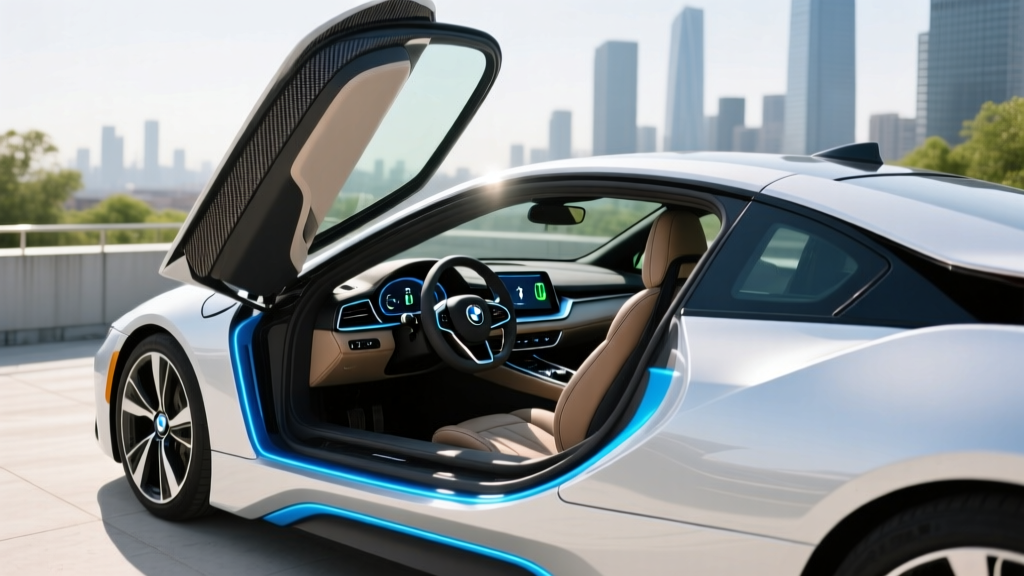
The BMW i8 was never a conventional sports car, and it was never a conventional hybrid. Produced from the 2014 through 2020 model years, this plug-in hybrid (PHEV) paired a turbocharged three-cylinder gasoline engine with an electric motor and a carbon-fiber-reinforced plastic (CFRP) chassis in a package that looked like a concept car you could actually drive. Discontinued over half a decade ago, the i8 now lives exclusively on the used market — and in 2026, well-kept examples have settled into a $40,000–$70,000 price band that makes them an intriguing, if unconventional, PHEV proposition.
This guide covers everything a prospective buyer needs: the powertrain specs, real-world fuel economy, electric-only range, battery longevity and replacement cost, and where the i8 fits against modern PHEVs and full EVs. If you are cross-shopping a used i8 against a new Toyota Prius Prime or a BMW 330e, the numbers below will clarify what you are actually getting.
BMW i8 Powertrain: How the PHEV System Works
The i8 is a plug-in hybrid, not a conventional hybrid (HEV). That distinction matters: a conventional hybrid like the Toyota Prius generates all its electricity from the engine and regenerative braking — you never plug it in. The i8 has a charge port and a battery large enough to drive on electricity alone for a limited distance, then switches to hybrid operation once the battery depletes.
HEV vs PHEV: Where the i8 Fits
| Feature | Conventional Hybrid (HEV) | Plug-In Hybrid (PHEV) — i8 |
|---|---|---|
| Plug-in charging | No — self-charging via engine + regen | Yes — AC Level 1/Level 2 |
| Electric-only driving | Brief low-speed assist only | EPA-rated 18 miles (i8 Roadster: 17 mi) |
| Battery size | ~1–2 kWh | 11.6 kWh total / ~9.4 kWh usable |
| Federal tax credit (new) | None | Was eligible; no credit on used purchase unless via §25E used-EV credit |
The i8's powertrain splits duties between the rear and front axles. A 1.5-liter turbocharged three-cylinder BMW TwinPower engine drives the rear wheels through a six-speed automatic, producing 228 horsepower and 236 lb-ft of torque. An electric motor sits at the front axle, delivering 131 horsepower and 184 lb-ft through a two-speed automatic. Combined system output is 369 horsepower and 420 lb-ft of torque, enabling a 0–60 mph time of approximately 4.2 seconds for the coupe (4.4 seconds for the Roadster).
| Specification | Value |
|---|---|
| Gasoline engine | 1.5L turbocharged 3-cylinder, 228 HP / 236 lb-ft (rear axle) |
| Electric motor | 131 HP / 184 lb-ft (front axle) |
| Combined system output | 369 HP / 420 lb-ft |
| Battery (total / usable) | 11.6 kWh / ~9.4 kWh, lithium-ion (NMC chemistry) |
| EPA electric-only range | 18 miles (Coupe) / 17 miles (Roadster) |
| EPA MPGe (charge-sustaining + electric) | 69 MPGe combined (Coupe) |
| EPA MPG (gas-only, charge-sustaining) | 27 MPG combined (28 city / 29 highway) |
| Total range (gas + electric) | ~330 miles |
| 0–60 mph | 4.2 seconds (Coupe) / 4.4 seconds (Roadster) |
| Top speed | 155 mph (electronically limited) |
| AC charging (Level 2) | 3.7 kW max — full charge in ~3 hours |
| DC fast charging | Not supported |
| Drivetrain | All-wheel drive (engine rear / motor front) |
| Curb weight | ~3,500 lbs (Coupe) |
Fuel Economy: EPA Numbers vs Real-World i8 MPG
Fuel economy in a PHEV depends entirely on how you use it. The EPA publishes two figures for the i8: an MPGe rating that accounts for electric driving and a gasoline-only MPG figure for when the battery is depleted.
| Mode | City | Highway | Combined |
|---|---|---|---|
| Charge-depleting (electric + gas blended) | 69 MPGe combined | ||
| Charge-sustaining (gas only, battery depleted) | 28 MPG | 29 MPG | 27 MPG |
Real-world expectations: Owners who charge nightly and drive short commutes (under 20 miles) report regularly achieving 50–80+ MPGe because most trips run entirely on electricity. On longer highway trips where the battery depletes within the first 15–18 miles, the car operates as a conventional hybrid and delivers closer to 25–28 MPG at sustained 70–75 mph speeds. Cold weather reduces electric-only range by roughly 15–25%, cutting the EV portion to around 13–15 miles in freezing conditions.
The i8's charge-sustaining MPG is respectable for a 3,500-pound sports car but unremarkable next to a modern PHEV like the Toyota Prius Prime, which returns 48 MPG combined on gas alone and 44 miles of EV range. The i8 was designed for performance, not maximum efficiency.
Electric-Only Range and Charging
The i8's EPA-rated 18-mile electric-only range (17 for the Roadster) was modest even at launch and is short by 2026 standards. The Toyota RAV4 Prime delivers 42 miles; the Jeep Wrangler 4xe manages 21. Still, 18 miles covers many daily commutes, grocery runs, and school drop-offs without burning a drop of gasoline.
Charging is straightforward but limited by modern standards. The i8 accepts Level 1 (120V household outlet) at roughly 1.4 kW, which replenishes the battery in about 7 hours. On a Level 2 (240V) station at its maximum 3.7 kW rate, a full charge takes approximately 3 hours. The i8 does not support DC fast charging — there is no CCS or CHAdeMO port. For a car with only 18 miles of range, this is not a practical limitation; you will charge at home or at a destination and rarely need rapid top-ups.
The i8 uses a standard J1772 connector for AC charging, compatible with virtually every public Level 2 station in the United States. An adapter is not needed for Level 2; however, the i8 predates the NACS (Tesla) connector standard, so Tesla Destination Chargers may require a J1772-to-NACS adapter depending on the station configuration.
Battery Longevity, Warranty, and Replacement Cost
BMW i8 High-Voltage Battery Warranty & Lifespan
- Original warranty: 8 years / 80,000 miles (whichever comes first), covering defects and capacity loss below ~70% of original capacity
- Chemistry: NMC (nickel manganese cobalt) lithium-ion
- Reported degradation: Most 2014–2020 i8 owners report 10–20% capacity loss at 60,000–100,000 miles, translating to 14–16 miles of EV range from the original 18
- Battery replacement cost (2026 estimate): $12,000–$18,000 for a new OEM module set, plus $1,500–$3,000 labor at a BMW specialist
- Third-party refurbishment: Independent EV shops now offer cell-level module replacement for $6,000–$10,000, depending on how many of the six modules need service
The i8's high-voltage battery has proven more durable than early skeptics feared. BMW designed the pack with conservative charge buffers — the usable 9.4 kWh draws from an 11.6 kWh gross capacity — which reduces stress on the cells and slows degradation. Forum data from i8 owners with 80,000+ miles commonly shows State of Health (SoH) readings between 80–88%, meaning the battery retains most of its original capacity.
For a used buyer in 2026, this means most i8s on the market still deliver 14–17 miles of EV range. However, any 2014–2016 model with over 80,000 miles is likely past its original 8-year battery warranty. Before purchasing, request a BMW high-voltage battery health report from a dealer or use an OBD-II scanner with BMW-specific software (such as BimmerCode or ISTA) to pull the SoH percentage. A reading below 75% should factor into your price negotiation, as it signals approaching module service.
According to fueleconomy.gov, the 2020 BMW i8 Coupe carries the EPA ratings cited above. For battery warranty specifics on used BMW PHEVs, BMW's official high-voltage battery warranty page outlines coverage terms.
Reliability and Ownership Costs
The i8's reliability record is mixed, reflecting its low-volume, exotic construction. The 1.5L three-cylinder engine (shared with the Mini Cooper) is well-proven and generally trouble-free. The electric motor and power electronics have been robust across the fleet. The primary concerns are:
- CFRP body panels: Carbon fiber repairs require specialized body shops and cost significantly more than steel or aluminum. A fender-bender that might cost $2,000 on a steel-bodied car can run $8,000–$15,000 on the i8.
- Butterfly doors: The hinge and gas-strut mechanisms on the coupe's dihedral doors are known to wear; strut replacement runs $400–$800 per side.
- Climate control compressor: Electrically driven, shared between cabin cooling and battery thermal management. Failure is uncommon but costly ($2,500–$4,000) when it occurs.
- 12V battery: Like many PHEVs and EVs, the i8's 12V auxiliary battery can fail if the car sits unplugged for extended periods, leaving the vehicle unable to start even with a full high-voltage battery.
Insurance premiums are elevated due to the i8's exotic construction and sports-car classification. Expect $2,500–$4,500 annually depending on your profile and state — roughly 40–60% higher than a BMW 330e.
Tax Credits and Used Pricing in 2026
When sold new, the BMW i8 did not qualify for the full $7,500 federal §30D tax credit because its original MSRP ($148,495 for the 2020 Coupe) far exceeded the IRS MSRP cap of $55,000 for sedans and sports cars. This remains the case: no federal new-vehicle credit ever applied.
For 2026 used buyers, the IRS §25E Used Clean Vehicle Credit offers up to $4,000 (30% of the sale price, capped at $4,000) if you meet income requirements and purchase from a licensed dealer. Key eligibility criteria:
- Sale price must be $25,000 or less — most i8s exceed this threshold, effectively disqualifying them
- Buyer AGI limits: $75,000 single / $112,500 head of household / $150,000 joint
- Vehicle must be at least two model years old (i8 qualifies)
- Must purchase from a licensed dealer, not private party
- Vehicle must have a battery capacity of at least 7 kWh (i8's 11.6 kWh qualifies)
Given that most 2026 i8 listings range from $40,000 to $70,000, the §25E credit will not apply to the vast majority of transactions. Buyers should not factor a tax credit into their i8 purchase budget.
Who Should Buy the i8 Hybrid — And Who Should Look Elsewhere
Reasons to Buy
- Exotic supercar styling with a 0–60 time of 4.2 seconds
- Carbon-fiber chassis and aluminum structure — lightweight and rigid
- 18 miles of EV range covers short commutes silently and emission-free
- Depreciation has largely plateaued; well-kept examples hold value
- AWD traction from the split powertrain
- Conversation piece — nothing else on the road looks like it
Reasons to Skip
- 18-mile EV range is short even by 2020 standards, let alone 2026
- 27 MPG gas-only is unremarkable for a PHEV
- No DC fast charging
- Carbon-fiber body repair costs are extreme
- Tiny rear seats (coupe) or no rear seats (Roadster) limit practicality
- No federal tax credit at used-market prices above $25,000
- Insurance and maintenance costs reflect exotic-car status
The Verdict: Choose the i8 If… / Look Elsewhere If…
Choose the i8 if you want a head-turning PHEV sports car for weekend drives and short commutes, you have access to home Level 2 charging, and you accept exotic-car maintenance costs for exotic-car rewards.
Look elsewhere if your priority is maximum EV range, low cost of ownership, back-seat practicality, or tax-credit savings. A new Toyota Prius Prime ($33,445 base, 44-mile EV range, 48 MPG gas-only, eligible for up to $3,750 in §30D credit) delivers dramatically better daily-driver efficiency. A used Chevrolet Volt or BMW 330e offers more practicality at a lower price.
Frequently Asked Questions
How many MPG does the BMW i8 hybrid get?
The EPA rates the 2020 BMW i8 Coupe at 69 MPGe combined when factoring in electric driving, and 27 MPG combined (28 city / 29 highway) in charge-sustaining gas-only mode. Real-world gas-only highway driving typically yields 25–28 MPG. Owners who charge daily and commute under 18 miles often see effective MPGe well above 50.
How far can the BMW i8 go on electric only?
The EPA rates the i8 Coupe at 18 miles of electric-only range (17 miles for the Roadster). Real-world range is typically 15–18 miles in mild weather and 13–15 miles in freezing temperatures due to battery chemistry limitations and cabin heating demand.
Is the BMW i8 a hybrid or a plug-in hybrid?
The BMW i8 is a plug-in hybrid (PHEV). It has a charge port, a battery large enough for meaningful electric-only driving, and qualifies for PHEV-specific incentives (when price and income criteria are met). A conventional hybrid (HEV) like the standard Toyota Prius cannot be plugged in and has no meaningful electric-only range.
Is the BMW i8 reliable, and what does battery replacement cost?
The i8's powertrain has proven mechanically sound, with the 1.5L engine and electric motor showing few systemic failures. The main reliability concerns involve carbon-fiber body repair costs and aging door mechanisms. High-voltage battery replacement runs $12,000–$18,000 for a full OEM set, or $6,000–$10,000 for third-party module-level repair. Most 2014–2020 examples still show 80–88% battery health.
Does the BMW i8 qualify for any tax credit in 2026?
As a used vehicle typically priced above $25,000, the i8 does not qualify for the §25E used clean vehicle credit (which requires a sale price of $25,000 or less). It never qualified for the §30D new-vehicle credit due to its MSRP exceeding the $55,000 cap for non-SUV body styles. Consult a tax professional and review current IRS guidance for your specific situation.
Hybrid vs PHEV vs EV — which is right for me?
A conventional hybrid (HEV) is best if you have no home charging access and want maximum MPG without plugging in — think Toyota Prius at 57 MPG combined. A plug-in hybrid (PHEV) like the i8 suits drivers with home charging who want short EV commutes plus gas-engine range for road trips. A full EV (BEV) is ideal if you have reliable home charging, want zero tailpipe emissions, and are comfortable with 250–350+ miles of range — models like the Tesla Model 3 or Hyundai Ioniq 6 deliver lower running costs than any PHEV over time.