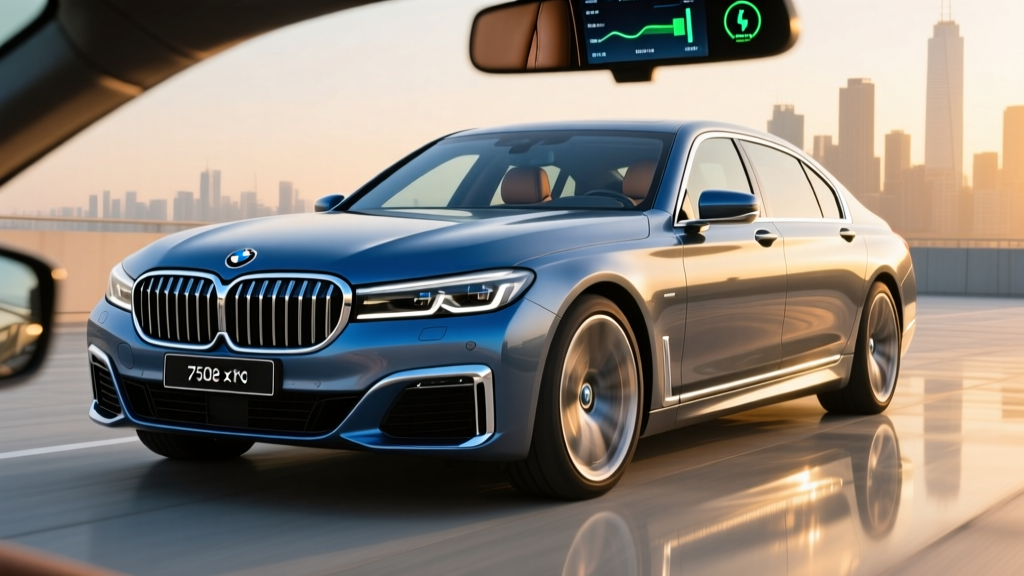
The BMW 7 Series has long been the Bavarian benchmark for full-size luxury sedans, but in an era of electrification, the nameplate has evolved. The current-generation BMW 750e xDrive plug-in hybrid (PHEV) represents BMW's strategy for buyers who want electric commuting capability without sacrificing the range and flexibility of a gasoline engine. It is not a conventional hybrid — it is a plug-in that can operate as a pure EV for short distances before seamlessly transitioning to a combined gas-electric powertrain.
If you're researching the BMW 7 Series hybrid, you're likely weighing it against both the fully electric BMW i7 and traditional luxury sedans from Mercedes-Benz and Audi. This guide breaks down everything that matters: real-world MPG, electric-only range, charging logistics, tax credit eligibility, and whether a PHEV or a full BEV makes more sense for your daily driving pattern.
HEV vs. PHEV: What the BMW 750e xDrive Actually Is
Before diving into specs, it's critical to understand the distinction between hybrid types, because BMW only offers the 7 Series as a plug-in hybrid — not a conventional self-charging hybrid (HEV).
| Feature | Conventional Hybrid (HEV) | Plug-In Hybrid (PHEV) |
|---|---|---|
| Battery Size | ~1-2 kWh | 18.7 kWh usable (BMW 750e) |
| Electric-Only Range | 0-2 miles (low speed) | EPA 34 miles |
| External Charging | No — regenerated only | Yes — Level 1/Level 2 |
| Gas Engine | Always available | Engages after battery depletes |
| Federal Tax Credit | Not eligible (§30D) | Potentially up to $7,500 |
The BMW 750e xDrive is firmly a PHEV. Its 18.7 kWh usable battery (from a 25.7 kWh gross pack) allows meaningful electric-only commuting, and it requires plugging in to unlock its full efficiency and cost-saving potential. If you never charge it, you're simply carrying extra weight and achieving mediocre fuel economy for a luxury sedan.
Powertrain, Performance, and Combined Output
The 750e xDrive pairs BMW's well-proven B58 3.0-liter turbocharged inline-six engine with an electric motor integrated into the eight-speed automatic transmission. The combined system output is substantial:
| Engine | 3.0L turbocharged inline-6 |
| Engine Power | 312 hp / 354 lb-ft |
| Electric Motor | 184 hp / 207 lb-ft (integrated) |
| Combined System Output | 490 hp / 516 lb-ft |
| 0-60 mph | 4.6 seconds |
| Drivetrain | xDrive (AWD) |
| Transmission | 8-speed automatic |
| Usable Battery Capacity | 18.7 kWh (25.7 kWh gross) |
| Battery Chemistry | NMC (Nickel Manganese Cobalt) |
| EPA Electric-Only Range | 34 miles |
| Total Combined Range | ~380 miles (est.) |
| EPA Fuel Economy (hybrid mode) | 25 mpg combined |
| MPGe (electric + gas combined) | 50 MPGe |
| Fuel Tank | 14.8 gallons |
| Base MSRP | ~$107,000 |
The 490 combined horsepower gives the 750e serious urgency, especially in the 20-50 mph range where electric torque fills in before the turbo spools. BMW's xDrive all-wheel-drive system distributes power to both axles, and the sedan feels planted despite its substantial curb weight of approximately 5,200 pounds.
Fuel Economy: EPA Numbers vs. Real-World MPG
The EPA rates the 750e xDrive at 50 MPGe when combining electric and gasoline operation, and 25 mpg combined when operating purely as a hybrid (after battery depletion). Here's the city/highway breakdown:
| Mode | City | Highway | Combined |
|---|---|---|---|
| Hybrid (charge-depleted) | 24 mpg | 27 mpg | 25 mpg |
| MPGe (with full charge) | — | — | 50 MPGe |
Real-world expectations: The 25 mpg charge-depleted figure is realistic for mixed driving. On the highway at 75 mph, expect closer to 27-28 mpg thanks to the efficient inline-six and favorable aerodynamics. In city driving with frequent regenerative braking, owners report 23-25 mpg once the battery is depleted. The MPGe figure of 50 is only achievable if you start each trip with a full charge and drive within the 34-mile electric window — which, for many commuters, is realistic.
For comparison, a conventional BMW 740i (mild-hybrid inline-six) achieves an EPA 28 mpg combined. The 750e's advantage is not in highway cruising efficiency but in electric-mode commuting, where it uses zero gasoline for short trips.
Electric-Only Range and Charging Details
The EPA rates the 750e xDrive at 34 miles of electric-only range. In real-world conditions, that number fluctuates:
EPA Electric Range: 34 miles
Real-World Expectations:
• Mild weather, city driving: 30-34 miles
• Highway at 70 mph: 25-28 miles
• Cold weather (below 32°F): 22-27 miles
• Climate control impact: reduces range ~10-15% in extreme temps
For a daily commute under 30 miles round-trip, the 750e can operate almost entirely on electricity during weekdays, with the gasoline engine available for longer weekend trips. This is the PHEV sweet spot.
| Onboard Charger | 7.4 kW (Level 2 AC) |
| Level 1 (120V, 12A) | ~1.4 kW — full charge in ~13 hours |
| Level 2 (240V, 32A) | 7.4 kW — full charge in ~2.75 hours |
| DC Fast Charging | Not supported |
| Charging Port | J1772 (AC only) |
A critical limitation: the BMW 750e does not support DC fast charging. This is common among PHEVs with smaller batteries, but it means you're limited to Level 1 or Level 2 AC charging. A home Level 2 charger (240V) is strongly recommended — a full charge takes under three hours, meaning you can easily top up between evening arrival and morning departure. Level 1 (standard 120V outlet) will work but requires overnight charging to fully replenish.
Pricing, Tax Credits, and Ownership Costs
The 2026 BMW 750e xDrive starts at approximately $107,000 (including destination), before options. A well-equipped example with the Executive Package, premium leather, and driver-assistance upgrades can push past $120,000.
Federal tax credit eligibility (§30D): The BMW 750e xDrive is potentially eligible for a federal plug-in hybrid tax credit, but the amount depends on battery component and critical mineral sourcing requirements under current IRS rules. Because BMW sources battery cells from suppliers that may not fully meet the domestic-content thresholds, the credit may be reduced or unavailable for 2026 model-year vehicles. Key eligibility factors:
- MSRP cap: Sedan cap is $55,000 — the 750e does NOT qualify under this cap
- Buyer income limits: $150,000 single / $300,000 joint filer AGI
- Battery component sourcing: must meet North American assembly thresholds
- Critical minerals: must meet approved-source percentages
- Point-of-sale transfer: available for qualifying vehicles through participating dealers
Because the 750e's MSRP far exceeds the $55,000 sedan cap established under the Inflation Reduction Act, this vehicle does not qualify for the federal §30D new EV/PHEV tax credit. Buyers should consult IRS.gov for the most current rules and check with a tax professional regarding any state-level incentives, which vary by jurisdiction and may offer rebates for PHEVs regardless of MSRP caps.
Reliability and Battery Warranty
BMW's hybrid powertrain is built on the proven B58 engine platform, which has earned a strong reliability reputation since its introduction. The electric motor integration is relatively simple compared to more complex hybrid architectures, reducing potential failure points.
BMW PHEV Battery Warranty:
• Duration: 8 years / 80,000 miles (whichever comes first)
• Coverage: defects and capacity loss below 70% of original capacity
• Hybrid system warranty: 8 years / 80,000 miles
• Powertrain warranty: 4 years / 50,000 miles
Battery replacement cost: If the high-voltage battery requires replacement outside of warranty, expect costs in the range of $8,000 to $14,000 (parts and labor) based on current BMW parts pricing and dealer labor rates. The modular battery design means individual cell modules can sometimes be replaced rather than the full pack, potentially reducing costs. However, PHEV batteries are smaller and less stressed than full EV batteries, and degradation over 8-10 years is typically modest — most owners report minimal capacity loss when following normal charging practices.
For long-term reliability data, IIHS and NHTSA provide safety ratings, while owner forums and Consumer Reports offer crowdsourced reliability feedback on the current 7 Series generation.
BMW 750e vs. BMW i7 vs. Gas 740i: Which Fits You?
The BMW 7 Series lineup gives buyers three distinct powertrain paths. Here's a practical decision framework:
Choose the BMW 750e xDrive (PHEV) if:
- Your daily commute is under 35 miles and you can charge at home
- You take regular long road trips where EV charging infrastructure is sparse
- You want electric-mode silence for city driving but 380+ miles of total range
- You're not ready to commit to a full EV but want reduced fuel consumption
Choose the BMW i7 (full EV) if:
- You have reliable home Level 2 charging
- Your typical trips fall within the i7's ~318-mile EPA range
- You want zero tailpipe emissions and minimal maintenance
- You value the smoothest, quietest powertrain experience
Choose the BMW 740i (gas/mild-hybrid) if:
- You cannot charge at home and have no interest in plugging in
- You want the lowest purchase price in the 7 Series lineup
- Your driving is predominantly highway where PHEV electric range offers little benefit
The 750e makes the most financial sense when you actually plug it in. Driving it as a conventional hybrid (without charging) yields 25 mpg in a $107,000 sedan — a result the $87,000 740i matches or beats with less complexity. The PHEV's value proposition is entirely dependent on utilizing those 34 electric miles daily.
Pros
- 34 miles of electric-only range covers most commutes
- 490 hp combined with seamless gas-electric transition
- No range anxiety — 380+ total miles with gas engine
- Quiet, refined electric-mode city driving
- Proven B58 engine with strong reliability track record
Cons
- Does not qualify for federal §30D tax credit (MSRP exceeds cap)
- No DC fast charging capability
- 25 mpg charge-depleted is unremarkable for the price
- $107,000+ starting price with limited incentives
- Heavy curb weight affects handling dynamics
Frequently Asked Questions
How many MPG does the BMW 750e xDrive get?
The EPA rates the 750e at 50 MPGe when combining electric and gas operation. Once the battery is depleted, it operates as a conventional hybrid achieving 25 mpg combined (24 city / 27 highway). Real-world highway driving often yields 27-28 mpg, while city driving with a depleted battery returns 23-25 mpg.
How far can the BMW 750e go on electric only?
The EPA rates the 750e xDrive at 34 miles of electric-only range. Real-world range varies from 22-27 miles in cold weather to 30-34 miles in mild conditions with moderate speeds. Highway driving at 70+ mph reduces electric range to approximately 25-28 miles.
Is the BMW 750e reliable, and what does battery replacement cost?
The 750e uses BMW's proven B58 inline-six with a well-integrated electric motor, and the overall powertrain has a solid reliability track record. The high-voltage battery is covered for 8 years/80,000 miles. Out-of-warranty battery replacement is estimated at $8,000-$14,000, though modular design may allow partial repairs. PHEV batteries tend to degrade slowly given their smaller size and moderate cycling.
Does the BMW 750e qualify for any tax credit?
No. The BMW 750e xDrive's MSRP (~$107,000) exceeds the federal §30D sedan cap of $55,000, making it ineligible for the new clean vehicle tax credit regardless of battery sourcing. Some state-level incentives may still apply — check your state's energy or environmental agency for current PHEV rebates. Always verify current rules at IRS.gov.
Do I need to plug in the BMW 750e, or does it charge itself?
You need to plug it in to benefit from electric-only driving. The 750e is a plug-in hybrid, not a conventional self-charging hybrid. While regenerative braking and the engine do maintain some charge, meaningful electric range (34 miles) requires Level 1 or Level 2 charging. Without plugging in, you're carrying 500+ pounds of battery for no efficiency gain.
Can the BMW 750e DC fast charge?
No. The 750e xDrive supports only AC charging — Level 1 (120V) at ~1.4 kW or Level 2 (240V) at up to 7.4 kW. A full Level 2 charge takes approximately 2.75 hours. DC fast charging is not available, which is typical for PHEVs with batteries under 20 kWh usable.
The BMW 750e xDrive occupies a specific niche: luxury sedan buyers who want electric commuting without range anxiety, and who can charge at home. It's not the most efficient choice in the 7 Series lineup — the fully electric i7 is more compelling for committed EV drivers — but for those who regularly exceed 300 miles between stops or who lack consistent charging access on the road, the 750e's dual powertrain offers a practical compromise. Just remember: its value depends entirely on whether you'll actually plug it in.