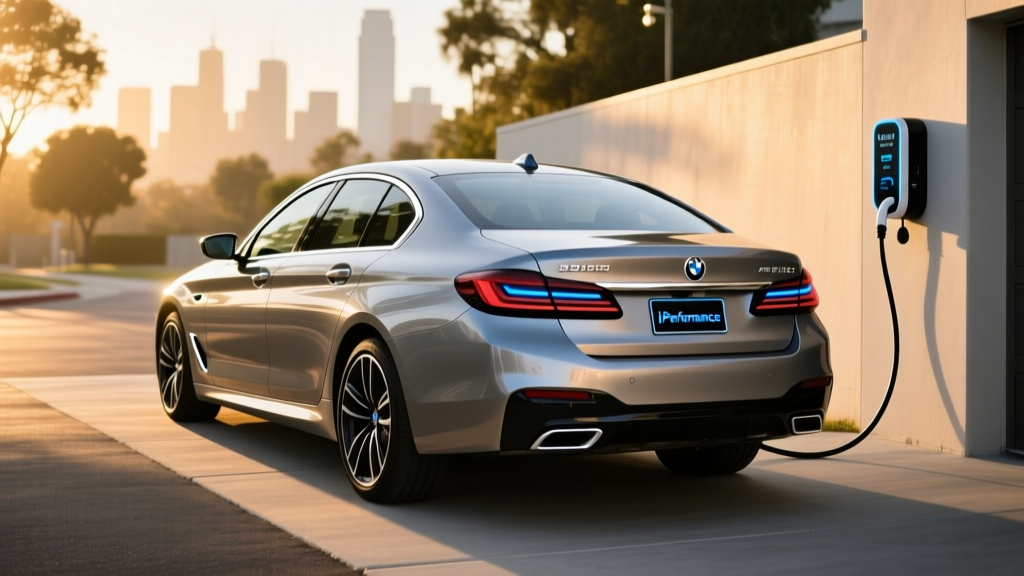
The BMW 5 Series has long been the benchmark midsize luxury sedan, and the current G60 generation's plug-in hybrid variant — the BMW 550e xDrive — is the most compelling version for buyers not yet ready to go fully electric. With an EPA-rated 38 miles of electric-only range, a combined 483 horsepower, and the ability to run purely on electrons for most daily commutes, the 550e occupies a specific niche: luxury sedan buyers who want EV-like daily driving without range anxiety on longer trips.
This guide covers the 2026 BMW 550e xDrive (the sole hybrid in the current 5 Series U.S. lineup), its real-world efficiency, charging logistics, federal tax credit eligibility, and how it compares to both full EVs and conventional gas models. If you've been searching for a BMW 5 Series hybrid, this is the only variant currently sold new in the United States.
HEV vs PHEV: Which BMW 5 Series Hybrid Exists?
Before diving into specs, a critical distinction that trips up many shoppers:
Conventional Hybrid (HEV)
Uses a small battery recharged by the engine and regenerative braking. No plug required. Typical electric-only assist is limited to low speeds. Not available in the U.S. 5 Series lineup. The mild-hybrid 530i (48V system) provides minor efficiency assist but cannot drive on electric power alone.
Plug-In Hybrid (PHEV)
Carries a larger battery that charges via plug (Level 1 or Level 2). Can drive substantial distances on electricity alone before the gasoline engine activates. The BMW 550e xDrive is this type. It offers 38 EPA-rated miles of pure electric range, then seamlessly transitions to hybrid operation using its turbocharged inline-six.
For U.S. buyers, the only true BMW 5 Series hybrid you can buy is the 550e xDrive PHEV. In some European and Asian markets, BMW also offers the 520e (a lower-output PHEV) and a 530e in certain model years, but these are not imported to the United States for 2026.
Battery, Electric Range, and Total Driving Range
The 550e xDrive uses a 22.1 kWh (gross) / 18.7 kWh (net usable) lithium-ion battery pack mounted beneath the rear seats and trunk floor. This is a high-voltage NMC (nickel manganese cobalt) pack, not LFP — BMW prioritizes energy density to maximize electric-only range in a sedan platform where packaging space is limited.
| Specification | Value |
|---|---|
| Powertrain | 3.0L turbocharged inline-6 + electric motor (PHEV) |
| Combined System Output | 483 hp / 516 lb-ft torque |
| Gas Engine | 312 hp inline-6 turbo |
| Electric Motor | 181 hp (integrated into 8-speed transmission) |
| Battery (Gross / Usable) | 22.1 kWh / 18.7 kWh |
| Battery Chemistry | NMC (nickel manganese cobalt) |
| EPA Electric-Only Range | 38 miles |
| EPA Combined Range (gas + electric) | ~430 miles |
| EPA MPGe (electric + gas combined) | 64 MPGe |
| EPA MPG (hybrid mode, gas only) | 28 city / 31 hwy / 29 combined |
| 0–60 mph | 4.2 seconds |
| Drivetrain | xDrive AWD |
| AC Charging (Level 2) | 7.4 kW onboard charger |
| DC Fast Charging | Not available |
| Charge Time (Level 2, 0–100%) | ~3.0 hours |
| Charge Time (Level 1, 120V) | ~14–16 hours |
| Base MSRP | $72,575 (incl. destination) |
| Battery/Powertrain Warranty | 8 years / 80,000 miles |
Real-World Range Expectations
EPA electric-only: 38 miles. In real-world mixed driving (65–75°F, moderate terrain), expect 33–38 miles on a full charge. Highway-only driving at 75+ mph reduces this to roughly 26–30 miles. In cold weather (below 32°F), plan for 24–30 miles of electric range due to cabin heating demand and reduced battery efficiency. When the gasoline engine takes over, the 15.3-gallon tank yields approximately 430 total miles before refueling.
The 550e does not support DC fast charging — a deliberate BMW engineering decision to save weight and cost in a PHEV that's designed to charge primarily at home or work overnight. For a sedan with a 22 kWh battery, this is acceptable; a full charge on a Level 2 home charger takes roughly 3 hours, meaning you can easily replenish between errands or during a workday.
Fuel Economy: EPA Ratings vs Real-World MPG
| Mode | City | Highway | Combined |
|---|---|---|---|
| Charge-Depleting (Electric + Gas) | 64 MPGe | ||
| Charge-Sustaining (Hybrid/Gas Only) | 28 MPG | 31 MPG | 29 MPG |
Understanding these two figures is essential for PHEV ownership:
- 64 MPGe represents efficiency when you start with a full battery charge and drive through both electric and hybrid modes. This is the figure that reflects daily commuting with regular plug-in charging.
- 29 MPG combined (gas only) is what you'll see on road trips or any time the battery is fully depleted and the car operates as a conventional hybrid. For a 4,800+ lb luxury AWD sedan with 483 hp, this is competitive — the non-hybrid BMW 530i xDrive achieves roughly 27 MPG combined for comparison.
Real-world note: Owners who charge nightly and commute under 35 miles round-trip will burn very little gasoline during the work week. On a 500-mile road trip, expect the car to average 27–30 MPG once the battery is depleted — consistent with EPA estimates, since highway driving is where BMW's turbocharged inline-six is most efficient. City driving in hybrid mode can sometimes exceed EPA estimates thanks to regenerative braking recapturing energy at low speeds, a common PHEV advantage.
Powertrain and Driving Experience
The 550e pairs BMW's B58 3.0-liter turbocharged inline-six (312 hp) with an electric motor (181 hp) integrated into the ZF 8-speed automatic transmission. Combined system output is 483 horsepower and 516 lb-ft of torque, routed through xDrive all-wheel drive.
The result is a 0–60 mph time of 4.2 seconds — quicker than the base 530i (5.8 seconds) and approaching M550i territory. The electric motor fills in the torque curve below 2,000 RPM, eliminating turbo lag and providing instant throttle response in city driving.
Driving modes include:
- Electric: Pure EV mode, up to 87 mph, for silent emissions-free commuting
- Hybrid: System manages gas/electric blend for optimal efficiency
- Sport: Both powertrains deliver maximum output for spirited driving
- Battery Hold: Preserves current charge level for later use (useful when entering a city center after highway driving)
The transition between electric and gasoline power is notably smooth — one of the best-executed PHEV handoffs in the luxury segment. The inline-six's natural refinement helps mask the engine start event, and the 8-speed ZF transmission shifts imperceptibly in normal driving.
Charging: Home Setup and What You Need
The 550e comes with a 7.4 kW onboard AC charger and no DC fast-charging capability. Here's what that means in practice:
| Charging Level | Power | Time (0–100%) | Typical Use Case |
|---|---|---|---|
| Level 1 (120V household outlet) | ~1.4 kW | 14–16 hours | Overnight top-up if no Level 2 available |
| Level 2 (240V home charger) | Up to 7.4 kW | ~3.0 hours | Primary daily charging method |
| DC Fast Charge | N/A | N/A | Not supported on 550e |
Home charging recommendation: A Level 2 home charger (240V, 32A or higher) is strongly recommended. A full charge takes about 3 hours, meaning you can charge during evening hours and wake up to a full battery every morning. Installation typically costs $800–$2,000 depending on your electrical panel's capacity and the distance from panel to charging location. If your panel is at capacity (common in older homes), a 200-amp service upgrade may add $1,500–$3,000 — consult a licensed electrician for a site assessment.
The 550e uses a standard J1772 connector for AC charging, compatible with all public Level 2 stations (ChargePoint, EVgo, Tesla Destination Chargers with adapter). No NACS or CCS adapter is needed for AC charging.
Pricing, Tax Credits, and Ownership Costs
The 2026 BMW 550e xDrive starts at $72,575 including destination. Key options include the Executive Package (~$4,000), M Sport Package (~$3,500), and various driver-assistance upgrades. A well-equipped 550e typically lands between $78,000 and $85,000.
Federal Tax Credit Eligibility (§30D)
The BMW 550e xDrive's federal tax credit status for 2026 is complex and depends on several factors that change frequently:
- MSRP Cap: Sedans must be under $55,000 MSRP to qualify. The 550e at $72,575 exceeds this cap and does not qualify for the new-vehicle §30D credit.
- Income Limits: Even if MSRP-eligible, buyer AGI must be ≤$150K (single) / $300K (joint).
- Battery Sourcing: Critical minerals and battery components must meet escalating domestic-content thresholds.
- Point-of-Sale Transfer: Eligible credits can be transferred to the dealer at purchase for an immediate price reduction — but only if the vehicle itself qualifies.
Bottom line: The 550e xDrive does not qualify for the federal §30D new-vehicle tax credit due to the MSRP cap for sedans. Check IRS.gov §30D guidelines for current-year rules, and consult a tax professional for your specific situation.
Some state-level incentives may still apply. California, Colorado, New York, and other states offer their own PHEV rebates that are not subject to the same MSRP caps — check your state's energy office or DMV for current programs.
| Cost Category | 550e xDrive (PHEV) | 530i xDrive (Gas) |
|---|---|---|
| Purchase Price (base) | $72,575 | $61,175 |
| Federal Tax Credit | $0 (MSRP cap) | $0 |
| Fuel/Energy (5 yr, 12K mi/yr) | ~$4,200 | ~$9,500 |
| Maintenance (5 yr) | ~$3,800 | ~$4,500 |
| Insurance (5 yr avg) | ~$14,000 | ~$12,500 |
| Estimated Depreciation | ~$32,000 | ~$28,000 |
| 5-Year Total (approx.) | ~$126,575 | ~$115,675 |
The 550e's fuel savings are meaningful — roughly $5,300 less in energy costs over five years if you charge regularly. However, the higher purchase price, slightly elevated insurance premiums (common for PHEVs), and steeper depreciation on luxury PHEVs mean the total cost of ownership gap narrows. The 550e makes financial sense primarily for buyers who value the electric driving experience, the performance upgrade, and the environmental benefit — not purely as a cost-saving measure over the 530i.
Reliability, Battery Warranty, and Long-Term Costs
BMW High-Voltage Battery Warranty
8 years / 80,000 miles — whichever comes first. BMW warrants the high-voltage battery against defects and excessive capacity loss (typically defined as dropping below 70% of original capacity during the warranty period). The gasoline engine and 8-speed transmission carry BMW's standard 4-year / 50,000-mile new-vehicle warranty.
BMW's PHEV powertrains have proven reliable in the current generation. The B58 inline-six is one of BMW's most dependable engines, widely used across the lineup since 2016 with few systemic issues. The electric motor, integrated into the ZF transmission, has minimal wear components.
Battery replacement cost: Out of warranty, a 550e high-voltage battery replacement is estimated at $8,000–$12,000 including labor, based on current BMW PHEV battery pricing. However, BMW's NMC packs are engineered with robust thermal management (liquid cooling), and degradation data from the previous-generation 530e (G30) shows typical capacity retention of 90–94% after 5 years and 60,000 miles when charged primarily on Level 2. Catastrophic battery failure is rare.
To maximize battery longevity:
- Avoid consistently charging to 100% and leaving the car parked in hot conditions — set a charge limit of 80–90% for daily use if your routine allows
- Use preconditioning (available via the BMW app) to warm or cool the cabin while still plugged in, reducing battery strain
- Level 2 charging generates less heat than rapid DC charging — not applicable here since the 550e doesn't support DC fast charging, which is actually a longevity benefit
Who Should Buy the BMW 550e vs a Full EV or Gas Sedan?
Pros
- 38 miles electric covers most daily commutes emissions-free
- 483 hp with instant electric torque — quicker than the 530i
- No range anxiety on road trips — gas engine provides 430+ total miles
- Smooth, nearly imperceptible gas/electric transitions
- Quiet electric-mode driving in city environments
- Reduced fuel costs if charged regularly
- Strong build quality and BMW's latest iDrive 8.5 infotainment
Cons
- $72,575 base price — $11,400 more than the 530i xDrive
- No DC fast charging limits public charging convenience
- Does not qualify for the $7,500 federal tax credit (MSRP cap)
- Trunk space reduced by battery placement (~2 cu ft less than 530i)
- Added weight (~4,850 lbs) affects handling vs non-hybrid 5 Series
- Requires home Level 2 charging to realize full efficiency benefit
- Complex powertrain means more potential service points long-term
Choose the BMW 550e xDrive If:
- Your daily round-trip commute is under 35 miles and you can charge at home
- You want electric daily driving but take regular road trips exceeding 250 miles
- You value the performance upgrade (483 hp vs 255 hp in the 530i)
- You live in a state with additional PHEV incentives that offset the price premium
- Your garage or parking space is not yet wired for a dedicated Level 2 charger but you plan to install one
Choose the BMW 530i (Gas) Instead If:
- You cannot install a home charger (apartment, street parking, HOA restrictions)
- Your budget is closer to $60,000–$65,000
- You drive mostly highway miles where the PHEV advantage diminishes
Choose a Full EV (BMW i5, Tesla Model S, Mercedes EQE) Instead If:
- You have reliable home and/or workplace charging
- Your longest regular trip is under 300 miles (or you don't mind one charging stop)
- You want to eliminate gasoline entirely and reduce maintenance (no oil changes, fewer moving parts)
- You qualify for the federal EV tax credit on a qualifying model under the MSRP cap
Frequently Asked Questions
How many MPG does the BMW 550e hybrid get?
The EPA rates the 550e xDrive at 64 MPGe combined when using both electric and gas power. Once the battery is depleted and the car operates in hybrid-only mode, it achieves 28 city / 31 highway / 29 combined MPG. Real-world highway driving in hybrid mode typically yields 27–30 MPG, consistent with EPA figures. City drivers who charge regularly may burn very little gasoline during the week.
How far can the BMW 550e go on electric only?
The EPA rates the 550e at 38 miles of electric-only range. In real-world conditions, expect 33–38 miles in moderate temperatures and mixed driving, 26–30 miles at sustained highway speeds, and 24–30 miles in freezing weather. Electric-only top speed is 87 mph.
Does the BMW 550e qualify for a federal tax credit?
No. The federal §30D clean vehicle credit imposes a $55,000 MSRP cap on sedans, and the 550e's $72,575 base price exceeds this threshold. Some state-level PHEV incentives may still apply — check your state's energy or environmental agency for current programs. Always consult IRS.gov for the latest federal credit rules.
Is the BMW 550e reliable, and what does battery replacement cost?
BMW's current-generation PHEV powertrain has proven reliable, built around the well-regarded B58 inline-six and a ZF 8-speed transmission with integrated electric motor. The high-voltage battery is warrantied for 8 years / 80,000 miles. Out-of-warranty replacement is estimated at $8,000–$12,000. Real-world data from the previous-generation 530e suggests 90–94% battery capacity retention after 5 years with normal Level 2 charging.
Can I charge the BMW 550e at a DC fast charger?
No. The 550e supports only AC charging (Level 1 at 120V and Level 2 at 240V). The onboard charger accepts up to 7.4 kW, enabling a full charge in approximately 3 hours on a Level 2 home charger. BMW omitted DC fast charging to reduce weight and cost — a reasonable trade-off for a PHEV designed for home and workplace charging.
How does the 550e compare to the BMW i5 (full EV)?
The BMW i5 eDrive40 offers 295 miles of EPA range, 335 hp, and a starting price around $67,775. It qualifies for different incentive structures and eliminates gasoline entirely but requires confidence in charging infrastructure for longer trips. The 550e trades EV range for the flexibility of a gasoline engine, making it better suited for frequent long-distance drivers who also want electric commuting.
Does the 550e have less trunk space than the gas 5 Series?
Yes. The high-voltage battery reduces trunk volume by approximately 2 cubic feet compared to the 530i. The 550e offers roughly 16.4 cu ft of cargo space versus 18.4 cu ft in the gas model. The rear seats do not fold flat in the 550e due to battery placement — a meaningful limitation if you regularly carry long items.
Sources: EPA Fuel Economy (fueleconomy.gov), BMW USA Official Specifications, IRS §30D Clean Vehicle Credit Guidelines.