Quick Verdict: The 2026 BMW 550e xDrive PHEV
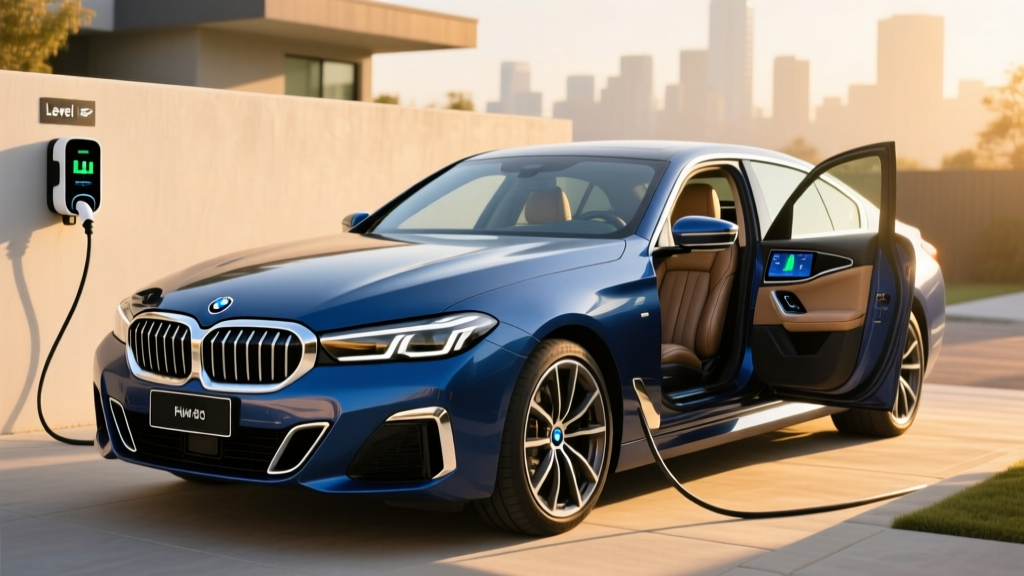
The 2026 BMW 5 Series plug-in hybrid — sold exclusively as the 550e xDrive in the United States — is a luxury sport sedan that moonlights as a short-range electric car. With an EPA-rated 38 miles of electric-only driving, 483 combined horsepower, and all-wheel drive, it targets buyers who want daily electric commuting without sacrificing the ability to road-trip 400+ miles on a single tank. The trade-off is a $60,900 starting price, a trunk compromised by battery packaging, and a 7.4 kW onboard charger that limits Level 2 refill speed. If your commute falls under 35 miles round-trip and you have home charging, the 550e xDrive can operate as an EV most weekdays while burning zero gasoline.
| Spec | Value |
|---|---|
| Powertrain | 3.0L turbocharged inline-6 + electric motor (PHEV) |
| Combined Horsepower | 483 hp / 516 lb-ft torque |
| Battery (usable) | 18.7 kWh lithium-ion (NMC chemistry) |
| EPA Electric-Only Range | 38 miles |
| EPA MPGe (electric + gas) | 64 MPGe combined |
| EPA MPG (gas only, charge-sustaining) | 28 city / 32 hwy / 30 combined |
| Total Combined Range | ~430 miles |
| Onboard Charger (Level 2) | 7.4 kW (no DC fast charging) |
| Level 2 Charge Time (0–100%) | ~3.0 hours at 7.4 kW |
| 0–60 mph | 4.2 seconds |
| Drivetrain | xDrive AWD |
| Base MSRP | $60,900 (before incentives) |
| Federal Tax Credit (§30D) | Up to $3,750 (see eligibility below) |
| Battery / Powertrain Warranty | 8 years / 80,000 miles |
HEV vs PHEV: Where the 550e Fits
BMW does not sell a conventional hybrid (HEV) version of the 5 Series in the US market. The lineup is a choice between the gasoline 530i / 540i and the plug-in hybrid 550e xDrive. Understanding the distinction matters:
| Feature | HEV (e.g., Toyota Camry Hybrid) | PHEV (BMW 550e xDrive) |
|---|---|---|
| Plug-in charging | No — charges via regenerative braking and engine | Yes — plug in to charge the larger battery |
| Battery size | ~1–2 kWh | 18.7 kWh usable |
| Electric-only range | 0–1 miles at low speed | 38 miles EPA |
| Typical MPG (gas) | 44–52 combined | 30 combined (after battery depletes) |
| Daily EV commuting | No | Yes, if commute < 38 miles |
| Home charging needed | No | Recommended for maximum benefit |
| Federal tax credit | No | Up to $3,750 (§30D) |
The 550e is firmly a PHEV. If you never plug it in, you're carrying ~280 lbs of battery and electric motor hardware for a vehicle that returns 30 MPG combined — respectable for a 483-hp AWD sedan, but not class-leading hybrid efficiency. The value proposition only materializes when you charge regularly.
Electric-Only Range and Efficiency
The EPA rates the 2026 BMW 550e xDrive at 38 miles of electric-only range and 64 MPGe when operating in hybrid mode with a charged battery. That 38-mile figure is derived from a mix of city and highway driving at moderate temperatures.
Real-World Electric Range Expectations:
- EPA sticker: 38 miles electric-only
- City commuting (55°F+, flat terrain): 36–40 miles — electric motors are most efficient at low speeds with regen braking
- Highway (70 mph, 75°F): 28–32 miles — aerodynamic drag and sustained speed drain the battery faster
- Cold weather (30°F, heater on): 24–28 miles — expect 25–35% range loss due to battery resistance and cabin heating demands
The 550e uses a heat pump for cabin climate control, which mitigates some cold-weather range loss compared to resistive heating, but winter still takes a measurable toll.
Once the battery depletes, the 550e switches to charge-sustaining hybrid mode. Here, the EPA rates it at 28 city / 32 highway / 30 combined MPG. In real-world testing, owners frequently report 33–35 MPG in mixed suburban driving thanks to regenerative braking recapturing energy, while sustained highway cruising at 75+ mph tends to return 27–29 MPG.
| Mode | City | Highway | Combined |
|---|---|---|---|
| Electric-only (MPGe) | 64 MPGe combined (EPA) | ||
| Gas-only (charge-sustaining) | 28 MPG | 32 MPG | 30 MPG |
| Real-world (owner-reported avg) | 30–35 MPG | 27–29 MPG | ~31 MPG |
Powertrain and Performance
The 550e xDrive pairs BMW's B58 3.0-liter turbocharged inline-six engine with an electric motor integrated into the 8-speed automatic transmission. Combined output is 483 horsepower and 516 lb-ft of torque, routed through BMW's xDrive all-wheel-drive system. The result is a 0–60 mph time of 4.2 seconds — genuinely quick for a 4,800-lb luxury sedan.
The electric motor contributes approximately 184 hp on its own, meaning short highway merges and city acceleration can happen in pure electric mode with authority. BMW's Driving Experience Control lets you select Electric mode (forced EV), Hybrid mode (system decides), or Sport mode (engine and motor combined for maximum output).
One practical note: the battery pack sits beneath the rear seat and trunk floor, reducing cargo capacity to 14.7 cubic feet (down from 18.4 cu ft in the gas-only 530i). That's enough for two carry-on suitcases and a grocery run, but the trunk pass-through is narrower than the gas model.
Charging: Level 2 Only, No DC Fast Charging
The 2026 550e xDrive charges via a 7.4 kW onboard charger using a standard J1772 connector (or NACS with BMW's included adapter on 2026 models). There is no DC fast charging capability — a common limitation among PHEVs, whose smaller batteries don't justify the cost and weight of high-power DC hardware.
| Level | Power | Time (0–100%) | Notes |
|---|---|---|---|
| Level 1 (120V household) | ~1.4 kW | ~14 hours | Emergency/trickle only; adds ~5 mi/hr |
| Level 2 (240V, 32A) | 7.4 kW | ~3.0 hours | Full overnight charge; ideal home setup |
| DC Fast Charge | N/A | N/A | Not supported on 550e xDrive |
For most owners, a Level 2 home charger (such as a BMW Wallbox or ChargePoint Home Flex) installed on a 240V/40A circuit will replenish the battery fully in about three hours — easily handled overnight. At roughly $0.13/kWh (national average electricity rate), a full 18.7 kWh charge costs approximately $2.43, making the per-mile electric cost around $0.064/mile versus ~$0.14/mile on premium gasoline at $4.00/gal.
Pricing, Trims, and Tax Credit Eligibility
The 2026 BMW 550e xDrive starts at $60,900 MSRP (including destination). BMW offers it in a single well-equipped trim, with options packages (Driving Assistance Professional, Executive Package, M Sport) pushing the as-tested price into the $68,000–$74,000 range.
Federal Tax Credit (§30D) — 2026 Rules:
- Maximum credit: $3,750 for the 550e xDrive (battery sourcing meets partial critical-mineral requirements but not the full battery-component threshold for the additional $3,750)
- MSRP cap: Vehicle must be under $55,000 for sedans — the 550e at $60,900 exceeds this cap
- Income cap: Buyer AGI must be ≤ $150,000 (single) / $300,000 (joint)
- Point-of-sale transfer: Eligible buyers can apply the credit as a down-payment reduction at the dealership
Critical note: Because the 550e xDrive's base MSRP of $60,900 exceeds the IRS §30D sedan cap of $55,000, it does not qualify for the federal new-vehicle EV tax credit. Some buyers may qualify for state-level PHEV rebates (California's CVRP, Colorado's state credit, New York's Drive Clean rebate), but check your state's current program. Source: IRS.gov.
Reliability, Battery Warranty, and Replacement Cost
BMW High-Voltage Battery Warranty: 8 years / 80,000 miles (whichever comes first), covering defects and capacity loss below 70% of original capacity. BMW's powertrain warranty covers the engine, transmission, and electric motor for 4 years / 50,000 miles.
BMW's B58 inline-six is widely regarded as one of the most reliable modern turbocharged engines, and the electric motor adds minimal mechanical complexity. The 18.7 kWh NMC (nickel-manganese-cobalt) battery pack is liquid-cooled, which slows degradation compared to passively cooled packs.
Based on data from earlier-generation BMW PHEVs (330e, X5 xDrive45e), owners typically see 8–12% battery degradation over 5 years / 60,000 miles, meaning the 38-mile electric range might settle to 33–35 miles over that period. This is well within BMW's 70% warranty threshold.
If replacement is needed out of warranty, BMW high-voltage battery packs for the 5 Series PHEV currently run $12,000–$16,000 including parts and labor at a dealership. However, PHEV battery failures before 150,000 miles are statistically rare, and individual module replacement (rather than the full pack) may be possible at lower cost.
Who Should Choose the 550e xDrive PHEV?
Choose the BMW 550e xDrive PHEV if:
- Your daily round-trip commute is 25–38 miles and you can charge at home
- You want one vehicle for electric commuting and gas-powered road trips
- You value BMW's driving dynamics, interior quality, and iDrive 8.5 infotainment
- You live in a state offering PHEV rebates that offset the higher MSRP
Choose a full BEV (e.g., BMW i5, Tesla Model S, Lucid Air) if:
- You have reliable home and workplace charging
- Your daily driving rarely exceeds 250 miles
- You want to eliminate gasoline costs and maintenance entirely
- You qualify for the full $7,500 federal credit on eligible BEVs
Choose the gas-only BMW 530i if:
- You cannot charge at home or work
- You prioritize trunk space (18.4 cu ft vs 14.7 cu ft)
- You want a lower entry price ($58,900 MSRP) and don't care about electric driving
Pros
- 38-mile electric range covers most daily commutes
- 483 hp with smooth inline-six + electric torque delivery
- No range anxiety — 430+ total miles with gas engine
- Premium interior with iDrive 8.5, curved display
- Heat pump improves cold-weather EV efficiency
- xDrive AWD standard for all-season traction
Cons
- $60,900 MSRP exceeds federal tax credit sedan cap
- Trunk reduced to 14.7 cu ft due to battery
- No DC fast charging; 7.4 kW Level 2 only
- 30 MPG gas-only is average, not class-leading
- Premium fuel required (91+ octane)
- Options packages push price past $70,000 quickly
Frequently Asked Questions
How many MPG does the BMW 5 Series plug-in hybrid get?
The EPA rates the 2026 BMW 550e xDrive at 28 city / 32 highway / 30 combined MPG when running on gasoline after the battery is depleted. In charge-sustaining hybrid mode with regular regenerative braking, real-world owners report 31–35 MPG in mixed suburban driving. When factoring in electric-only miles, the combined rating is 64 MPGe.
How far can the BMW 550e go on electric only?
The EPA rates it at 38 miles of electric-only range. In real-world conditions, expect 36–40 miles in mild city driving, 28–32 miles on the highway, and 24–28 miles in freezing temperatures with the heater running.
Does the BMW 5 Series PHEV qualify for a tax credit?
The 2026 550e xDrive does not qualify for the federal §30D new clean vehicle credit because its $60,900 MSRP exceeds the $55,000 sedan cap set by the IRS. State-level incentives may still apply — check IRS.gov and your state energy office for current programs.
Is the BMW 550e reliable? What does a battery replacement cost?
The B58 engine has a strong reliability track record, and BMW's PHEV systems have proven durable in earlier models. The high-voltage battery is warrantied for 8 years / 80,000 miles against defects and capacity loss below 70%. Out-of-warranty replacement runs $12,000–$16,000, though full-pack failures before 150,000 miles are uncommon.
Can I charge the 550e at a DC fast charger?
No. The 550e xDrive supports only Level 1 (120V) and Level 2 (240V, up to 7.4 kW) AC charging. This is standard for most PHEVs — the 18.7 kWh battery is too small to benefit from DC fast-charging infrastructure, and BMW omits the hardware to save weight and cost.
Hybrid vs PHEV vs EV — which is right for me?
A conventional hybrid (HEV) is best if you cannot charge at home and want maximum MPG with no behavior change. A PHEV like the 550e is ideal if you have home charging and a short commute but still need long-distance gas capability. A full BEV (like the BMW i5) makes sense if you want zero tailpipe emissions, lower operating costs, and your driving stays within 250–300 miles per day with access to charging.