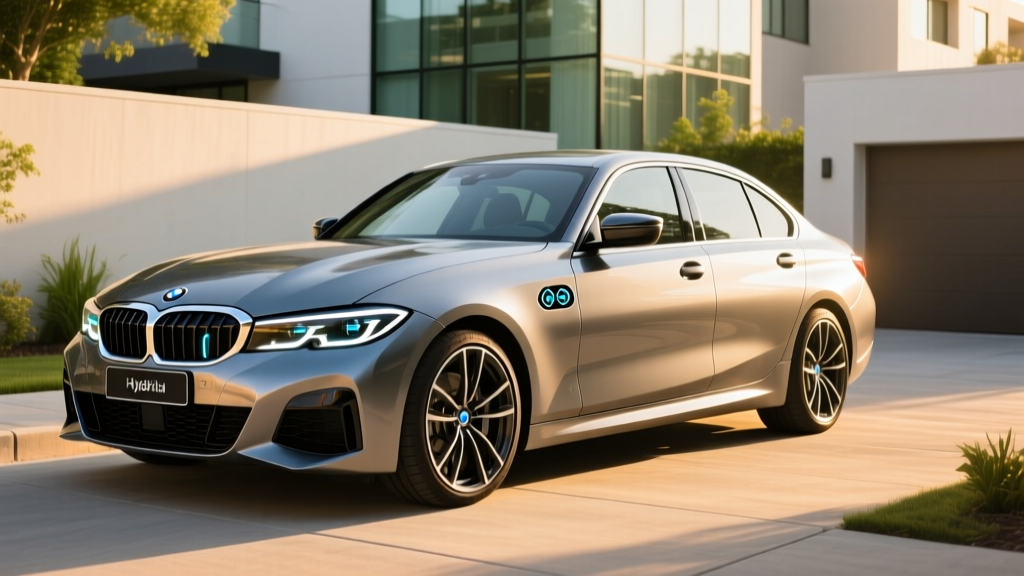
Quick Verdict: The BMW 330e Bridges Gas and Electric
The BMW 330e is a plug-in hybrid electric vehicle (PHEV) that pairs a turbocharged 2.0-liter four-cylinder engine with an electric motor integrated into its eight-speed automatic transmission. For drivers who want electric-only commuting without committing to a full battery electric vehicle (BEV), the 330e offers a practical middle ground: roughly 22 miles of zero-emission driving, 288 combined horsepower, and the ability to road-trip without charging-planning anxiety.
This guide covers the current-generation BMW 330e sedan — its EPA fuel economy, electric-only range, battery specs, charging logistics, pricing, federal tax credit eligibility, and long-term reliability. We'll also clarify how it compares to both conventional hybrids and full EVs so you can decide which electrified powertrain actually fits your routine.
HEV vs PHEV: Where the BMW 330e Fits
Before diving into specs, it's worth distinguishing the two main hybrid categories, since buyers often conflate them:
| Feature | Conventional Hybrid (HEV) | Plug-in Hybrid (PHEV) |
|---|---|---|
| Plug-in charging? | No — charges via regenerative braking and engine | Yes — has a larger battery you charge externally |
| Electric-only range | 1–2 miles at low speed | 20–50+ miles depending on model |
| Battery size | ~1–2 kWh | ~10–30 kWh |
| Gas engine | Always available | Always available |
| Tax credit eligible? | No | Sometimes — depends on battery sourcing rules |
The BMW 330e is a PHEV. It has a 19.5 kWh battery pack (gross capacity), can be plugged in to charge, and delivers meaningful electric-only driving. A conventional hybrid like the Toyota Prius cannot do this.
Fuel Economy and Electric Range: The Numbers That Matter
| Metric | EPA Estimate | Real-World Expectation |
|---|---|---|
| Combined MPGe (electric + gas) | 75 MPGe | 65–80 MPGe depending on charging habits |
| Gas-only combined MPG | 28 MPG combined | 26–31 MPG (city-biased driving can exceed EPA) |
| City MPG (gas-only) | 25 MPG | 27–30 MPG (regen braking helps in stop-and-go) |
| Highway MPG (gas-only) | 32 MPG | 28–33 MPG (aerodynamic drag at 75+ mph reduces efficiency) |
| Electric-only range | 22 miles | 18–24 miles (cold weather drops this to ~14–16 miles) |
| Total combined range | ~370 miles | ~320–380 miles depending on conditions |
Real-world range note: The EPA's 22-mile electric estimate assumes moderate temperatures and mixed driving. In winter conditions below 32°F, expect a 25–35% reduction in electric-only range due to battery chemistry limitations and cabin heating demands. Highway driving at sustained 70+ mph also reduces electric range to roughly 16–18 miles. If your one-way commute is 15 miles or less, you'll likely run electric most days with overnight charging.
The 330e's gas-only efficiency is competitive with non-hybrid luxury sport sedans but doesn't match dedicated hybrids like the Toyota Prius (57 MPG combined). The PHEV advantage is the electric buffer: if you charge regularly and commute under 22 miles, you may burn almost no gasoline on weekdays.
Powertrain, Performance, and Battery Specs
| Specification | BMW 330e (Current Generation) |
|---|---|
| Engine | 2.0L turbocharged inline-4 (181 hp, 258 lb-ft) |
| Electric motor | Integrated into 8-speed transmission (107 hp) |
| Combined output | 288 hp, 310 lb-ft torque |
| 0–60 mph | 5.6 seconds |
| Battery (gross / usable) | 19.5 kWh / ~17.0 kWh usable |
| Battery chemistry | NMC (nickel manganese cobalt) |
| Drivetrain | Rear-wheel drive (xDrive AWD available) |
| Transmission | 8-speed automatic (ZF) |
| Top speed (electric only) | ~87 mph |
BMW integrates the electric motor directly into the ZF eight-speed transmission housing rather than using a separate motor on the axle. This means the 330e can blend electric and gas power seamlessly through the gears — there's no rubber-band CVT feel. The 288 combined horsepower figure reflects the system's peak output when both power sources work together; you won't see 181 + 107 = 288 hp simultaneously at all RPMs.
The 19.5 kWh gross battery uses NMC chemistry, which offers higher energy density than LFP (lithium iron phosphate) but is more sensitive to sustained high states of charge. BMW's thermal management system actively cools and heats the pack to mitigate degradation.
Charging: Level 1, Level 2, and the DC Fast-Charge Question
| Charging Level | Power (kW) | 0–100% Time | Connector |
|---|---|---|---|
| Level 1 (120V household outlet) | ~1.4 kW | ~14 hours | J1772 |
| Level 2 (240V home/public) | 3.7 kW (onboard charger limit) | ~5 hours | J1772 |
| DC Fast Charging | Not supported | N/A | N/A |
Critical detail: The BMW 330e does not support DC fast charging. Its onboard AC charger maxes out at 3.7 kW, meaning even a 50 kW public DC fast charger will only deliver 3.7 kW to the battery. This is standard for most PHEVs — their smaller batteries don't justify the cost and weight of DC fast-charge hardware.
For most owners, overnight Level 2 charging at home is the practical setup. A full charge in ~5 hours means you can plug in when you get home and wake up with a full battery. Level 1 (standard 120V outlet) works but is slow enough that it's only practical if you drive very few electric miles daily or can leave the car plugged in for extended periods.
Home charging setup: A Level 2 home charger (like a ChargePoint Home Flex or BMW Wallbox) requires a 240V circuit, typically 20–40 amps. Installation costs range from $500–$2,000 depending on panel capacity and wiring distance. Since the 330e caps at 3.7 kW, you don't need a 48-amp charger — a 16-amp circuit delivers the full charge rate. Always consult a licensed electrician for your specific setup.
Pricing, Trims, and Federal Tax Credit Eligibility
The BMW 330e sedan starts at approximately $45,900 MSRP (base, RWD). The xDrive all-wheel-drive variant adds roughly $2,000. With common option packages (Premium, Driving Assistance, larger wheels), expect a typical transaction price of $48,000–$54,000.
Federal §30D tax credit for the BMW 330e (2026 rules):
- Maximum credit: Up to $7,500 — but split into two halves ($3,750 for critical minerals + $3,750 for battery component sourcing)
- MSRP cap: Sedans must be under $55,000 MSRP — the base 330e qualifies, but heavily optioned builds may exceed the cap
- Buyer income limits: AGI must not exceed $150,000 (single) / $300,000 (married filing jointly)
- Battery sourcing requirements: Critical minerals and battery components must meet escalating domestic/FtA-partner sourcing thresholds — BMW's supply chain partially qualifies, but the exact credit amount varies by production batch
- Point-of-sale transfer: If eligible, you can transfer the credit to the dealer at purchase for an immediate price reduction
Source: IRS §30D Clean Vehicle Credit. Eligibility rules change frequently — verify with a tax professional and the IRS qualifying vehicle list before purchasing.
The PHEV tax credit landscape is less generous than for full EVs. Many PHEVs with smaller battery packs (< 7 kWh) don't qualify at all. The 330e's 19.5 kWh battery clears the minimum 7 kWh threshold, but sourcing requirements mean the actual credit may be $3,750 rather than the full $7,500. Check the IRS qualifying list for the specific model year and build date.
Reliability, Battery Warranty, and Long-Term Costs
| Coverage | Terms |
|---|---|
| Hybrid battery warranty | 8 years / 80,000 miles |
| Capacity retention threshold | ~70% of original capacity (below this triggers warranty replacement) |
| Powertrain warranty | 4 years / 50,000 miles (BMW standard new-vehicle warranty) |
| Battery replacement cost (out of warranty) | $8,000–$12,000 estimated (parts + labor) |
BMW's hybrid battery warranty meets the federal minimum of 8 years / 80,000 miles (extended to 10 years / 150,000 miles in CARB states like California, New York, and Massachusetts). The warranty covers defects and capacity loss below approximately 70% of original capacity.
Real-world degradation data: PHEV batteries experience less stress than full EV batteries because they operate in a narrower state-of-charge window (BMW buffers the top and bottom ~15% to reduce wear). Based on owner reports and fleet data from similar NMC packs, expect 5–10% capacity loss over 5 years / 60,000 miles. Most 330e owners will not see warranty-level degradation within the coverage period.
The out-of-pocket replacement cost of $8,000–$12,000 is a legitimate long-term consideration, though by the time the battery might need replacement at 120,000+ miles, the vehicle's residual value will have dropped accordingly. Many owners sell or trade before facing this expense.
For overall reliability, the 330e's powertrain is well-established — the B48 2.0L engine and ZF 8-speed transmission are shared across millions of BMW vehicles. The electric motor integration has proven durable. The main reliability watch items are the high-voltage contactors and the onboard charger module, both of which fall under the hybrid warranty.
Who Should Buy the BMW 330e — And Who Shouldn't
Choose the BMW 330e if:
- Your daily commute is 15–22 miles one way and you can charge at home overnight
- You want a luxury sport sedan with strong acceleration (288 hp, 5.6s 0–60) but better fuel economy than a gas-only 330i
- You regularly take road trips exceeding 300 miles and don't want to plan around DC fast chargers
- You live in an apartment or area with limited public charging infrastructure — the gas engine is always your backup
- You value BMW's driving dynamics and interior quality but want some electrification
Choose a full EV (like the BMW i4 or Tesla Model 3) if:
- You have reliable home charging and your daily driving rarely exceeds 200 miles
- You want zero tailpipe emissions and minimal maintenance (no oil changes, no transmission fluid)
- You want to maximize the federal tax credit — full EVs with qualifying battery sourcing are more likely to receive the full $7,500
- You're optimizing for lowest cost-per-mile over 5+ years
Choose a conventional hybrid (like the Toyota Prius or Honda Accord Hybrid) if:
- You cannot charge at home or work — a PHEV without regular charging becomes a heavier, less-efficient gas car
- You prioritize maximum fuel economy (50+ MPG) over performance
- Your budget is under $35,000
Pros
- Seamless electric-to-gas transition — no range anxiety
- 288 hp makes it genuinely quick (5.6s 0–60)
- 22-mile electric range covers most short commutes
- BMW driving dynamics and interior quality
- Eligible for partial federal tax credit (up to $3,750–$7,500)
- 8-year/80,000-mile hybrid battery warranty
Cons
- Only 3.7 kW AC charging — slow for a PHEV
- No DC fast charging capability
- Electric range drops significantly in cold weather
- Base MSRP near $46K — options push it above the $55K tax credit cap
- Trunk space reduced by battery pack (~13 cu ft vs ~17 in gas 3 Series)
- Gas-only MPG (28 combined) isn't exceptional for a hybrid
Frequently Asked Questions
How many MPG does the BMW 330e get?
The EPA rates the BMW 330e at 75 MPGe when combining electric and gas operation. Running on gasoline alone, it returns 28 MPG combined (25 city / 32 highway). In real-world driving, owners who charge nightly and commute short distances report using very little gasoline — some fill the tank only once a month. If you never plug it in, expect 26–31 MPG depending on driving style, which is acceptable for a 288 hp luxury sedan but not class-leading.
How far can the BMW 330e go on electric only?
The EPA estimates 22 miles of electric-only range. Real-world results range from 18–24 miles in moderate weather, dropping to 14–16 miles in freezing temperatures due to battery resistance and cabin heating demands. At highway speeds above 70 mph, electric range also shrinks to roughly 16–18 miles. The 330e can reach up to 87 mph on electric power alone, so highway merging is not an issue.
Does the BMW 330e qualify for a federal tax credit?
The 330e may qualify for a partial or full §30D federal clean vehicle credit (up to $7,500), depending on battery sourcing compliance, your adjusted gross income, and the vehicle's final MSRP. The base model at ~$45,900 is under the $55,000 sedan cap, but adding options can push it over. Income limits are $150,000 (single) or $300,000 (joint). Check the IRS qualifying vehicle list for the specific model year, as sourcing compliance can change between production runs.
Is the BMW 330e reliable, and what does battery replacement cost?
The 330e's powertrain is well-proven — the B48 engine and ZF transmission are used across BMW's lineup with solid reliability records. The hybrid-specific components (battery, electric motor, power electronics) are covered by an 8-year/80,000-mile warranty. Out-of-warranty battery replacement is estimated at $8,000–$12,000. Most owners will not face this cost, as PHEV batteries in buffered charge windows degrade slowly — expect 5–10% capacity loss over 5 years.
Should I get the BMW 330e or a full electric vehicle?
If you can charge at home and your daily driving stays under 200 miles, a full EV like the BMW i4 eDrive40 (307-mile range) offers lower operating costs, stronger tax credit eligibility, and zero tailpipe emissions. Choose the 330e if you frequently drive 300+ miles without overnight stops, lack reliable charging access, or want the flexibility of a gas engine for winter and mountain driving. The PHEV is a bridge solution — excellent for specific use cases, but not the lowest-cost or lowest-emission option.
Can the BMW 330e charge at public DC fast chargers?
No. The 330e only supports AC charging (Level 1 and Level 2) via its J1772 port, capped at 3.7 kW. DC fast chargers (CCS, NACS, CHAdeMO) will not connect to or charge the 330e. This is normal for PHEVs — their smaller batteries don't require or justify DC fast-charge hardware. Plan to charge at home overnight or at Level 2 public stations (workplace, shopping centers).