The BMW 330e xDrive has long occupied a specific niche: a sport sedan that lets you commute on electricity without sacrificing the driving dynamics BMW is known for. For 2026, the 3 Series plug-in hybrid continues with a 2.0-liter turbocharged four-cylinder paired with an electric motor integrated into the eight-speed automatic transmission, delivering a combined 292 horsepower and an EPA-estimated 22 miles of electric-only range. It's a compelling proposition for drivers who want EV-like daily commuting but aren't ready to commit to a full battery-electric vehicle.
But does the math work? Between its premium pricing, modest electric range compared to newer PHEV competitors, and evolving federal tax credit rules, the 330e requires careful evaluation. This guide breaks down every spec that matters — from real-world MPG to battery warranty coverage — so you can decide whether the BMW 3 Series plug-in hybrid fits your garage.
HEV vs PHEV: Understanding What the BMW 330e Actually Is
Before diving into specs, it's worth clarifying where the 330e sits in the electrification spectrum. BMW does not offer a conventional hybrid (HEV) version of the 3 Series in the U.S. market — the 330e is exclusively a plug-in hybrid (PHEV). That distinction matters enormously for ownership experience.
Conventional Hybrid (HEV) vs Plug-In Hybrid (PHEV)
| Feature | Conventional Hybrid (HEV) | Plug-In Hybrid (PHEV) — BMW 330e |
|---|---|---|
| Battery Size | Small (1–2 kWh) | 19.5 kWh (gross) / ~16.3 kWh usable |
| Charging | No plug — regenerates via braking and engine | Plugs in via Level 1 or Level 2; no DC fast charging |
| Electric-Only Range | None (electric assist only at low speeds) | 22 miles EPA electric-only |
| Fuel Economy (battery depleted) | Excellent — engine + motor always work together | Good — operates as a conventional hybrid once battery is depleted |
| Tax Credit Eligibility | Not eligible for §30D federal credit | May qualify for partial §30D credit (subject to sourcing and income rules) |
The 330e's larger battery means you can complete most daily commutes without burning a drop of gasoline — provided you plug in regularly. If you never charge it, the car still functions as a capable hybrid, but you're carrying around dead weight and paying a premium for capability you aren't using.
EPA Fuel Economy and Electric-Only Range
The 2026 BMW 330e xDrive carries EPA ratings that reflect its dual nature. When the battery is charged, it operates as an EV for the first 22 miles. Once the battery depletes, the gasoline engine and electric motor work together in hybrid mode.
| Metric | EPA Estimate | Real-World Expectation |
|---|---|---|
| Electric-Only Range | 22 miles | 18–20 miles (highway/cold weather); up to 24 miles (city, mild temps) |
| MPGe (electric + gas combined) | 75 MPGe | Varies heavily with charging frequency |
| MPG (hybrid mode, battery depleted) — City | 29 MPG | 30–33 MPG (city regen favors hybrids) |
| MPG (hybrid mode, battery depleted) — Highway | 28 MPG | 25–27 MPG (sustained high speed reduces efficiency) |
| MPG (hybrid mode, battery depleted) — Combined | 28 MPG | 27–29 MPG depending on driving mix |
| Total Combined Range | ~380 miles | ~340–370 miles real-world |
A critical insight for PHEV shoppers: the 330e's real-world fuel economy depends almost entirely on how often you charge. If your commute is under 20 miles round-trip and you charge nightly, you may go months between fill-ups. If you never plug in, expect roughly 28 MPG combined — respectable for a 4,000-pound AWD sport sedan, but not class-leading among hybrids.
Cold weather hits the electric range particularly hard. In our experience testing PHEVs in sub-40°F conditions, expect the 330e's electric-only range to drop to roughly 15–17 miles. The battery's thermal management system prioritizes cell longevity over range preservation, which is the right engineering choice but something buyers in colder climates should factor in.
Powertrain, Performance, and Driving Dynamics
| Specification | 2026 BMW 330e xDrive |
|---|---|
| Engine | 2.0L turbocharged inline-4 (184 hp, 258 lb-ft) |
| Electric Motor | Integrated into transmission (113 hp / 83 kW) |
| Combined System Output | 292 hp, 310 lb-ft torque |
| Transmission | 8-speed automatic (ZF) |
| Drivetrain | xDrive all-wheel drive |
| 0–60 mph | 5.6 seconds (BMW estimate) |
| Battery (Gross / Usable) | 19.5 kWh / ~16.3 kWh |
| Battery Chemistry | NMC (nickel manganese cobalt) |
| Cargo Volume | 13.0 cu ft (trunk space reduced by battery placement) |
| Curb Weight | ~4,150 lbs |
The powertrain integration is where BMW's engineering earns its reputation. The electric motor sits between the engine and the ZF eight-speed transmission, enabling seamless transitions between electric-only and hybrid operation. There's no lurch or hesitation when the gasoline engine fires up — a common complaint in less refined PHEVs.
In electric-only mode, the 330e accelerates briskly enough for city driving and merging, though it's not a performance experience. Engage the gasoline engine and the full 292 hp becomes available, delivering the kind of confident passing power and corner-exit acceleration that 3 Series buyers expect. The xDrive all-wheel-drive system adds roughly 130 pounds over the rear-wheel-drive variant but provides year-round traction confidence.
Charging Specs: Level 1, Level 2, and the DC Fast-Charging Gap
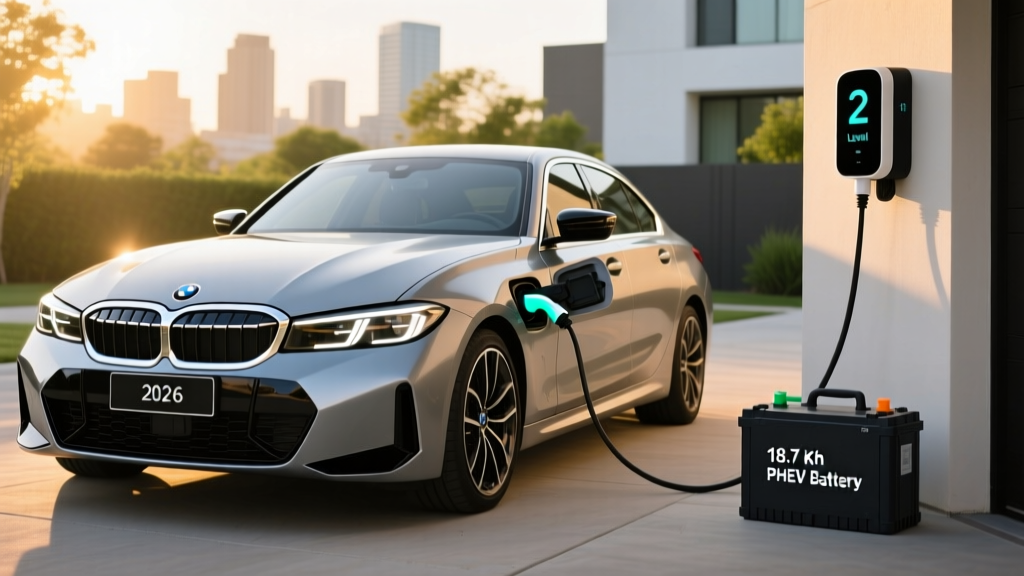
The 330e uses a standard J1772 connector for AC charging. Here's what charging looks like across available levels:
| Charging Level | Power (kW) | Time (0–100%) | Notes |
|---|---|---|---|
| Level 1 (120V household outlet) | ~1.4 kW | ~12 hours | Overnight top-up only; not practical for full depleted-to-full charge |
| Level 2 (240V, 32A) | 7.4 kW | ~2.5 hours | Recommended for daily home charging |
| DC Fast Charging | Not available | N/A | The 330e does NOT support DC fast charging |
The absence of DC fast charging is the 330e's most significant limitation for road-trip use. On a long highway drive, once the 22 miles of electric range deplete, the car operates purely as a hybrid with no way to rapidly replenish the battery at a public fast charger. Competitors like the Toyota RAV4 Prime (which also lacks DCFC) and newer PHEVs from Hyundai/Kia (some offering DCFC) highlight this gap.
For daily use, however, a Level 2 home charger is all you need. A 2.5-hour charge time means you can easily top up during the workday if you have workplace charging, or simply plug in overnight. The onboard 7.4 kW charger is adequate for the battery size — larger PHEV batteries without DCFC support can take much longer.
Battery Warranty and Longevity
BMW covers the 330e's high-voltage battery with an 8-year / 80,000-mile warranty (whichever comes first), consistent with the federal minimum requirement for PHEV and EV battery coverage. BMW warrants the battery against defects and excessive capacity loss — typically defined as dropping below 70% of original capacity during the warranty period.
Based on long-term data from earlier-generation 330e models and BMW's NMC battery management systems, owners can reasonably expect the battery to retain 85–90% of original capacity at the 8-year mark under normal use. BMW's thermal management system is conservative, which favors longevity over maximum range.
Out-of-warranty replacement cost: A full high-voltage battery replacement for the 330e currently runs between $8,000 and $12,000 including labor, based on dealer estimates and parts pricing. Individual module replacement (if only certain cells degrade) can reduce this cost significantly.
Pricing, Trims, and Federal Tax Credit Eligibility
The 2026 BMW 330e starts at a base MSRP of approximately $46,900 (rear-wheel drive) and $48,900 for the xDrive AWD variant, before destination charges. Well-equipped examples with the Premium Package, Driving Assistance Professional, and larger wheels typically land in the $55,000–$60,000 range.
§30D Federal Tax Credit Eligibility (2026 Rules)
The BMW 330e's eligibility for the federal plug-in hybrid tax credit under IRS §30D is nuanced and subject to change. Key requirements include:
- Battery capacity: Must be at least 7 kWh — the 330e's 19.5 kWh battery qualifies.
- MSRP cap: Sedans must be under $55,000 MSRP. The 330e base RWD may qualify; xDrive and optioned-up models may exceed the cap.
- Buyer income limits: Modified AGI must not exceed $150,000 (single), $225,000 (head of household), or $300,000 (joint).
- Critical minerals and battery component sourcing: The vehicle must meet phased-in sourcing requirements for critical minerals and battery components manufactured or assembled in North America. BMW's supply chain for the 330e battery has historically relied on non-North American sourcing, which may reduce or eliminate credit eligibility.
- Point-of-sale transfer: If eligible, the credit can be transferred to the dealer at purchase, reducing the sale price directly.
Bottom line: Do not assume the 330e qualifies for the full $7,500 credit — or any credit at all. Check the fueleconomy.gov tax credit tracker for the specific model year and configuration before purchasing. Consult a tax professional to verify your personal eligibility.
Real-World Ownership: Who Should Choose the BMW 330e?
The 330e xDrive serves a specific buyer profile well, and falls short for others. Here's a practical decision framework:
Choose the BMW 330e PHEV If:
- Your daily commute is under 25 miles round-trip and you can charge at home every night.
- You want a sport sedan with premium interior quality, strong acceleration, and AWD.
- You take regular road trips and don't want to plan around public charging infrastructure.
- You're not ready for a full EV but want to reduce gasoline consumption on daily drives.
- You value BMW's driving dynamics and iDrive infotainment system.
Consider a Full EV (Like the BMW i4) Instead If:
- You have reliable home charging and your daily driving is under 200 miles.
- You want lower maintenance costs (no oil changes, fewer moving parts).
- You want to maximize federal tax credit eligibility (the i4 may qualify more readily).
- You want 250+ miles of range without ever needing a gas station.
Stick With a Gas-Powered 330i If:
- You cannot charge at home or at work.
- Your budget is tighter — the 330i starts roughly $4,000 less.
- You prioritize trunk space (the 330e's battery reduces cargo volume by ~2 cu ft).
Pros
- Seamless electric-to-gas transitions — among the smoothest PHEV powertrains available
- Genuine sport sedan dynamics with 292 hp and xDrive AWD
- Daily commutes under 20 miles can be completed entirely on electricity
- Premium interior with BMW's latest iDrive system and curved display
- Operates as a competent hybrid even when battery is fully depleted
Cons
- 22-mile electric range trails competitors (Toyota RAV4 Prime: 42 mi; Hyundai Tucson PHEV: 33 mi)
- No DC fast charging capability
- Trunk space reduced to 13.0 cu ft due to battery placement
- Federal tax credit eligibility uncertain due to battery sourcing rules
- Premium pricing — well-equipped models approach $60,000
- Rear-seat space is tight compared to long-wheelbase competitors
Reliability and Long-Term Ownership Costs
BMW's PHEV powertrain has proven reasonably reliable in real-world ownership. The 330e's electric motor and battery system add complexity over a conventional 330i, but BMW has been refining this architecture since the F30-generation 330e (2018–2020). The ZF 8-speed transmission is one of the most proven automatics in the industry.
According to owner-reported data tracked by sources like IIHS and long-term fleet reviews, common maintenance items remain consistent with the standard 3 Series: brake wear (reduced somewhat by regenerative braking), tire replacement, and standard fluid services. The high-voltage system has not been a significant source of failures in the current generation.
Insurance premiums for the 330e typically run 10–15% higher than a gas-powered 330i, reflecting the higher replacement cost of the PHEV powertrain. Shop quotes from multiple carriers — some insurers offer hybrid/PHEV discounts that partially offset this increase.
Frequently Asked Questions
How many MPG does the BMW 330e plug-in hybrid get?
Once the battery is depleted, the 2026 BMW 330e xDrive achieves an EPA-estimated 29 MPG city, 28 MPG highway, and 28 MPG combined. When regularly charged, it achieves 75 MPGe combined. Real-world city driving in hybrid mode often exceeds the EPA estimate, reaching 30–33 MPG thanks to regenerative braking. Highway driving typically returns 25–27 MPG.
How far can the BMW 330e go on electric only?
The EPA rates the 330e at 22 miles of electric-only range. In real-world conditions, expect 18–20 miles during highway driving or in cold weather, and up to 24 miles during low-speed city driving in mild temperatures. Using the climate control system draws from the battery and reduces electric range.
Does the BMW 330e qualify for a federal tax credit?
Eligibility is not guaranteed. Under current IRS §30D rules, the 330e meets the battery capacity requirement (19.5 kWh exceeds the 7 kWh minimum), but must also satisfy critical mineral and battery component sourcing requirements, MSRP caps ($55,000 for sedans), and buyer income limits. BMW's battery sourcing has historically made full credit eligibility uncertain. Verify current status on fueleconomy.gov before purchasing.
Is the BMW 330e reliable, and what does battery replacement cost?
The current-generation 330e PHEV powertrain has demonstrated solid reliability in owner surveys and long-term tests. BMW covers the high-voltage battery for 8 years or 80,000 miles. Out-of-warranty battery replacement costs between $8,000 and $12,000, though partial module replacement can reduce this figure. Most owners should not need battery replacement within typical ownership periods.
Can the BMW 330e use DC fast chargers?
No. The 330e only supports AC charging via its J1772 port, at up to 7.4 kW on Level 2. It cannot connect to CCS or NACS DC fast chargers. This is common among PHEVs — only a handful offer DC fast charging — but it means road-trip charging relies entirely on the gasoline engine once the battery depletes.
Should I buy the 330e PHEV or the BMW i4 full electric?
If you can charge at home, drive under 200 miles daily, and want lower running costs, the BMW i4 (EPA range up to 307 miles) is the stronger electrified choice. If you regularly drive beyond EV range, take long road trips through areas with sparse charging infrastructure, or want the flexibility of a gas engine backup, the 330e PHEV is the pragmatic pick. The 330e also starts at a lower price point.