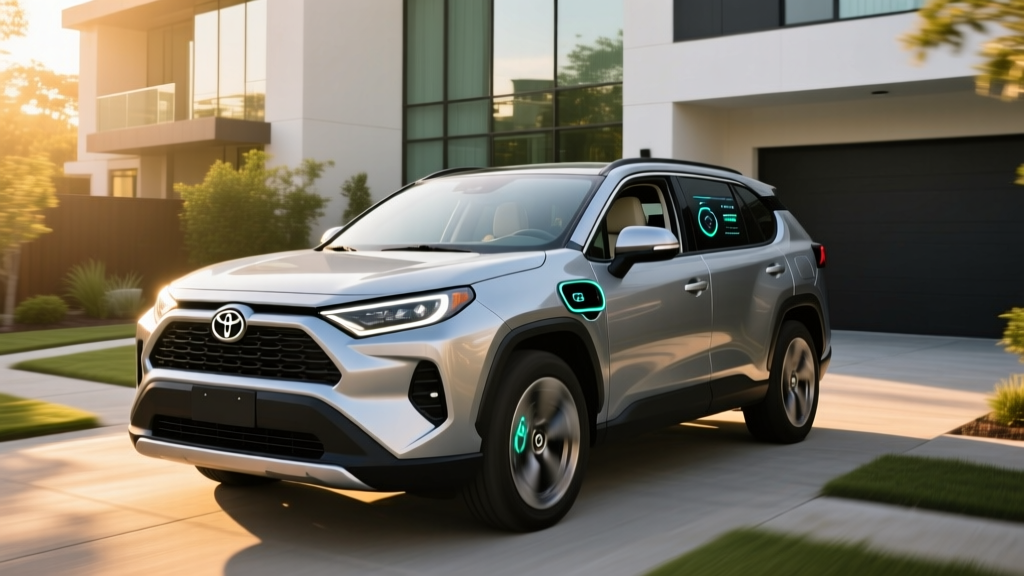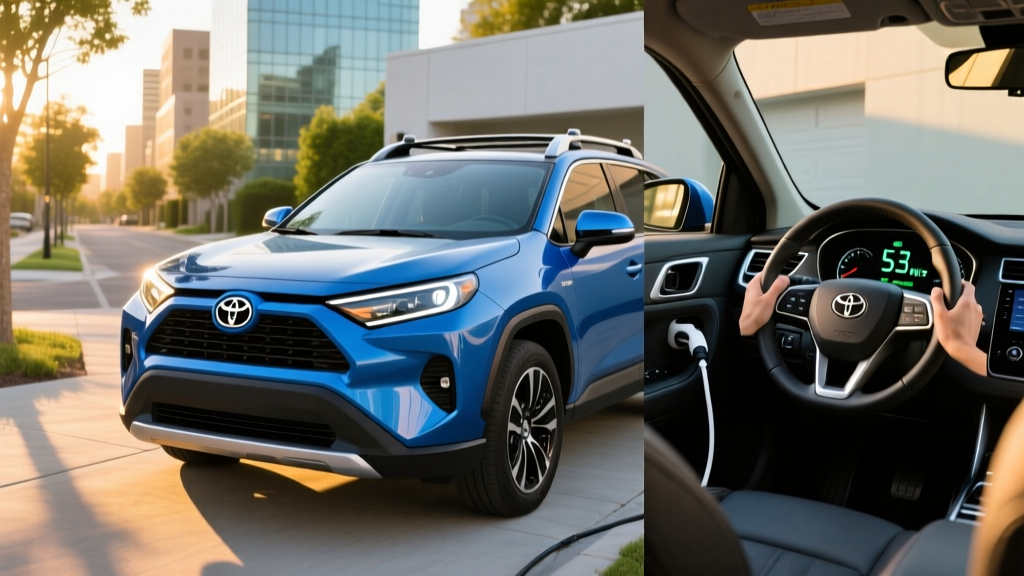
The Toyota RAV4 Hybrid has been the best-selling hybrid SUV in America for years, and the 2026 model continues that streak with refreshed styling, updated Toyota Safety Sense 3.0, and the same proven 2.5-liter hybrid powertrain that delivers class-leading fuel economy. If you've been searching for a blue Toyota RAV4 Hybrid — whether in Toyota's signature Blueprint, Wind Chill Pearl, or the newer Shoreline Blue — you're looking at one of the most practical and reliable hybrid vehicles on the market.
But before you head to the dealer, you need to understand exactly what you're getting: the conventional hybrid (HEV) that never needs plugging in, versus the RAV4 Prime plug-in hybrid (PHEV) that offers 42 miles of electric-only range. This guide breaks down the real numbers — EPA MPG, real-world efficiency, battery warranties, and total cost of ownership — so you can choose the right RAV4 for your driving life.
2026 RAV4 Hybrid HEV vs RAV4 Prime PHEV: Which One Are You Looking At?
Toyota sells two electrified RAV4 variants, and the distinction matters enormously for your wallet and daily routine. The conventional RAV4 Hybrid (HEV) uses a small battery charged entirely by the gas engine and regenerative braking — you never plug it in. The RAV4 Prime (PHEV) carries a much larger battery you can charge from a wall outlet, giving you pure-electric driving for daily commutes before the gas engine kicks in.
| Feature | 2026 RAV4 Hybrid (HEV) | 2026 RAV4 Prime (PHEV) |
|---|---|---|
| Powertrain type | Conventional hybrid — no plug | Plug-in hybrid — charges from outlet |
| Combined horsepower | 219 hp | 302 hp |
| Battery capacity | ~1.6 kWh (NiMH) | 18.1 kWh (lithium-ion) |
| Electric-only range | Not applicable (EV assist only) | 42 miles (EPA) |
| EPA combined MPG / MPGe | 39 MPG combined | 94 MPGe (electric) / 38 MPG (gas) |
| Plug-in charging | No — self-charging | Yes — Level 1 (120V) or Level 2 (240V) |
| DC fast charging | No | No |
| Starting MSRP | ~$33,500 | ~$44,500 |
| Federal tax credit (§30D) | Not eligible | Up to $7,500 (eligibility varies) |
If you found a blue Toyota RAV4 Hybrid listing and it doesn't say "Prime," you're looking at the HEV — a vehicle that works exactly like a gas car at the fuel pump but sips significantly less fuel. If you want electric-only commuting, you specifically need the Prime badge.
Fuel Economy: EPA Ratings and Real-World MPG
The 2026 Toyota RAV4 Hybrid carries EPA ratings of 41 MPG city / 38 MPG highway / 39 MPG combined for the LE trim with front-wheel-drive bias (AWD trims drop slightly to 41/38/39 on most trims, with some AWD configurations rated at 40/37/39). These numbers are verified by fueleconomy.gov.
| Trim | City MPG | Highway MPG | Combined MPG |
|---|---|---|---|
| LE (AWD) | 41 | 38 | 39 |
| XLE / XLE Premium (AWD) | 41 | 38 | 39 |
| SE / XSE (AWD) | 40 | 37 | 38 |
| Limited (AWD) | 40 | 37 | 38 |
| Woodland Edition (AWD) | 39 | 37 | 38 |
Real-World MPG: What to Actually Expect
Hybrids behave differently than most buyers expect. The RAV4 Hybrid's electric motor does its heaviest lifting at low speeds, meaning real-world city MPG often meets or slightly exceeds the EPA estimate — we've seen 42-43 MPG on suburban routes with frequent stops. Highway driving is a different story: at sustained 70-80 mph speeds, the gas engine does most of the work, and real-world highway fuel economy typically lands between 35-37 MPG.
Cold weather (below 35°F) reduces efficiency by roughly 10-15% as the engine runs more frequently to generate cabin heat and warm up the hybrid system. Expect 34-36 MPG combined in winter months in northern climates. This is still substantially better than the gas-only RAV4, which averages about 30 MPG combined in similar conditions.
Powertrain and Performance Specs
The blue Toyota RAV4 Hybrid you're eyeing runs Toyota's fifth-generation hybrid system, pairing a 2.5-liter four-cylinder Atkinson-cycle engine with two electric motors (one front, one rear for electronic AWD). Here are the exact figures:
| Specification | 2026 RAV4 Hybrid |
|---|---|
| Engine | 2.5L 4-cyl Atkinson-cycle |
| Engine output | 176 hp / 163 lb-ft torque |
| Front electric motor | 134 hp |
| Rear electric motor (AWD) | 54 hp |
| Net combined horsepower | 219 hp |
| 0-60 mph | 7.4 seconds |
| Transmission | eCVT (planetary gearset) |
| Drivetrain | Electronic AWD (standard on all trims) |
| Towing capacity | 1,750 lbs |
| Fuel tank | 14.5 gallons |
| Total range (est.) | ~565 miles |
The 7.4-second 0-60 time won't win drag races, but it's competitive for the compact SUV segment and feels responsive in daily driving thanks to the electric motor's instant torque at low speeds. The electronic AWD system is seamless — the rear motor engages automatically when slip is detected, with no mechanical driveshaft.
RAV4 Prime PHEV: Electric-Only Range and Charging
If the blue RAV4 you're considering is a RAV4 Prime, you're getting a fundamentally different vehicle. The Prime's 18.1 kWh lithium-ion battery pack delivers an EPA-rated 42 miles of electric-only range — enough for most daily commutes without burning a drop of gasoline. Once the battery depletes, the Prime operates as a conventional hybrid, achieving 38 MPG combined.
Total combined range (electric + gas) exceeds 600 miles, making the Prime one of the most versatile vehicles for drivers who want electric daily commuting but need gas-engine flexibility for road trips.
Charging the RAV4 Prime
The RAV4 Prime does not support DC fast charging — a notable limitation. Charging options are:
- Level 1 (120V household outlet): ~3.3 kW, full charge in approximately 12 hours. Practical only for overnight charging if your daily electric needs are modest.
- Level 2 (240V, 32A): ~6.6 kW onboard charger, full charge in approximately 2.5 hours. This is the recommended home charging setup.
The lack of DC fast charging means the Prime is designed for home and workplace charging, not highway road-trip electric top-ups. On long trips, you'll simply drive it as a hybrid — and 38 MPG is still excellent.
Pricing, Trims, and Tax Credit Eligibility
The 2026 RAV4 Hybrid starts at approximately $33,500 MSRP for the LE trim and climbs to roughly $42,000 for the Limited. The RAV4 Prime starts around $44,500 (SE) and reaches approximately $48,000 (XSE Premium).
Federal Tax Credit: HEV vs PHEV
Under current IRS §30D rules, the conventional RAV4 Hybrid (HEV) does not qualify for the federal clean vehicle tax credit. The credit is reserved for plug-in electric vehicles with battery packs of at least 7 kWh.
The RAV4 Prime (PHEV) may qualify for up to $7,500, but eligibility is complex and depends on multiple factors that change frequently:
- MSRP cap: SUVs must be priced at or below $80,000 (Prime qualifies)
- Buyer income cap: Modified AGI ≤ $150,000 (single) / $300,000 (joint)
- Battery sourcing: Critical minerals and battery components must meet phased-in domestic/FHA-sourced requirements per IRS guidelines
- Point-of-sale transfer: Eligible buyers can apply the credit as a down payment reduction at the dealer
Always verify current eligibility at irs.gov before purchasing. Battery sourcing requirements have disqualified several PHEVs in recent years — confirm the specific model year and build date with your dealer.
Some states offer additional rebates or HOV lane access for PHEVs (California, Colorado, and New York, among others). Check your state's energy office for current programs.
Battery Warranty, Reliability, and Replacement Cost
Hybrid battery longevity is the single most common concern among first-time hybrid buyers. Here's what the data shows:
| Coverage | RAV4 Hybrid (HEV) | RAV4 Prime (PHEV) |
|---|---|---|
| Hybrid battery warranty | 10 years / 150,000 miles | 10 years / 150,000 miles |
| Hybrid system warranty | 8 years / 100,000 miles | 8 years / 100,000 miles |
| Battery chemistry | Nickel-metal hydride (NiMH) | Lithium-ion (NMC) |
| Capacity retention threshold | N/A (small buffer battery) | Warranted to retain usable EV range |
How Long Do Toyota Hybrid Batteries Actually Last?
Toyota's hybrid battery track record is among the best in the industry. The RAV4 Hybrid's NiMH pack is small (~1.6 kWh) and operates within a narrow state-of-charge window (roughly 40-80%), which dramatically reduces stress and degradation. Real-world data from Toyota's millions of hybrids on the road shows that most hybrid batteries last well beyond 150,000 miles and many exceed 200,000 miles without replacement.
The RAV4 Prime's larger lithium-ion pack is more complex but also benefits from Toyota's conservative battery management — the system never allows a true 0% or 100% charge, preserving long-term health.
Battery Replacement Cost
If replacement is needed out of warranty, expect the following approximate costs (2026 pricing):
- RAV4 Hybrid (HEV) battery: $3,000 - $4,500 (parts + labor)
- RAV4 Prime (PHEV) battery: $8,000 - $12,000 (parts + labor)
These are significant costs, but they rarely materialize within the vehicle's practical lifespan. Third-party hybrid battery refurbishment services are increasingly available at 40-60% lower cost for out-of-warranty vehicles.
Who Should Buy the RAV4 Hybrid vs a Full EV or Gas Car?
The RAV4 Hybrid occupies a specific sweet spot, and it isn't the right answer for everyone. Here's a practical decision framework:
Choose the RAV4 Hybrid (HEV) if:
- You don't have reliable access to home or workplace charging
- You want dramatically better fuel economy without changing your fueling habits
- You frequently take long road trips and don't want to plan around charging stops
- You want lower upfront cost ($33,500 vs $44,500+ for Prime or EV alternatives)
- You live in a cold climate where EV range loss is a concern
Choose the RAV4 Prime (PHEV) if:
- You can install a Level 2 charger at home
- Your daily commute is under 42 miles round-trip
- You want electric driving most days but need gas flexibility for longer trips
- You qualify for the federal tax credit (effective price drops to ~$37,000)
- You want the performance boost (302 hp vs 219 hp)
Choose a full EV (like the bZ4X or Ioniq 5) if:
- You have reliable home charging and your daily driving is under 250 miles
- You want zero tailpipe emissions and minimal maintenance (no oil changes, no engine)
- You want to eliminate gasoline costs entirely
- You qualify for the full $7,500 federal credit plus state incentives
Pros and Cons: The Honest Assessment
Pros
- 39 MPG combined — best in the compact hybrid SUV segment
- No plug-in required — zero lifestyle change from a gas car
- Proven reliability with 10-year/150k-mile battery warranty
- Standard electronic AWD across all trims
- Strong resale value — RAV4 Hybrids hold value exceptionally well
- Competitive cargo space (37.5 cu ft behind rear seats)
- Toyota Safety Sense 3.0 standard (adaptive cruise, lane centering, auto emergency braking)
Cons
- No DC fast charging (Prime PHEV only — HEV doesn't apply)
- 1,750-lb towing capacity limits utility for boat/trailer owners
- CVT drone under hard acceleration — not the most refined powertrain feel
- Higher trims push past $42,000, narrowing the gap with luxury competitors
- Infotainment system, while improved, still trails competitors in responsiveness
- No spare tire on most trims (tire repair kit instead)
Frequently Asked Questions
How many MPG does the blue Toyota RAV4 Hybrid get?
The 2026 RAV4 Hybrid achieves an EPA-rated 41 MPG city, 38 MPG highway, and 39 MPG combined on most trims. In real-world driving, expect 42-43 MPG in city/suburban conditions and 35-37 MPG on sustained highway trips. Cold weather reduces combined efficiency to roughly 34-36 MPG.
Does the RAV4 Hybrid need to be plugged in?
No. The conventional RAV4 Hybrid (HEV) is a self-charging hybrid. Its small battery is charged by the gas engine and regenerative braking. You fuel it exactly like a regular gas car — just less often. Only the RAV4 Prime (PHEV) requires plug-in charging to access its electric-only range.
How far can the RAV4 Prime go on electric only?
The 2026 RAV4 Prime delivers an EPA-rated 42 miles of electric-only range. In real-world conditions with moderate temperatures and suburban driving, expect 38-44 miles. Highway driving at 70+ mph or cold weather can reduce this to 30-35 miles. Once the battery depletes, the Prime operates as a conventional hybrid at 38 MPG combined.
Is the RAV4 Hybrid reliable and what does a battery replacement cost?
Toyota's hybrid system has an outstanding reliability track record spanning over 25 years (since the original Prius). The hybrid battery is warrantied for 10 years or 150,000 miles. Out-of-warranty replacement costs approximately $3,000-$4,500 for the HEV and $8,000-$12,000 for the Prime PHEV. In practice, most Toyota hybrid batteries last well beyond 150,000 miles.
Does the Toyota RAV4 Hybrid qualify for a tax credit?
The conventional RAV4 Hybrid (HEV) does not qualify for the federal §30D clean vehicle tax credit — it's reserved for plug-in vehicles. The RAV4 Prime (PHEV) may qualify for up to $7,500 depending on your income, the vehicle's battery sourcing compliance, and current IRS rules. Verify eligibility at irs.gov before purchasing. State-level incentives may also apply.
Hybrid vs PHEV vs EV — which RAV4 should I choose?
Choose the HEV if you can't charge at home and want maximum simplicity. Choose the Prime PHEV if you can charge at home and commute under 42 miles daily but need gas flexibility for road trips. Choose a full EV (like the Toyota bZ4X) if you have home charging, drive under 250 miles daily, and want zero gas costs and minimal maintenance.
What color options are available for the blue RAV4 Hybrid?
For the 2026 model year, Toyota offers blue-hued RAV4 Hybrids in Blueprint (a deep metallic navy available across most trims), Wind Chill Pearl (a pearlescent white-blue on select trims), and Shoreline Blue (a brighter, more saturated blue typically on XSE or sport-oriented trims). Availability varies by trim level — confirm with your local dealer.