Quick Verdict: The Blue Honda CR-V Hybrid at a Glance
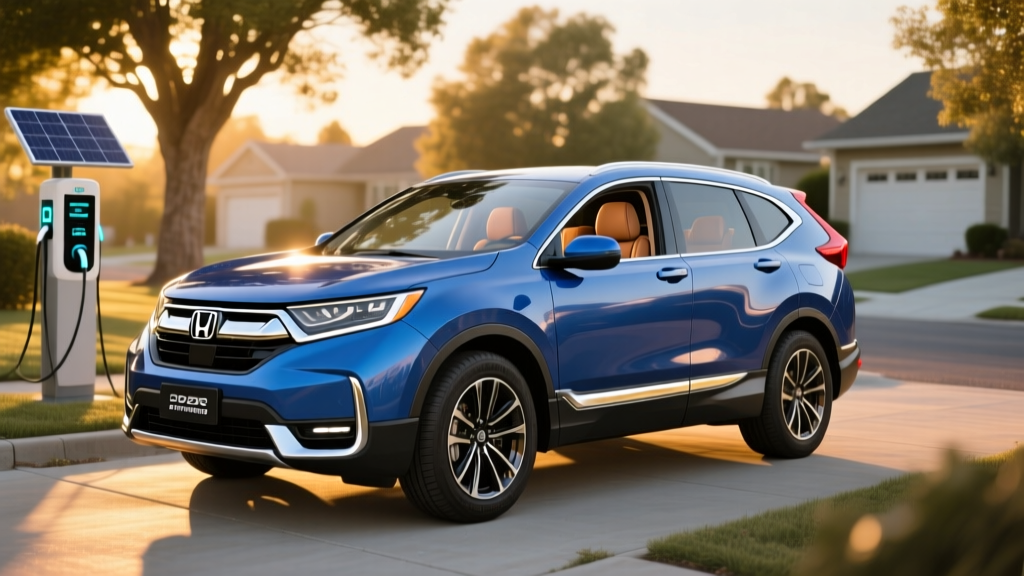
If you've been searching for a blue Honda CR-V Hybrid, you're looking at one of the most popular compact SUVs in America — and for good reason. The 2026 CR-V Hybrid pairs a 2.0-liter Atkinson-cycle four-cylinder engine with a two-motor hybrid system to deliver an EPA-estimated 40 MPG combined in front-wheel-drive form. Available in striking colors like Canyon River Blue and still offered in the deep Urban Gray Pearl, the Hybrid trim accounts for over half of all CR-V sales, and it's easy to see why: no plug required, no range anxiety, and a powertrain that actually gets better mileage in city driving than on the highway.
This guide covers everything you need to know before ordering — from real-world fuel economy and powertrain specs to battery warranty, pricing by trim, and whether the CR-V Hybrid, a PHEV competitor, or a full EV makes more sense for your daily driving.
| EPA Combined MPG | 40 MPG (FWD) / 37 MPG (AWD) |
| City / Highway (FWD) | 43 city / 36 highway |
| Combined Horsepower | 204 hp |
| Powertrain | 2.0L I-4 + 2-motor hybrid system |
| Drivetrain | FWD standard, AWD available |
| Cargo Volume | 36.3 cu ft (rear seats up) / 76.5 cu ft (folded) |
| Starting MSRP | $36,395 (Sport FWD) |
| Hybrid Battery Warranty | 8 years / 100,000 miles |
HEV vs PHEV vs EV: Where Does the CR-V Hybrid Fit?
Before we get into the numbers, let's clear up a common point of confusion. The Honda CR-V Hybrid is a conventional hybrid electric vehicle (HEV). That means it does not plug in. It charges its small battery pack entirely through regenerative braking and the gasoline engine. You fuel it at any gas station, exactly like a conventional car — the hybrid system simply makes the gasoline go further.
HEV (CR-V Hybrid)
- No plug-in required
- Self-charging via regen + engine
- 40 MPG combined (FWD)
- ~520 miles total range
- No federal tax credit
PHEV (e.g., Toyota RAV4 Prime)
- Plugs in for electric-only driving
- ~42 miles EV range, then hybrid
- 94 MPGe combined (electric mode)
- ~600 miles total range
- May qualify for $3,750–$7,500 credit
BEV (e.g., Tesla Model Y)
- 100% electric, no gasoline
- ~300+ miles EPA range
- 100+ MPGe equivalent
- Requires home or public charging
- Up to $7,500 federal credit (§30D)
Bottom line: If you want maximum simplicity — no charging cables, no electrical upgrades, no plug-in routine — the CR-V Hybrid is the right call. If you have home charging access and a short commute, a PHEV or full EV will save more on fuel. We'll break down that decision framework later in this guide.
EPA Fuel Economy and Real-World MPG
The 2026 Honda CR-V Hybrid is rated by the EPA at 43 MPG city, 36 MPG highway, and 40 MPG combined in front-wheel-drive configuration. Opt for the available Real Time AWD and those numbers drop to 40 city / 34 highway / 37 combined — a reasonable trade for all-weather traction.
| Configuration | City MPG | Highway MPG | Combined MPG |
|---|---|---|---|
| Sport FWD | 43 | 36 | 40 |
| Sport AWD | 40 | 34 | 37 |
| Sport-L FWD | 43 | 36 | 40 |
| Sport Touring AWD (standard) | 40 | 34 | 37 |
Source: fueleconomy.gov, EPA estimates. Your mileage will vary based on driving conditions, climate, and habits.
Real-World MPG: What Owners Actually Report
Here's where Honda's hybrid system shines. Like most hybrids, the CR-V Hybrid tends to exceed its EPA city rating in stop-and-go traffic because the electric motors handle low-speed propulsion while the engine stays off or runs at its most efficient RPM. Owners on Fuelly and CR-V forums routinely report 41–45 MPG in mixed suburban driving with the FWD model.
Highway driving is a different story. At sustained 75–80 mph speeds, the gasoline engine does most of the work, and real-world highway MPG typically lands between 33–36 MPG for FWD and 31–34 MPG for AWD. Cold weather (below 40°F) can reduce combined fuel economy by 3–5 MPG due to reduced battery efficiency, longer engine warm-up cycles, and increased cabin heating demand.
Powertrain and Performance
The 2026 CR-V Hybrid uses Honda's fourth-generation two-motor hybrid system. Here's exactly what's under the hood:
- Engine: 2.0-liter DOHC Atkinson-cycle inline-4, 145 hp @ 6,100 rpm, 134 lb-ft torque @ 4,500 rpm
- Drive Motor: 181 hp, 247 lb-ft torque
- Combined System Output: 204 hp, 247 lb-ft torque
- Transmission: Electronically controlled CVT (e-CVT) — no traditional gears or belt
- 0–60 mph: Approximately 7.8 seconds (AWD)
The e-CVT isn't a conventional continuously variable transmission with a steel belt and pulleys. It's a planetary gearset that seamlessly blends power from the engine and electric motors. The result is smooth, linear acceleration without the rubber-band effect that older CVTs exhibited.
The AWD system uses a dedicated rear-mounted electric motor rather than a mechanical driveshaft from the engine. This means torque distribution to the rear wheels is managed electronically and can respond faster than a traditional mechanical AWD system. It's not designed for off-roading, but it handles rain, snow, and gravel roads with confidence.
Pricing by Trim and Tax Credit Eligibility
The 2026 CR-V Hybrid is available in four trims. Here's the current MSRP breakdown:
| Trim | Drivetrain | MSRP | Federal Tax Credit |
|---|---|---|---|
| Sport | FWD | $36,395 | Not eligible |
| Sport | AWD | $37,895 | Not eligible |
| Sport-L | FWD or AWD | $39,895–$41,395 | Not eligible |
| Sport Touring | AWD (std) | $43,895 | Not eligible |
Does the CR-V Hybrid Qualify for a Tax Credit?
No. Under IRS §30D rules, the federal clean vehicle credit applies only to plug-in electric vehicles (BEVs and PHEVs) with a minimum battery capacity of 7 kWh that meet battery-component and critical-mineral sourcing requirements. The CR-V Hybrid is a conventional HEV with a small (~1.1 kWh) battery that does not plug in. It does not qualify for the federal §30D credit or any state EV rebate tied to plug-in capability.
However, some states and local utilities offer modest incentives for conventional hybrids — typically $250–$500 rebates or HOV lane access. Check your state's energy office or utility provider for current programs. These vary by jurisdiction and change frequently, so consult official sources before relying on them.
Battery Warranty, Reliability, and Replacement Costs
How Long Will the Hybrid Battery Last?
Honda's fourth-generation hybrid system uses a relatively small lithium-ion battery pack (approximately 1.1 kWh gross capacity). Unlike a full EV battery that cycles through deep charge and discharge events daily, the CR-V Hybrid's battery operates in a narrow state-of-charge window — typically between 40% and 80%. This shallow cycling dramatically reduces degradation stress.
Based on long-term data from Honda's hybrid lineup (Insight, Accord Hybrid, previous-gen CR-V Hybrid), most hybrid battery packs last well beyond 150,000 miles without significant capacity loss. The hybrid system's battery management computer actively prevents deep discharges and overcharges, which are the primary causes of lithium-ion degradation.
Battery Replacement Cost
If your hybrid battery does fail outside of warranty, replacement cost at a Honda dealer typically ranges from $2,000 to $4,000 including parts and labor for the current-generation CR-V Hybrid. Independent hybrid specialists may offer refurbished battery packs for $1,200–$2,500. This is dramatically less than EV battery replacement, which can exceed $10,000–$20,000, because the hybrid battery is much smaller.
Overall Reliability
The CR-V Hybrid powertrain has proven reliable across the current generation (introduced for 2023). The e-CVT has no wear-prone belts or clutches, and the electric motors have essentially unlimited service life. The primary maintenance items remain standard: oil changes (every 7,500–10,000 miles with synthetic), brake fluid, cabin air filter, and tires. Regenerative braking reduces wear on the friction brakes, often extending pad life to 80,000+ miles.
Who Should Buy the Blue Honda CR-V Hybrid?
The CR-V Hybrid occupies a specific sweet spot. Here's a decision framework to determine if it's right for you — or if you should look at a PHEV or full EV instead.
✓ Choose the CR-V Hybrid If:
- You don't have access to home or workplace charging
- You want EV-like city efficiency without plugging in
- You frequently take long road trips (500+ miles per tank)
- You live in an apartment or street-park with no outlet access
- You want lower upfront cost vs. PHEV or BEV alternatives
- You prefer Honda's reliability record and dealer network
✗ Consider a PHEV or BEV Instead If:
- You have Level 2 home charging and a commute under 30 miles
- You want to drive on electricity alone (zero tailpipe emissions)
- You want to qualify for the $3,750–$7,500 federal tax credit
- Your state offers significant EV/PHEV rebates (e.g., CA, CO, NY)
- You want one-pedal driving and instant electric torque
- You plan to install solar and want to "fuel" from your roof
The Cost-Per-Mile Comparison
At $3.40/gallon (national average) and 40 MPG combined, the CR-V Hybrid costs approximately $0.085 per mile in fuel. A comparable BEV charging at $0.15/kWh at home with an efficiency of 3.5 miles/kWh costs about $0.043 per mile — roughly half. However, the CR-V Hybrid's lower purchase price (typically $5,000–$8,000 less than a comparable EV after any credits) means it takes 60,000–100,000+ miles of driving for the EV's fuel savings to offset the price difference, depending on your electricity rate and the specific models compared.
Pros and Cons
Pros
- 43 MPG city — excellent stop-and-go efficiency
- No plug-in required; fuel at any gas station
- 204 hp provides confident highway merging
- 36.3 cu ft cargo space (no battery intrusion)
- 8-year/100,000-mile hybrid battery warranty
- Available in attractive Canyon River Blue exterior
- Honda Sensing safety suite standard on all trims
- Low maintenance costs (no transmission fluid changes, extended brake life)
Cons
- No federal tax credit eligibility (HEV, not PHEV)
- AWD drops combined MPG from 40 to 37
- Highway MPG trails city MPG (common for hybrids)
- Engine noise under hard acceleration (e-CVT drone)
- Not eligible for most state EV/PHEV incentives
- Sport Touring trim approaches $44K — near PHEV territory
- No spare tire (tire inflation kit included)
Frequently Asked Questions
How many MPG does the blue Honda CR-V Hybrid get?
The 2026 CR-V Hybrid with front-wheel drive is EPA-rated at 43 city / 36 highway / 40 combined MPG. The AWD version is rated at 40 city / 34 highway / 37 combined. In real-world suburban driving, many owners report 41–45 MPG combined, though sustained highway driving at 75+ mph typically yields 33–36 MPG.
Does the Honda CR-V Hybrid need to be plugged in?
No. The CR-V Hybrid is a conventional hybrid (HEV), not a plug-in hybrid (PHEV). It charges its battery entirely through regenerative braking and the gasoline engine. You never need to plug it in — just fill up at a gas station like any other car.
Is the CR-V Hybrid reliable, and what does a battery replacement cost?
Honda's current-generation hybrid powertrain has demonstrated strong reliability. The hybrid battery is covered for 8 years / 100,000 miles (10 years / 150,000 miles in CARB states). Out-of-warranty battery replacement typically costs $2,000–$4,000 at a dealer, or $1,200–$2,500 through independent hybrid specialists. Most hybrid batteries last well beyond 150,000 miles due to shallow charge cycling.
Does the CR-V Hybrid qualify for any tax credit?
No. The federal §30D clean vehicle credit applies only to plug-in electric vehicles (BEVs and PHEVs) with at least 7 kWh of battery capacity. The CR-V Hybrid's small (~1.1 kWh) battery and lack of plug-in capability make it ineligible. Some states and utilities offer minor hybrid incentives ($250–$500), but these vary by location — check your state energy office for current programs.
Should I get the CR-V Hybrid or a plug-in hybrid like the RAV4 Prime?
It depends on your charging access and commute. If you can charge at home and your daily round-trip commute is under 40 miles, a PHEV like the Toyota RAV4 Prime (42 miles EV range) lets you drive mostly on electricity, saving significantly on fuel and qualifying for potential tax credits. If you lack home charging, drive long distances regularly, or want a lower purchase price, the CR-V Hybrid's simplicity and strong real-world MPG make it the more practical choice.
What color options are available for the CR-V Hybrid?
The 2026 CR-V Hybrid is available in several colors depending on trim, including Canyon River Blue (a popular blue-gray metallic), Urban Gray Pearl, Crystal Black Pearl, Platinum White Pearl, Solar Silver Metallic, and Radiant Red Metallic. Canyon River Blue is the most sought-after "blue" option and is available on Sport and Sport-L trims. Availability varies by trim level and model year — confirm with your local dealer.
Prices, specs, and incentive eligibility are based on 2026 model-year information and current IRS §30D guidelines. Always verify with Honda's official site, your tax professional, and fueleconomy.gov before purchasing.