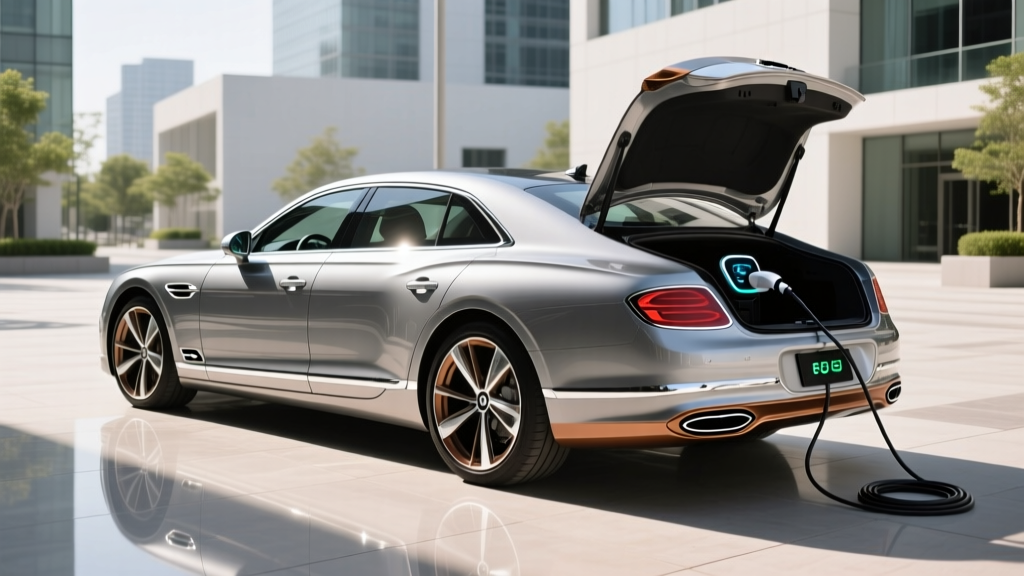
The Bentley Flying Spur Hybrid occupies a rare niche: a full-size luxury sedan that pairs a twin-turbo V6 with a plug-in electric motor, offering silent electric-only cruising through city centers and 536 combined horsepower when you need it. For buyers weighing ultra-luxury against electrification, this PHEV presents a compelling bridge — but its real-world efficiency, charging practicality, and ownership costs deserve a hard look beyond the winged-B badge.
This guide covers the Flying Spur Hybrid's powertrain specs, EPA fuel economy, electric-only range, charging times, battery warranty, federal tax-credit eligibility under current IRS §30D rules, and who should consider this PHEV versus a full battery-electric vehicle or a conventional hybrid.
Flying Spur Hybrid Powertrain: V6 Meets Electric Motor
The Bentley Flying Spur Hybrid is a plug-in hybrid electric vehicle (PHEV), not a conventional hybrid (HEV). That distinction matters: unlike a Toyota Prius-style HEV that charges its small battery solely through regenerative braking and the engine, the Flying Spur Hybrid has a larger battery pack you can plug in to charge, enabling meaningful electric-only driving before the gasoline engine engages.
HEV vs. PHEV — Why It Matters Here:
- HEV (Conventional Hybrid): Small battery (~1-2 kWh), no plug, electric motor assists the engine at low speeds. Cannot drive on electricity alone for more than a mile or two. Example: Toyota Camry Hybrid.
- PHEV (Plug-in Hybrid): Larger battery (14-25 kWh typical), plug-in charging, 20-50 miles of electric-only range before the engine takes over. The Flying Spur Hybrid falls here.
The Flying Spur Hybrid pairs a 2.9-liter twin-turbocharged V6 engine with a 100 kW (134 hp) electric motor integrated into the eight-speed dual-clutch transmission. Combined output reaches 536 horsepower and 553 lb-ft of torque, propelling this 5,500+ pound sedan from 0-60 mph in approximately 4.1 seconds — figures that belie its efficiency-oriented positioning.
| Specification | Value |
|---|---|
| Powertrain Type | Plug-in Hybrid (PHEV) |
| Engine | 2.9L Twin-Turbo V6 |
| Electric Motor | 100 kW (134 hp) |
| Combined Horsepower | 536 hp |
| Combined Torque | 553 lb-ft |
| Transmission | 8-speed dual-clutch automatic |
| Battery Capacity (Usable) | ~14.1 kWh usable (18.0 kWh gross) |
| Battery Chemistry | Lithium-ion (NMC) |
| 0-60 mph | 4.1 seconds |
| Top Speed | 177 mph |
| Drivetrain | All-wheel drive |
| Curb Weight | ~5,520 lbs |
| Base MSRP (2025 MY) | ~$226,000 |
EPA Fuel Economy and MPGe: What the Numbers Say
The EPA rates the Bentley Flying Spur Hybrid at 45 MPGe (miles per gallon equivalent) when operating in combined electric-plus-gasoline mode. Once the battery is depleted and the car runs as a conventional hybrid, the EPA rates it at approximately 19 MPG combined.
MPGe is the standard metric for PHEVs: it converts electrical energy consumption into a gasoline-equivalent figure so you can compare across vehicle types. A higher MPGe means less total energy used per mile when the battery is charged.
| Mode | City | Highway | Combined |
|---|---|---|---|
| Charge-Sustaining (Gas Only) | 17 MPG | 22 MPG | 19 MPG |
| Blended (Electric + Gas) | 45 MPGe (combined) | ||
Real-world MPG vs. EPA: In practice, PHEV fuel economy depends entirely on your driving and charging habits. If you charge daily and commute under 25 miles, you may burn almost no gasoline on weekdays — achieving effective triple-digit MPGe. On long highway road trips with a depleted battery, expect the 17-22 MPG range, consistent with a heavy luxury V6 sedan. Owners who rarely plug in will see fuel economy closer to the 19 MPG combined figure, negating much of the PHEV advantage.
For authoritative EPA data, consult the official listing at fueleconomy.gov.
Electric-Only Range and Total Driving Range
The EPA rates the Flying Spur Hybrid at approximately 21 miles of electric-only range. In real-world driving — particularly at highway speeds or in cold weather — expect closer to 15-18 miles before the V6 seamlessly engages. City driving at moderate temperatures may stretch this to the full 21 miles or slightly beyond, thanks to regenerative braking recapturing energy at stoplights.
Electric Range Reality Check:
EPA estimate: 21 miles electric-only. Real-world expectation: 15-18 miles at highway speeds or in cold weather; up to 21+ miles in city driving at moderate temperatures. The gasoline tank provides an additional ~380 miles of range, for a total combined range of approximately 400+ miles.
The 18.0 kWh gross battery (approximately 14.1 kWh usable, with the remainder reserved as a buffer to protect longevity) is modest by PHEV standards. Competitors like the BMW 7 Series PHEV or Mercedes-Benz S 580e offer larger batteries and longer electric-only ranges — a trade-off against the Bentley's performance tuning and packaging priorities.
When the battery depletes, the Flying Spur Hybrid operates as a conventional hybrid, blending engine and motor power. You'll never be stranded — the 21.1-gallon fuel tank ensures long-distance capability even without charging infrastructure.
Charging: Level 2 Times and the DC Fast-Charging Gap
The Flying Spur Hybrid supports Level 2 AC charging at up to 7.2 kW via its onboard charger. Using a 240-volt Level 2 home charger or public AC station, a full 0-100% charge takes approximately 2.5 hours.
| Charging Level | Power (kW) | Time (0-100%) | Miles of Range Added/Hour |
|---|---|---|---|
| Level 1 (120V household) | ~1.4 kW | ~10-12 hours | ~3-4 miles/hr |
| Level 2 (240V home/public) | 7.2 kW | ~2.5 hours | ~8-10 miles/hr |
| DC Fast Charging | Not supported | ||
Critical note: The Flying Spur Hybrid does not support DC fast charging. This is typical for PHEVs — the smaller battery makes DC fast-charging hardware cost-prohibitive and unnecessary for most use cases. You'll charge exclusively via AC (Level 1 or Level 2), which is perfectly adequate for overnight home charging or topping up at a workplace charger during the day.
The charging connector is a standard J1772 (the universal AC connector for non-Tesla EVs in North America). If you own a Tesla Wall Connector at home, you'll need a J1772 adapter — widely available for under $30 — or install a dedicated J1772 Level 2 unit such as a ChargePoint Home Flex or Emporia Vue.
For a detailed breakdown of home Level 2 installation costs (typically $800-$2,500 depending on panel capacity and wiring distance), consult a licensed electrician for a site-specific quote.
Pricing, Tax Credits, and Ownership Costs
The Bentley Flying Spur Hybrid starts at approximately $226,000 MSRP before destination charges, with well-optioned examples easily exceeding $270,000 once you add Mulliner specification paint, Naim audio, rear-seat entertainment, and the Touring Specification package.
Federal tax credit eligibility (§30D): Under current IRS rules, the federal plug-in vehicle tax credit offers up to $7,500 for qualifying new PHEVs and EVs. However, several requirements apply:
- MSRP cap: Sedans must have an MSRP at or below $55,000 to qualify. The Flying Spur Hybrid (~$226,000) far exceeds this cap and does not qualify for the §30D new-vehicle credit.
- Buyer income limits: Modified adjusted gross income must not exceed $150,000 (single), $225,000 (head of household), or $300,000 (joint). Most Flying Spur buyers exceed these thresholds.
- Battery sourcing and critical minerals: Even if price and income qualified, the battery must meet progressively tightening sourcing requirements for critical minerals and component manufacturing.
- Point-of-sale transfer: Qualifying buyers can transfer the credit to the dealer for an upfront price reduction — but again, this vehicle does not meet the MSRP requirement.
For the most current §30D rules, always verify at irs.gov or consult a tax professional before purchase.
State incentives: Some states offer their own PHEV rebates or HOV-lane access regardless of MSRP. California's Clean Fuel Rebate, for example, has historically included PHEVs but often with income or price limitations. Check your state's energy office or DMV for current programs.
Total cost of ownership: Beyond the purchase price, budget for premium insurance ($4,000-$7,000+ annually), premium fuel for the V6, scheduled Bentley dealer service, and tire replacement (21-inch performance tires run $400-$600 each). The PHEV powertrain reduces fuel costs if you charge regularly, but at this price point, fuel savings are a rounding error against depreciation and maintenance.
Battery Warranty, Reliability, and Replacement Costs
Bentley covers the Flying Spur Hybrid's high-voltage battery with a warranty of 8 years or 100,000 miles (whichever comes first), with a capacity-retention threshold typically set at 70% of original capacity. If the battery degrades below this threshold within the warranty period, Bentley will repair or replace it at no cost.
Battery Warranty Summary:
- Coverage: 8 years / 100,000 miles
- Capacity threshold: ~70% state of health
- Replacement cost (out of warranty): Estimated $12,000-$18,000 for the battery pack, plus labor
This is consistent with industry norms. Most PHEV and EV batteries retain 85-92% capacity after 8 years based on fleet data, and outright failure before 150,000+ miles is uncommon.
Reliability considerations: Bentley as a brand does not rank highly in mainstream reliability surveys (J.D. Power, Consumer Reports), though this reflects the complexity and low production volume of hand-built luxury cars rather than specific PHEV powertrain failures. The V6 hybrid system itself shares architecture with Porsche's PHEV powertrains (the Panamera E-Hybrid uses a related setup), which have demonstrated solid durability in the field.
The 12-volt auxiliary battery — separate from the high-voltage traction battery — powers electronics, infotainment, and door locks. Like any car, it will need replacement every 4-6 years (~$300-$500). If the 12V dies, the car won't start even if the main battery is fully charged — a common EV/PHEV owner surprise.
Flying Spur Hybrid vs. Full EV vs. Conventional Hybrid: Which Fits You?
The right choice depends on your driving patterns, charging access, and what you're optimizing for:
Choose the Flying Spur Hybrid (PHEV) if:
- You want a Bentley with the ability to drive short distances on electric power silently and emissions-free in city centers.
- You take frequent long road trips where charging infrastructure gaps make a full EV impractical.
- You have reliable Level 2 charging at home or work to capture the 21-mile electric range daily.
- You value 536 hp performance alongside moderate efficiency gains.
Choose a full EV (like the Rolls-Royce Spectre or upcoming Bentley EV) if:
- You want zero tailpipe emissions and minimal drivetrain maintenance (no oil changes, no transmission fluid).
- You have reliable home charging and your daily driving stays within 250-300 miles.
- You want the lowest per-mile energy cost and the smoothest, quietest acceleration.
Choose a conventional hybrid (HEV, non-plug-in) if:
- You cannot charge at home or work and don't want to rely on public charging.
- You want simpler ownership — no plug, no battery-management complexity — with modest fuel savings.
- Note: Bentley does not currently offer a conventional HEV; the Flying Spur Hybrid is PHEV-only.
Pros and Cons: The Honest Assessment
Pros
- Silent electric-only driving for ~21 miles — ideal for residential neighborhoods and city centers
- 536 hp and 4.1-second 0-60 — genuine performance credentials
- 400+ mile total range eliminates road-trip range anxiety
- Handcrafted Bentley interior quality, Mulliner customization options
- 8-year/100,000-mile battery warranty provides long-term peace of mind
- No dependence on public DC fast-charging infrastructure
Cons
- 21-mile electric range is short compared to PHEV rivals (BMW 7 PHEV: ~35 miles, S 580e: ~30+ miles)
- No DC fast-charging capability
- 19 MPG combined on gas alone — modest efficiency when battery is depleted
- $226,000+ MSRP disqualifies it from the federal §30D tax credit
- Heavy curb weight (~5,520 lbs) increases tire wear and braking distances
- Bentley dealer network is sparse in many regions — service access may require travel
Frequently Asked Questions
How many MPG does the Bentley Flying Spur Hybrid get?
The EPA rates it at 45 MPGe combined (electric + gas) and 19 MPG combined when running on gasoline alone after the battery depletes. City gas-only driving drops to about 17 MPG; highway reaches 22 MPG. Real-world results depend heavily on how often you charge — daily charging can push effective MPGe well above the sticker number.
How far can the Flying Spur Hybrid go on electric only?
The EPA rates it at 21 miles of electric-only range. In real-world highway or cold-weather driving, expect 15-18 miles. City driving at moderate temperatures may achieve the full 21 miles. Once depleted, the V6 engine engages seamlessly and the car continues as a conventional hybrid.
Does the Bentley Flying Spur Hybrid qualify for a federal tax credit?
No. Under current IRS §30D rules, the $7,500 federal tax credit requires sedan MSRPs at or below $55,000. The Flying Spur Hybrid starts around $226,000, far exceeding this cap. Buyer income limits and battery-sourcing requirements present additional barriers. Some state-level incentives may apply — check your state's energy office for current programs.
Is the Flying Spur Hybrid reliable, and what does battery replacement cost?
The PHEV powertrain shares architecture with Porsche's proven hybrid systems. Bentley's brand-level reliability ratings are middling due to low-volume hand-built complexity, not hybrid-specific failures. The high-voltage battery carries an 8-year/100,000-mile warranty. Out-of-warranty replacement is estimated at $12,000-$18,000, though most PHEV batteries retain 85%+ capacity well past the warranty period.
Can the Flying Spur Hybrid DC fast charge?
No. Like nearly all PHEVs, the Flying Spur Hybrid supports AC charging only — Level 1 (120V, ~10-12 hours) and Level 2 (240V at 7.2 kW, ~2.5 hours for a full charge). The 18 kWh battery is small enough that DC fast-charging hardware isn't cost-effective or necessary.
How does the Flying Spur Hybrid compare to a full-electric Bentley?
Bentley has announced plans for full electrification by 2030 under its Beyond100 strategy, but as of 2026, no fully electric Flying Spur is on sale. The Hybrid is the most electrified Flying Spur currently available. If you need zero-emissions luxury today, the Rolls-Royce Spectre (full EV, 260-mile range, ~$420,000) is the closest analog in the ultra-luxury segment.
Sources: EPA Fuel Economy — Bentley Flying Spur Hybrid, IRS Clean Vehicle Tax Credits (§30D), Bentley Motors official specifications.