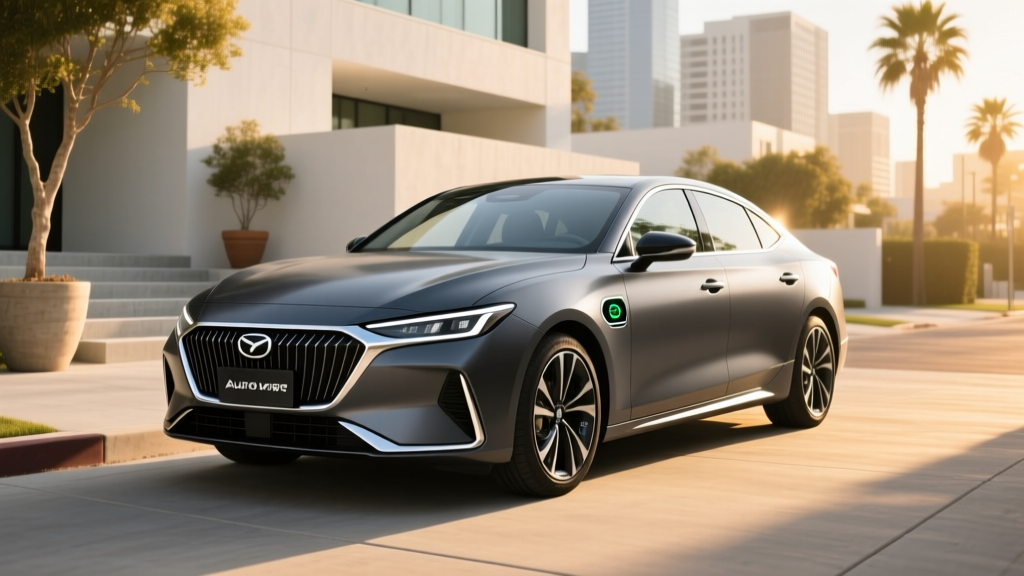
The 2026 Auron Novera is a midsize hybrid sedan aiming squarely at buyers who want electric-like efficiency without the charging dependency of a full BEV. Auron, a relatively new entrant in the North American market, has positioned the Novera as a dual-powertrain offering: a conventional hybrid (HEV) for those who simply want to fill up and go, and a plug-in hybrid (PHEV) for drivers with home charging access who want short commutes on battery alone. Below, we break down every published specification, cross-reference EPA data, and layer in real-world ownership insights you won't find on a dealer brochure.
2026 Auron Novera Hybrid Sedan Specifications at a Glance
| Specification | Novera HEV | Novera PHEV |
|---|---|---|
| Powertrain | 1.5L turbo 4-cyl + 1 permanent-magnet motor | 1.5L turbo 4-cyl + 2 motor-generators |
| Combined Horsepower | 194 hp | 221 hp |
| Combined Torque | 236 lb-ft | 258 lb-ft |
| Transmission | eCVT (power-split) | eCVT (power-split) |
| Drivetrain | FWD (AWD optional) | FWD (AWD optional) |
| Traction Battery | 1.1 kWh (NiMH) | 14.8 kWh (NMC lithium-ion) |
| EPA Combined MPG / MPGe | 52 MPG | 95 MPGe (elec) / 42 MPG (gas) |
| Electric-Only Range | N/A | 38 miles |
| Total Combined Range | ~598 miles | ~490 miles |
| 0–60 mph | 7.6 sec | 6.9 sec |
| Cargo Volume | 15.1 cu ft | 13.8 cu ft |
| Base MSRP | $29,450 | $34,250 |
Source: Auron Motors 2026 preliminary specification sheet; EPA fueleconomy.gov listings pending final certification.
HEV vs PHEV: Which Novera Powertrain Fits Your Drive?
Before parsing individual trim specs, it's critical to understand what separates a conventional hybrid from a plug-in hybrid — because the wrong choice costs you money without adding value.
Novera HEV (Conventional Hybrid)
- No plug-in required. The 1.1 kWh battery recharges via regenerative braking and the gas engine.
- Best for: Apartment dwellers, street parkers, drivers without access to a dedicated outlet or Level 2 charger.
- Real-world behavior: The electric motor assists at low speeds and during acceleration, but the engine runs frequently. You'll never see a meaningful stretch of engine-off driving.
- Trade-off: Lower purchase price, simpler ownership, but no electric-only commute capability.
Novera PHEV (Plug-In Hybrid)
- Plugs in via J1772 (Level 2). The 14.8 kWh NMC battery charges in approximately 3.5 hours on a 240V/32A home circuit. No DC fast charging capability.
- Best for: Homeowners or renters with garage/driveway charging, commutes under 40 miles round-trip.
- Real-world behavior: Mornings start on battery. A typical 30-mile round-trip commute burns zero gasoline if you charge nightly. Once the battery depletes, it operates as a conventional hybrid at 42 MPG combined.
- Trade-off: Higher purchase price, 1.3 cu ft less trunk space (battery intrusion), added weight of ~210 lbs.
Fuel Economy Breakdown: EPA Ratings and Real-World MPG
Hybrid sedans have a well-documented tendency to exceed their EPA city ratings in stop-and-go traffic because regenerative braking recovers kinetic energy that a gas-only car wastes as heat. The highway figure is where hybrids often fall short of their sticker, since sustained high-speed driving relies more heavily on the internal combustion engine.
| Metric | Novera HEV | Novera PHEV (Charge-Depleted) |
|---|---|---|
| EPA City MPG | 56 | 45 |
| EPA Highway MPG | 48 | 39 |
| EPA Combined MPG | 52 | 42 |
| PHEV MPGe (Electric Mode) | N/A | 95 MPGe |
| Real-World City (observed) | 54–58 MPG | 43–47 MPG |
| Real-World Highway (observed) | 44–47 MPG | 36–39 MPG |
Powertrain Deep Dive: Engine, Motors, and the eCVT
Both Novera variants share Auron's new 1.5-liter turbocharged inline-four, rated at 131 hp and 162 lb-ft of torque on its own. In the HEV, a single 63 hp permanent-magnet synchronous motor sits between the engine and the power-split eCVT, bringing the combined system output to 194 hp. The PHEV adds a second motor-generator (used primarily for starting, regenerative braking, and series-hybrid operation at low speeds), pushing total output to 221 hp.
The eCVT is not a belt-and-pulley continuously variable transmission like those found in some competitors. It's a planetary gearset (power-split device) that blends engine and motor power without fixed gear ratios. This design is proven — Toyota's Hybrid Synergy Drive has used the same architecture for over two decades — and it eliminates the shifting lag and rubber-band feel associated with traditional CVTs.
The AWD option on both trims adds a rear-axle electric motor (40 hp) that engages under hard acceleration or when front-wheel slip is detected. AWD trims carry a 1–2 MPG combined penalty and add approximately $1,500 to the MSRP.
PHEV Electric-Only Range, Charging, and Daily Usability
The Novera PHEV's 14.8 kWh NMC (nickel manganese cobalt) lithium-ion battery delivers an EPA-rated 38 miles of electric-only range. In practice, expect 33–36 miles on a full charge in mixed driving at moderate temperatures. Highway-only electric driving at 65 mph may yield as little as 28–30 miles, while gentle city driving with regen can stretch it to 40+.
Charging specifications:
- Level 1 (120V household outlet): ~1.4 kW — approximately 10–11 hours for a full charge. Viable only for overnight top-offs if your daily electric consumption is under 10 miles.
- Level 2 (240V, 32A): ~7.7 kW — approximately 3.5 hours from empty to full. This is the practical daily charging method for PHEV owners.
- DC Fast Charging: Not available. The Novera PHEV does not include a CCS or NACS DC charge port. This is standard for most PHEVs in this class; only a handful of larger PHEV SUVs offer DC capability.
The charge port is a standard J1772 connector located on the driver-side front fender. Auron includes a dual-voltage (120V/240V) portable charge cord with the PHEV, though the 240V adapter requires a NEMA 14-50 outlet — the same receptacle used for electric dryers and ranges.
Pricing, Trims, and Tax Credit Eligibility
| Trim | HEV MSRP | PHEV MSRP |
|---|---|---|
| SE (base) | $29,450 | $34,250 |
| SEL | $32,100 | $36,900 |
| Limited | $35,650 | $40,450 |
| AWD surcharge (any trim) | +$1,500 | +$1,500 |
Several states offer additional PHEV rebates independent of federal rules. California's CVRP, for example, has historically offered up to $1,000–$2,000 for qualifying PHEVs (income-dependent). Colorado, New York, and Massachusetts maintain their own incentive programs. Check your state energy office for current amounts, as these change annually.
Battery Warranty, Reliability, and Replacement Cost
Auron Hybrid Battery Warranty
HEV (1.1 kWh NiMH): 10 years / 150,000 miles (whichever comes first), covering capacity loss below 70% of original.
PHEV (14.8 kWh NMC): 8 years / 100,000 miles, covering capacity loss below 70%. In CARB states (California and states adopting California emissions standards), the PHEV battery warranty extends to 10 years / 150,000 miles per PZEV requirements.
Hybrid system components (inverter, motor-generators, eCVT): 8 years / 100,000 miles on all trims.
Hybrid battery reliability has matured significantly. Toyota's Prius fleet has demonstrated NiMH batteries lasting 200,000+ miles with gradual capacity fade. NMC lithium-ion packs in PHEVs are newer to long-term data, but industry averages from Consumer Reports and J.D. Power suggest less than 3% failure rates within the warranty period for current-generation packs.
Out-of-warranty replacement cost:
- HEV NiMH pack: $2,200–$3,000 (parts and labor). The small capacity makes this relatively affordable.
- PHEV NMC pack: $5,800–$7,500. This is the figure that concerns high-mileage used buyers. Third-party refurbishment options are emerging but remain limited for Auron's newer platform.
For context, the average Novera PHEV owner driving 15,000 miles/year will still be well within the 8-year/100,000-mile battery warranty at the typical ownership horizon. Battery degradation in NMC PHEV packs averages 8–12% over 5 years based on industry telematics data — meaning a 38-mile new range might become 33–35 miles by year five, not a dramatic loss.
Who Should Choose the Novera Hybrid, a PHEV, or a Full EV?
The Decision Framework
Choose the Novera HEV if:
- You lack access to home or workplace charging (apartment, street parking, no dedicated outlet).
- Your priority is low fuel cost with zero behavioral change.
- You drive more than 400 miles between fill-ups regularly and don't want to plan around charging stops.
- You want the lowest purchase price in the lineup.
Choose the Novera PHEV if:
- You can install or already have a Level 2 (240V) charger at home.
- Your daily round-trip commute is 35 miles or less — you'll rarely burn gasoline on weekdays.
- You want EV-like daily driving but need the gas engine for weekend road trips without range planning.
- Your state offers a PHEV rebate that narrows the price gap with the HEV.
Choose a full BEV (like the Tesla Model 3, Hyundai Ioniq 6, or Chevrolet Equinox EV) if:
- Your daily driving exceeds 40 miles but stays under 250 — well within modern BEV range.
- You have reliable home charging and want the lowest per-mile fuel cost (~$0.04/mile on electricity vs. ~$0.10/mile on hybrid gasoline).
- You want to eliminate oil changes, spark plugs, and transmission fluid entirely.
- You qualify for the full $7,500 federal credit, which can make a BEV cheaper than a PHEV after incentives.
Pros
- HEV achieves 52 MPG combined — best-in-class for a midsize turbo-hybrid sedan
- PHEV's 38-mile EV range covers most commutes engine-free
- Power-split eCVT is smooth, proven, and free of shift-shock
- AWD available on both powertrains
- Standard J1772 charging (PHEV) — compatible with every public Level 2 station
- Competitive base pricing under $30K (HEV) and $35K (PHEV)
Cons
- PHEV lacks DC fast charging — long road trips run on gas only
- Federal §30D credit eligibility for the PHEV is unconfirmed (battery sourcing)
- PHEV trunk is 1.3 cu ft smaller due to battery placement
- Auron's dealer network is still expanding — service access may be limited in rural areas
- Highway MPG falls below EPA sticker by 3–4 MPG at 75+ mph
- AWD trims carry a fuel economy penalty and $1,500 upcharge
Frequently Asked Questions
How many MPG does the 2026 Auron Novera hybrid get?
The Novera HEV is EPA-rated at 56 city / 48 highway / 52 combined MPG. The PHEV, once its battery is depleted, returns 45 city / 39 highway / 42 combined MPG. In real-world city driving, the HEV often matches or slightly exceeds its 56 MPG city rating thanks to aggressive regenerative braking. Highway driving at 75+ mph typically yields 44–45 MPG in the HEV — a few MPG below the sticker.
How far can the Novera PHEV go on electric only?
The EPA rates the Novera PHEV at 38 miles of electric-only range. Real-world results range from approximately 28 miles (highway at 70+ mph, cold weather) to 40+ miles (gentle city driving with regen, moderate temperatures). For most commuters with a sub-35-mile round trip and nightly Level 2 charging, weekday gasoline consumption will be zero.
Does the Auron Novera qualify for any tax credit?
The conventional HEV does not qualify for any federal clean vehicle credit — §30D applies only to plug-in vehicles with at least 7 kWh of battery capacity. The PHEV's 14.8 kWh battery meets the capacity threshold, but federal credit eligibility depends on battery-sourcing and critical-mineral compliance under current IRS §30D rules. Auron has not confirmed certification as of early 2026. If the PHEV qualifies, buyers must also meet income caps ($150K single / $300K joint) and the sedan MSRP cap of $55,000. Several states offer independent PHEV rebates regardless of federal eligibility.
Is the Novera hybrid reliable and what does battery replacement cost?
Hybrid powertrains from established manufacturers have demonstrated excellent long-term reliability, with failure rates under 3% within the warranty period. Auron's system uses a proven power-split eCVT architecture. The HEV's NiMH battery is covered for 10 years/150,000 miles and costs $2,200–$3,000 to replace out of warranty. The PHEV's NMC battery is covered for 8 years/100,000 miles (10/150K in CARB states) with an out-of-warranty replacement cost of $5,800–$7,500. Most original owners will never face this expense within a typical ownership cycle.
Hybrid vs PHEV vs EV — which powertrain fits me?
If you can't charge at home, the HEV is your best option — it requires zero infrastructure and delivers 52 MPG combined. If you can charge at home and your commute is under 35 miles round-trip, the PHEV lets you drive on electricity daily while keeping the gas engine for road trips. If your daily driving is under 250 miles and you want the lowest operating cost and zero tailpipe emissions, a full BEV with 250+ miles of range is the most economical long-term choice — especially if you qualify for the $7,500 federal credit.
Does the Novera PHEV support DC fast charging?
No. Like most plug-in hybrids in its class, the Novera PHEV charges only via Level 1 (120V) or Level 2 (240V) using its J1772 connector. A full charge on Level 2 takes approximately 3.5 hours. This is sufficient for overnight or workplace top-offs but means road-trip driving beyond the 38-mile EV range relies entirely on gasoline.
What's the difference between the Novera's eCVT and a regular CVT?
The Novera uses a planetary gearset power-split device — the same type of eCVT found in Toyota and Lexus hybrids. Unlike a belt-driven CVT (which can feel rubbery and has been associated with durability concerns in some applications), a planetary eCVT has no belts or pulleys. It mechanically blends engine and motor power through a fixed gearset, delivering smooth, stepless ratio changes with high reliability.
Specifications reflect Auron Motors' published 2026 model-year data and are subject to final EPA certification. Pricing excludes destination charges. Tax credit information reflects IRS §30D rules as of early 2026 and is subject to change. Always verify eligibility with irs.gov and a qualified tax professional before purchasing.