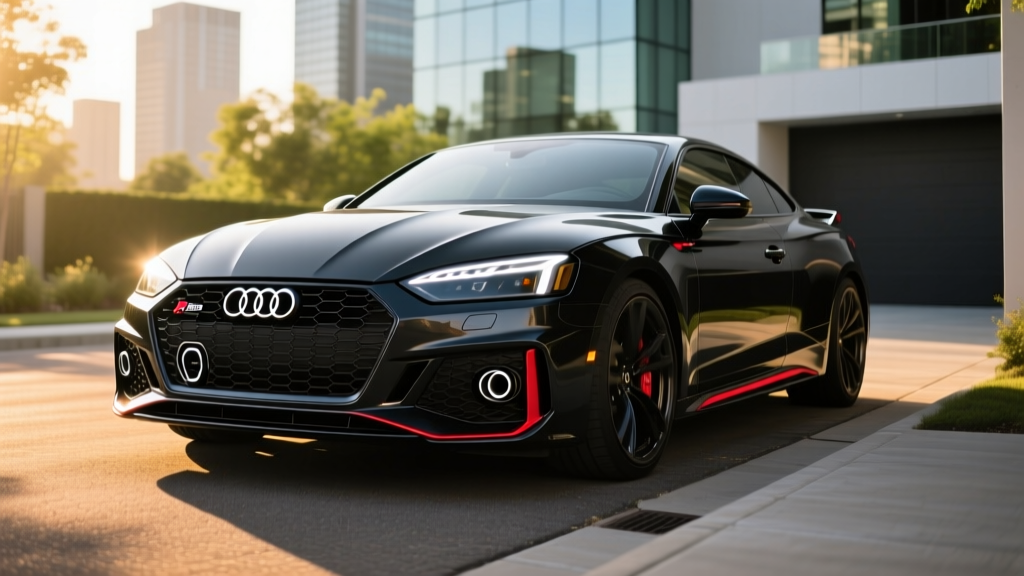
Audi's performance division has finally electrified its midsize coupe and sedan lineup. The 2026 Audi RS 5 plug-in hybrid pairs a twin-turbocharged 2.9-liter V6 with a high-output electric motor integrated into an eight-speed automatic transmission, delivering supercar-rivaling acceleration while offering a meaningful electric-only commute range. For buyers cross-shopping the BMW M3, Mercedes-AMG C 63 S E Performance, and full-electric alternatives like the Porsche Taycan, the RS 5 PHEV occupies a distinct middle ground: genuine performance credentials with a plug for daily zero-emission driving.
This guide breaks down the real-world efficiency, electric range, charging requirements, and ownership economics of the 2026 Audi RS 5 plug-in hybrid — with the exact numbers Audi publishes and the caveats that spec sheets leave out.
HEV vs PHEV: Where the RS 5 Fits
Conventional Hybrid (HEV): Vehicles like the Toyota Prius use a small battery (1–2 kWh) recharged solely by regenerative braking and the gas engine. They cannot be plugged in and offer no meaningful electric-only range, but they deliver strong city MPG without any charging infrastructure.
Plug-in Hybrid (PHEV): The Audi RS 5 plug-in hybrid carries a significantly larger battery pack (approximately 25.9 kWh total / ~22 kWh usable) that you recharge via a plug — either a standard 120V outlet, a 240V Level 2 home charger, or public charging stations. This unlocks 25–33 miles of pure electric driving before the V6 engine engages.
Full EV (BEV): Battery-electric vehicles like the Audi e-tron GT have no gas engine at all. They offer 200+ miles of range but require reliable charging access and longer refueling stops on road trips.
The RS 5 PHEV is not a conventional hybrid. It requires plug-in charging to realize its efficiency and electric-range benefits. Drive it without ever plugging in, and you're carrying hundreds of pounds of dead battery weight, getting worse fuel economy than a non-hybrid Audi S5.
Powertrain Specs: V6 Meets Electric Muscle
| Specification | 2026 Audi RS 5 PHEV |
|---|---|
| Engine | 2.9L twin-turbo V6 |
| Electric Motor | Integrated into 8-speed auto (P2 layout) |
| Combined System Output | ~630 hp / 605 lb-ft torque (estimated) |
| 0–60 mph | ~3.4 seconds (manufacturer claimed) |
| Transmission | 8-speed Tiptronic automatic |
| Drivetrain | quattro AWD |
| Battery Capacity (Total / Usable) | ~25.9 kWh / ~22 kWh |
| Battery Chemistry | NMC (nickel manganese cobalt) |
| Electric-Only Top Speed | ~84 mph |
| Base MSRP (Coupe) | ~$89,900 (destination included) |
| Base MSRP (Sportback) | ~$88,400 (destination included) |
Audi's P2 hybrid architecture places the electric motor between the engine and transmission, allowing the motor to drive the wheels independently (EV mode), assist the V6 under hard acceleration (boost mode), or regenerate energy during braking. The combined ~630 hp output positions the RS 5 PHEV between the outgoing RS 5 (444 hp) and the Mercedes-AMG C 63 S E Performance (~671 hp).
EPA Fuel Economy and Electric Range
| Driving Mode | City | Highway | Combined |
|---|---|---|---|
| Charge-Depleting (EV + Gas) | — | — | ~56 MPGe |
| Charge-Sustaining (Gas Only) | ~22 mpg | ~29 mpg | ~25 mpg |
Electric-only range (EPA): ~30 miles
Total combined range: ~410 miles (EV + gas tank)
These figures require context. The EPA's MPGe rating blends electric and gas driving during the first ~30 miles after a full charge. Once the battery depletes, the RS 5 PHEV operates as a conventional hybrid, returning approximately 25 mpg combined — respectable for a 4,500+ lb performance car but far from economy-car territory.
Real-World Range & MPG Expectations: In mixed highway driving at 70–75 mph, expect electric-only range to drop to approximately 22–25 miles. In cold weather (below 32°F), battery chemistry reduces usable capacity by 15–25%, potentially cutting EV range to 18–22 miles. For city commuters with short trips and regular charging, the RS 5 PHEV can run almost entirely on electricity for weeks. Charge-sustaining MPG in real-world highway use tends to land around 23–26 mpg, slightly below the EPA estimate due to the car's weight and performance tuning.
Charging: Level 1, Level 2, and the DC Fast-Charge Question
| Charging Level | Power (kW) | Time (0–100%) | Connector |
|---|---|---|---|
| Level 1 (120V household) | ~1.4 kW | ~16 hours | |
| Level 2 (240V, 32A) | ~7.7 kW | ~2.5–3 hours | |
| DC Fast Charging | Not supported | N/A |
Most PHEVs in this class, including the RS 5 plug-in hybrid, do not support DC fast charging. The onboard charger maxes out at approximately 7.7 kW on Level 2. For daily use, this is rarely a problem: a 240V home wall box or a workplace charger will fully replenish the 22 kWh usable battery in under three hours, meaning you can easily top off between commute segments.
On road trips, DC fast-charging absence is irrelevant — the V6 engine takes over, and you refuel at any gas station in five minutes. However, if your lifestyle involves frequent long trips where you'd want to quick-charge at highway rest stops, a full BEV with 200+ kW DC capability (or simply relying on the gas engine) is the more practical choice.
Tax Credit Eligibility: The §30D Reality Check
Under current IRS §30D rules for 2026, qualifying new PHEVs can receive up to $7,500 in federal tax credits — but eligibility hinges on several strict requirements:
- MSRP cap: Sedans/coupes must have an MSRP at or below $55,000. The RS 5 PHEV's ~$88,000+ starting price disqualifies it entirely.
- Battery sourcing & critical minerals: Even if the price fit, battery components and critical minerals must meet phased-in domestic-content thresholds.
- Buyer income limits: AGI must not exceed $150,000 (single) / $300,000 (joint).
- Point-of-sale transfer: Eligible credits can be transferred to the dealer as a down-payment reduction — but only if the vehicle itself qualifies.
Bottom line: The 2026 Audi RS 5 plug-in hybrid does not qualify for the federal §30D new clean vehicle credit due to its MSRP exceeding the $55,000 cap for cars. Some states offer their own PHEV rebates (California's CVRP, for example, has its own income and price caps) — check your state incentive database for local programs, but expect limited or no government incentive at this price point.
Battery Warranty, Degradation, and Replacement Cost
Audi Hybrid Battery Warranty: 8 years / 100,000 miles (whichever comes first), covering defects and capacity loss below a specified threshold (typically 70% of original capacity).
Federal mandate: The EPA and CARB require PHEV battery warranties of at least 8 years / 100,000 miles (10 years / 150,000 miles in CARB states like California, New York, and others).
NMC lithium-ion batteries in PHEVs degrade more slowly than in full EVs because the smaller pack cycles less deeply — you're typically using 80–90% of capacity per charge rather than the deep discharges common in BEVs. Real-world data from similar Audi/VW Group PHEVs suggests 5–8% capacity loss over the first 5 years / 60,000 miles under normal use.
Battery replacement cost: If the battery falls outside warranty coverage, expect a replacement cost in the range of $12,000–$18,000 (parts and labor) at an Audi dealership. This is a legitimate long-term ownership risk for second owners purchasing the RS 5 PHEV outside the warranty window. Third-party hybrid battery refurbishment services may offer lower-cost alternatives as the vehicle ages.
Who Should Choose the RS 5 PHEV vs. a Full EV or Gas Car?
Pros
- ~630 hp with quattro AWD delivers genuine sports-car acceleration (3.4s to 60)
- 30-mile electric range covers most daily commutes without burning fuel
- No range anxiety on road trips — gas engine + 410-mile total range
- Refined Audi interior, strong build quality, usable rear seats (Sportback)
- Regenerative braking and EV mode enable silent neighborhood driving
Cons
- ~$89,000 starting MSRP with no federal tax credit eligibility
- Charge-sustaining MPG (~25) is mediocre if you never plug in
- No DC fast charging — irrelevant for most, limiting for some
- Heavy curb weight (~4,600 lbs) impacts handling vs. pure ICE RS models
- Long-term battery replacement cost ($12K–$18K) outside warranty
Choose the Audi RS 5 PHEV if: You want a daily-driver performance car with 30+ miles of electric commute capability, you have reliable Level 2 charging at home or work, and you take road trips too often to commit to a full BEV. You accept the premium price and won't rely on tax credits.
Choose a full EV (Audi e-tron GT, Porsche Taycan, Tesla Model S) if: You have home charging, your daily driving exceeds 30 miles, you want the lowest per-mile fuel cost, and you're ready to plan road-trip charging stops.
Choose a gas-only performance car (BMW M3, Audi S5) if: You lack home charging access, you rarely commute short distances, or you want to avoid PHEV weight and battery-replacement risk entirely.
Choose a conventional hybrid (no plug) if: You want better fuel economy without installing a charger — but no conventional hybrid offers RS 5–level performance.
Reliability Considerations
Audi's overall reliability ratings remain mid-pack among luxury brands, and the RS 5 PHEV's complexity — a twin-turbo V6, an integrated electric motor, high-voltage electronics, and an eight-speed automatic — creates more potential failure points than either a pure EV or a conventional gas car. The P2 hybrid transmission module, in particular, is a proprietary component that requires specialized dealership service.
That said, the hybrid battery itself is well-protected by thermal management and the 8-year warranty. The gasoline engine is a proven VW Group design (the EA839 2.9L V6) used across Audi, Porsche, and Bentley models since 2018, with a known track record. Most early PHEV reliability complaints in the VW Group have centered on software integration and charging-system electronics rather than the high-voltage battery.
Frequently Asked Questions
How many MPG does the Audi RS 5 plug-in hybrid get?
The EPA rates the RS 5 PHEV at approximately 56 MPGe combined when blending electric and gas driving. Once the battery depletes, it returns roughly 25 mpg combined (22 city / 29 highway) in charge-sustaining mode. Real-world results vary: city commuters who charge daily may burn almost no gasoline for weeks, while highway-heavy drivers who rarely plug in will see 23–26 mpg.
How far can the RS 5 PHEV go on electric only?
The EPA-estimated electric-only range is approximately 30 miles. In real-world driving — especially at highway speeds or in cold weather — expect 22–27 miles. This is sufficient for most one-way commutes under 15 miles with charging at both ends.
Does the Audi RS 5 PHEV qualify for a federal tax credit?
No. Under current IRS §30D rules, new sedans and coupes must have an MSRP at or below $55,000 to qualify. The RS 5 PHEV starts above $88,000, disqualifying it. Some state-level incentives may apply — check your state's EV rebate program for details.
Is the hybrid battery reliable and what does replacement cost?
Audi covers the high-voltage battery for 8 years / 100,000 miles (10/150,000 in CARB states). NMC batteries in PHEVs typically degrade 5–8% over five years. Out-of-warranty replacement costs approximately $12,000–$18,000 at a dealership.
Can the RS 5 PHEV DC fast charge?
No. Like most PHEVs, it supports Level 1 (120V) and Level 2 (240V, up to 7.7 kW) charging only. A full charge on Level 2 takes approximately 2.5–3 hours. DC fast charging is not available.
Hybrid vs PHEV vs EV — which is right for me?
A conventional hybrid (HEV) suits drivers who want better MPG without plugging in. A PHEV like the RS 5 is ideal for drivers with short commutes and home charging who also take longer road trips. A full EV (BEV) offers the lowest running costs but requires reliable charging access and acceptance of longer refueling times on trips. The RS 5 PHEV specifically targets performance-oriented buyers who want electric daily driving without sacrificing the range and refueling speed of a gas engine.