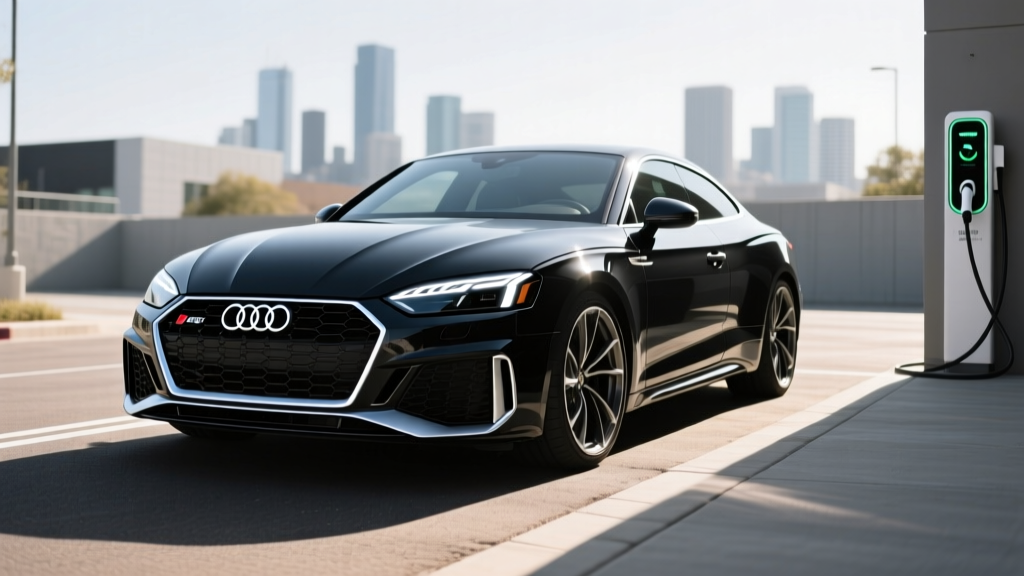
Audi's performance hybrid strategy crystallizes with the 2026 Audi RS 5 PHEV (marketed in Europe as the RS 5 e-hybrid). It threads a needle few automakers attempt: pairing a twin-turbo V6 with an electric motor to deliver genuine RS-car acceleration while offering a short electric-only commute mode. For buyers who want sports-sedan thrirts without fully committing to a battery-electric vehicle, this plug-in hybrid (PHEV) is worth a close look — but its trade-offs are real.
Quick Verdict: What the RS 5 PHEV Gets Right (and Wrong)
Buy it if: You want a 463-hp luxury sportback with real RS credentials, a short electric commute mode, and the ability to road-trip without charging stops.
Skip it if: Your priority is maximum fuel savings — the electric-only range is modest, and once the battery depletes, the V6 drinks fuel like any performance car.
Unlike a conventional hybrid (HEV) such as the Toyota Prius, which recharges its small battery through regenerative braking and the engine, the RS 5 PHEV carries a larger battery you can plug in to charge. That distinction matters enormously for daily driving: plug in overnight, and your commute can be zero-tailpipe-emission. Forget to plug in, and you're driving a heavy, thirsty V6.
Powertrain: V6 Meets Electric Motor
| Specification | 2026 Audi RS 5 PHEV |
|---|---|
| Engine | 2.9L twin-turbo V6 |
| Electric Motor | Integrated in transmission (P2 layout) |
| Combined Horsepower | 463 hp |
| Combined Torque | 516 lb-ft |
| Transmission | 8-speed automatic (tiptronic) |
| Drivetrain | quattro AWD |
| 0–60 mph | ~4.3 seconds (est.) |
| Battery (Gross / Usable) | ~25.9 kWh / ~20.7 kWh |
| Battery Chemistry | NMC (nickel manganese cobalt) |
| EPA Electric-Only Range | ~25 miles (est.) |
| EPA MPGe (EV mode) | ~54 MPGe (est.) |
| EPA MPG (hybrid mode) | ~24 city / 30 hwy / 26 combined (est.) |
| Total Combined Range | ~380 miles (est.) |
| Max AC Charging (Level 2) | 7.4 kW |
| DC Fast Charging | Not available |
| Level 2 Charge Time (0–100%) | ~3 hours |
| Base MSRP | ~$82,000 (est.) |
| Federal Tax Credit (§30D) | Up to $3,750 (est., subject to sourcing rules) |
| Battery Warranty | 8 years / 100,000 miles |
The P2 hybrid architecture places the electric motor between the engine and transmission, allowing the car to drive on electricity alone at low speeds, assist the engine during hard acceleration, or regenerate energy during braking. The 2.9L V6 — co-developed with Porsche — produces roughly 325 hp on its own, with the electric motor filling in approximately 138 hp of additional output.
This is not a range-extender setup. The engine and motor can work together or independently, and the system manages the blend based on drive mode selection. In EV mode, the RS 5 PHEV can reach highway speeds (up to ~84 mph) on electricity alone, though doing so will deplete the battery faster than the EPA estimate suggests.
Electric-Only Range and Charging: The Daily Commute Test
EPA Electric-Only Range: ~25 miles (estimated)
Real-World Expectation: ~18–22 miles in mixed driving; ~14–17 miles in cold weather or sustained highway use above 65 mph.
The ~25-mile electric range is competitive with other performance PHEVs like the BMW M340e but falls short of efficiency-oriented plug-in hybrids such as the Toyota RAV4 Prime (42 miles). For a commute under 20 miles round-trip with home charging, the RS 5 PHEV can operate almost entirely on electricity on weekdays.
| Charging Level | Power (kW) | Time (0–100%) | Notes |
|---|---|---|---|
| Level 1 (120V household) | ~1.4 kW | ~15 hours | Emergency/trickle only |
| Level 2 (240V, 32A) | 7.4 kW | ~3 hours | Standard home/public AC |
| DC Fast Charging | N/A | N/A | Not supported on RS 5 PHEV |
The lack of DC fast charging is typical for PHEVs in this segment — the battery is simply too small to justify the hardware cost and weight. A Level 2 home charger (240V, 32-amp circuit) will replenish the battery from empty to full in approximately three hours, meaning an overnight charge is more than sufficient.
One practical note: preconditioning the battery while plugged in — a feature accessible through the myAudi app — warms the battery pack in cold weather, preserving electric range and improving regenerative braking efficiency. Use it.
Fuel Economy: What the EPA Numbers Mean in Practice
| Mode | City | Highway | Combined |
|---|---|---|---|
| EV Mode (MPGe) | ~58 MPGe | ~50 MPGe | ~54 MPGe |
| Hybrid Mode (MPG) | ~24 MPG | ~30 MPG | ~26 MPG |
PHEV fuel economy is uniquely dependent on driver behavior. If you charge nightly and commute 20 miles, you may visit a gas station once a month. If you never plug in, the RS 5 PHEV returns roughly 26 MPG combined — respectable for a 463-hp all-wheel-drive sportback, but not dramatically better than the gas-only Audi S5.
Real-world MPG in hybrid mode tends to track closely with EPA estimates on the highway but can exceed them in stop-and-go city driving, where regenerative braking recaptures more energy. Expect 27–29 MPG in urban traffic once the battery is depleted, and 28–31 MPG on flat highway cruises at 65–70 mph.
HEV vs. PHEV vs. EV: Which Powertrain Fits You?
Conventional Hybrid (HEV): No plug. Small battery recharged by engine and regen braking. Best for drivers who want better MPG without changing habits. Example: Toyota Camry Hybrid (52 MPG combined). Cannot drive on electricity alone for meaningful distances.
Plug-in Hybrid (PHEV): Plugs in. Larger battery enables 20–40 miles of electric-only driving. Best for drivers with home/workplace charging and short commutes who also take road trips. Example: Audi RS 5 PHEV (~25 mi EV range).
Battery Electric (BEV): Plugs in. No engine. 250–400+ miles of range. Best for drivers with reliable charging access who want zero tailpipe emissions and lowest operating cost. Example: Audi e-tron GT (238 mi EPA range).
The RS 5 PHEV occupies a narrow lane: you want RS-level performance, you have access to Level 2 charging at home, your weekday driving is under 30 miles, and you road-trip frequently enough that a pure EV's charging logistics feel like a burden. If any of those conditions don't apply, reconsider.
Pricing, Tax Credits, and Total Cost
The 2026 Audi RS 5 PHEV is expected to start around $82,000 before destination charges and options. Well-equipped examples with the RS Design package, carbon-fiber trim, and adaptive suspension will push past $95,000.
Federal §30D Tax Credit Eligibility (2026 rules):
- Credit amount: Up to $3,750 (partial credit — dependent on critical-mineral and battery-component sourcing thresholds per IRS guidelines)
- MSRP cap: Sedans must be under $55,000 — the RS 5 PHEV exceeds this cap and does NOT qualify for the new-vehicle §30D credit
- Income cap: $150K single / $300K joint filers (moot given MSRP cap)
- Point-of-sale transfer: Available for qualifying vehicles — but again, MSRP cap disqualifies the RS 5 PHEV
This is the cold reality for luxury PHEVs: the MSRP cap effectively excludes the RS 5 PHEV from the federal new-vehicle credit. Some state-level incentives (California's CVRP, Colorado's state credit) may partially apply — check your state's energy office for current programs. Leasing may unlock the commercial clean vehicle credit (§45W) passed through as a lease discount, depending on the lessor's structure.
On the ownership-cost side, expect higher insurance premiums than the gas-only S5 (performance PHEVs carry expensive battery and powertrain repair costs), but lower fuel spend if you charge regularly. Audi includes complimentary scheduled maintenance for the first year or 10,000 miles.
Reliability, Battery Warranty, and Replacement Cost
High-Voltage Battery Warranty: 8 years / 100,000 miles (whichever comes first), covering defects and capacity loss below 70% of original capacity.
Powertrain Warranty: 4 years / 50,000 miles
Estimated Battery Replacement Cost (out of warranty): $12,000–$18,000 (parts and labor, based on comparable Audi/VW Group PHEV packs)
Audi's 8-year/100,000-mile hybrid battery warranty meets the industry standard and aligns with EPA-mandated emissions-component coverage. The 70% capacity-retention threshold means Audi will repair or replace the battery if it degrades below that level within the warranty period. In practice, NMC PHEV batteries managed by sophisticated thermal systems (the RS 5 uses liquid cooling) typically retain 85–90% capacity after 8 years of normal use, based on data from earlier VW Group PHEVs.
Reliability for the RS 5 PHEV specifically is unproven — it's a new powertrain configuration for this model. The 2.9L V6 has a solid track record in the S4/S5 and RS 5 (gas), but the added complexity of the P2 electric motor, high-voltage wiring, and dual cooling circuits introduces more potential failure points. IIHS and NHTSA crash-test ratings should be monitored as they become available.
For comparison, conventional hybrids from Toyota and Honda have demonstrated exceptional long-term reliability, with original batteries lasting 150,000+ miles routinely. European PHEVs have a shorter track record, and out-of-warranty battery replacement costs remain a legitimate concern for second-owners.
Driving Dynamics: Does the Hybrid System Compromise the RS?
The additional ~300 lbs of battery and electric motor hardware raises the curb weight to approximately 4,400 lbs — noticeable in tight corners compared to the gas RS 5 but effectively masked by the standard adaptive dampers and torque-vectoring rear differential. The instant torque from the electric motor fills the gap before the turbos spool, making the RS 5 PHEV feel more responsive from a standstill than its gas counterpart.
Drive modes include EV (electric-only), Hybrid (automatic blending), and RS (maximum combined output with aggressive throttle mapping and shift points). In RS mode, the system prioritizes performance over efficiency, and the battery acts as a power buffer rather than a range extender. Expect 0–60 mph in approximately 4.3 seconds — quick, but not supercar-quick, and a few tenths behind the lighter gas-only RS 5.
Regenerative braking is adjustable via steering-wheel paddles, with three levels of deceleration. Maximum regen provides moderate one-pedal-driving capability in EV mode around town, though it won't bring the car to a complete stop — you'll still need the friction brakes at the last few mph.
Pros, Cons, and the Competition
Pros
- 463 hp with V6 soundtrack and electric torque fill
- ~25-mile EV range covers most weekday commutes
- No range anxiety on road trips — gas engine takes over seamlessly
- quattro AWD and adaptive suspension standard
- Premium RS interior with Virtual Cockit Plus
Cons
- Exceeds $55K MSRP cap — no federal §30D tax credit
- No DC fast charging (Level 2 only)
- ~4,400-lb curb weight hurts agility vs. gas RS 5
- Electric range drops to ~15 miles in cold weather
- Out-of-warranty battery replacement cost ($12K–$18K)
The RS 5 PHEV's closest rival is the BMW M340e xDrive, which offers a similar inline-six PHEV layout with slightly more electric range (~30 miles estimated) and a lower starting price. The Mercedes-AMG C 63 S E Performance takes a radically different approach — a four-cylinder engine with a massive electric motor producing 671 hp — but sacrifices the engine character many buyers want. Within Audi's own lineup, the e-tron GT offers pure-electric performance with 238 miles of range, but no road-trip flexibility without charging planning.
Frequently Asked Questions
How many MPG does the 2026 Audi RS 5 PHEV get?
An estimated 54 MPGe combined in EV mode and approximately 26 MPG combined (24 city / 30 highway) in hybrid mode after the battery is depleted. Real-world results vary significantly based on how often you plug in to charge.
How far can the RS 5 PHEV go on electric only?
The EPA-estimated electric-only range is approximately 25 miles. In real-world conditions — especially cold weather or sustained highway speeds — expect 18–22 miles. This covers most daily commutes if you charge at home overnight.
Does the Audi RS 5 PHEV qualify for a federal tax credit?
No. Under current IRS §30D rules, the $55,000 MSRP cap for sedans disqualifies the RS 5 PHEV from the new clean vehicle credit. State incentives may partially apply. Leasing may unlock a pass-through commercial credit depending on the lessor.
Is the RS 5 PHEV reliable, and what does a battery replacement cost?
Long-term reliability data is not yet available for this specific powertrain. The 2.9L V6 has a solid track record, but the hybrid system adds complexity. The battery is warrantied for 8 years/100,000 miles. Out-of-warranty replacement is estimated at $12,000–$18,000.
Should I buy the RS 5 PHEV or a full EV like the e-tron GT?
Choose the RS 5 PHEV if you need road-trip flexibility without charging stops, have a short commute you can cover on electricity, and value the V6 engine character. Choose the e-tron GT (or another BEV) if you have reliable home and workplace charging, want lower operating costs, and are comfortable planning DC fast-charging stops on long trips.
Can I DC fast charge the RS 5 PHEV?
No. Like most PHEVs, the RS 5 supports AC charging only — up to 7.4 kW on Level 2, taking about 3 hours for a full charge. The battery is too small to justify DC fast-charging hardware.
What's the difference between the RS 5 PHEV and a regular hybrid?
A conventional hybrid (HEV) like the Toyota Camry Hybrid cannot plug in and offers only brief electric assist. The RS 5 PHEV plugs in, carries a much larger battery (~25.9 kWh vs. ~1–2 kWh for an HEV), and can drive 25 miles on electricity alone before the engine engages.