Quick Verdict: The Audi Q5 TFSI e PHEV at a Glance
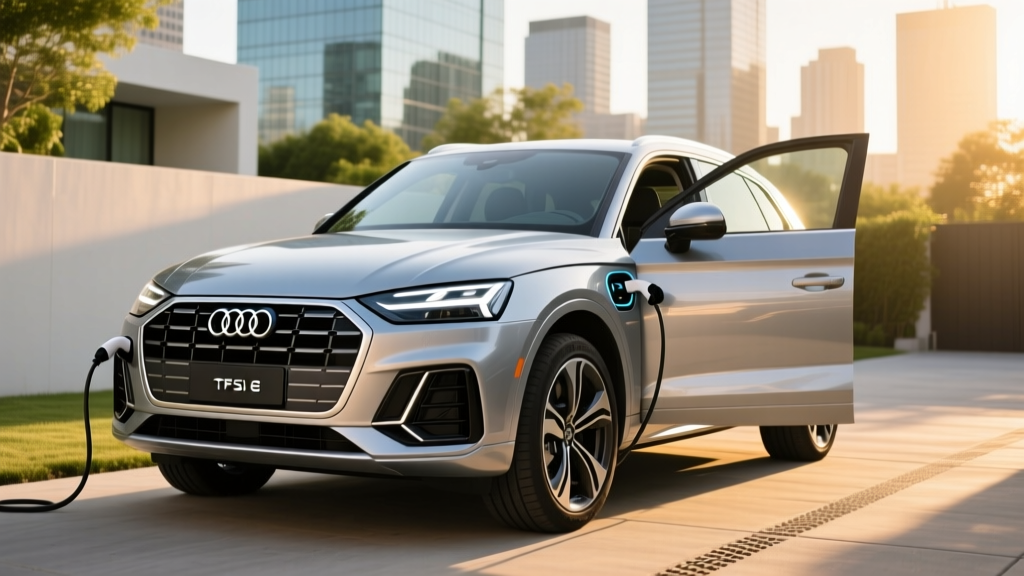
The 2026 Audi Q5 TFSI e PHEV occupies a narrow but compelling lane: it's a luxury compact SUV that can handle short commutes on electricity alone while retaining a turbocharged gas engine for road trips. With 23 miles of EPA-rated electric-only range and a combined system output of 362 horsepower, it's designed for buyers who want EV-like daily driving without committing to a full battery-electric vehicle.
But the Q5 TFSI e isn't for everyone. Its relatively small 17.9 kWh battery means most drivers will burn gas on longer commutes, and its $58,000+ starting price puts it in direct competition with some of the best EVs on the market. Here's everything you need to know before deciding.
| Spec | 2026 Audi Q5 55 TFSI e |
|---|---|
| Powertrain | 2.0L turbo I4 + electric motor (PHEV) |
| Combined Output | 362 hp / 369 lb-ft torque |
| Battery (usable) | 14.1 kWh (17.9 kWh gross), lithium-ion |
| Electric-Only Range (EPA) | 23 miles |
| Total Range (gas + electric) | ~440 miles |
| EPA Combined MPGe | 61 MPGe (electric + gas) |
| EPA Combined MPG (gas only) | 26 MPG |
| 0-60 mph | 5.0 seconds |
| Level 2 Charge Time (0-100%) | ~2.5 hours at 7.2 kW |
| DC Fast Charging | Not available |
| Drivetrain | quattro AWD |
| Base MSRP | $58,695 (Premium trim) |
| Federal Tax Credit (§30D) | Up to $3,750 (see eligibility below) |
| Battery Warranty | 8 years / 100,000 miles |
HEV vs PHEV: What the Audi Q5 TFSI e Actually Is
Before diving into specs, it's critical to distinguish between a conventional hybrid (HEV) and a plug-in hybrid (PHEV), because the Audi Q5 TFSI e is strictly a PHEV.
| Feature | Conventional Hybrid (HEV) | Plug-In Hybrid (PHEV) |
|---|---|---|
| Battery Size | 1-2 kWh | 10-30+ kWh |
| Electric-Only Range | 0-2 miles (assist only) | 20-50+ miles |
| Plug-In Charging | No — charges via regen & engine | Yes — Level 1/Level 2 |
| Gas Engine | Yes (primary power) | Yes (backup + highway) |
| Tax Credit Eligibility | No federal credit | Potentially up to $7,500 |
| Example | Toyota RAV4 Hybrid | Audi Q5 TFSI e |
The Q5 TFSI e has a 17.9 kWh battery pack that you plug in overnight. On a full charge, it can drive up to 23 miles using only its electric motor — enough for many short commutes and errands. Once the battery depletes, the 2.0-liter turbocharged four-cylinder engine takes over seamlessly, and the vehicle operates like a conventional hybrid, using regenerative braking and engine power to recharge the battery incrementally.
If you never plug it in, the Q5 TFSI e still functions — it just becomes a heavy, less efficient hybrid getting around 26 MPG combined. Plugging in is where the value lies.
Electric-Only Range and Real-World Efficiency
The EPA rates the 2026 Audi Q5 55 TFSI e at 23 miles of all-electric range. That figure assumes moderate temperatures, mixed driving, and a fully charged battery.
Real-World Range Expectations:
- EPA Sticker: 23 miles electric-only
- Real-world mixed driving (55-70°F): 19-22 miles
- Highway-only at 70+ mph: 15-18 miles (aerodynamic drag drains battery faster)
- Cold weather (below 32°F): 13-17 miles (cabin heating + battery resistance)
The Q5 TFSI e uses a resistive heater rather than a heat pump, which significantly impacts winter electric range. Plan for roughly 30% range loss in freezing conditions.
Once the battery is depleted, the EPA rates the Q5 TFSI e at 26 MPG combined on gasoline alone (25 city / 27 highway). In real-world testing, owners who charge nightly and drive less than 20 miles daily report using almost no gasoline for weeks. Drivers with 40+ mile commutes, however, will burn gas regularly and should expect 24-27 MPG on longer trips — respectable for a 4,600-pound luxury SUV, but not exceptional.
EPA Fuel Economy Breakdown
| Mode | City | Highway | Combined |
|---|---|---|---|
| Electric + Gas (MPGe) | — | — | 61 MPGe |
| Gas Only (MPG) | 25 | 27 | 26 |
| Electric-Only Range | 23 miles (EPA) | ||
Powertrain and Performance
The 2026 Q5 55 TFSI e pairs a 2.0-liter turbocharged inline-four (producing 261 hp on its own) with a 141-hp electric motor integrated into the seven-speed S tronic dual-clutch transmission. Combined system output is 362 horsepower and 369 lb-ft of torque, routed through Audi's quattro all-wheel-drive system.
The result is a 0-60 mph time of 5.0 seconds — genuinely quick for a compact luxury SUV and noticeably faster than the gas-only Q5 45 TFSI (which runs 5.7 seconds). The electric motor fills in torque instantly at low speeds, eliminating the turbo lag you'd feel in the conventional model.
Three driving modes manage the powertrain:
- EV Mode: Pure electric driving up to ~84 mph (battery permitting)
- Hybrid Mode: Automatic blending of gas and electric for maximum efficiency
- Battery Hold/Charge: Preserves battery for later use or uses the engine to recharge while driving (useful before entering city centers or for destination charging)
Charging: Level 2 Only, No DC Fast Charging
The Q5 TFSI e accepts up to 7.2 kW on Level 2 AC charging, using a standard J1772 connector (or NACS with an adapter on newer models). A full 0-100% charge takes approximately 2.5 hours on a 240V Level 2 home charger.
On a standard 120V Level 1 household outlet, expect roughly 8-10 hours for a full charge — adequate for overnight replenishment if you drive less than 20 miles daily.
| Charging Level | Power | Time (0-100%) | Miles Added/Hour |
|---|---|---|---|
| Level 1 (120V) | ~1.4 kW | ~8-10 hours | ~2-3 miles |
| Level 2 (240V, 32A) | 7.2 kW | ~2.5 hours | ~9-10 miles |
| DC Fast Charge | N/A | N/A | Not supported |
Critical limitation: The Q5 TFSI e does not support DC fast charging. You cannot use Electrify America, Tesla Supercharger (NACS DC), or any public fast-charging network to replenish the battery quickly. This is typical for PHEVs with smaller batteries, but it means road-trip charging is impractical — you'll simply drive on gas.
For home Level 2 installation, budget $800-$2,000 for a quality charger (ChargePoint Home Flex, Emporia Level 2, or similar) plus $500-$2,500 for electrician installation, depending on panel capacity and run length. A 200-amp electrical panel is usually sufficient; older homes may need a $2,000-$4,000 panel upgrade.
Pricing, Trims, and Federal Tax Credit Eligibility
The 2026 Audi Q5 55 TFSI e starts at $58,695 for the Premium trim, rising to approximately $63,495 for Premium Plus and $68,000+ for Prestige. Destination charges add $1,195.
Federal Tax Credit (§30D): Does the Q5 TFSI e Qualify?
Under current IRS rules for 2026, the Audi Q5 TFSI e may qualify for up to $3,750 in federal tax credits — not the full $7,500. The reduction reflects partial compliance with critical-mineral and battery-component sourcing requirements under the Inflation Reduction Act.
§30D Credit Requirements (2026):
- MSRP must not exceed $80,000 for SUVs (Q5 TFSI e qualifies)
- Buyer AGI must not exceed $150,000 (single) / $300,000 (joint) / $225,000 (head of household)
- Battery components must meet domestic-content thresholds (partial compliance = $3,750)
- Critical minerals must meet sourcing thresholds (partial compliance = $3,750)
- Credit can be transferred to dealer at point of sale as a purchase-price reduction
- Vehicle must be assembled in North America (Q5 is built in San José Chiapa, Mexico — qualifies)
Source: IRS §30D Clean Vehicle Credit. Eligibility varies by buyer income and vehicle build date. Consult a tax professional before purchasing.
After a potential $3,750 credit, the effective base price drops to approximately $54,945 — still premium, but more competitive against fully electric alternatives like the BMW iX or Tesla Model Y Performance.
Battery Warranty, Reliability, and Replacement Cost
Audi covers the Q5 TFSI e high-voltage battery for 8 years or 100,000 miles (whichever comes first), warranting it against defects and excessive capacity loss below 70% of original capacity. This aligns with the federal mandate for PHEV/EV battery warranties and matches competitors like BMW and Volvo.
Audi Q5 TFSI e Battery Warranty:
- Duration: 8 years / 100,000 miles
- Capacity threshold: 70% of original (12.5 kWh usable minimum)
- Coverage: Defects, cell failures, excessive degradation
- Out-of-warranty replacement cost: $8,000-$12,000 (estimated, based on comparable PHEV packs)
PHEV batteries experience less stress than full-EV batteries because they operate in a narrower state-of-charge window (typically 15-85% to prolong lifespan). Real-world data from earlier Audi PHEV models (2019-2023 Q5 TFSI e) suggests minimal degradation — most owners report 90%+ battery health after 5 years of daily charging. The smaller 17.9 kWh pack also means replacement costs are far lower than a 75-100 kWh EV battery, which can run $15,000-$25,000.
Audi's overall vehicle reliability ratings from J.D. Power and Consumer Reports place the brand near the industry average. The Q5 specifically scores well for build quality and drivetrain durability, though infotainment software glitches remain a common complaint across the VW Group platform.
Who Should Buy the Q5 TFSI e — And Who Shouldn't
The Q5 TFSI e makes sense for a specific buyer profile. Here's a decision framework:
Choose the Audi Q5 TFSI e PHEV if:
- Your daily round-trip commute is under 20 miles and you can charge at home nightly
- You want a luxury compact SUV with genuine performance (5.0s 0-60)
- You take 3+ road trips per year and don't want to plan around public charging infrastructure
- You live in a cold climate where EV range loss is a concern
- You want to reduce gas consumption without committing to a full EV
Choose a full EV (like the BMW iX, Tesla Model Y, or Audi Q4 e-tron) if:
- Your commute exceeds 30 miles daily (you'll burn gas constantly in the Q5 TFSI e)
- You have reliable home charging AND access to DC fast charging for road trips
- You want maximum fuel savings and zero tailpipe emissions
- You're eligible for the full $7,500 federal credit on a qualifying EV
Choose a conventional hybrid (like the Lexus NX 350h) if:
- You cannot install a home charger (apartment, street parking)
- You want hybrid efficiency without ever plugging in
- Your budget is below $50,000
Pros
- 362 hp with instant electric torque — genuinely quick
- 23 miles electric covers most short commutes
- No range anxiety — gas engine for road trips
- Premium interior, quiet cabin, strong build quality
- quattro AWD standard for all-weather confidence
- Eligible for partial $3,750 federal tax credit
Cons
- No DC fast charging — impractical for road-trip recharging
- 23-mile electric range is short vs. rivals (RAV4 Prime: 42 mi)
- $58,695 starting price is steep for the electric range offered
- No heat pump — significant winter range loss
- Cargo space reduced vs. gas Q5 (battery under floor)
- Only $3,750 tax credit vs. $7,500 for qualifying EVs
Frequently Asked Questions
How many MPG does the Audi Q5 TFSI e get?
The EPA rates the 2026 Q5 55 TFSI e at 26 MPG combined (25 city / 27 highway) when operating on gasoline after the battery is depleted. In combined electric-and-gas driving, it achieves 61 MPGe. Real-world highway driving at 75+ mph typically yields 24-26 MPG on gas. In city driving with a charged battery, many owners report using little to no gasoline for weeks.
How far can the Audi Q5 TFSI e go on electric only?
The EPA rates the Q5 TFSI e at 23 miles of all-electric range. In real-world conditions, expect 19-22 miles in moderate weather, 15-18 miles at sustained highway speeds, and 13-17 miles in freezing temperatures due to cabin heating demands and battery resistance. The electric motor can propel the vehicle up to approximately 84 mph before the gas engine engages.
Does the Audi Q5 TFSI e qualify for a tax credit?
Under 2026 IRS §30D rules, the Q5 TFSI e qualifies for up to $3,750 in federal tax credits (not the full $7,500) due to partial compliance with battery-sourcing requirements. Buyer income must not exceed $150,000 (single) or $300,000 (joint filing). The credit can be applied as a point-of-sale reduction through a participating dealer. Always verify eligibility at irs.gov and consult a tax professional.
Is the Audi Q5 TFSI e reliable, and what does battery replacement cost?
The Q5 TFSI e's powertrain has proven reliable in early model years (2019-2025), with PHEV batteries showing minimal degradation due to conservative state-of-charge management. Audi's battery warranty covers 8 years/100,000 miles against capacity loss below 70%. Out-of-warranty replacement is estimated at $8,000-$12,000 — significantly less than a full-EV battery. Common issues reported are infotainment software glitches rather than powertrain failures.
Can the Audi Q5 TFSI e use DC fast chargers?
No. The Q5 TFSI e only supports Level 1 (120V) and Level 2 (240V) AC charging, with a maximum charge rate of 7.2 kW. It cannot connect to DC fast-charging networks like Electrify America, EVgo, or Tesla Superchargers. A full Level 2 charge takes approximately 2.5 hours. This is standard for PHEVs with smaller battery packs.
Hybrid vs PHEV vs EV — which should I choose?
A conventional hybrid (HEV) like the Lexus NX 350h requires no plug-in charging and delivers 35-40 MPG consistently — ideal if you can't charge at home. A PHEV like the Q5 TFSI e gives you 20-25 miles of electric driving for short commutes plus a gas engine for road trips — ideal if you can charge nightly but travel long distances regularly. A full EV (like the Audi Q4 e-tron or Tesla Model Y) offers 250-320 miles of range, zero tailpipe emissions, and the lowest per-mile fuel cost — ideal if you have home charging access and your road trips align with DC fast-charging infrastructure. Your choice depends on daily mileage, charging access, and trip patterns.