Audi's Hybrid SUV Strategy for 2026
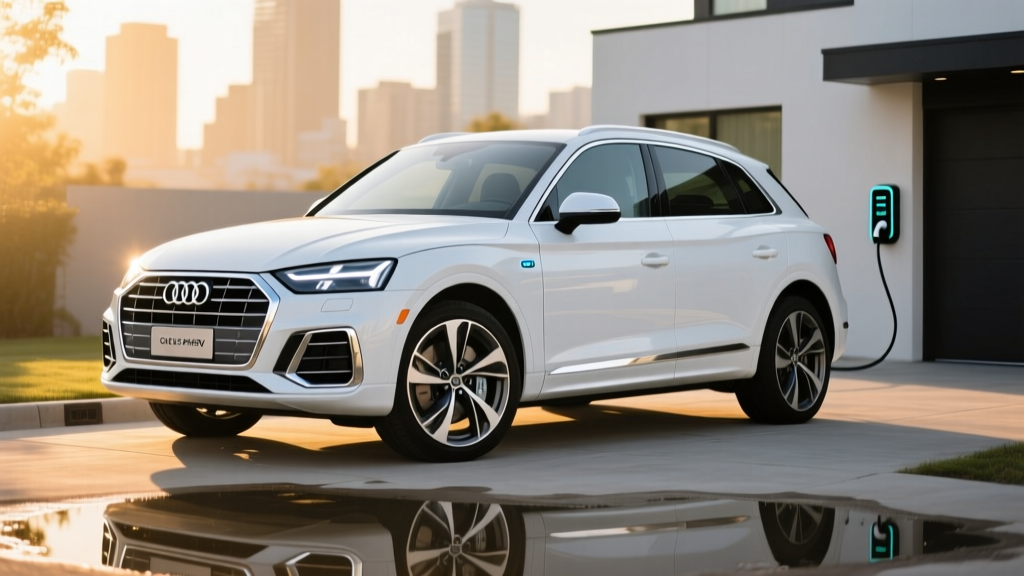
Audi's approach to electrified SUVs in the US market centers on one core offering: the Audi Q5 TFSI e, a plug-in hybrid (PHEV) that pairs a turbocharged gasoline engine with an electric motor and a modest battery pack. For 2026, Audi does not sell a conventional hybrid (HEV) SUV in the United States — every electrified Audi SUV is either a PHEV or a full battery-electric vehicle (BEV) like the Q4 e-tron or Q8 e-tron.
This matters because the distinction between a conventional hybrid and a plug-in hybrid determines how you fuel the vehicle, what you pay at the pump, and whether you qualify for federal tax incentives. If you've been searching for Audi SUV hybrid models, the Q5 TFSI e is the model to evaluate.
A conventional hybrid (HEV) like the Toyota RAV4 Hybrid uses regenerative braking and its gas engine to charge a small battery. You never plug it in. It delivers improved MPG but zero electric-only driving.
A plug-in hybrid (PHEV) like the Audi Q5 TFSI e has a larger battery (measured in kWh) that you charge by plugging in — at home or at a public station. It can drive on electricity alone for a limited range before the gas engine engages.
2026 Audi Q5 TFSI e: Powertrain and Performance Specs
The 2026 Audi Q5 55 TFSI e quattro uses a 2.0-liter turbocharged four-cylinder engine paired with an electric motor integrated into the seven-speed S tronic dual-clutch transmission. Combined output is 362 horsepower and 369 lb-ft of torque, routed through Audi's quattro all-wheel-drive system.
| Specification | Value |
|---|---|
| Powertrain | 2.0L turbo I4 + electric motor |
| Combined Horsepower | 362 hp |
| Combined Torque | 369 lb-ft |
| Battery Capacity (gross / usable) | 17.9 kWh / ~14.7 kWh |
| Battery Chemistry | NMC (nickel manganese cobalt) |
| Transmission | 7-speed S tronic dual-clutch |
| Drivetrain | quattro AWD |
| 0–60 mph | 5.0 seconds |
| EPA Electric-Only Range | 23 miles |
| Total Combined Range (est.) | ~400 miles |
| EPA MPGe (electric + gas) | 61 MPGe |
| EPA MPG (gas only, combined) | 26 MPG |
| Max AC Charge Rate | 7.4 kW (Level 2) |
| DC Fast Charging | Not available |
| Charge Time (0–100%, Level 2) | ~2.5 hours |
| Charge Time (Level 1, 120V) | ~8 hours |
Source: EPA Fuel Economy — Audi Q5 PHEV
Fuel Economy Breakdown: Real-World MPG vs. EPA Sticker
The EPA rates the 2026 Q5 55 TFSI e at 26 MPG combined when operating as a hybrid (battery depleted). The city/highway split is approximately 25 city / 27 highway. When the battery is charged, the combined rating jumps to 61 MPGe — a metric that converts electricity consumption into a gasoline-equivalent figure.
| Driving Mode | City | Highway | Combined |
|---|---|---|---|
| Charge-depleted (gas hybrid) | 25 MPG | 27 MPG | 26 MPG |
| Charge-sustaining (EPA MPGe) | 61 MPGe (combined) | ||
| Electric-only | ~2.9 kWh/mile (71 MPGe city) | ||
Plug-in hybrids reward drivers who charge regularly. If your daily commute is under 23 miles and you charge nightly, you may burn almost no gasoline for weeks. On long highway road trips with a depleted battery, expect the Q5 PHEV to deliver closer to 24–25 MPG — slightly below the EPA highway sticker — because the vehicle carries the dead weight of a battery it isn't using. Owners who rarely plug in typically report 22–24 MPG, which is only marginally better than the gas-only Q5 45 TFSI (rated at 25 MPG combined).
Electric-Only Range and Charging Logistics
The Q5 TFSI e delivers 23 miles of EPA-rated electric-only range. In real-world conditions — moderate temperatures, mixed city driving — expect 18–22 miles. In cold weather (below 35°F), that figure can drop to 14–17 miles because the battery is less efficient and cabin heating draws additional energy.
For many commuters, 23 miles covers a round-trip errand or a short work commute. For longer commutes, the gasoline engine seamlessly takes over once the battery is depleted.
Charging the Q5 PHEV
The Q5 TFSI e accepts a maximum of 7.4 kW on Level 2 AC charging (240V). It does not support DC fast charging — a common limitation among PHEVs due to their smaller battery packs and cost packaging. Here's what charging looks like in practice:
| Charging Level | Voltage | Power (kW) | 0–100% Time | Use Case |
|---|---|---|---|---|
| Level 1 | 120V | ~1.4 kW | ~8 hours | Overnight at standard outlet |
| Level 2 | 240V | 7.4 kW | ~2.5 hours | Home wallbox or public AC |
| DC Fast Charge | — | — | — | Not supported |
A full Level 2 charge in 2.5 hours means you can top up during the workday or between errands if you have access to a Level 2 charger. Most PHEV owners install a Level 2 home charger for overnight replenishment, which costs $800–$2,000 installed depending on your electrical panel.
Pricing, Trims, and Federal Tax Credit Eligibility
The 2026 Audi Q5 55 TFSI e starts at approximately $57,995 MSRP (Premium trim), with the Premium Plus and Prestige trims climbing to $62,495 and $67,995 respectively. Destination charges add roughly $1,195.
| Trim | MSRP | Key Additions |
|---|---|---|
| Premium | $57,995 | Leather, 10.1" MMI display, power liftgate |
| Premium Plus | $62,495 | Virtual cockpit, 360° cameras, Bang & Olufsen audio |
| Prestige | $67,995 | Head-up display, matrix LED headlights, adaptive cruise |
Under IRS §30D Clean Vehicle Credit, qualifying new PHEVs can receive up to $7,500 — but eligibility depends on three requirements that change frequently:
- MSRP cap: SUVs must be at or below $80,000 MSRP. All Q5 TFSI e trims qualify.
- Buyer income cap: Modified AGI must not exceed $150,000 (single) / $300,000 (joint).
- Battery sourcing: Critical minerals and battery components must meet phased-in domestic-content thresholds. As of 2026, the sourcing requirements are strict, and many PHEVs — including certain Audi configurations — may qualify for only $3,750 (half credit) or none at all depending on supply-chain compliance.
The credit can now be transferred at the point of sale, reducing your purchase price directly rather than waiting for tax filing. Always verify current eligibility with your dealer and a tax professional before purchase, as battery-sourcing compliance is model-specific and can change mid-year.
Most US states do not offer additional hybrid-specific incentives, though a handful (California, Colorado, Massachusetts, among others) have state-level rebates or HOV-lane access for PHEVs. Check your state's energy office for current programs.
Battery Warranty, Reliability, and Long-Term Costs
The Q5 TFSI e's high-voltage battery is covered by Audi's hybrid component warranty: 8 years or 100,000 miles (whichever comes first), with a capacity-retention threshold typically set at 70% of original capacity. If the battery degrades below that threshold within the warranty period, Audi will repair or replace it at no cost.
If a battery replacement is needed after the warranty expires, expect a cost in the range of $8,000–$12,000 for a PHEV battery pack of this size (17.9 kWh), including parts and labor. However, PHEV batteries are smaller and experience less thermal stress than full-EV batteries, and real-world data from similar VAG PHEV platforms shows minimal degradation (5–10%) over the first 8–10 years of typical use. Complete battery failure within the first 150,000 miles is rare.
The 2.0L TFSI engine in the Q5 is well-established, and the S tronic transmission has been in Audi's lineup for over a decade. Common maintenance items include DSG fluid service (~every 40,000 miles) and standard brake wear — though regenerative braking extends pad life significantly compared to the gas-only Q5. IIHS and NHTSA safety ratings for the Q5 platform remain strong, with the model earning top marks in crashworthiness.
Who Should Buy the Audi Q5 PHEV?
- 362 hp — significantly quicker than the gas Q5 (5.0s 0–60)
- 23-mile electric range covers most daily errands
- Premium cabin with standard quattro AWD
- No range anxiety — gas engine covers long trips
- Eligible for partial or full §30D credit (verify sourcing)
- 23-mile EV range is short vs. rivals (RAV4 Prime: 42 mi)
- No DC fast charging
- Heavy — fuel economy mediocre when battery is depleted
- $58K+ starting price is steep for a compact luxury SUV
- Cargo space slightly reduced vs. gas Q5 (battery packaging)
- Choose the Q5 TFSI e (PHEV) if: You want a luxury compact SUV, have home charging access, commute under 25 miles daily, and regularly take road trips where you don't want to plan around charging stations.
- Choose a full EV (Audi Q4 e-tron, 265-mile range) if: You have reliable home charging, rarely drive over 200 miles without stopping, and want zero tailpipe emissions with lower per-mile fuel cost (~$0.04–$0.06/mi vs. $0.14–$0.18/mi for gas).
- Choose the gas Q5 45 TFSI if: You cannot charge at home, drive mostly highway miles, and want a lower purchase price (~$45,000 MSRP) without the complexity of a hybrid powertrain.
Frequently Asked Questions
How many MPG does the Audi Q5 hybrid get?
The 2026 Audi Q5 55 TFSI e gets 26 MPG combined (25 city / 27 highway) when operating on gasoline with a depleted battery. When factoring in electric-only driving, the EPA rates it at 61 MPGe combined. Real-world results depend heavily on how often you charge — owners who plug in daily may use very little gasoline, while those who rarely charge typically see 22–24 MPG.
How far can the Audi Q5 PHEV go on electric only?
The EPA rates the Q5 TFSI e at 23 miles of electric-only range. In real-world driving, expect 18–22 miles in mild weather and as low as 14–17 miles in cold conditions (below 35°F). This covers most short commutes and errands but falls short of PHEV competitors like the Toyota RAV4 Prime (42 miles) or the Jeep Wrangler 4xe (22 miles, in a very different vehicle class).
Does the Audi Q5 hybrid qualify for a tax credit?
The Q5 TFSI e may qualify for up to $7,500 under the federal §30D Clean Vehicle Credit, but eligibility depends on your income (under $300K joint / $150K single), the vehicle's MSRP (under $80K — all trims qualify), and battery-sourcing compliance. As of 2026, critical-mineral and battery-component sourcing rules are stringent, and the Q5 PHEV may qualify for only $3,750 or potentially $0 depending on the specific battery batch. Verify with your dealer and review the IRS official guidance before purchase.
Is the Audi Q5 PHEV reliable, and what does battery replacement cost?
The Q5 PHEV powertrain uses well-established Audi/VW Group components. The 2.0L TFSI engine and S tronic transmission have years of field data behind them. The high-voltage battery is warrantied for 8 years / 100,000 miles at 70% capacity retention. Out-of-warranty battery replacement costs approximately $8,000–$12,000, but PHEV batteries of this size rarely require full replacement within the first 150,000 miles. Expect 5–10% capacity loss over a decade of normal use.
Can I charge the Audi Q5 PHEV at a DC fast charger?
No. The Q5 TFSI e only supports AC charging — up to 7.4 kW on Level 2 (240V) or approximately 1.4 kW on a standard 120V household outlet (Level 1). DC fast charging is not available on this model, which is typical for PHEVs with smaller battery packs. A full charge from empty takes about 2.5 hours on Level 2 or 8 hours on Level 1.
How does the Q5 PHEV compare to the gas-only Q5?
The PHEV adds ~100 hp (362 vs. 261 hp), cuts 0–60 time from 6.0 to 5.0 seconds, and provides short-range electric driving — but costs roughly $12,000–$13,000 more than the base gas Q5 45 TFSI. If you charge regularly, the PHEV saves on fuel; if you don't, the weight penalty means fuel economy is only marginally better. The PHEV also sacrifices a small amount of cargo space to battery packaging.