Quick Verdict: The Q5 55 TFSI e Quattro in 2026
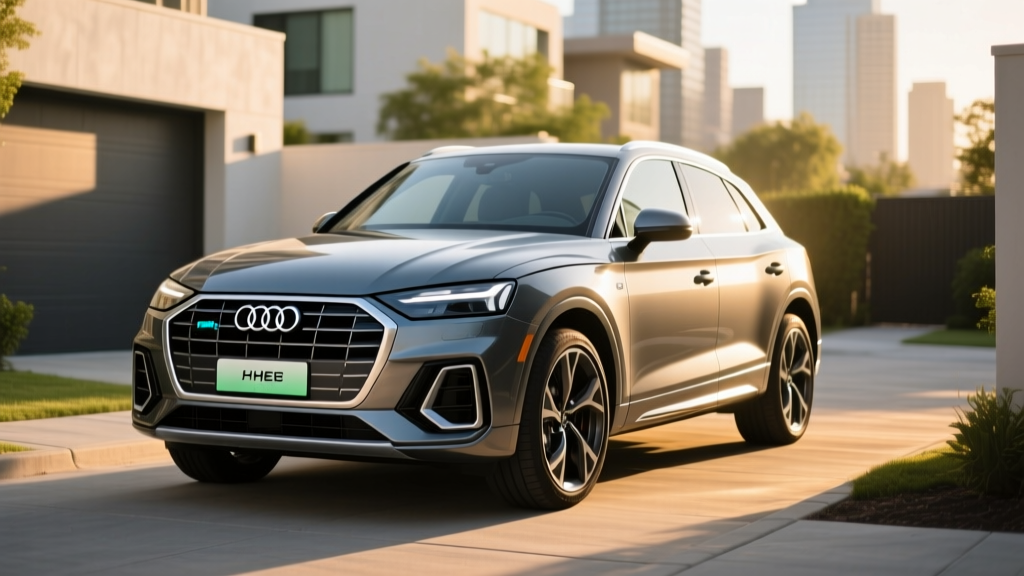
The 2026 Audi Q5 55 TFSI e Quattro occupies a narrow but appealing lane: a luxury compact SUV that handles the daily commute on electrons and the weekend road trip on gasoline. With 23 miles of EPA-rated electric-only range and a combined 28 MPG once the battery depletes, the Q5 PHEV targets buyers who want electric commuting without committing to a full BEV. The 362-horsepower powertrain and standard quattro all-wheel drive preserve Audi's performance identity, while a starting MSRP near $60,295 keeps it competitive against the BMW X5 xDrive50e and Volvo XC60 Recharge.
But the Q5 PHEV's appeal hinges on your routine. If you can charge at home and your commute fits within 20 miles, this SUV runs almost entirely on electricity Monday through Friday. If you lack home charging access, you're paying a premium for a battery you'll rarely use — and a conventional Q5 45 TFSI or a full EV like the Audi Q4 e-tron may serve you better.
HEV vs PHEV: Where the Q5 55 TFSI e Fits
Audi does not sell a conventional hybrid (HEV) version of the Q5 in the United States. The Q5 lineup splits into gasoline (45 TFSI), plug-in hybrid (55 TFSI e), and the fully electric Q4 e-tron on a separate platform. Understanding the distinction matters:
| Feature | Conventional Hybrid (HEV) | Plug-In Hybrid (PHEV) — Q5 55 TFSI e |
|---|---|---|
| Plug-in charging | No — regenerative braking only | Yes — Level 1 or Level 2 AC |
| Electric-only range | 0–2 miles at low speed | 23 miles (EPA) |
| Battery size | ~1–2 kWh | 17.9 kWh (usable) |
| Fuel economy (battery depleted) | 35–50 MPG typical | 28 MPG combined |
| Federal tax credit | None | Up to $6,454 (varies by sourcing) |
The Q5 PHEV is a plug-in hybrid. You must plug it in regularly to capture its electric range and efficiency benefits. If you never plug in, you'll get roughly 28 MPG from the hybrid system — respectable for a 4,600-pound luxury SUV, but not class-leading among hybrids.
Electric Range, MPG, and Real-World Efficiency
The EPA rates the 2026 Q5 55 TFSI e at 23 miles of electric-only range and 28 MPG combined once the battery is depleted. Combined MPGe (miles per gallon equivalent, which measures efficiency while using both electricity and gasoline) is rated at 58 MPGe. Here's the full breakdown from fueleconomy.gov:
| Metric | EPA Rating | Real-World Expectation |
|---|---|---|
| Electric-only range | 23 miles | 18–22 mi (highway/cold weather); up to 25 mi (city, mild temps) |
| MPG combined (hybrid mode) | 28 MPG | 26–30 MPG depending on driving style and terrain |
| MPG city (hybrid mode) | 27 MPG | 28–31 MPG — regen braking helps in stop-and-go |
| MPG highway (hybrid mode) | 29 MPG | 25–28 MPG at 75+ mph |
| MPGe (combined, EV + gas) | 58 MPGe | Varies with charge frequency |
| Total combined range | ~420 miles | ~380–430 miles depending on conditions |
The Q5 PHEV's real-world advantage emerges for commuters with short one-way trips. A 10-mile-each-way commute means nearly zero gasoline use during the work week, provided you charge at home overnight. Over a year, owners who charge daily and drive 30 miles or fewer on weekdays report using 4–6 gallons per week — a dramatic reduction versus the gasoline Q5's 24 MPG combined.
Powertrain, Battery, and Charging Specifications
The 2026 Q5 55 TFSI e pairs a 2.0-liter turbocharged four-cylinder engine with an electric motor integrated into the seven-speed S tronic dual-clutch transmission. The combined output is 362 horsepower and 369 lb-ft of torque, with standard quattro all-wheel drive.
| Specification | 2026 Audi Q5 55 TFSI e Quattro |
|---|---|
| Engine | 2.0L turbocharged I4 (261 hp) |
| Electric motor | Permanent-magnet synchronous (integrated in transmission) |
| Combined output | 362 hp / 369 lb-ft torque |
| Battery (usable) | 17.9 kWh lithium-ion (NMC chemistry) |
| EPA electric range | 23 miles |
| Level 1 charging (120V, 1.4 kW) | ~12 hours (0–100%) |
| Level 2 charging (240V, 7.7 kW) | ~2.5 hours (0–100%) |
| DC fast charging | Not available |
| Transmission | 7-speed S tronic dual-clutch automatic |
| Drivetrain | quattro AWD |
| 0–60 mph | 5.0 seconds (manufacturer estimate) |
| Curb weight | ~4,610 lbs |
| Cargo volume | 24.7 cu ft (rear seats up) / 51.6 cu ft (folded) |
Charging reality: The Q5 PHEV charges exclusively via AC — either a standard 120V household outlet (Level 1) or a 240V Level 2 home charger. There is no DC fast-charging capability, which is typical for PHEVs in this class. At 7.7 kW on Level 2, a full charge takes roughly 2.5 hours, meaning you can easily top off during a workday or overnight. The included Level 1 cord provides about 5 miles of range per hour of charging — sufficient for overnight replenishment if your daily electric driving stays under 20 miles.
kWh vs kW reminder: The battery stores 17.9 kWh of energy (capacity). The onboard charger accepts up to 7.7 kW of power (rate). These are not interchangeable — kWh is how much energy the battery holds, kW is how fast energy flows into it.
Pricing, Trims, and Federal Tax Credit Eligibility
The 2026 Audi Q5 55 TFSI e Quattro starts at an MSRP of approximately $60,295 (including destination). Available in Premium, Premium Plus, and Prestige trims, a fully loaded Prestige model can approach $72,000 with options.
Regarding the federal plug-in vehicle tax credit (IRS §30D): the Q5 PHEV qualifies for a partial credit. The credit amount depends on two components — critical minerals sourcing and battery component sourcing — each worth up to $3,750. For 2026, the Q5 PHEV's battery sourcing yields a combined credit of approximately $3,750 to $6,454, depending on model-year sourcing updates. The credit is available as a point-of-sale transfer to the dealer, reducing your purchase price at the time of sale.
- MSRP cap: SUVs must have an MSRP at or below $80,000 — the Q5 PHEV qualifies across all trims.
- Buyer income cap: Modified adjusted gross income must not exceed $150,000 (single), $225,000 (head of household), or $300,000 (joint filers).
- Battery sourcing: Critical minerals and battery components must meet phased-in thresholds under the Inflation Reduction Act. Audi's current sourcing qualifies for partial credit.
- Point-of-sale transfer: You may transfer the credit to the dealer for an immediate price reduction, or claim it on your tax return using IRS Form 8936.
- State incentives: Several states offer additional rebates for PHEVs (e.g., California, Colorado, New York). Check your state's energy office for current programs.
For definitive eligibility, consult IRS.gov §30D guidelines or a qualified tax professional, as sourcing requirements and eligible vehicle lists update quarterly.
Battery Warranty, Reliability, and Replacement Cost
Reliability: The Q5 PHEV's powertrain is proven — the 2.0L TFSI engine and S tronic transmission are shared across the Volkswagen Group's lineup and have been refined over multiple generations. The PHEV system adds complexity (high-voltage battery, electric motor, power electronics), but Audi's hybrid components have been in production since the A3 e-tron in 2016. Common owner-reported issues are minor — mostly related to infotainment software rather than powertrain reliability.
Battery replacement cost: If the high-voltage battery requires replacement outside of warranty, expect a cost between $12,000 and $16,000 including parts and labor at an Audi dealer. This is comparable to other luxury PHEVs. However, PHEV batteries are smaller and experience less stress than full-EV batteries (shallower charge cycles), and most owners will never need a replacement within typical ownership periods of 8–12 years.
Maintenance advantage: The Q5 PHEV requires the same routine maintenance as the gasoline Q5 — oil changes, brake fluid, cabin filters — but brake pad life is typically extended due to regenerative braking. Expect brake pads to last 60,000–80,000 miles versus 30,000–50,000 miles on a conventional Q5.
Driving Impressions and Daily Usability
On the road, the Q5 55 TFSI e feels like a properly quick luxury SUV. The combined 362 hp delivers confident highway merging and a 5.0-second 0–60 time that outpaces most competitors in this segment. In EV-only mode, acceleration is adequate for city driving (0–30 mph feels brisk), though the gasoline engine engages under hard throttle regardless of battery charge.
The transition between electric and gasoline power is one of the smoothest in the PHEV segment. At cruising speed, you may not notice the engine starting. The S tronic transmission shifts cleanly, and regenerative braking is adjustable via steering-wheel paddles — from near-freewheeling to moderate one-pedal-like deceleration, though it does not come to a full stop on regen alone.
Cargo trade-off: The PHEV battery occupies space beneath the rear cargo floor. The Q5 PHEV offers 24.7 cubic feet behind the rear seats — about 1.5 cubic feet less than the gasoline Q5. You also lose the spare tire (replaced by a tire-repair kit). For most buyers, this is a minor compromise.
Q5 PHEV vs Competitors: How It Stacks Up
| Spec | 2026 Audi Q5 55 TFSI e | 2026 BMW X5 xDrive50e | 2026 Volvo XC60 Recharge |
|---|---|---|---|
| Starting MSRP | $60,295 | $67,500 | $58,950 |
| Combined HP | 362 hp | 483 hp | 455 hp |
| EPA electric range | 23 miles | 38 miles | 35 miles |
| Battery (usable) | 17.9 kWh | 25.7 kWh | 18.8 kWh |
| MPG combined (hybrid) | 28 MPG | 24 MPG | 28 MPG |
| 0–60 mph | 5.0 sec | 4.6 sec | 4.5 sec |
| DC fast charge | No | No | No |
| Federal tax credit (est.) | $3,750–$6,454 | $3,750–$7,500 | $3,750–$7,500 |
The Q5 PHEV's advantage is its lower entry price and strong fuel economy in hybrid mode. The BMW X5 xDrive50e offers significantly more electric range (38 miles) and power but costs $7,000+ more. The Volvo XC60 Recharge sits between them on price and beats the Audi on electric range and acceleration. If electric-only commuting range is your top priority, the BMW or Volvo serve better. If you want a lower MSRP and a more compact footprint, the Q5 wins.
Who Should Choose the Q5 PHEV vs a Full EV or Gas Car
Choose the Audi Q5 PHEV if:
- Your daily round-trip commute is 20 miles or fewer and you can charge at home overnight.
- You want electric commuting but regularly take road trips exceeding 200 miles where charging infrastructure is uncertain.
- You value luxury, all-wheel drive, and a refined interior but don't want to pay the X5 or Cayenne E-Hybrid premium.
- You want a federal tax credit that a conventional gas Q5 cannot offer.
Choose a full EV (e.g., Audi Q4 e-tron, Tesla Model Y) if:
- You have reliable home charging and your daily driving stays under 250 miles.
- You want zero gasoline purchases, zero oil changes, and lower per-mile fuel costs.
- You want access to the full $7,500 federal tax credit (subject to eligibility).
Choose a conventional gas Q5 45 TFSI if:
- You cannot charge at home or at work — a PHEV's battery is dead weight without regular plugging in.
- Your budget is under $50,000 and the PHEV premium doesn't pencil out in fuel savings.
- You drive mostly highway miles where the PHEV's electric range provides minimal benefit.
Frequently Asked Questions
How many MPG does the Audi Q5 PHEV get?
The EPA rates the 2026 Q5 55 TFSI e at 27 MPG city, 29 MPG highway, and 28 MPG combined in hybrid mode (battery depleted). In real-world city driving with regenerative braking, owners often see 28–31 MPG. Highway driving at speeds above 75 mph typically yields 25–28 MPG. When regularly charged, many owners use gasoline only on long trips.
How far can the Q5 PHEV go on electric only?
The EPA rates the Q5 PHEV at 23 miles of electric-only range. Real-world results vary: expect 18–22 miles in cold weather or at highway speeds, and up to 25 miles in mild conditions with city driving. The gasoline engine engages automatically when the battery depletes or under hard acceleration.
Hybrid vs PHEV vs EV — which fits me?
A conventional hybrid (HEV) never plugs in and offers 35–50 MPG with no electric-only range — ideal if you lack charging access. A plug-in hybrid (PHEV) like the Q5 55 TFSI e plugs in for 20–40 miles of electric range, then operates as a hybrid — ideal for short commutes with occasional long trips. A full EV (BEV) runs entirely on electricity with 250–350+ miles of range — ideal if you can charge at home and want the lowest operating cost. Your charging access and daily mileage determine the best fit.
Is the Q5 PHEV reliable, and what does a battery replacement cost?
The Q5 PHEV's powertrain is well-proven, and Audi's hybrid components have been in production for nearly a decade. The high-voltage battery is warranted for 8 years/100,000 miles against defects and excessive capacity loss (below ~70%). Out-of-warranty battery replacement costs approximately $12,000–$16,000, though most PHEV batteries last well beyond the warranty period due to shallow charge cycles and active thermal management.
Does the Audi Q5 PHEV qualify for a tax credit?
Yes. Under IRS §30D, the 2026 Q5 55 TFSI e qualifies for a partial federal tax credit estimated between $3,750 and $6,454, depending on current battery-sourcing compliance. The credit is available as a point-of-sale transfer (reducing your purchase price at the dealership) or as a claim on your federal tax return. Buyer income caps apply: $150,000 single / $300,000 joint. Check fueleconomy.gov for the latest eligible-vehicle list and consult a tax professional for personal eligibility.
Can the Q5 PHEV DC fast charge?
No. Like most plug-in hybrids, the Q5 55 TFSI e charges via AC only — Level 1 (120V) or Level 2 (240V). At 7.7 kW on Level 2, a full charge takes about 2.5 hours. Given the 17.9 kWh battery, DC fast charging would add cost and weight for marginal benefit, as the battery replenishes quickly on AC power.
What happens if I never plug in the Q5 PHEV?
The Q5 PHEV operates as a conventional hybrid when not plugged in, returning approximately 28 MPG combined. However, you forfeit the electric-only range, the fuel-cost savings, and the environmental benefit of electric commuting. You'll also carry 500+ pounds of battery and electric motor as dead weight. If you cannot commit to regular charging, the gasoline Q5 45 TFSI (24 MPG combined) is a more honest choice at a lower price.